


Hezbollah Escalates its Rhetoric, Threatens Lebanese Govt

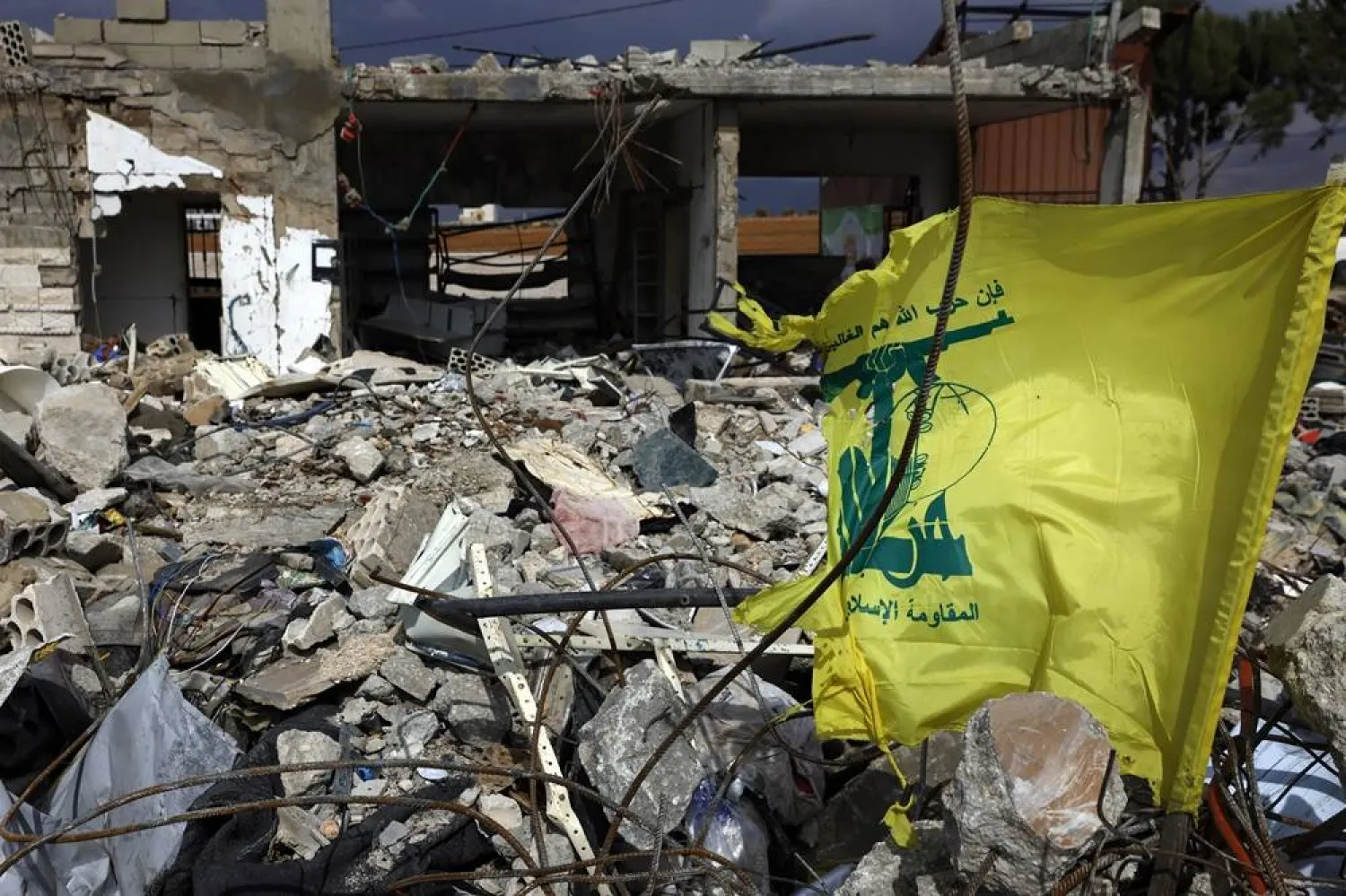
23 March 2026, Lebanon, Chaat: A Hezbollah flag is seen fixed to the debris after an Israeli airstrike that targeted a residential home in Chaat. (dpa)
TT

Hezbollah Escalates its Rhetoric, Threatens Lebanese Govt

23 March 2026, Lebanon, Chaat: A Hezbollah flag is seen fixed to the debris after an Israeli airstrike that targeted a residential home in Chaat. (dpa)

Leading Hezbollah officials decided to escalate their rhetoric against the Lebanese government, threatening to take new political approaches after the war, even as its fighters battle Israeli troops on the ground.

The Iran-backed party has decided to effectively open a new battle in Lebanon, this time against the government and the political authority.

Mahmoud Qamati, deputy head of Hezbollah's political council, said last week: “A confrontation with the political authority is inevitable after the war.”

“Hezbollah is capable of turning the country and government upside down. The party’s patience has limits, and the traitors will pay for their betrayal,” he declared.

The government has slammed Hezbollah for dragging Lebanon to a new war with Israel and banned the group’s military operations. It has also expressed readiness for Lebanon to engage with negotiations with Israel to end the war.

Hezbollah political council member Wafiq Safa echoed Qamati’s remarks, saying the party will force the government to retract its decision to ban its military operations, “regardless of the way it will do so.”

At the moment, the party will not topple the government in the streets, but it has a “new agenda” that it will implement after the war, including street action, he said.

Hezbollah opponents dismissed the threats, saying the party was resorting to such rhetoric to rally its supporters after witnessing their displacement from the war, as well as the destruction of their homes and the mounting death toll.

Change MP Mark Daou told Asharq Al-Awsat: “Hezbollah is in the heart of the battle. It will try to escalate its positions to rally its supporters given their humanitarian plight and the party’s own failure in offering the displaced any real assistance.”

The Hezbollah leadership instructed its officials to “stir debates that are fodder for the media that would portray the party as coming under attack and so as the garner the public’s support,” he explained.

“Hezbollah is suffering from successive setbacks. The decisions taken by the government since 2024 until now are mounting against it,” he remarked.

“The party’s weapons are no longer legal and its allies have distanced themselves from it,” he added. It has also lost its ally, the Syrian regime, and its main backer Iran is under attack by the US and Israel.

“Hezbollah therefore has to protect itself by resorting to stoking sectarian tensions inside Lebanon,” Daou noted.

As for the post-war phase, that is up to the state to manage, such as reconstruction, protecting the people and addressing the affairs of the displaced, said the MP.

“The state will decide what will happen after the war. The Lebanese army also has a major responsibility to secure the situation in Lebanon and stop Hezbollah’s military operations so that the state can have control over decisions of war and peace,” he remarked.

Jad Al-Akhaoui, a Shiite opponent to Hezbollah and head of the Lebanese Democratic Coalition, said the party’s escalating rhetoric against the government “reflects changes in its political and military environment.”

“The blows it has suffered on various levels forced it to stoke tensions to compensate for its relative losses on the ground,” he told Asharq Al-Awsat.

He noted that there have been rising calls within the Shiite community, which is the party’s main support base, demanding that the state impose monopoly over arms and that Hezbollah be held responsible for dragging Lebanon to war.

Hezbollah has reacted to these calls by adopting a sharper rhetoric in an attempt to intimidate its internal opponents and prevent a new political movement that works against it from emerging, he explained.

On Safa’s statements, Al-Akhaoui said Hezbollah is sensing that there will be official or international efforts to curb the party’s activities after the war.

“So, it is acting preemptively by drawing red lines as if to say that any decision about his weapons will be confronted, perhaps through means that go beyond traditional politics,” he remarked.

Al-Akhaoui ruled out that Hezbollah would succeed in having full control over post-war Lebanon as it did before the conflict. “It will still hold major sway and have the ability to obstruct or impose conditions, but not have total control,” he added.


France Urges Israel ‘to Refrain’ from Occupying South Lebanon Zone

France's Foreign Affairs Minister Jean-Noel Barrot attends an interview with AFP journalists at the Quai d'Orsay French Foreign ministry in Paris on March 24, 2026. (AFP)
TT

France Urges Israel ‘to Refrain’ from Occupying South Lebanon Zone

France's Foreign Affairs Minister Jean-Noel Barrot attends an interview with AFP journalists at the Quai d'Orsay French Foreign ministry in Paris on March 24, 2026. (AFP)

Israel should "refrain" from sending in forces to take control of a zone in south Lebanon, France's foreign minister told AFP on Tuesday, warning that such a move would have "major humanitarian consequences".

"We urge the Israeli authorities to refrain from such ground operations, which would have major humanitarian consequences and would exacerbate the country's already dire situation," Jean-Noel Barrot said in an interview with AFP.

His comments came after Israel earlier said its military would take control of south Lebanon up to the Litani River, around 30 kilometers (20 miles) from the border.

Lebanon was pulled into the Middle East war when the Tehran-backed Hezbollah group began firing rockets into Israel on March 2 to avenge the killing of Iran's supreme leader Ali Khamenei.

Israel has since launched strikes across Lebanon, killing at least 1,072 people and displacing more than a million others in more than three weeks of fighting. It has also sent ground troops into the country's south.

Barrot, who visited Lebanon and Israel last week, called on Israel to seize a "historic opportunity" for dialogue with Lebanon's government, saying that Beirut was "turning its words into action" to counter Tehran's interference in the country.

He noted that during his visit to Lebanon on March 19, President Joseph Aoun called for a truce and the opening of negotiations with Israel to stop the war between it and Hezbollah.

"There is a moment to seize, it is historic, and that moment is now," Barrot said, calling for "high-level political dialogue" with the Lebanese government.

Lebanon's government has acted against Iranian interests and withdrew its approval of the Iranian ambassador's accreditation on Tuesday, a decision Barrot hailed as "courageous".

Iranian ambassador Mohammad Reza Sheibani was told to leave Lebanese territory by Sunday.

"I wish to commend the statements and actions of the Lebanese government...which this morning took a courageous decision by expelling the Iranian ambassador," Barrot said.

Hezbollah strongly objected to the move, calling on the government to reverse it.

It was "no small matter" that Lebanon's government had also expelled "a number of representatives of the Revolutionary Guards" in the country, Barrot said, referring to the country's ideological army.

Beirut has accused Iran's Revolutionary Guards of commanding Hezbollah's operations in its war against Israel, having decided on March 5 to ban all activity by the organization in the country.

The government also took the unprecedented step of imposing a ban on Hezbollah military activities and called on the group to hand over its weapons to the state.


Israeli Army Says Strike Killed Lebanese Member of Iran’s Quds Force

A photograph shows the damage after an Israeli strike targeted an apartment in Hazmieh, on the eastern outskirts of Beirut, on March 23, 2026. (AFP)
TT

Israeli Army Says Strike Killed Lebanese Member of Iran’s Quds Force

A photograph shows the damage after an Israeli strike targeted an apartment in Hazmieh, on the eastern outskirts of Beirut, on March 23, 2026. (AFP)

Israel announced on Tuesday that a strike it carried out near Beirut the day before killed a member of Iran's Quds Force, who a Lebanese security source said had survived a previous attack in the same area.

On Monday Israel struck an apartment in Hazmieh, an upscale town overlooking Beirut and near the presidential palace and diplomatic missions.

In a statement Tuesday, the Israeli army said it had killed Mohammed Ali Kurani, "a Quds Force terrorist who was advancing terror attacks directed by Iranian intelligence officials".

The Quds Force is the foreign operations arm of Iran's Revolutionary Guards.

A Lebanese security source told AFP that Kurani hailed from Nabatieh governorate in south Lebanon, and was "known by his military alias Haj Sadeq".

The source said he was a "security officer" in the Iran-backed Lebanese group Hezbollah, and by virtue of his position, would likely have been coordinating with the Quds Force.

Kurani survived an earlier March 4 strike on a hotel, also in Hazmieh, with the source saying "a recording that night documented his leaving the hotel with his wife and son".

The strike hit the room where he and his family had stayed for just two hours, and resulted in injuries to a receptionist who later died of her wounds.

Monday's strike targeted a room in an apartment that had been rented in his wife's name since last October, the source added, noting Lebanese President Joseph Aoun and his sister own two units in the same building.

Lebanon was dragged into the Middle East war on March 2 when Hezbollah fired rockets at Israel in retaliation for US-Israeli attacks that killed Iran's supreme leader.

Following Monday's strike, Hazmieh Mayor Jean Asmar announced the municipality would take new measures with regards to hosting people displaced by the war "so that this incident is not repeated".


Sudan’s RSF Says Captured Strategic Town on Ethiopia Border

RSF commander Gen. Mohammed Hamdan Dagalo, center, greets the crowd during a military-backed tribes' rally in the Nile River State of Sudan, July 13, 2019. (AP)
TT

Sudan’s RSF Says Captured Strategic Town on Ethiopia Border

RSF commander Gen. Mohammed Hamdan Dagalo, center, greets the crowd during a military-backed tribes' rally in the Nile River State of Sudan, July 13, 2019. (AP)

Sudanese paramilitary group the Rapid Support Forces said on Tuesday that it and its allies had seized control of the town of Kurmuk on the border with Ethiopia after "fierce fighting".

"Elite troops from the Rapid Support Forces and the Sudan People's Liberation Movement-North (SPLM-N) have succeeded in fully liberating the strategic town of Kurmuk," the RSF said in a statement.

Its forces also took over two other nearby areas, it said, "following fierce fighting waged since yesterday".

On Tuesday morning, a representative of the army-aligned government in Damazin, the capital of Blue Nile state where Kurmuk is located, said "the situation in Kurmuk is critical and it's very difficult for the forces on the ground to hold their positions".

Fighting began on Sunday around the small border town in the far southeast of Sudan, which the army considers vital because it sits on one of the few roads to Ethiopia.

The faction of the SPLM-N led by Abdelaziz al-Hilu and allied to the RSF maintains a foothold in southern Blue Nile, a narrow strip of land jutting south between Ethiopia and South Sudan.

From there, it reportedly maintains supply lines from both countries, building on decades-old links.

Ethiopia has denied separate allegations that it is harboring RSF camps.

The war in Sudan, which began in 2023, pits the RSF against the regular army and has left tens of thousands dead, displaced around 11 million people and triggered one of the world's worst humanitarian crises.
