


UK Inflation Holds at 3% in February Ahead of Likely Iran War Jump

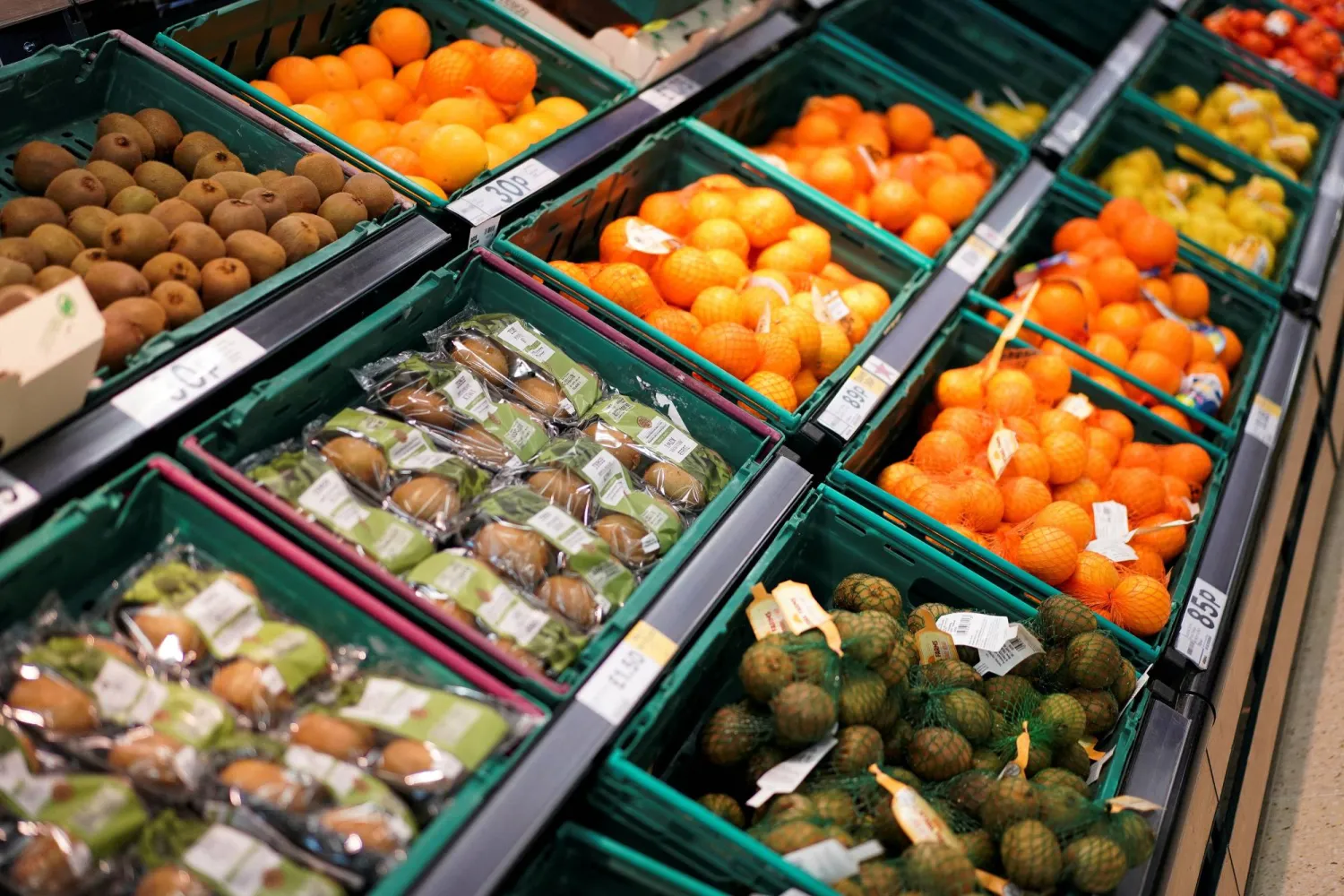
Fruit is displayed for sale inside a supermarket in London (Reuters)
TT

UK Inflation Holds at 3% in February Ahead of Likely Iran War Jump

Fruit is displayed for sale inside a supermarket in London (Reuters)

British consumer price inflation held at an annual rate of 3.0% in February, unchanged from January's rate, official figures showed on Wednesday, ahead of a likely upward lurch as war in the Middle East pushes up prices.

Economists polled by Reuters had expected inflation to remain at 3.0%, its lowest level since March 2025.

Before the US-Israeli attack on Iran at the end of February, the Bank of England had forecast that inflation would fall to close to its 2% target in April, when changes to regulated household energy bills and other prices take effect.

But last week the BoE sharply increased its inflation forecast, predicting it would rise towards 3.5% ⁠by the middle ⁠of the year.

A survey published on Tuesday showed inflation expectations among the British public surged, adding to the BoE's challenge.

While most households' energy tariffs are currently capped, new prices are due to take effect in July and manufacturers have already reported the sharpest jump in costs since 1992, which may soon be passed on to consumers.

Financial markets on Tuesday were betting on nearly ⁠three quarter-point interest rate rises by the BoE this year, though many economists think the central bank will keep rates on hold due to the headwinds to growth from higher energy costs.

Governor Andrew Bailey last week advised people against making any firm bets that the BoE would raise rates.

Wednesday's data showed services price inflation - which the BoE watches closely as a gauge of longer-term inflation pressures - fell to 4.2% in February from 4.4% in January, its lowest since March 2022 and just below economists' expected reading of 4.3%.

The decline reflected reduced inflation for restaurants, cafes and ⁠tickets for concerts ⁠and other cultural events.

However, core inflation, which excludes more volatile food, energy, alcohol and tobacco prices, rose slightly to 3.2% from 3.1%, where it had been expected to hold.

British inflation is the highest among major advanced economies and the country's reliance on natural gas for electricity generation and heating makes it vulnerable to price shocks.

Prime Minister Keir Starmer's government has introduced measures to limit rises in the cost of living, although finance minister Rachel Reeves said on Tuesday any household energy subsidies this year would be more narrowly targeted than during the last gas price surge in 2022.

British inflation rose to its highest since 1981 in October 2022 at 11.1% and over the past five years has rarely been near its 2% target.



China Shipping Giant Cosco Resumes Bookings to Some Gulf Countries

A cargo ship operated by Cosco Shipping is docked at the foreign trade container terminal of Qingdao Port, operated by Shandong Port Group, in China's eastern Shandong province on March 25, 2026. (Photo by CN-STR / AFP)
TT

China Shipping Giant Cosco Resumes Bookings to Some Gulf Countries

A cargo ship operated by Cosco Shipping is docked at the foreign trade container terminal of Qingdao Port, operated by Shandong Port Group, in China's eastern Shandong province on March 25, 2026. (Photo by CN-STR / AFP)

Chinese shipping giant Cosco said on Wednesday that it was resuming new bookings for container shipments to some Gulf countries, after a three-week suspension in response to the Middle East war.

The state-owned, Shanghai-based firm was among several major shipping groups to pause operations in the Strait of Hormuz, a key waterway through which one-fifth of the world's oil and gas passes normally.

Tehran has said several times it was not targeting friendly nations, but transits through the Strait had nevertheless largely ground to a halt.

Iran said in a statement circulated by the International Maritime Organization on Tuesday that "non-hostile vessels" would be granted safe passage through the waterway.

Cosco "resumed new bookings for general cargo containers for shipments" from the "Far East" to the UAE, Saudi Arabia, Bahrain, Qatar, Kuwait, and Iraq "with immediate effect", according to a company statement.

It did not mention shipments travelling in the opposite direction, from the Gulf.

"New booking arrangements and the actual carriage are subject to change due to the volatile situation in the Middle East region," it added.

Cosco, which operates one of the world's largest oil tanker fleets, announced on March 4 that it would suspend new bookings for services for routes through the Strait of Hormuz owing to the "escalating conflicts in the Middle East region and resultant restrictions on maritime traffic".


Qatar Emir Makes Minor Changes to QIA Board

People visit a mall in Doha on March 23, 2026. (Photo by AFP)
TT

Qatar Emir Makes Minor Changes to QIA Board

People visit a mall in Doha on March 23, 2026. (Photo by AFP)

Qatar's Emir Sheikh Tamim bin Hamad Al Thani issued a decree on Wednesday ⁠making minor changes to ⁠the board of the ⁠Qatar Investment Authority, while keeping Sheikh Bandar bin Mohammed bin Saud Al Thani as chairman and Sheikh ⁠Mohammed ⁠bin Hamad bin Khalifa Al Thani as deputy chairman.

The decision stipulated that QIA’s Board of Directors would be restructured as follows: Sheikh Bandar bin Mohammed bin Saud Al Thani as Chairman, Sheikh Mohammed bin Hamad bin Khalifa Al Thani as Deputy Chairman, Ali bin Ahmed Al Kuwari as a member, Saad bin Sherida Al Kaabi as a member, Sheikh Faisal bin Thani bin Faisal Al-Thani as a member, Nasser bin Ghanim Al Khelaifi as a member, and Hassan bin Abdullah Al Thawadi as a member.

The decision is effective starting from its date of issue and is to be published in the official gazette.


Oil Falls More Than 5% and World Shares Gain Over Possible de-escalation of Iran War

A man fills his car with petrol at the petrol station in Port Dickson, Negri Sembilan, Malaysia, 25 March 2026. EPA/FAZRY ISMAIL
TT

Oil Falls More Than 5% and World Shares Gain Over Possible de-escalation of Iran War

A man fills his car with petrol at the petrol station in Port Dickson, Negri Sembilan, Malaysia, 25 March 2026. EPA/FAZRY ISMAIL

Oil prices fell more than 5% and world shares gained on Wednesday over the possibility of a de-escalation of the Iran war and negotiations between the United States and Iran. US futures were up 0.9%.

In early European trading, Britain's FTSE 100 rose 1% to 10,072.60. France's CAC 40 was up 1.4% to 7,855.31, while Germany's DAX was 1.6% higher at 22,989.80.

Tokyo’s Nikkei 225 was up 2.9% to 53,749.62. South Korea’s Kospi gained 1.6% to 5,642.21.

Hong Kong’s Hang Seng rose 1.1% to 25,335.95, while the Shanghai Composite index was 1.3% higher at 3,931.84. Labubu doll maker Pop Mart's Hong Kong-listed shares fell 22.5%, after it announced annual revenue for last year that was largely in line with analysts’ estimates.

Australia’s S&P/ASX 200 climbed 1.9%. Taiwan’s Taiex was up 2.5%.

US President Donald Trump's claims of progress being made from talks with Iran this week and his postponement on Monday of a deadline to “obliterate” Iran’s power plants over the reopening of the Strait of Hormuz have also fueled optimism that an end to the Iran war could come soon.

Trump's administration has offered a 15-point ceasefire plan to Iran, but an Iranian military spokesperson mocked the US’ attempt at a ceasefire deal Wednesday.

With the Strait of Hormuz being a key waterway for crude oil and liquefied natural gas transport, oil and gas prices have spiked and fluctuated in recent days.

Oil prices fell again on growing hopes for a de-escalation. Brent crude, the international standard, fell 5.2% to $94.97 per barrel. It was around $104 on Tuesday.

Benchmark US crude was down 5.3% early Wednesday to $87.44 a barrel.

While Iran has denied negotiations were taking place, and attacks in the Middle East continued, Pakistan has offered to host talks between Washington and Tehran. And as Trump raised optimism of a de-escalation of the war, at least 1,000 more American troops from the 82nd Airborne Division are said to be deployed to the Middle East in the coming days.

On Tuesday, US stocks closed lower. The S&P 500 lost 0.4% to 6,556.37. The Dow Jones Industrial Average edged down 0.2% to 46,124.06, while the Nasdaq composite was 0.8% lower to 21,761.89.

Shares of Estee Lauder sank more than 9%, following confirmation that the US-listed company is in merger talks with Spanish beauty and perfume group Puig.

In other dealings early Wednesday, gold prices resumed its rise after falling earlier. It dropped in part because of rising US Treasury yields over dimming expectations of a Federal Reserve rate cut after the spike in oil prices threatened to fuel global inflation.

The price of gold was up 3.6% early Wednesday to $4,561.90 per ounce. It was above $5,000 earlier this month.

The US dollar was at 158.84 Japanese yen, up from 158.69. The euro was trading at 1.1602, down from $1.1608.