


Oil Climbs and Equities Sink amid Mixed Messages on 'Talks'

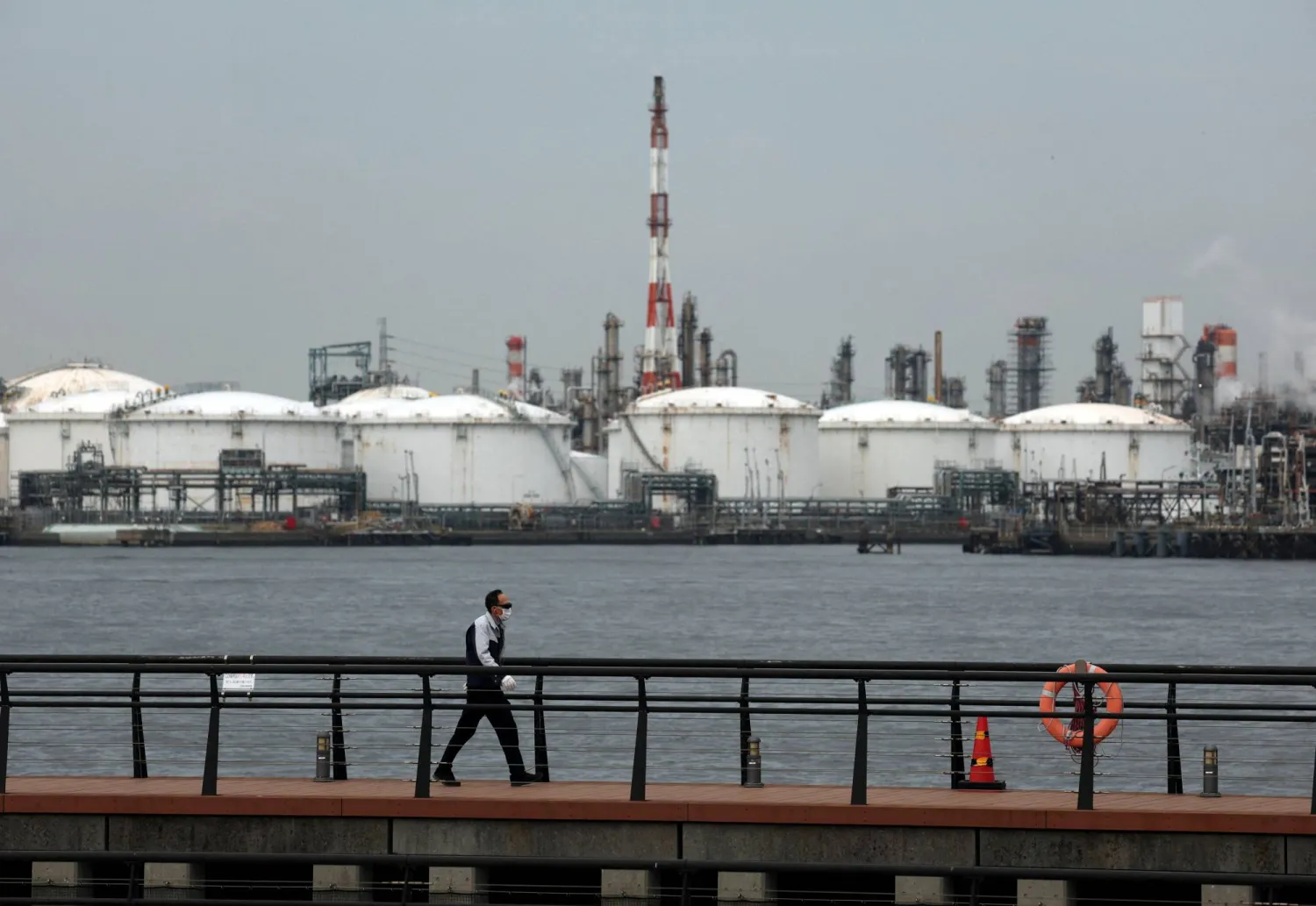
FILE PHOTO: An oil refinery in the Keihin Industrial Zone in Kawasaki, south of Tokyo, Japan March 17, 2026.  REUTERS/Issei Kato/File Photo
FILE PHOTO: An oil refinery in the Keihin Industrial Zone in Kawasaki, south of Tokyo, Japan March 17, 2026. REUTERS/Issei Kato/File Photo
TT

Oil Climbs and Equities Sink amid Mixed Messages on 'Talks'

FILE PHOTO: An oil refinery in the Keihin Industrial Zone in Kawasaki, south of Tokyo, Japan March 17, 2026.  REUTERS/Issei Kato/File Photo
FILE PHOTO: An oil refinery in the Keihin Industrial Zone in Kawasaki, south of Tokyo, Japan March 17, 2026. REUTERS/Issei Kato/File Photo

Oil prices jumped and equities fell Thursday as investors tracked developments in the Middle East amid hopes that US and Iranian officials will bring an end to a conflict that has ramped up fears of an unprecedented global energy crisis.

Markets have been buoyed since late Monday after Donald Trump backed down on a threat to destroy Iran’s energy infrastructure and said the two sides were in peace talks.

But while crude prices are down from last week and the mood on trading floors has been better than most of March, uncertainty and the virtual closure of the Strait of Hormuz -- through which around 20 percent of oil and gas passes -- continue to cast a dark shadow.

Washington presented a 15-point plan to end the war, including Iran giving up its enriched uranium and opening up the waterway, while Tehran's state-run TV reported officials had put forward their own five conditions for hostilities to end.

Trump on Wednesday threatened to "unleash hell" if Iran did not strike a deal, but Foreign Minister Abbas Araghchi said his country does not intend to negotiate.

But the US president also said Iran was taking part in peace talks and the denials were because negotiators feared being killed by their own side.

"Pressure on energy prices, shipping flows and broader financial conditions remains one of the few meaningful sources of leverage (Iran) retains," said Saxo Markets' Charu Chanana.

"There is therefore little incentive to relinquish that leverage prematurely, particularly if market stress strengthens its negotiating position.

However, she added: "It would be imprudent to assume diplomacy is absent simply because it is not visible. In conflicts of this nature, public rhetoric and private negotiation often diverge materially.

"Markets understand this dynamic, and they also tend to inflect before the political endgame is formally in place."

With investors holding on to hope that a deal can be struck, oil prices have stabilized this week, with Brent just above $100 and WTI around $90.

Both contracts rallied Thursday.

Stocks in Wall Street and Europe rose but Asian markets struggled after a two-day rally.

Tokyo, Hong Kong, Shanghai, Seoul, Sydney, Taipei, Singapore, Manila, Bangkok and Jakarta fell along with London, Paris and Frankfurt.

City Index's Fiona Cincotta said for any recovery to gain traction, "investors will want to see clearer signs of de-escalation, including the reopening of the Strait of Hormuz".

Her remarks come after the head of the International Chamber of Commerce, John Denton, warned the conflict could cause the "worst industrial crisis" in decades.

"The head of the International Energy Agency has warned that the world is facing an energy crisis more severe than the oil shocks of the 1970s," he added.

"From a business perspective, we believe this could yet become the worst industrial crisis in living memory."

Meanwhile, the World Trade Organization said disruptions to fertilizer supplies posed a double threat to global food security through scarcity and high prices, with a third of the global fertilizer supply normally transiting the Strait of Hormuz.



US State Dept Orders Global Warning About Alleged AI Thefts by DeepSeek, Other Chinese Firms

The logo of DeepSeek is seen during the Global Developer Conference, organized by the Shanghai AI Industry Association in Shanghai on February 21, 2025. (AFP)
TT

US State Dept Orders Global Warning About Alleged AI Thefts by DeepSeek, Other Chinese Firms

The logo of DeepSeek is seen during the Global Developer Conference, organized by the Shanghai AI Industry Association in Shanghai on February 21, 2025. (AFP)

The US State Department has ordered a global push to bring attention to what it says are widespread efforts by Chinese companies, including AI startup DeepSeek, to steal intellectual property from US artificial intelligence labs, according to a diplomatic cable seen by Reuters.

The cable, dated Friday and sent to diplomatic and consular posts around the world, instructs diplomatic staff to speak to their foreign counterparts about "concerns over adversaries' extraction and distillation of US A.I. models."

"A separate demarche request and message has been sent to Beijing for raising with China," the document states.

Distillation is the process of training smaller AI models using output from larger, more ‌expensive ones as ‌part of an effort to lower the costs of training a ‌powerful ⁠new AI tool.

This ⁠week, the White House made similar accusations, but the cable has not been previously reported. The State Department did not immediately respond to a request for comment.

OpenAI has warned US lawmakers that DeepSeek was targeting the ChatGPT maker and the nation's leading AI companies to replicate models and use them for its own training, Reuters reported in February.

CHINA REJECTS ACCUSATIONS

The Chinese Embassy in Washington on Friday reiterated its stance that the accusations are baseless.

"The allegations that Chinese entities are stealing American AI intellectual property are ⁠groundless and are deliberate attacks on China's development and progress in the ‌AI industry," it said in a statement to Reuters.

DeepSeek, whose ‌low-cost AI model stunned the world last year, on Friday launched a preview of a highly anticipated ‌new model, called the V4, adapted for Huawei chip technology, underlining China's growing autonomy in the ‌sector.

DeepSeek also did not immediately respond to a request for comment. In the past, it has said that its V3 model used data naturally occurring and collected through web crawling and it had not intentionally used synthetic data generated by OpenAI.

Many Western and some Asian governments have banned their institutions and officials from using ‌DeepSeek, citing data privacy concerns. Nevertheless, DeepSeek's models have consistently been among the most used on international platforms that host open-source models.

The State Department ⁠cable said its purpose ⁠was to "warn of the risks of utilizing AI models distilled from US proprietary AI models, and lay the groundwork for potential follow-up and outreach by the US government."

It also mentioned Chinese AI firms Moonshot AI and MiniMax . Neither company immediately responded to a request for comment.

The cable said that "AI models developed from surreptitious, unauthorized distillation campaigns enable foreign actors to release products that appear to perform comparably on select benchmarks at a fraction of the cost but do not replicate the full performance of the original system."

It added that the campaigns also "deliberately strip security protocols from the resulting models and undo mechanisms that ensure those AI models are ideologically neutral and truth-seeking."

The White House accusations and the cable come just weeks before US President Donald Trump is set to visit Chinese President Xi Jinping in Beijing. They could well raise tensions in a long-running tech war between the rival superpowers, which had been lowered by a detente brokered last October.


Bessent Rules Out Renewal of Iranian and Russian Oil Waivers

US Secretary of Treasury Scott Bessent testifies during the Senate Appropriations Committee hearing on 'A Review of the President's FY2027 Budget Request for the Department of the Treasury' on Capitol Hill in Washington, DC, USA, 22 April 2026. (EPA)
TT

Bessent Rules Out Renewal of Iranian and Russian Oil Waivers

US Secretary of Treasury Scott Bessent testifies during the Senate Appropriations Committee hearing on 'A Review of the President's FY2027 Budget Request for the Department of the Treasury' on Capitol Hill in Washington, DC, USA, 22 April 2026. (EPA)

Treasury Secretary Scott Bessent said Friday that the US does not plan to renew a waiver allowing the purchase of Russian oil and petroleum products that are currently at sea.

He also said a renewal of a one-time waiver for Iranian oil at sea is totally off the table.

“Not the Iranians,” Bessent told The Associated Press. “We have the blockade, and there’s no oil coming out.”

In an AP interview about the impact of the war on the global energy market and other topics, Bessent also said he had no plans to extend the sanctions relief for Russia.

“I wouldn’t imagine that we’d have another extension. I think the Russian oil on the water has been largely sucked up,” he said.


Dollar Set for Weekly Gain on Stalled US-Iran Talks and Middle East Uncertainty

US dollar banknotes (Reuters)
TT

Dollar Set for Weekly Gain on Stalled US-Iran Talks and Middle East Uncertainty

US dollar banknotes (Reuters)

The dollar was on track for its first weekly gain in three weeks on Friday in broadly muted trading, as stalled peace negotiations between the US and Iran dampened hopes for an immediate easing of Middle East tensions.

While Lebanon and Israel extended their ceasefire for three weeks ahead of its expiration on Sunday, Iran showed off its control over the Strait of Hormuz by releasing footage of its commandos storming a huge cargo ship, leaving the timing of the reopening of the world's most important shipping corridor uncertain and keeping oil prices elevated.

The dollar index, which measures the greenback against a basket of currencies including the yen and the euro, slipped 0.1% to 98.75 but remained on track for a weekly gain of 0.5%. The euro was 0.1% higher at $1.169, Reuters reported.

Sterling edged 0.1% higher, with stronger-than-expected UK retail sales for March barely moving the needle.

"If you look at the last week the major theme is just that there's no real progression with peace talks. For markets, it's difficult when there's no deadline," said Tommy Von Brömsen, FX strategist at Handelsbanken in Stockholm.

Brent crude futures rose 1.5% to $106.60 a barrel.

The dollar has drawn safe-haven demand amid the uncertainty. It gained ground in March as concerns over the conflict deepened, but gave back some of those gains this month as optimism over a potential resolution grew.

"Oil and the dollar are still moving pretty closely together, and with crude creeping back up ... I'd say the dollar is still staying fairly firm," said Sho Suzuki, a market analyst at Matsui Securities.

Meanwhile, the yen was steady after four days of losses, rising 0.1% to 159.7 per dollar.

CENBANK BONANZA LOOMS

Traders are looking ahead to a central-bank-heavy week next week, with the Bank of Japan, European Central Bank, Bank of England and Federal Reserve among those due to deliver policy decisions.

"The main message from the central banks is that they are - so far at least - in a kind of 'wait-and-see' approach," said Handelsbanken's Von Bromsen.

He said the focus will be on communication and guidance, as market watchers assess how policymakers are digesting not just higher energy prices but the second-round effects of potentially higher inflation.

The European Central Bank will hold its deposit rate on April 30 but hike it in June, according to just over half of economists polled by Reuters, in a bid to protect a war-induced energy shock from knocking the euro zone economy off balance.

Meanwhile in Japan core consumer inflation slowed below the central bank's 2% target for a second straight month in March. Analysts, though, expect inflation to accelerate back above the Bank of Japan's target in coming months, as companies begin to pass on higher fuel costs from the Middle East conflict.

The BOJ is set to hold its two-day policy meeting ending on Tuesday. Reuters reported the bank is likely to hold off raising interest rates next week as fading prospects of a near-term end to the Middle East war keep the country's economic and price outlook highly uncertain. The BOJ is still expected to signal its readiness to hike to counter mounting price pressures.

Japanese Finance Minister Satsuki Katayama reiterated her verbal warning on intervention on Friday that authorities can take "decisive" action against speculative moves in the foreign exchange market, a day after saying Japan has a "free hand" to intervene and that past interventions had been effective.

The Australian dollar rose 0.1% versus the greenback to $0.7135. New Zealand's kiwi rose 0.1% to $0.5859.

In cryptocurrencies, bitcoin was little changed at $77,895.85.