


Iran Says Nuclear Facilities Have Been Targeted After Israel Says Attacks ‘Will Escalate and Expand’

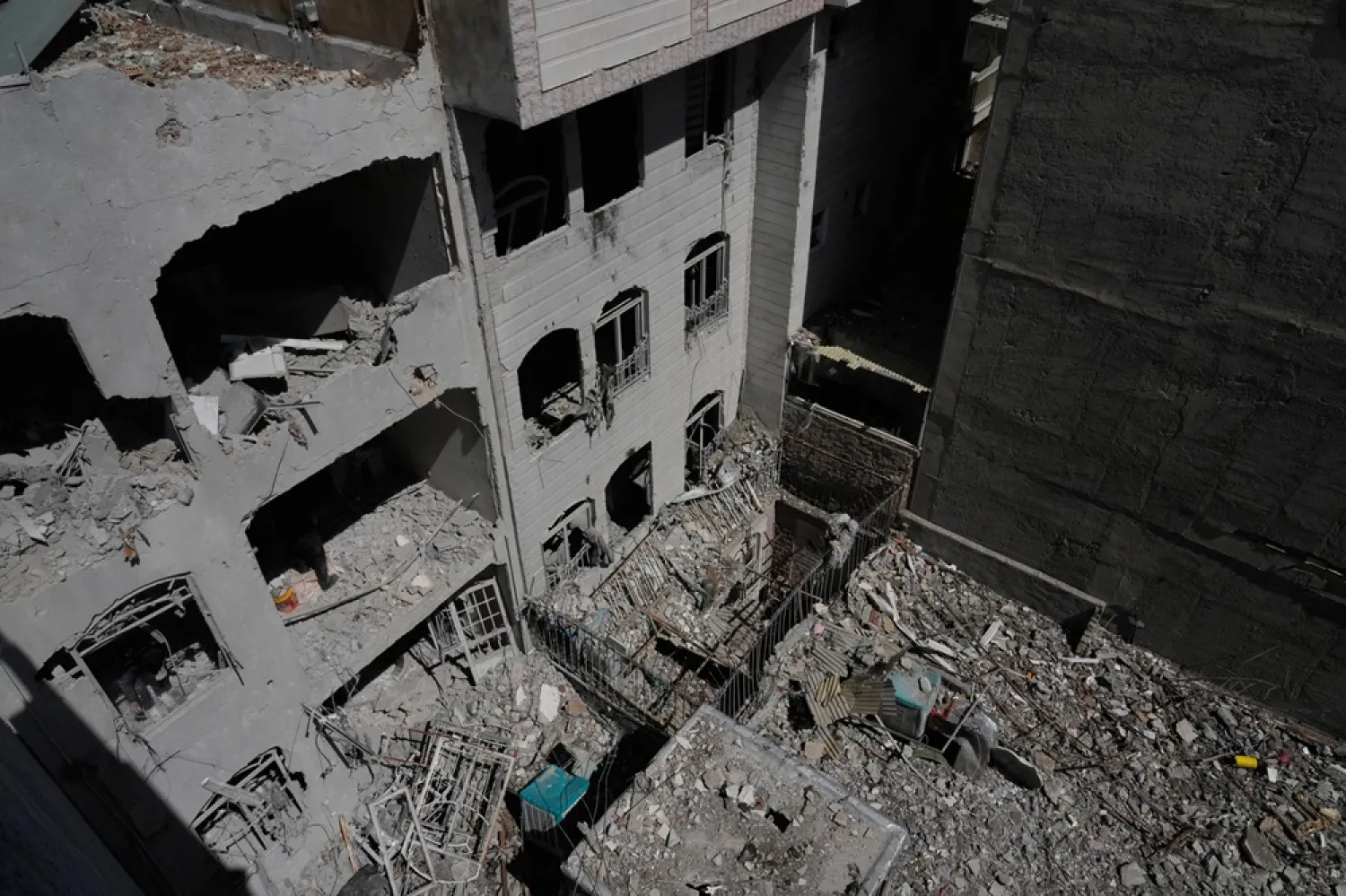
A building is damaged after a nearby residential building was hit in an overnight US-Israeli strike in Tehran, Friday, March 27, 2026. (AP)
TT

Iran Says Nuclear Facilities Have Been Targeted After Israel Says Attacks ‘Will Escalate and Expand’

A building is damaged after a nearby residential building was hit in an overnight US-Israeli strike in Tehran, Friday, March 27, 2026. (AP)

Iran state media says its nuclear facilities were attacked Friday, just hours after Israel threatened to “escalate and expand” its campaign against Tehran. 

IRNA reports that a heavy-water plant and a yellowcake production plant were struck. Yellowcake is a concentrated form of uranium after impurities are removed from the raw ore. Heavy water is used as a moderator in nuclear reactors. 

Word of the attacks came after US President Donald Trump claimed talks on ending the war were going well and gave Tehran more time to open the Strait of Hormuz. Iran has given no sign of backing down. 

With stock markets reeling and economic fallout from the war extending far beyond the Middle East, Trump is under growing pressure to end Iran's chokehold on the strait, a strategic waterway through which a fifth of the world's oil is usually shipped. 

Iran has rejected a 15-point US proposal for a ceasefire that includes it relinquishing control of the strait, but at the same time has ordered thousands more troops to the region — possibly in preparation for a military attempt to wrest the waterway from Iran. 

Trump has said if Iran doesn't reopen the strait to all traffic by April 6, he will order the destruction of Iran’s energy plants. He said Thursday that talks on ending the conflict were going “very well.” Iran maintains it is not engaged in any negotiations. 

Israel targets Iran's weapons production and Lebanese capital  

Air raid sirens sounded in Israel and the military said it has been intercepting Iranian missiles on a daily basis. Defense Minister Israel Katz said Iran “will pay heavy, increasing prices for this war crime.” 

“Despite the warnings, the firing continues," Katz said. "And therefore attacks in Iran will escalate and expand to additional targets and areas that assist the regime in building and operating weapons against Israeli citizens.” 

Israel’s military said its attacks Friday targeted sites “in the heart of Tehran” where ballistic missiles and other weapons are produced. It said it also hit missile launchers and storage sites in Western Iran. 

Smoke rose over Beirut after a pre-dawn strike, and Lebanon's Health Ministry later reported two people were killed. 

Iran launches missiles and drones at Gulf 

Saudi Arabia's Defense Ministry said it shot down missiles and drones targeting the capital, Riyadh. 

Kuwait said its Shuwaikh Port in Kuwait City and the Mubarak Al Kabeer Port to the north, which is under construction as part of China’s “Belt and Road” initiative, sustained “material damage” in attacks. It appeared to be one of the first times a Chinese-affiliated project in the Gulf Arab states has come under assault in the war. China has continued to purchase Iranian crude. 

US stocks fell on opening Friday, in a fifth straight losing week — Wall Street’s longest such streak in nearly four years. The S&P 500 dropped 0.4% in early trading Friday. The Dow lost 0.6%, and the Nasdaq fell 0.6%, breaking the week’s pattern of flip‑flopping gains and losses as hopes for an end to the war vacillated. 

Asian shares also fell Friday over growing doubts about the chances of de-escalation. Oil prices rose again, the Brent crude, the international standard, at $107 a barrel in morning trading, up more than 45% since Israel and the US attacked Iran on Feb. 28 to start the war. 

US pushes diplomatic solution while sending more troops to the region 

Iran's stranglehold on shipping through the Strait of Hormuz has increased concerns of a global energy crisis, and appears part of a strategy to get the US to back down by roiling the world economy. A Gulf Arab bloc said Thursday that Iran has been exacting tolls from ships to ensure safe passage. 

Trump envoy Steve Witkoff said Washington delivered a 15-point “action list" to Iran for a possible ceasefire, using Pakistan as an intermediary. It proposes restricting Iran’s nuclear program and reopening the Strait of Hormuz. 

Iran rejected the US offer and presented its own five-point proposal that included reparations and recognition of its sovereignty over the vital strait. 

Diplomats from several countries have tried to organize a direct meeting between US and Iranian envoys, possibly in Pakistan. 

Egypt's Foreign Ministry said in a statement Friday that Foreign Minster Badr Abdelatty spoke with his Turkish and Pakistani counterparts by phone as part of "intensive efforts" to organize the talks. Abdelatty said they hoped for "gradual de-escalation efforts that would ultimately lead to the end of the war." 

Türkiye's Foreign Ministry confirmed those calls and said Foreign Minister Hakan Fidan also spoke with US officials. 

Meeting in France, the G7 foreign ministers adopted a declaration calling for an immediate halt to attacks against populations and infrastructure. 

Meanwhile, US ships drew closer to the region carrying some 2,500 Marines, and at least 1,000 paratroopers from the 82nd Airborne — trained to land in hostile territory to secure key positions and airfields — have been ordered to the Middle East. 

The UN Security Council will engage in a closed consultation on Iran on Friday, according to two UN diplomats who spoke on condition of anonymity because the meeting is not public. They said Russia requested the meeting and that the US, which holds the Security Council presidency, scheduled it. 

Jan Egeland, secretary general of the Norwegian Refugee Council, said its teams in Iran have reported “countless homes, hospitals and schools have been damaged or destroyed,” and that nearly every neighborhood in Tehran has sustained damage. 

“Civilians are paying the highest price for this war — it must end” Egeland said in a statement. 

The UN's International Organization for Migration said Friday that 82,000 civilian buildings in Iran, including hospitals and the homes of 180,000 people, are damaged. 

“If this war continues, we risk a far wider humanitarian disaster,” Egeland said. “Millions could be forced to flee across borders, placing immense pressure on an already overstretched region.” 

Israel deployed the 162nd Division into southern Lebanon to support efforts to protect its northern border towns from Hezbollah attacks and uproot the militant group, the military said. 

Death toll climbs, primarily in Iran and Lebanon  

Eighteen people have died in Israel, while four Israeli soldiers have been killed in Lebanon. Two Israeli soldiers were severely injured in Lebanon on Friday during an “operational accident,” the military said. 

Authorities said more than 1,100 people have died in Lebanon and over 1,900 people have been killed in Iran. 

At least 13 American troops have been killed and four people in the occupied West Bank and 20 in Gulf Arab states have also died. 

In Iraq, where Iranian-supported militia groups have entered the conflict, 80 members of the security forces have died.’’ 


China Voices Concern Over US Seizure of Iranian Cargo Ship, Urges Further Talks

13 April 2026, China, Beijing: Guo Jiakun, spokesman for the Chinese Foreign Ministry, speaks to journalists. (dpa)
TT

China Voices Concern Over US Seizure of Iranian Cargo Ship, Urges Further Talks

13 April 2026, China, Beijing: Guo Jiakun, spokesman for the Chinese Foreign Ministry, speaks to journalists. (dpa)

China has expressed concern over the "forced interception" by the US of an Iranian-flagged cargo ship, a Chinese foreign ministry spokesperson said on Monday, urging relevant parties to abide by the ceasefire agreement in a responsible ‌manner.

"The situation ‌in the Strait of ‌Hormuz ⁠is sensitive and complicated," ⁠said spokesman Guo Jiakun during a regular press briefing. Parties involved should avoid further escalation and "create the necessary conditions for normal transit through the strait ⁠to resume," he added.

The ‌US said ‌earlier it fired on and seized ‌an Iranian cargo ship that tried ‌to run its blockade of Iranian ports.

Iran's military said the ship had been travelling from China ‌and vowed retaliation against what it called "armed piracy by the US ⁠military."

Beijing ⁠on Monday also urged relevant parties to "continue to maintain the momentum of the ceasefire and negotiations".

"Now that a window for peace has opened, favorable conditions should be created to bring the war to an end as soon as possible," Guo said.


Russia Arrests German Woman in Alleged Bomb Plot

People visit the observation deck at Vorobyovy gory (Sparrow Hills) with the main building of the Ministry of Foreign Affairs of Russia in the background during a spring day in Moscow, Russia, 17 April 2026. (EPA)
TT

Russia Arrests German Woman in Alleged Bomb Plot

People visit the observation deck at Vorobyovy gory (Sparrow Hills) with the main building of the Ministry of Foreign Affairs of Russia in the background during a spring day in Moscow, Russia, 17 April 2026. (EPA)

Russia said Monday it had arrested a German woman found with a homemade bomb in her backpack in what it alleged was a Ukrainian-hatched plot to blow up a security services facility in the south.

Russia has arrested dozens of people throughout the four-year war, mostly its own citizens, on allegations of working for Ukraine to carry out sabotage attacks.

There has been a string of high-profile arrests of Western citizens since Moscow ordered its troops into Ukraine -- typically on espionage charges that are widely seen as baseless, with those detained later swapped in exchange for Russians jailed abroad.

Detentions of Western citizens for carrying out or preparing actual attacks are much rarer.

The FSB security agency said the woman, born in 1969, had been dragged into the alleged plot by a citizen from a Central Asian country, who was working on orders from Ukraine.

She was detained and found with an improvised explosive device in her bag in the Caucasus city of Pyatigorsk, the FSB said.

The FSB said it had "prevented a terrorist attack planned by the Kyiv regime against a law enforcement facility in the Stavropol region, involving a German citizen born in 1969," the agency said in a statement.

The FSB said the device -- which contained an explosive charge equivalent to 1.5 kilograms (three pounds) of TNT -- was supposed to be detonated remotely, killing the German woman.

The blast was prevented by electronic jamming, the FSB added.

- 'Radical ideology' -

A man from an unidentified Central Asian state, born in 1997 and "a supporter of radical ideology", was found and arrested near the targeted site, it added.

The pair face life in prison on terrorist charges.

There was no immediate reaction to the allegations in Kyiv or Berlin.

Video footage of the purported arrest published on state media showed armed Russian security agents approach the woman, who was lying face down dressed in all black in a car park.

Another video showed masked plainclothes agents pulling a man into a station, followed by a controlled explosion of the backpack.

Russia has previously accused Ukraine of working with fundamentalists to carry out terror attacks inside Russia, without providing evidence.

Officials initially alleged that the perpetrators of a 2024 massacre at a concert hall on the outskirts of Moscow that killed 150 people were ISIS members in coordination with Ukraine.

ISIS claimed responsibility for that attack, making no reference of any Ukrainian involvement, for which no evidence was presented by Moscow and which Kyiv denies.


Iran Foreign Ministry Says US Not Serious About Pursuing Diplomacy

An Iranian woman walks next to a wall painting of Iran’s national flag on a street in Tehran, Iran, 20 April 2026. (EPA)
TT

Iran Foreign Ministry Says US Not Serious About Pursuing Diplomacy

An Iranian woman walks next to a wall painting of Iran’s national flag on a street in Tehran, Iran, 20 April 2026. (EPA)

Iran's foreign ministry said Monday that the United States was not serious about pursuing diplomacy, citing what it called "violations" of their two-week ceasefire.

"While claiming diplomacy and readiness for negotiations, the US is carrying out behaviors that do not in any way indicate seriousness in pursuing a diplomatic process," said ministry spokesman Esmaeil Baqaei in a weekly press briefing.

He said a US attack on an Iranian cargo ship early Monday, the US naval blockade on Iranian ports, and delays in implementing a ceasefire in Lebanon were all "clear violations of the ceasefire".

Iran has been at war with Israel and the United States since February 28 when strikes killed supreme leader Ali Khamenei, triggering a conflict that has engulfed the region.

Tehran and Washington have since held a round of negotiations which failed to culminate in a deal to end the war. It took place against the backdrop of a fragile two-week ceasefire which began on April 8.

US President Donald Trump said Sunday he had ordered US negotiators to travel to Pakistan on Monday to hold another round of talks, but Iran has yet to confirm its attendance.

"As of now, while I am at your service, we have no plans for the next round of negotiation, and no decision has been made in this regard," said Baqaei.

Key sticking points include Iran's stockpile of highly enriched uranium and the status of the strategic Strait of Hormuz, which has been largely closed since the outbreak of the war.

"Regarding the issue of transferring enriched uranium, neither during this period of negotiations nor before has transferring it to the United States been discussed," Baqaei said.

"It was never raised as an option for us," he added.
