


Dollar Rides Haven Demand as Middle East Talks Ring Hollow

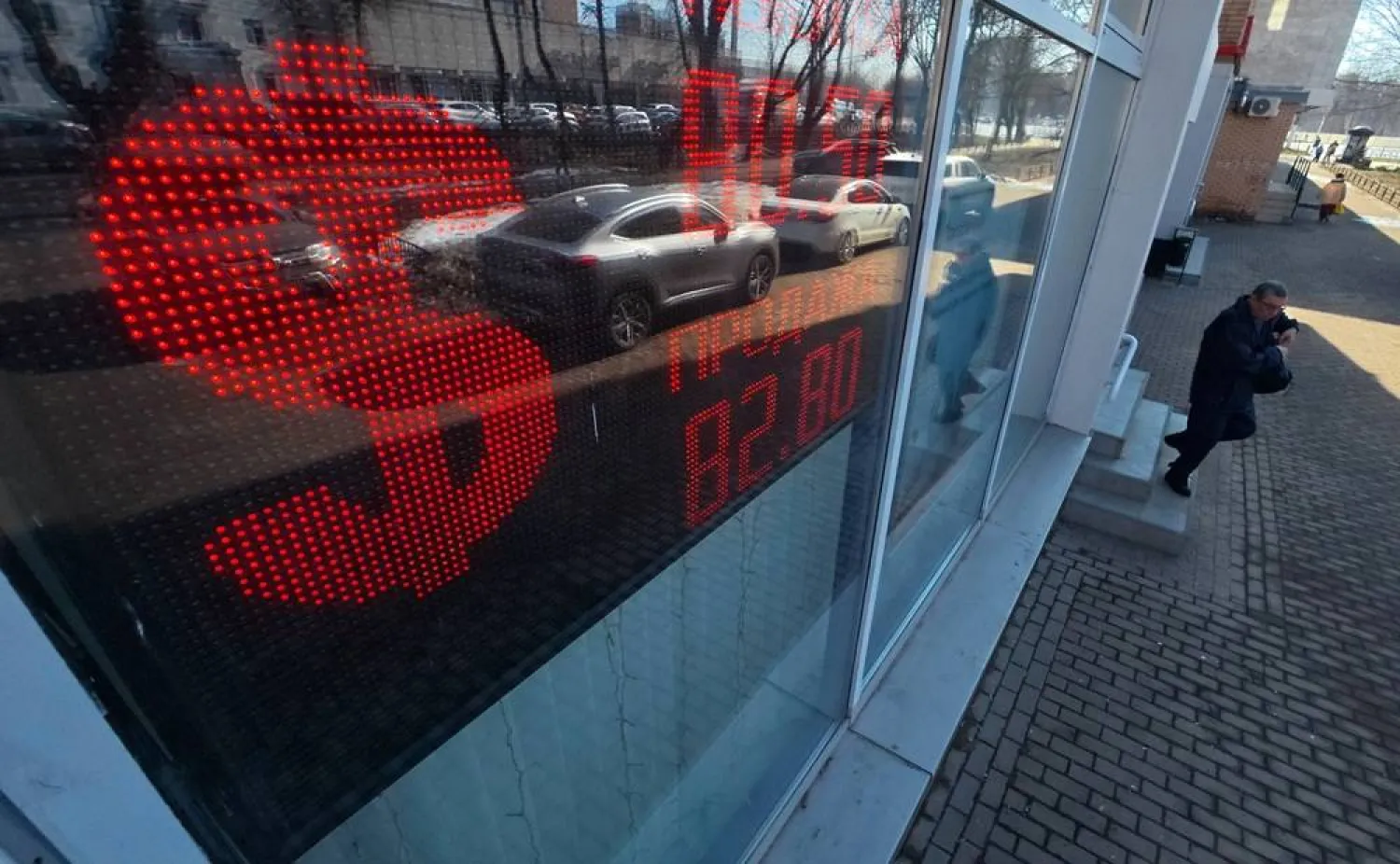
An electronic panel displays US Dollar currency symbol at an exchange office in Podolsk, outside Moscow, Russia, 26 March 2026. (EPA)
TT

Dollar Rides Haven Demand as Middle East Talks Ring Hollow

An electronic panel displays US Dollar currency symbol at an exchange office in Podolsk, outside Moscow, Russia, 26 March 2026. (EPA)

The dollar hovered near multi-month peaks on Friday as investors sought safety in the shadow of an intensifying Middle East war and mounting doubts over any path to de-escalation.

Markets were on edge following another rollercoaster week as US President Donald Trump again extended a deadline for striking Iran's energy facilities into April, even as Washington and Tehran offered starkly conflicting accounts of diplomatic progress.

The Pentagon is also looking at sending up to 10,000 additional ground troops to the Middle East, the Wall Street Journal reported on Thursday, doing little to bolster investor hopes ‌of an imminent ‌end to the war.

That kept the dollar bid ‌as ⁠investors flocked to ⁠the safe-haven currency and ramped up expectations of a US rate hike by the year-end, owing to the inflationary pulse from higher-for-longer energy prices.

The yen, on the other hand, was left on the cusp of 160 per dollar and stood at 159.58. The euro was nursing losses and tacked on 0.1% to $1.1540, while sterling was little changed at $1.3339.

"It doesn't look like the conflict will end anytime soon," said Carol Kong, a ⁠currency strategist at Commonwealth Bank of Australia. "The dollar is king while ‌this conflict lasts."

"If we're right about this ‌conflict being protracted, I think oil prices will just keep rising and it will ‌push the dollar higher, at the expense of net energy importers like the Japanese ‌yen and the euro," she added.

The darkening market mood sent the risk-sensitive Australian dollar down to a two-month trough, though it later rebounded and traded 0.2% higher at $0.6903. The New Zealand dollar languished near its lowest level since January and last stood at $0.5769.

Against a basket ‌of currencies, the dollar was marginally weaker at 99.83, but still on track for a 2.2% rise this month, which would ⁠mark its ⁠biggest gain since July last year.

Investors are now pricing in an over 40% chance of a 25-basis-point rate hike from the Federal Reserve by September, according to CME Fedwatch tool, in a sharp reversal from more than 50 bps worth of easing expected before the war.

The Bank of England and the European Central Bank are also seen tightening policy, with the hawkish sea change in rate expectations hammering bonds and sending yields rising.

"A more prolonged disruption to energy supplies would deliver a larger hit to activity that would meet most definitions of a global recession and prompt a broader monetary tightening cycle," said analysts at Capital Economics in a note.

Yields on US Treasuries edged slightly higher on Friday, following a sharp rise overnight, with the two-year yield at 3.9899%. The benchmark 10-year yield was up about 1 bp to 4.4278%.



Egypt Imposes Business Curfew to Counter Soaring Fuel Costs

Cairo was forced to raise fuel prices by more than 30 percent, after strikes on regional oil infrastructure and threats against the Strait of Hormuz (File Photo)
TT

Egypt Imposes Business Curfew to Counter Soaring Fuel Costs

Cairo was forced to raise fuel prices by more than 30 percent, after strikes on regional oil infrastructure and threats against the Strait of Hormuz (File Photo)

Egypt has ordered shops, restaurants and shopping malls to close from 9:00 pm from Saturday, hoping to curb energy bills that have more than doubled because of the Iran war.

Prime Minister Mostafa Madbouly announced the curfew and said it would last for a month initially.

"Shops, shopping centers, restaurants and cafes will all close at 9:00 pm on weekdays," he said, adding that on Thursdays and Fridays at the weekend they will be allowed to stay open until 10:00 pm, Reuters reported.

The premier said that before the war, Egypt's monthly energy bill was $560 million. Today, for the same quantity, he said Egypt is paying $1.650 billion.

Madbouly said Cairo must work on the "worst-case scenario" in the face of a war whose outcome is unpredictable.

Tourism Minister Sherif Fathy said the new restrictions "will not affect tourists" or flagship destinations, a statement from his office said.

At the beginning of March, Cairo was forced to raise fuel prices by more than 30 percent, after strikes on regional oil infrastructure and threats against the Strait of Hormuz, the crucial shipping route now virtually paralysed by the war.

Around a fifth of global crude oil and liquefied natural gas passes through the waterway in peacetime.

The rerouting of shipping away from the Suez Canal is also depriving Cairo of a vital source of foreign currency.


Turkish Central Bank Forex Sales since Start of Iran War Close to $45 Billion

Turkish Central Bank (official website)
TT

Turkish Central Bank Forex Sales since Start of Iran War Close to $45 Billion

Turkish Central Bank (official website)

The Turkish Central Bank's balance sheet for this week will show foreign exchange sales amounting to near $20 billion, bringing the total forex sales since the beginning of the Iran war to nearly $45 billion, bankers said, Reuters reported.

According to calculations made by four bankers, based on preliminary data for the first part of the week and their estimates for the rest of the week, the central bank's balance sheet will show $18-21 billion in foreign exchange sales.

Bankers said that although $8 billion of the total $20 billion was made before a public holiday last week, this figure will be reflected in the balance sheet on the first day of this week.

The central bank sold $26 billion in foreign exchange in the first three weeks of the war, using its gold reserves as well, resulting in a $35 billion decrease in its net reserves.


Mawani Adds Marsa Ocean Shipping's RSX Service to Jeddah Islamic Port

Mawani Adds Marsa Ocean Shipping's RSX Service to Jeddah Islamic Port
TT

Mawani Adds Marsa Ocean Shipping's RSX Service to Jeddah Islamic Port

Mawani Adds Marsa Ocean Shipping's RSX Service to Jeddah Islamic Port

The Saudi Ports Authority (Mawani) has announced the addition of the RSX service by Marsa Ocean Shipping to Jeddah Islamic Port, featuring a capacity of up to 372 TEUs and connecting Jeddah with the regional ports of Aden, Hodeidah, and Djibouti, SPA reported.

This expansion aligns with the National Transport and Logistics Strategy, aiming to enhance the Kingdom’s operational efficiency and its ranking in global performance indicators.

As a primary gateway, Jeddah Islamic Port utilizes its 62 multipurpose berths and specialized terminals to support a total capacity of 130 million tons, reinforcing Saudi Arabia’s position as a global logistics hub connecting three continents.
