


China Says Hopes to Boost Trade Cooperation with US

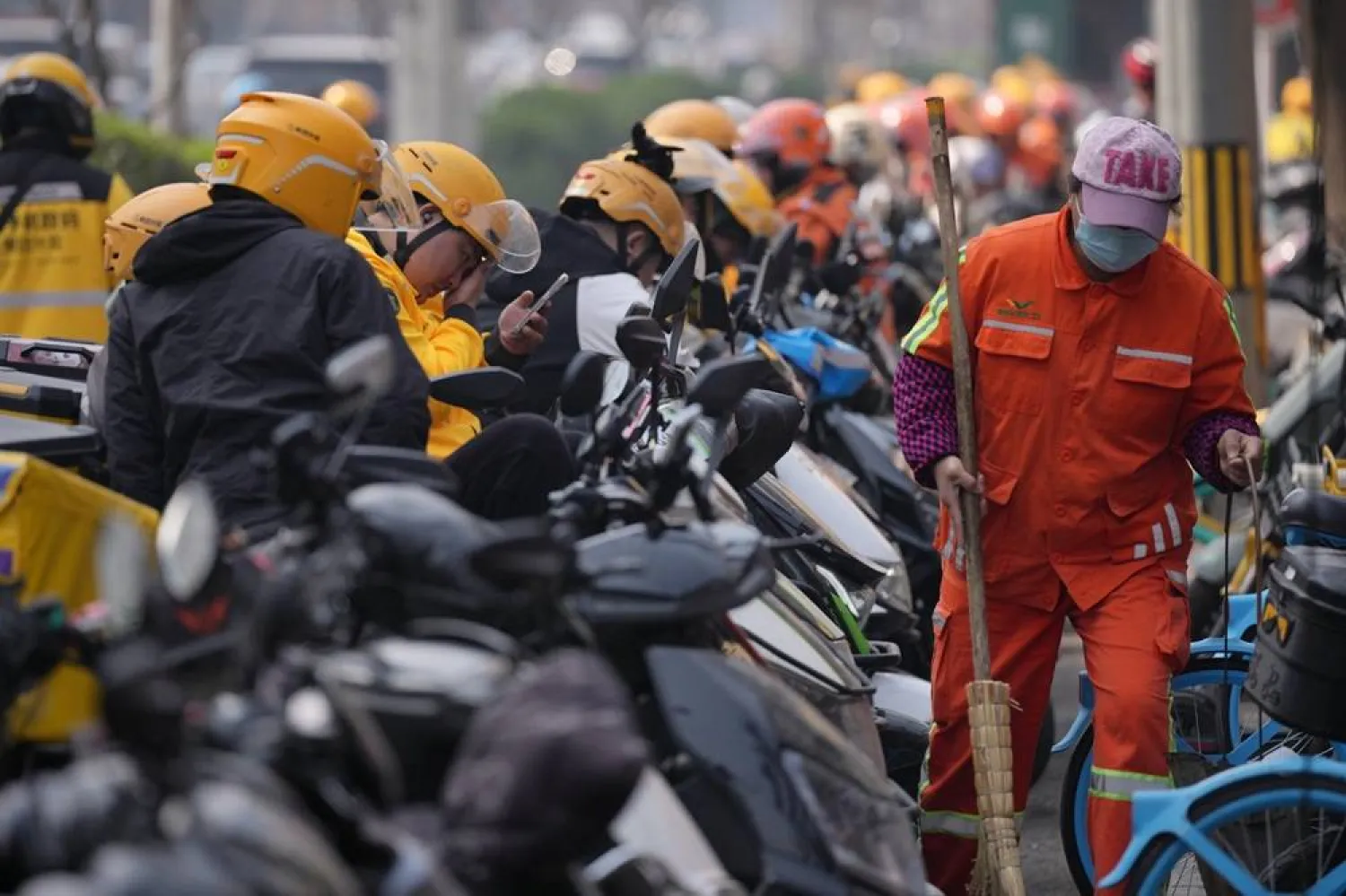
 A street cleaner walks by food delivery riders gather outside restaurants waiting for their online orders, in Beijing, China, Wednesday, March 25, 2026. (AP)
A street cleaner walks by food delivery riders gather outside restaurants waiting for their online orders, in Beijing, China, Wednesday, March 25, 2026. (AP)
TT

China Says Hopes to Boost Trade Cooperation with US

 A street cleaner walks by food delivery riders gather outside restaurants waiting for their online orders, in Beijing, China, Wednesday, March 25, 2026. (AP)
A street cleaner walks by food delivery riders gather outside restaurants waiting for their online orders, in Beijing, China, Wednesday, March 25, 2026. (AP)

China wishes to strengthen economic cooperation with the United States to avoid "vicious competition", commerce minister Wang Wentao told US Trade Representative Jamieson Greer, according to a readout released on Friday.

The two met on Thursday on the sidelines of a World Trade Organization (WTO) ministerial conference in Cameroon's capital, less than two months ahead of US President Donald Trump's planned visit to Beijing.

"China is willing to strengthen multilateral and regional economic and trade cooperation with the United States," Wang told Greer, according to a statement by the Beijing's Ministry of Commerce.

The two powers must "properly handle the relationship between competition and cooperation" and "avoid vicious competition," he said.

The world's two largest economies were locked in a bitter trade battle last year before agreeing to a truce in October.

High-level talks in Paris this month between US Treasury Secretary Scott Bessent and Chinese Vice Premier He Lifeng also helped to ease tensions.

Nevertheless, issues including US tariffs, a trade balance in China's favor, and US restrictions on exports of advanced technologies continue to threaten relations.

Wang expressed "grave concerns" on Thursday regarding recently announced US trade investigations signaling the possibility of fresh tariffs.

Washington's trade investigations target 60 economies, including China, and will look into "failures to take action on forced labor" and whether these burden or restrict US commerce.

The White House has said Trump will visit Beijing on May 14-15, with the timing postponed by several weeks as a result of the war in the Middle East.



Saudi Arabia Introduces New Irrigation Code to Save 2 Billion Cubic Meters of Water Annually

Part of the meetings of Saudi Water Week
TT

Saudi Arabia Introduces New Irrigation Code to Save 2 Billion Cubic Meters of Water Annually

Part of the meetings of Saudi Water Week

Saudi Arabia is expanding the use of treated wastewater as a strategic resource to support industrial and urban growth, with industrial consumption projected to exceed 100 million cubic meters annually by 2030.

The push comes alongside the launch of a new national irrigation code designed to save about 2 billion cubic meters of water each year.

CEO of the Saudi Irrigation Organization (SIO) Mohammed bin Zaid Abu Haid told Asharq Al-Awsat that water has become a cornerstone of the Kingdom’s development agenda.

He said rapid economic growth and the rollout of megaprojects across Saudi Arabia are driving demand for treated water as a key component of project infrastructure.

The corporation manages and operates dams while overseeing the transport, distribution, and reuse of treated water for urban, industrial, and agricultural purposes, a sector that is expanding rapidly, he said.

Treated water use in industry has risen by about 50 percent over the past two years, increasing from roughly 20 million cubic meters to 30 million cubic meters by the end of 2025. Abu Haid expects consumption to surpass 100 million cubic meters by 2030.

Urban demand has also grown sharply. Consumption for parks, green spaces, and projects under the Saudi Green Initiative climbed from about 65,000 cubic meters to nearly 13 million cubic meters, with forecasts pointing to 150 million cubic meters annually by 2030.

Abu Haid identified the Saudi Green Initiative as one of the main drivers of demand for treated water, alongside development projects, nature reserves, and expanding urban applications.

He also announced the imminent launch of the Irrigation Practices Code, developed by the corporation in partnership with the Food and Agriculture Organization of the United Nations. The code is expected to raise irrigation efficiency in the Kingdom from about 55 percent to more than 70 percent.

Once fully implemented, the code is projected to save around 2 billion cubic meters of water annually. Field trials have shown higher farm productivity, increased farmer incomes, and more efficient water use.

The code also aims to reduce water consumption in grain cultivation from 9,750 cubic meters per hectare to about 6,500 cubic meters per hectare. Abu Haid said the project is in its final stages and will be officially launched during the World Water Forum.


UK Economy Grows as Expected before Iran War Impact

FILE PHOTO: The London skyline is seen with the financial district in the background, in London, Britain, March 25, 2026. REUTERS/Isabel Infantes/File Photo
TT

UK Economy Grows as Expected before Iran War Impact

FILE PHOTO: The London skyline is seen with the financial district in the background, in London, Britain, March 25, 2026. REUTERS/Isabel Infantes/File Photo

Britain's economy grew robustly in the first quarter of 2026, official data confirmed on Tuesday, but households were squeezed even before the worst effects of the US-Iran conflict started to feed through.

Economic output grew by 0.6% in the first three months of the year, unchanged from an initial estimate by the Office for National Statistics.

"Services were the main driver of growth in the latest quarter, with strengths in computer programming, wholesale and advertising only offset by falls in rental companies and recruitment agencies," ⁠Liz McKeown, director ⁠of economic statistics at the ONS, said.

It marked the third year running of conspicuously strong growth in the first quarter — and some economists have raised concerns with the statistics office's seasonal adjustment processes.

According to Reuters, the ONS reiterated on Tuesday that a review had found no statistically significant seasonality, although it was monitoring it closely.

Business surveys and economic growth data for April suggest Britain's likely next prime minister to replace ⁠Keir Starmer, Andy Burnham, will face a tougher inheritance.

"Alongside softer household spending, tighter financial conditions and economic uncertainty will weigh on investment," said Matt Swannell, chief economic adviser to the EY ITEM Club, a consultancy.

"Even though the government will soon be under new leadership, fiscal policy is likely to remain tight in the near term."

The ONS revised growth in the final three months of 2025 down to 0.1%.

Output in 2025 as a whole was also slightly lower than previously thought at 1.3%, compared with a previous estimate of 1.4%.

Sterling showed little reaction to the data.

Real household disposable income per head, a measure of living standards that the Labour government aims to ⁠raise by the end ⁠of the parliamentary term, contracted by 0.8% in the first quarter, after a 1.2% rise at the end of 2025.

Households put less money aside in the first quarter with the savings ratio decreasing by 0.7 percentage points to 8.9%, driven by a fall in the contribution of non-pension saving.

The squeeze on households looks set to continue as the Bank of England held interest rates at 3.75% in June and investors are pricing in the first quarter-point increase by February 2027.

Britain's budget watchdog in March forecast the economy to expand 1.1%, although the projections were made before the Iran war started.

Compared with a year earlier, GDP was 0.9% higher, the ONS said, revised down from a previous estimate of 1.1%, while output on a per capita basis was 0.7% higher than the year before.


Shell Expects 65% Rise in Global LNG Demand by 2050

FILE PHOTO: Shell logo and stock graph are seen through a magnifier displayed in this illustration taken September 4, 2022. REUTERS/Dado Ruvic/Illustration/File Photo
TT

Shell Expects 65% Rise in Global LNG Demand by 2050

FILE PHOTO: Shell logo and stock graph are seen through a magnifier displayed in this illustration taken September 4, 2022. REUTERS/Dado Ruvic/Illustration/File Photo

Global liquefied natural gas demand is expected to rise by around 65% by 2050, driven largely by Asia as countries seek lower-emission alternatives to coal and data centers boost power demand, Shell said in an annual report on Tuesday.

Global demand is likely to reach nearly 700 million metric tons a year by that date, the world's largest trader of the superchilled fuel said in its 2026 LNG Outlook.

LNG trade, which reached 422 million tons in 2025, had been set to increase in 2026, it added.

However, severe disruption to shipping through the Strait of Hormuz has shut in around one-fifth of global monthly LNG ⁠supply since the ⁠Middle East conflict began.

As a result, global LNG trade in 2026 could be similar to last year's level if shipping through the strait returns to normal this summer, before returning to growth in 2027, Reuters quoted Shell as saying.

"The conflict created a system-wide shock with disruption cascading across all segments of the economy, but the LNG industry has proved resilient and able to adapt to changing market conditions," Cederic Cremers, Shell's president of integrated gas, said in the report.

The company said recent ⁠growth in LNG supply and regasification infrastructure had improved market resilience and helped limit the impact of the disruption to shipping through Hormuz.

In addition, the ramp-up of new liquefaction facilities in North America, improved performance at existing plants and slower Asian LNG imports have helped offset reduced supply from the Middle East.

Although Asian LNG spot prices rose above $20 per million British thermal units at the peak of the Middle East crisis, they remained well below levels seen in 2022 following Russia's invasion of Ukraine, reflecting greater resilience in the LNG market, Shell said.

About 180 million tons per year of new LNG supply is forecast to enter the market by 2030, improving the availability and affordability of gas and opening up demand ⁠in new markets.

Forecasts ⁠show South and Southeast Asia will account for around 40% of global LNG imports by 2050 as countries seek lower-emission alternatives to coal to meet rapidly growing energy demand.

In more mature Asian markets such as Japan, data centers are emerging as a new source of power demand, the report said.

LNG will also continue to play a key role in European energy security and help balance intermittent renewable power generation as domestic gas production declines, Shell said.

To meet rising demand, significant additional investment will be needed in new LNG export projects through the 2030s and 2040s, with around 200 million tons per year of new liquefaction capacity required in addition to projects already under construction.

"While more investment in both supply and demand infrastructure is needed, the long-term outlook remains strong and LNG will continue to be a stabilizing force in the global energy system," Cremers said.