


WTO Reform Talks Face US-Indian Obstacles

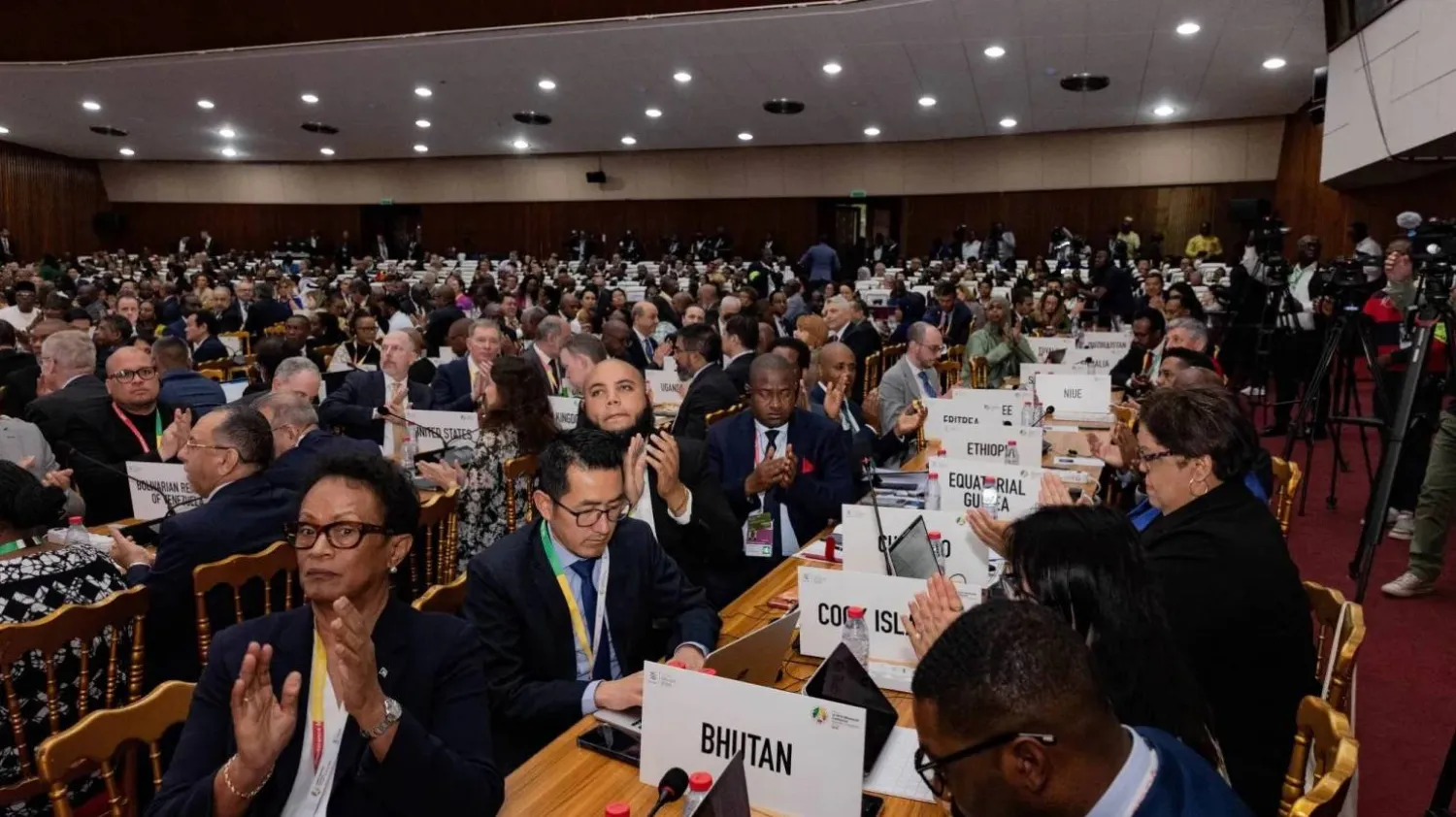
Delegates applaud during the opening of the World Trade Organisation (WTO) 14th ministerial meeting in Yaounde, Cameroon, on 26th March, 2026.  (WTO/Handout via Reuters)
TT

WTO Reform Talks Face US-Indian Obstacles

Delegates applaud during the opening of the World Trade Organisation (WTO) 14th ministerial meeting in Yaounde, Cameroon, on 26th March, 2026.  (WTO/Handout via Reuters)

Large differences remain between most countries and the US and India as trade ministers meet to discuss reforms at the World Trade Organization, two diplomats told Reuters on Friday.

The ministers are meeting in Yaounde, Cameroon, as the organization faces a critical test to its future amid a year of tariff-fueled trade turmoil and major disruption to shipping, energy prices and supply chains due to the Middle East conflict.

“There is a real commitment among ministers to reach an agreement on reforms, but there is a big elephant in the room blocking: India and the US,” a senior diplomat told Reuters.

Another diplomat from an African country said India so far has not shown signs of a change in position. Some flexibility, however, might be possible, the person added. The diplomats declined to be named due to the sensitivity of the negotiations.

While the US and India acknowledge the need to reform the global trading system, they have resisted proposals of a substantive workplan on reforms.

“Unfortunately on reform I don't see much room for maneuver between ⁠the US and India's positions,” said the senior diplomat.

India has also opposed an agreement to aid investment into developing countries and the US desire to permanently extend an e-commerce moratorium on customs duties on electronic transmissions like digital downloads, which expires this month.

“The US, China, EU and UK positions are reasonable, but there is one party that we need to see compromise from to make progress - India,” said Chris Southworth, the Secretary General of the UK International Chamber of Commerce.

“I think frustration among members will start to spillover here in Yaounde if we see no progress,” he added.

India’s Position

India's Minister of Commerce and Industry Piyush Goyal has cast doubt on US efforts to extend the e-commerce moratorium, saying it warranted a “careful reconsideration.” India is concerned about a loss of tariff revenue.

US Trade Representative Jamieson Greer said on Thursday Washington ⁠was not interested in a temporary extension to the ban, only a permanent one.

Goyal has also challenged moves by the EU, US, Canada and others for a subset of members to take decisions plurilaterally, saying any outcome should be agreed by consensus.

That has cast a shadow over whether an Investment Facilitation for Development Agreement to encourage foreign direct investment in developing and least-developed countries can be incorporated into the WTO rule book in Yaounde.

Türkiye on Thursday lifted its opposition to it.

Goyal's position showed India wants to protect the WTO's core architecture, said Ajay Srivastava, founder of think ⁠tank Global Trade Research Initiative and a former Indian negotiator.

“Together, these risk turning the WTO from a rules-based body into one driven by power and selective coalitions,” he said.

There is also deadlock over one of New Delhi's key priorities: a permanent solution on public stock holding to allow developing countries to give subsidies to rice and wheat farmers through a price support mechanism.

Big agricultural exporters ⁠like the US, EU and Australia fear it would let countries like India build large stocks of foodstuffs and dispose surpluses, potentially distorting trade.

Randa Sengupta, a senior researcher at think tank, the Third World Network, said PSH was important for supporting farmers and enabling food security for poorer communities in India.

‘Constructive’ Talks

Still, a concrete reform workplan was within ⁠reach, Norway's Foreign Minister Espen Barth Eide told Reuters.

“People are beginning to engage in the real questions,” he said, pointing to talks on the WTO's Most Favored Nation principle to treat states equally, while allowing exceptions to national security.

Similarly, Britain's Business Secretary Peter Kyle said a text on reforms was emerging and that constructive talks were taking place to ensure broad agreement.

Caption: Delegates applaud during the opening of the World Trade Organisation (WTO) 14th ministerial meeting in Yaounde, Cameroon, on 26th March, 2026. (WTO/Handout via Reuters)



What Does the Inclusion of Saudi Bonds in the J.P. Morgan Index Mean?

Saudi woman walks at the Saudi stock market in Riyadh - Reuters
TT

What Does the Inclusion of Saudi Bonds in the J.P. Morgan Index Mean?

Saudi woman walks at the Saudi stock market in Riyadh - Reuters

Saudi Arabia’s debt market is set for a strategic shift in early 2027, following J.P. Morgan’s announcement that local-currency bonds will be included in its global emerging markets bond index. The move represents a vote of confidence in the Kingdom’s structural reforms and is expected to open the door to substantial capital inflows that will help finance major economic transformation projects.

In a note, J.P. Morgan said the move follows a series of reforms to improve foreign investor access and enhance local market capabilities.

The bank added that Saudi sukuk, Shariah-compliant debt instruments that function similarly to bonds, with a remaining maturity of up to 15 years, will be eligible for inclusion in the Government Bond Index-Emerging Markets (GBI-EM), the most widely tracked benchmark of its kind, with $233 billion in assets tracking it.

J.P. Morgan said eight sukuk issues would be eligible for inclusion, with a total value of $69 billion.

The Kingdom’s inclusion in the index is expected to boost liquidity and demand for sovereign debt, contributing to lower borrowing costs.

In September, J.P. Morgan had placed Saudi Arabia on “Positive Index Watch,” paving the way for its eventual inclusion in the GBI-EM.

Commenting on the decision, Saudi Finance Minister Mohammed Al-Jadaan told Bloomberg that the move reflects continued confidence in the Kingdom’s economic transformation trajectory. He said the inclusion marks a new milestone in Saudi Arabia’s integration into global financial markets, adding that its immediate impact will be seen in broadening and diversifying the investor base and supporting long-term capital inflows into the domestic debt market, thereby strengthening the resilience and stability of the national economy.

The Significance of the Index

The importance of J.P. Morgan’s index lies in its role as a benchmark guiding major global fund allocations, particularly passive funds that track indices automatically. With an expected weighting of around 2.52 percent, Saudi bonds will become a core component of international investor portfolios, increasing government bond liquidity and reducing borrowing costs over the long term, a critical factor for the Kingdom’s economy.

Passive funds play a key role in ensuring steady inflows. Trillions of dollars globally are managed through such funds. Once Saudi Arabia is included in the index, these funds will purchase Saudi bonds to remain aligned with it. Unlike active investors, they do not rapidly buy or sell based on daily news or market sentiment, but continue to hold bonds as long as they remain in the index, providing significant stability to the Saudi debt market. Their participation also ensures a constant base of large-scale buyers, facilitating bond trading at any time.

Reforms That Paved the Way

This inclusion is the result of a series of regulatory reforms highlighted by the bank in its note. Saudi Arabia has improved international investor access by linking to the global Euroclear system, expanding its network of primary dealers to include international banks, and facilitating cross-border settlement and trading. These measures have enhanced legal certainty and transparency, making the Saudi debt market an attractive and secure destination for foreign capital.

Financial Stability Amid Regional Challenges

Beyond its economic dimensions, the move carries strategic significance amid ongoing geopolitical tensions in the region. Increased inflows into local bonds are expected to strengthen the government’s ability to manage any economic fallout from regional instability. It underscores the resilience and attractiveness of the Saudi economy, demonstrating its capacity to attract quality investment and secure the financing needed for its development plans regardless of external challenges.


S&P Warns African Sovereign Credit Rating Risks Likely to Worsen

Central Bank of Egypt building (A.P.)
TT

S&P Warns African Sovereign Credit Rating Risks Likely to Worsen

Central Bank of Egypt building (A.P.)

S&P Global Ratings warned on Thursday that the risks to African sovereign credit scores were likely to worsen the longer the Middle East war drags on.

The ratings agency said that higher fuel and fertilizer import costs would increase inflation and fiscal strains for countries, "potentially leading to rating pressure".

Egypt, Mozambique and Rwanda are among the "most exposed" the agency said, although Egypt's deep domestic capital markets and Rwanda's high levels of concessional debt provide some offset, according to Reuters.

Less exposed are net-oil exporters Nigeria, Angola and Congo-Brazzaville as well as Morocco, due to stronger foreign-currency reserves.

S&P's "base case" assumed that the conflict will peak and that the Strait of Hormuz will gradually reopen but related disruptions will likely persist for months. A resumption of hostilities and a more prolonged conflict would present a greater threat to many African sovereigns.

The ratings agency said it expected Africa's borrowing costs to increase due to war's impacts and as a result of global risk aversion.

S&P in recent weeks kept Egypt's credit rating on a "stable" outlook and affirmed ratings for Morocco, Ghana and Mozambique.


Gold Slips on Inflation Concerns as High Oil Prices and Stronger Dollar Weigh

An image made with a drone shows oil gas and fuel storage units at the Navigator Terminal in Grays, Britain, 14 April 2026. EPA/NEIL HALL
TT

Gold Slips on Inflation Concerns as High Oil Prices and Stronger Dollar Weigh

An image made with a drone shows oil gas and fuel storage units at the Navigator Terminal in Grays, Britain, 14 April 2026. EPA/NEIL HALL

Gold prices fell on Thursday, pressured by a stronger dollar and elevated oil prices that stoked inflation worries, as investors tried to assess the conflict direction from stalled US-Iran talks.

Spot gold was down 0.9% at $4,696.71 per ounce, as of 1135 GMT. US gold futures for June delivery fell 0.8% to $4,714.0.

The dollar inched higher, making greenback-priced bullion more expensive for holders of other currencies, while benchmark 10-year US Treasury yields rose to an over one-week high, raising the opportunity cost of holding non-yielding bullion.

"Gold continues to take its cues from the oil market, with rising energy costs keeping the risk of near-term dollar strength and elevated inflation in focus," said Ole Hansen, head of commodity strategy at Saxo Bank.

Iran seized two ships in the Strait of Hormuz as it tightened its grip on the strategic waterway after US President Donald Trump announced he was indefinitely calling off attacks, with no sign of peace talks restarting.

Iranian officials did not say they had agreed to any extension of the truce, accusing Washington of violating it by maintaining a blockade on Iranian trade by sea.

Brent crude oil prices rose above $100 a barrel on the stalled peace talks and as both nations maintained their restrictions on the flow of trade through the strait.

Higher crude oil prices can add to inflationary pressures, increasing the likelihood that interest rates remain elevated. While gold is often seen as an inflation hedge, higher rates dampen bullion’s appeal as it offers no yield.

Meanwhile, a Reuters poll of economists showed the US Federal Reserve will likely wait at least six months before cutting interest rates this year as war-driven energy shocks reignite already-elevated inflation.

"The current consolidation appears more a pause driven by rate uncertainty than a structural shift, and we maintain the view that gold is likely to reach a fresh record high later this year or in early 2027," Hansen added.

Spot silver fell 3.9% to $74.63 per ounce, while platinum lost 3.2% to $2,007.98, a more than one-week low for both metals. Palladium was down 4.8% at $1,470.79, a more than two-week low.