


Israel, Hezbollah Brace for Prolonged Fighting in South Lebanon

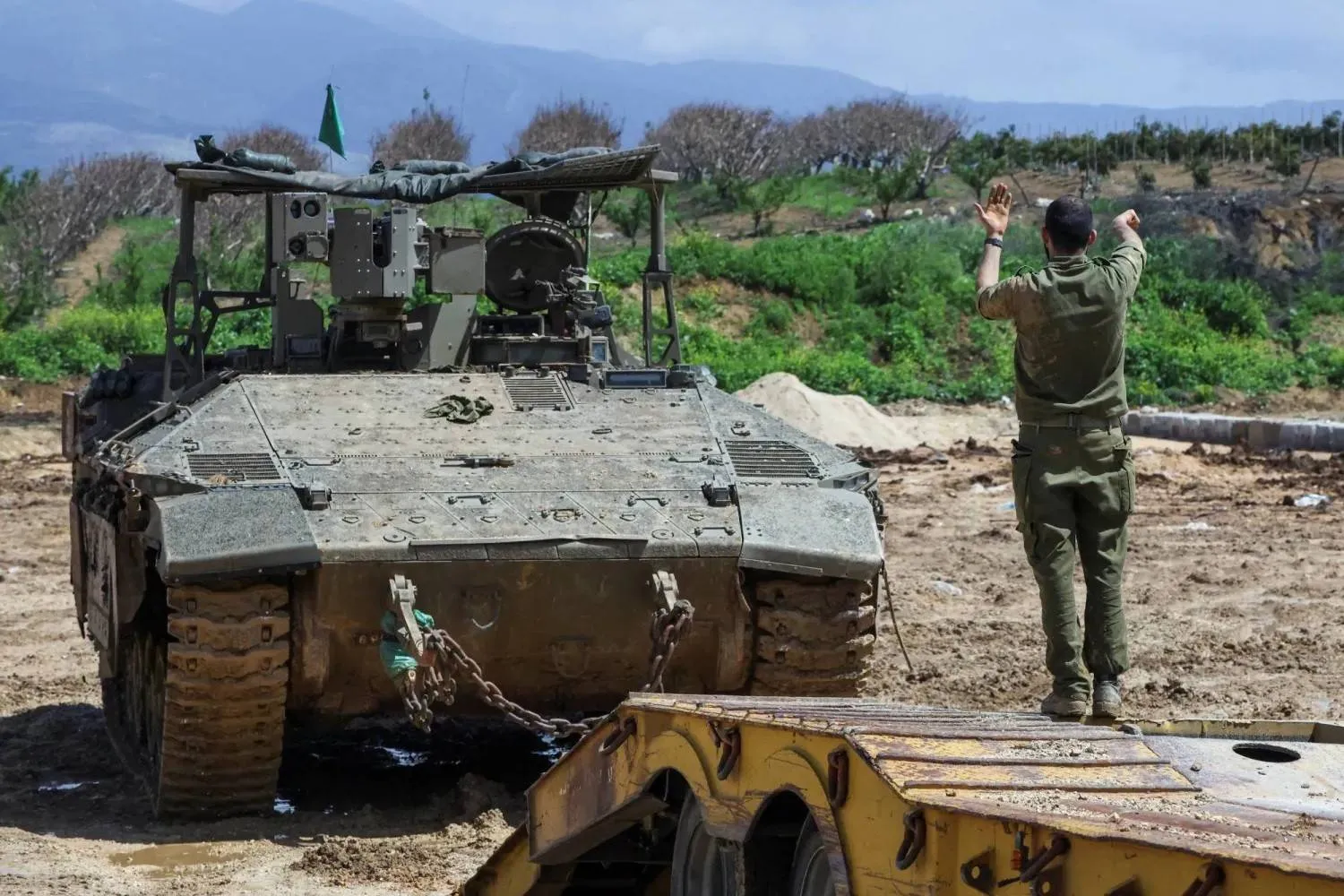
An Israeli soldier directs a tank near the Lebanese border (Reuters)
TT

Israel, Hezbollah Brace for Prolonged Fighting in South Lebanon

An Israeli soldier directs a tank near the Lebanese border (Reuters)

Hezbollah is preparing for a prolonged fight in south Lebanon and is insisting on an Israeli withdrawal from Lebanese territory before any ceasefire takes effect, to avoid a repeat of the last war’s outcome, Lebanese sources following the group’s talks with officials said.

Continued Israeli troop build-ups suggest the Israeli army is also bracing for a long battle.

Information in Lebanon on fighters targeted in airstrikes, reinforced by Israeli footage of operations in combat zones, points to a shift in Hezbollah’s military approach.

The group has reduced combat units to two or three fighters to limit attrition and granted field units authority to act independently, based on battlefield conditions.

Sources said Hezbollah is preparing for a long war and will not accept any political deal that does not guarantee an Israeli withdrawal before a ceasefire begins, to prevent Israel from using any pause to destroy more homes or entrench military positions inside Lebanon.

The group is telling officials its fighters will continue to resist Israeli incursions until a full withdrawal, however long that takes. Any political agreement, the sources said, would also ensure the return of prisoners, whose numbers have risen since the war began, and allow displaced residents to return to their homes.

Talks suspended

The leaks indicate Hezbollah has raised its conditions ahead of any potential agreement, although there are currently no negotiations or exchanged messages with Israel through any international mediator, the sources said.

Israel has also raised its demands, seeking political negotiations with the Lebanese state while fighting continues and while it holds Lebanese territory.

These demands are coupled with steps by the Lebanese government to disarm Hezbollah, secure northern Israel fully and eliminate any threat, diplomatic sources told Asharq Al-Awsat.

The stance mirrors Israeli statements. The Israeli military said, “If the Lebanese government does not disarm Hezbollah, we will do it.”

A UN official warned of “increasingly alarming rhetoric” from Israeli authorities and the military regarding southern Lebanon, adding that what is needed is full respect for Lebanon’s sovereignty and territorial integrity.

Advance of 10 kilometers

Israeli forces have made what is seen as a strategic advance along Lebanon’s coast, pushing nearly 10 kilometers from the border southwest of Naqoura toward Bayyada, about 12 kilometers from the coastal city of Tyre.

Local sources said progress on this axis has been relatively smooth, as Hezbollah’s defenses are positioned farther east, along the route the Israeli army would take to reach Shama and Tayr Harfa and seize the surrounding high ground.

That would allow it to overlook the valleys of Zibqin and Majdal Zoun, an area it failed to enter in the last war despite controlling Shama.

Elsewhere, Israeli forces have advanced further in Qantara, nearing the edges of Wadi al-Hujair, a strategic valley that marked Israel’s last point of control before its withdrawal from south Lebanon in 2000. Reaching it would cut Hezbollah's supply lines from the valley and the Litani River toward the interior.

In response, Hezbollah said it carried out a series of attacks targeting Israeli tanks and troop concentrations, and released images showing armored vehicles hit in Deir Siryan and Taybeh with guided missiles and drones. The group said its fighters were engaging Israeli forces at point-blank range in some areas of incursion and inside village neighborhoods.

The number of operations on Thursday reached nearly 90, announced in separate statements, the highest since the war began on Oct. 8, 2024, signaling a sharp escalation.

Israel now fully controls 11 villages across the first, second and third lines along the border.

At the same time, Israeli airstrikes hit the Zahrani area, causing casualties in Sarafand and Saksakiyeh.

Strikes also targeted Bazaliyah in the Bekaa in eastern Lebanon, as well as dozens of villages in the districts of Tyre, Nabatieh, Bint Jbeil, Marjayoun and Jezzine, in addition to attacks on Beirut’s southern suburbs.

Warnings over the humanitarian situation

On the humanitarian front, Karolina Lindholm Billing, UNHCR Representative in Lebanon, said about 150,000 people have been cut off after bridges over the Litani River were destroyed.

The situation remains deeply alarming, and there is a real risk of a humanitarian catastrophe, she said.

Marcoluigi Corsi, UNICEF Representative in Lebanon, said at a Friday press conference that displaced people in Lebanon are unable to find safe shelter even in the capital, Beirut, amid the Israeli offensive against Hezbollah.



Israeli Military Kills 15-year-old Palestinian in West Bank

File: Palestinian Territories, Nablus: A view of a damaged vehicle following an attack by Jewish settlers, who also wrote Hebrew slogans on the walls of houses in the village of Deir al-Hatab, east of Nablus in the West Bank. Photo: Mohammed Nasser/APA Images via ZUMA Press Wire/dpa
TT

Israeli Military Kills 15-year-old Palestinian in West Bank

File: Palestinian Territories, Nablus: A view of a damaged vehicle following an attack by Jewish settlers, who also wrote Hebrew slogans on the walls of houses in the village of Deir al-Hatab, east of Nablus in the West Bank. Photo: Mohammed Nasser/APA Images via ZUMA Press Wire/dpa

The Israeli military killed a 15-year-old Palestinian boy near Bethlehem late on Friday, according to the Palestinian health ministry, as violence in the Israeli-occupied West Bank surges.

The Palestinian health ministry said in a statement that the 15-year-old boy had died after arriving at the hospital in a critical condition with a gunshot wound to the abdomen, according to Reuters.

The boy had been shot in the Dheisheh camp during an Israeli military raid, the Palestinian WAFA state news agency reported.

The Israeli military said a Palestinian was killed after soldiers opened fire during what it described as a "violent riot" in which stones were thrown at soldiers near Bethlehem. The statement did not identify the Palestinian killed or specify why Israeli forces were in the area.

It was the third reported Palestinian killed in the West Bank by Israeli forces on Friday. The WAFA earlier on Friday reported that two Palestinian men had been shot dead by Israeli forces.

The West Bank has seen a surge in violence since October 2023 when Hamas carried out its deadly attack on Israel from Gaza.

Since then, the military has tightened restrictions on Palestinian movement in the West Bank, and launched raids that have displaced entire communities, while violence perpetrated by Israeli settlers against Palestinians has increased.


Baghdad Orders Probe after Drone Targets Kurdistan President’s Home

File Photo: President of Iraq’s autonomous Kurdistan Region Nechirvan Barzani - AFP
TT

Baghdad Orders Probe after Drone Targets Kurdistan President’s Home

File Photo: President of Iraq’s autonomous Kurdistan Region Nechirvan Barzani - AFP

A drone attack targeted the home of the president of Iraq's Kurdistan Region early on Saturday, security sources said, in an incident that comes as tensions continue to rise across northern Iraq.

Air defences also shot down a drone near a Peshmerga fighters’ base in Duhok, the sources added.

The strikes come amid a surge in attacks on both Iran-aligned militias and Kurdish forces as the US-Israeli war against Iran spills over into Iraq, drawing in multiple armed groups and straining Baghdad’s efforts to contain the fallout.

Prime Minister Mohammed Shia al-Sudani condemned the attack on Kurdish President Nechirvan Barzani’s home and spoke with him by phone, his office said.

Sudani ordered the creation of a joint federal-Kurdistan security and technical team to investigate the incidents and identify those responsible, the statement added.

Iraq's military accused the US and Israel of carrying out some of the airstrikes on the PMF.

Tehran-backed armed groups have also launched attacks on US bases in Iraq and the US embassy.


Israeli Strike Kills Three Lebanese Journalists

Journalists Ali Shaib and reporter Fatima Ftouni (National News Agency)
TT

Israeli Strike Kills Three Lebanese Journalists

Journalists Ali Shaib and reporter Fatima Ftouni (National News Agency)

An Israeli strike on a car in southern Lebanon has killed three Lebanese journalists, Reuters reported.

Al Manar reporter Ali Shaib and reporter Fatima Ftouni, from broadcaster Al Mayadeen, were killed when their vehicle was hit. Ftouni's brother, cameraman Mohammed Ftouni, had also been killed in the strike.

The Israeli military said in a statement it had "eliminated" Shaib, whom it described as a "terrorist" in a Hezbollah intelligence unit who had reported on the locations of Israeli soldiers in southern Lebanon. It accused him of "incitement" against Israeli soldiers and civilians.

The military's statement made no mention of any other deaths and provided no evidence to support the assertion that Shaib was a member of Hezbollah.

Lebanese President Joseph Aoun described them in a statement on X as "civilians doing their professional duty."

"It is a brazen crime that violates all treaties and norms through which journalists enjoy international protection in war," he said.

For his part, Prime Minister Nawaf Salam also stressed that “targeting journalists constitutes a flagrant violation of international humanitarian law and a clear breach of the rules that guarantee the protection of journalists in times of war.”

He said: “Lebanon, which holds press freedom and its role in high regard, affirms its commitment to protecting journalists and calls for respect for international law, the safeguarding of civilian lives, and an end to Israeli attacks targeting them.”

Also, Information Minister Paul Morcos said that “the targeting of journalists is repeated and deliberate,” and that what occurred “constitutes a documented war crime against the media and the journalistic mission.”

He added that the incident “adds to a growing record of attacks targeting media outlets and journalists,” noting that Lebanon has submitted to the UN Special Coordinator for Lebanon, Jeanine Hennis-Plasschaert, a detailed list of assaults against journalists as well as health and medical personnel.