


UK Equips Ship with Mine-Hunting Drones for Possible Strait of Hormuz Deployment

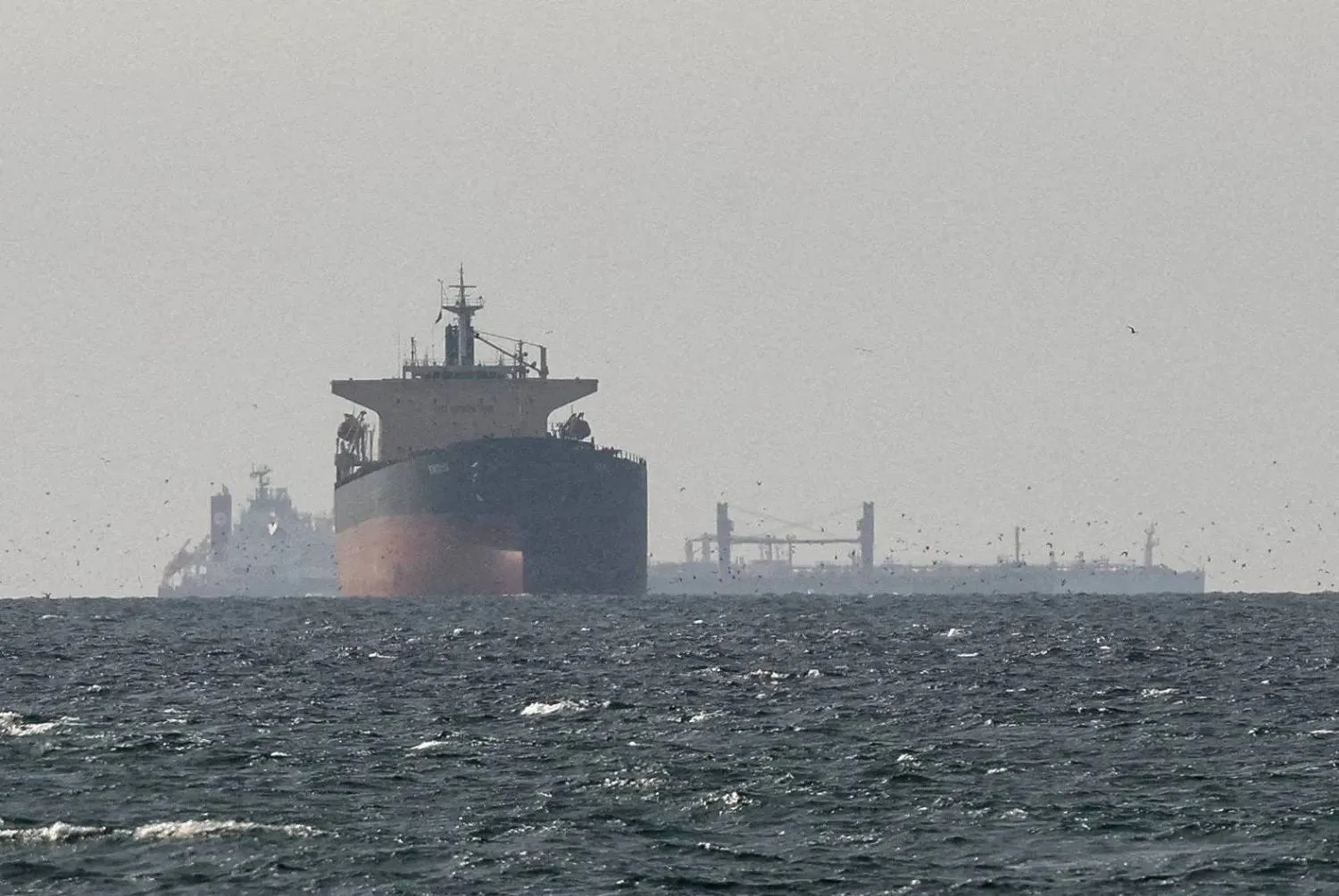
Cargo ships in the Gulf, near the Strait of Hormuz, as seen from northern Ras al-Khaimah, near the border with Oman’s Musandam governance, amid the US-Israeli conflict with Iran, in United Arab Emirates, March 11, 2026. REUTERS/Stringer/File Photo/File Photo  
TT

UK Equips Ship with Mine-Hunting Drones for Possible Strait of Hormuz Deployment

Cargo ships in the Gulf, near the Strait of Hormuz, as seen from northern Ras al-Khaimah, near the border with Oman’s Musandam governance, amid the US-Israeli conflict with Iran, in United Arab Emirates, March 11, 2026. REUTERS/Stringer/File Photo/File Photo  

Britain is preparing to deploy a Royal Navy evacuation vessel to the Strait of Hormuz, equipped with a fleet of autonomous drones designed for mine detection and clearance, to facilitate the reopening of the Strait of Hormuz, according to The Times newspaper.

Last week, the UK said the ship, which had been undergoing routine maintenance in Gibraltar, was sent to the Mediterranean where it is undertaking training drills.

Sources told The Times that Defense Secretary John Healey has reportedly authorized the development of plans for the vessel to move into the Arabian Gulf.

The ship will be retrofitted with multiple autonomous systems, including underwater drones and mine-hunting boats, which operate under a plug-and-play command and control configuration.

A defense source told The Times that “no decision” had yet been taken on deployment to the Strait of Hormuz, adding: “This preventative step gives ministers options should they be needed to help resume the normal flow of merchant shipping.”

About a fifth of global oil and LNG normally passes through the strait. On 2 March, in response to US-Israeli strikes, Iran announced it was closing the Strait of Hormuz. Two days later, Iran's Revolutionary Guard Corps (IRGC) has asserted full, proactive control over the strait.

Lloyd's List, a maritime intelligence company, reported that since the start of the war, 16 ships were attacked in the Strait of Hormuz and surrounding region, triggering severe maritime disruption.

US intelligence assessments indicate that at least a dozen mines, including Maham 3 and Maham 7 limpet devices, are present in the area, along with concerns over ten Ghadir-class midget submarines, which could further impede commercial navigation.

Meanwhile, the US sped up its military presence in the Middle East by the arrival of approximately 3,500 US Marines and sailors aboard the USS Tripoli, bringing transport and strike aircraft, amphibious assault assets, and tactical units, according to a statement by US Central Command. The move is part of a broader buildup in the region designed to protect navigation and secure the strait.

The closure of the narrow channel has sparked global fuel price with nearly 2,000 vessels trapped in the Arabian Gulf, according to the International Maritime Organization.

The British government is considering a scheme to help households if they are hit with soaring energy costs this winter. Finance Minister Rachel Reeves said last week that the government is considering support for households to offset the increase in ‌energy costs if the conflict in the Middle East continues.

Citing ongoing talks with Iran, US President Donald Trump said last week he was delaying a deadline for Iran to reopen the Strait of Hormuz or face destruction of its power plants.

He said the US and Iran have been meeting “directly and indirectly” and that Iran's new leaders have been “very reasonable.”

Trump had previously urged allies to dispatch warships to the region to aid in reopening the strait, though Western nations have thus far refrained from doing so.

The President has renewed his criticism of the UK government over its response to the Iran conflict and warned the NATO military alliance faced a “very bad” future if its members failed to help reopen the strait.


Over 3,300 People Have Died in Iran During War

Commuters make their way past a giant billboard of slain Iranian supreme leader Ali Khamenei at the Valiasr Square in Tehran on April 19, 2026. (AFP)
TT

Over 3,300 People Have Died in Iran During War

Commuters make their way past a giant billboard of slain Iranian supreme leader Ali Khamenei at the Valiasr Square in Tehran on April 19, 2026. (AFP)

Iran on Monday offered a new death toll for its war with Israel and the United States, with its forensic chief saying at least 3,375 people had been killed in the conflict.

The figure came from Abbas Masjedi, the head of Iran’s Legal Medicine Organization.

Masjedi, quoted by the judiciary’s Mizan news agency and other outlets Monday, said only four of the dead remain unidentified.

His comments did not break down casualties among civilians and security forces, instead just saying that 2,875 were male and 496 were female.

Masjedi said 383 of the dead were children 18 years old and under.

Masjedi’s figures raised questions about whether or not they included security force members, particularly given the levels of intense bombings targeting military bases and arsenals in the country.


China Voices Concern Over US Seizure of Iranian Cargo Ship, Urges Further Talks

13 April 2026, China, Beijing: Guo Jiakun, spokesman for the Chinese Foreign Ministry, speaks to journalists. (dpa)
TT

China Voices Concern Over US Seizure of Iranian Cargo Ship, Urges Further Talks

13 April 2026, China, Beijing: Guo Jiakun, spokesman for the Chinese Foreign Ministry, speaks to journalists. (dpa)

China has expressed concern over the "forced interception" by the US of an Iranian-flagged cargo ship, a Chinese foreign ministry spokesperson said on Monday, urging relevant parties to abide by the ceasefire agreement in a responsible ‌manner.

"The situation ‌in the Strait of ‌Hormuz ⁠is sensitive and complicated," ⁠said spokesman Guo Jiakun during a regular press briefing. Parties involved should avoid further escalation and "create the necessary conditions for normal transit through the strait ⁠to resume," he added.

The ‌US said ‌earlier it fired on and seized ‌an Iranian cargo ship that tried ‌to run its blockade of Iranian ports.

Iran's military said the ship had been travelling from China ‌and vowed retaliation against what it called "armed piracy by the US ⁠military."

Beijing ⁠on Monday also urged relevant parties to "continue to maintain the momentum of the ceasefire and negotiations".

"Now that a window for peace has opened, favorable conditions should be created to bring the war to an end as soon as possible," Guo said.


Russia Arrests German Woman in Alleged Bomb Plot

People visit the observation deck at Vorobyovy gory (Sparrow Hills) with the main building of the Ministry of Foreign Affairs of Russia in the background during a spring day in Moscow, Russia, 17 April 2026. (EPA)
TT

Russia Arrests German Woman in Alleged Bomb Plot

People visit the observation deck at Vorobyovy gory (Sparrow Hills) with the main building of the Ministry of Foreign Affairs of Russia in the background during a spring day in Moscow, Russia, 17 April 2026. (EPA)

Russia said Monday it had arrested a German woman found with a homemade bomb in her backpack in what it alleged was a Ukrainian-hatched plot to blow up a security services facility in the south.

Russia has arrested dozens of people throughout the four-year war, mostly its own citizens, on allegations of working for Ukraine to carry out sabotage attacks.

There has been a string of high-profile arrests of Western citizens since Moscow ordered its troops into Ukraine -- typically on espionage charges that are widely seen as baseless, with those detained later swapped in exchange for Russians jailed abroad.

Detentions of Western citizens for carrying out or preparing actual attacks are much rarer.

The FSB security agency said the woman, born in 1969, had been dragged into the alleged plot by a citizen from a Central Asian country, who was working on orders from Ukraine.

She was detained and found with an improvised explosive device in her bag in the Caucasus city of Pyatigorsk, the FSB said.

The FSB said it had "prevented a terrorist attack planned by the Kyiv regime against a law enforcement facility in the Stavropol region, involving a German citizen born in 1969," the agency said in a statement.

The FSB said the device -- which contained an explosive charge equivalent to 1.5 kilograms (three pounds) of TNT -- was supposed to be detonated remotely, killing the German woman.

The blast was prevented by electronic jamming, the FSB added.

- 'Radical ideology' -

A man from an unidentified Central Asian state, born in 1997 and "a supporter of radical ideology", was found and arrested near the targeted site, it added.

The pair face life in prison on terrorist charges.

There was no immediate reaction to the allegations in Kyiv or Berlin.

Video footage of the purported arrest published on state media showed armed Russian security agents approach the woman, who was lying face down dressed in all black in a car park.

Another video showed masked plainclothes agents pulling a man into a station, followed by a controlled explosion of the backpack.

Russia has previously accused Ukraine of working with fundamentalists to carry out terror attacks inside Russia, without providing evidence.

Officials initially alleged that the perpetrators of a 2024 massacre at a concert hall on the outskirts of Moscow that killed 150 people were ISIS members in coordination with Ukraine.

ISIS claimed responsibility for that attack, making no reference of any Ukrainian involvement, for which no evidence was presented by Moscow and which Kyiv denies.
