

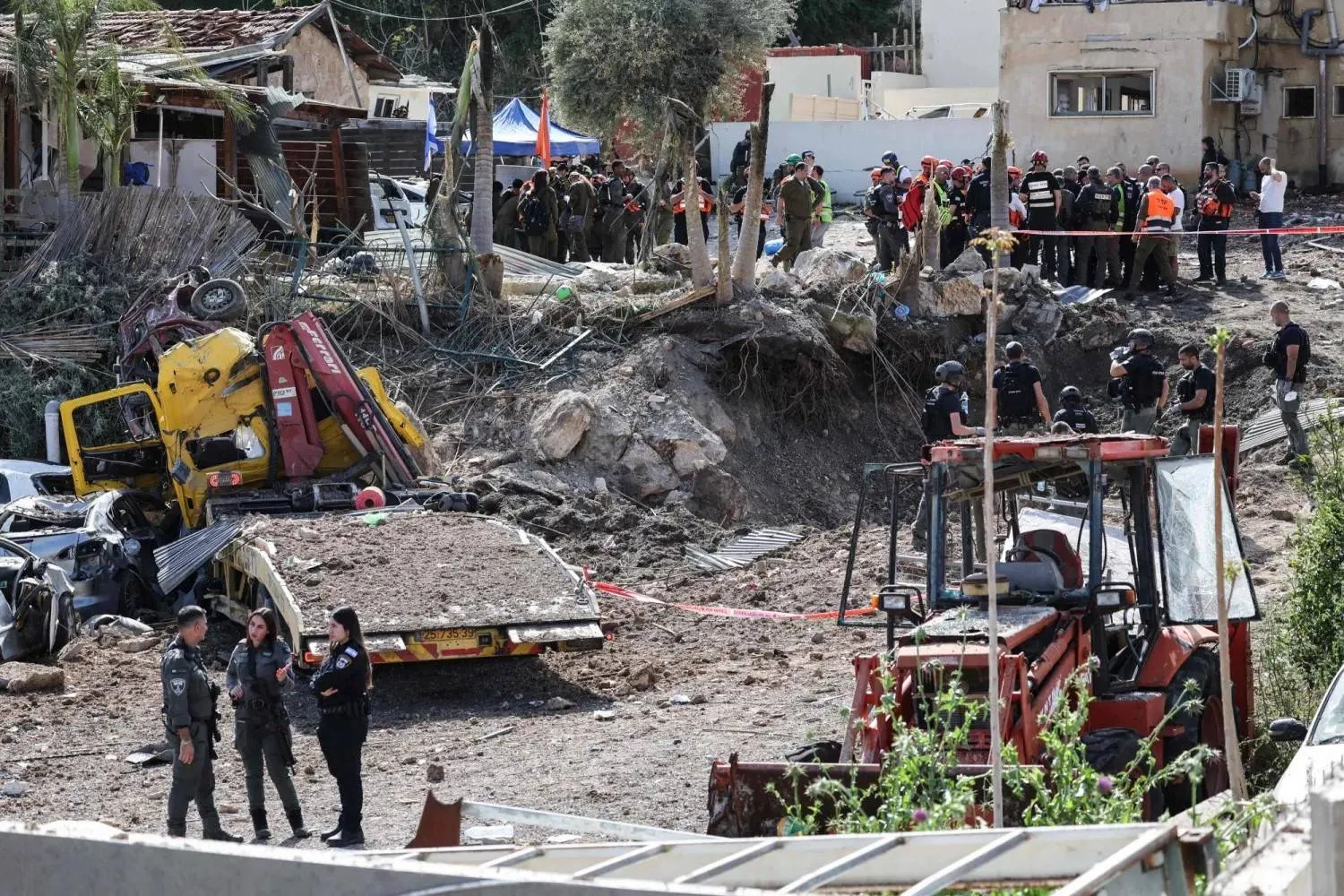

Israel to Help US Manage Strait of Hormuz Crisis Through Intelligence

Israel to Help US Manage Strait of Hormuz Crisis Through Intelligence
TT

Israel to Help US Manage Strait of Hormuz Crisis Through Intelligence

Israel to Help US Manage Strait of Hormuz Crisis Through Intelligence

Israel is helping the United States manage the crisis around the Strait of Hormuz through intelligence, a senior Israeli security official told the Yedioth Ahronoth newspaper on Monday, without addressing the issue of an Israeli involvement in any possible ground operations in Iran.

The official said the Israeli army had been tasked with creating conditions that could enable the fall of the regime and that Israel was “very close” to achieving the objectives it had set for itself in Iran, with assessments of the campaign’s gains being updated constantly.

“Israel is helping the United States manage the crisis around the Strait of Hormuz, primarily through intelligence,” the senior security official said.

He noted that the Israeli strikes on Iranian steel plants earlier this week had caused damage worth billions of dollars and had become a major preoccupation for Tehran.

The remarks came after Israeli sources affirmed that Tel Aviv supports a ground military operation in Iran, but that its troops are not expected to join.

Last Sunday, US Central Command chief Adm. Brad Cooper was in Israel and met with Israeli Army Chief of Staff Lt. Gen. Eyal Zamir and other top Israeli generals. According to Channel 12, they discussed US-Israeli coordination in the war on Iran, as well as efforts to stop Iranian weapons production.

Israel wants to continue the war and is pushing for a ground operation in Iran. However, it fears surprises from US President Donald Trump, who could still declare a temporary ceasefire.

On Monday, Yedioth Ahronoth said the assessment in Israel is that a ground operation could create a chance to break Iranian resistance or force a surrender.

Meanwhile, it wrote, preparations are underway in Pakistan for possible US-Iran negotiations, and there is also growing attention to the possibility that Washington could announce a ceasefire as early as this week to allow talks to proceed.

The newspaper said that although Trump has warned Tehran to reopen the strategic waterway or face broader US attacks on Iranian energy infrastructure, his comments are contradictory with reports saying US is on advanced talks with Iran.

Control Iran’s Oil

Last Sunday, Trump said he could “take the oil in Iran” and seize Iran’s export hub of Kharg Island.

In an interview with the Financial Times, the US President said his “preference would be to take the oil,” comparing it with the US military operation in Venezuela earlier this year.

An Israeli source cited by Channel 12 last week said that ending the war without removing Iran's enriched uranium stockpile is considered akin to “leaving smoldering embers” and a failure to address the core threat.

The source added that Israel is not willing to end the war now before reaching an absolute victory after eliminating Iran's missile and nuclear capabilities.

Researcher Udi Dekel of the Institute for National Security Studies wrote on Monday that since October 7, Israel has been trapped in a conception of “absolute security” that drives it toward continuous war.

“If security is defined as the complete removal of every threat already in its earliest stages of emergence, and even more so when it is clear and tangible—rather than its reduction or the construction of a stabilizing political framework—then almost any other outcome of conflict will be perceived as insufficient, any arrangement as surrender, and any achievement as partial and therefore a failure,” he said.

Dekel considered that Israel faces two traps: a ceasefire without an effective settlement mechanism linked to a war-termination mechanism regarding the nuclear issue and ballistic missiles, which would leave it needing a continuous follow-up campaign and repeated rounds of strikes, and a “war of attrition” with no exit point.

Mechanism for Cooperation with Washington

According to Dekel, in order to leverage the military success against Iran into a strategic achievement—blocking Iran’s path to rebuilding its nuclear and missile capabilities, and ensuring regional stability—a mechanism for cooperation with the United States and moderate Arab states is required.

Its purpose would be to advance four overlapping interests: weakening the regional radical camp and significantly reducing the Iranian threat; maintaining the US military presence in the region; expanding security cooperation with the United States and regional states; and promoting regional stability while preserving freedom of navigation, which is vital for economic development and strengthening the moderate camp.

The researcher offered possible scenarios for ending the war, including a termination mechanism based on understandings between the United States and the surviving regime in Iran in exchange for reopening the Strait of Hormuz and ensuring freedom of navigation, alongside continued negotiations on arrangements concerning the nuclear issue and missiles.

A dangerous scenario, he said, would be a prolonged attrition of Iran and internal destabilization that lead to broader regional chaos.

Dekel said the end of the war will not mean the end of the conflict. In conclusion, he wrote, Israel may find itself in a situation of operational victory against Iran alongside strategic failure.

Doubling Interceptor Missile Production

On Monday, Haaretz wrote that Israel's arms industry has ramped up production of interceptor missiles and other munitions in response to the country's continued wars on Iran and Hezbollah in southern Lebanon.

According to the report, Israel brought in massive stockpiles of munitions since last June. Its initial operational planning assumed the active, heavy-fire phase would last only about three weeks.

But as the war intensifies, Haaretz’ military correspondent Amos Harel, wrote that the Israeli defense industry has recently tripled the pace at which it produces interceptor missiles and other aerial munitions, in an attempt to respond to the army's needs during the war.

Production is expected to increase to four times the usual rate and continue through the Jewish holiday of Pesach, he said.

Meanwhile, US military cargo planes continue to deliver munitions to Israel as over 200 aircraft and ships have arrived in Israel carrying approximately 8,000 tons of military equipment, weaponry, and munitions since the start of the war.



Italy Reportedly Refuses US Aircraft Use of Sicily Base for Middle East Operations

In this US Air Force handout photo released by US Central Command public affairs, a US Air Force B-52H Stratofortress bomber aircraft prepares to refuel from a KC-135 Stratotanker aircraft during Operation Epic Fury over the US Central Command area of responsibility on March 20, 2026. (Photo by US Airforce / AFP)
TT

Italy Reportedly Refuses US Aircraft Use of Sicily Base for Middle East Operations

In this US Air Force handout photo released by US Central Command public affairs, a US Air Force B-52H Stratofortress bomber aircraft prepares to refuel from a KC-135 Stratotanker aircraft during Operation Epic Fury over the US Central Command area of responsibility on March 20, 2026. (Photo by US Airforce / AFP)

Italy has denied permission for US military aircraft to land at the Sigonella air base in Sicily before flying to the Middle East, a source close to the matter said on Tuesday, confirming a newspaper report.

Daily Corriere della Sera reported "some US bombers" had been due to land at the base in eastern Sicily ⁠before heading to the Middle ⁠East. It did not say when they had been due to land.

The source, who was not authorized to speak to media and declined to be ⁠identified, also did not specify how many aircraft were involved or when Rome declined to give permission.

Corriere della Sera added that permission was not granted as the US had not sought authorization and Italy's military leadership was not consulted, as required under treaties governing the use of US military ⁠installations ⁠in the country.

The Italian defense ministry had no immediate comment.

Center-left opposition parties have urged the government to block the US use of bases in Italy to avoid involvement in the conflict.

Prime Minister Giorgia Meloni's right-wing government has said it would seek parliamentary authorization should any such requests be made.

Israel’s military spokesperson says 10 soldiers have died fighting in Lebanon since the start of the Israeli invasion, including four deaths announced Tuesday.

As of Friday, the military said 261 troops had been injured, 22 seriously, in fighting since the start of the latest war.


Iran Media Says Strikes Put Desalination Plant on Gulf Island Out of Service

An aerial view of the island of Qeshm, separated from the Iranian mainland by the Clarence Strait, December 10, 2023. (Reuters file)
TT

Iran Media Says Strikes Put Desalination Plant on Gulf Island Out of Service

An aerial view of the island of Qeshm, separated from the Iranian mainland by the Clarence Strait, December 10, 2023. (Reuters file)

Iranian media said Tuesday airstrikes have put a desalination plant on Iran's Qeshm island in the strategic Strait of Hormuz out of service, though the report did not specify when the attack took place.

"One of the desalination plants on Qeshm Island was targeted... and is now completely out of service, as it is not possible to repair it in the short term," the ISNA news agency reported, quoting health ministry official Mohsen Farhadi.

Iran's Foreign Minister Abbas Araghchi had said a strike had taken place there on March 7, accusing the US of a "blatant and desperate crime".

Qeshm is the largest Iranian island in the Gulf, stretching for around one hundred kilometers across the Strait of Hormuz.

It has become a popular tourist destination in recent years for Iranians thanks to its rare UNESCO-listed rock formations and turquoise waters, but is also heavily militarized, analysts say.

There have been several attacks on desalination plants in the ongoing war, sparked by US-Israeli strikes on Iran on February 28.

Bahrain reported an Iranian strike on a facility on March 8, apparent retaliation for the US hit on Qeshm the day before.

Kuwait reported an Iranian attack on a desalination and electricity plant on Monday, which Tehran blamed on Israel.

The Middle East is among the driest regions in the world, with many countries dependent on desalination plants for domestic and industrial water supplies.

US President Donald Trump threatened on Monday to "obliterate" Iran's power infrastructure, oil wells and "possibly all desalinization plants."


France’s Macron Arrives in Japan for Talks Dominated by Mideast War

 France's President Emmanuel Macron (center-L) and his wife Brigitte arrives at Tokyo Haneda International Airport in Tokyo on march 31, 2026. (AFP)
France's President Emmanuel Macron (center-L) and his wife Brigitte arrives at Tokyo Haneda International Airport in Tokyo on march 31, 2026. (AFP)
TT

France’s Macron Arrives in Japan for Talks Dominated by Mideast War

 France's President Emmanuel Macron (center-L) and his wife Brigitte arrives at Tokyo Haneda International Airport in Tokyo on march 31, 2026. (AFP)
France's President Emmanuel Macron (center-L) and his wife Brigitte arrives at Tokyo Haneda International Airport in Tokyo on march 31, 2026. (AFP)

French President Emmanuel Macron arrived in Japan on Tuesday for a visit that initially aimed to strengthen partnerships in nuclear energy and space innovation but will now be dominated by the Middle East war.

Macron landed shortly before 5:30 pm (0830 GMT) in rainy and windy Tokyo, ahead of an expected evening meeting with several cultural figures including a renowned kimono painter.

He will then hold talks with Prime Minister Sanae Takaichi on Wednesday, and "the crisis in the Middle East will be at the heart of discussions", the Elysee said ahead of his Asia trip, which will also include a visit to South Korea.

The two leaders will discuss "how we can try to find common solutions", it added.

Japan depends on the Middle East for 95 percent of its oil imports and has had to dip into strategic stockpiles to temper the impact of rising fuel prices since the start of the war.

Iran has virtually closed the vital Strait of Hormuz -- through which a fifth of global crude and gas flows -- since the United States and Israel began striking the country on February 28.

Economy and finance ministers of G7 countries, which include France and Japan, said on Monday they stood ready to take "all necessary measures" to ensure the stability of the energy market as they tackled the economic consequences of the war.

Wednesday will be Macron's "first full-fledged meeting" with Takaichi, according to a Japanese foreign ministry official, though the two met on the sidelines of the G20 summit in November.

Among expectations for the talks was "continued communication" with a view towards the "calming down of the situation in Iran", the official said.

The two countries are also expected to discuss security and partnerships in the space sector, and intend to sign a roadmap on nuclear power in Japan, the Elysee said.

Macron's visit, his fourth to the country, comes as China-Japan ties worsen following Takaichi's suggestion in November that Tokyo might intervene militarily in any Chinese attempt to take Taiwan.

Macron visited China in December.

He and his wife Brigitte are due to have lunch with Emperor Naruhito and Empress Masako on Thursday but a hoped-for viewing of Japan's famous cherry trees in full bloom could be spoiled by rain forecast for the next three days in the Japanese capital.

He will be in Japan until April 2, and he will then visit South Korea at the invitation of President Lee Jae Myung.

"Macron will be the first European leader to make a state visit to South Korea since the launch of (our) new administration," the South Korean presidential office said earlier this month.
