


There are no sudden countries.

Diriyah Biennale Foundation logo
TT

There are no sudden countries.

Diriyah Biennale Foundation logo

Donya Abdulhadi

Executive Director, Marketing, Communication and Strategic Partnerships

Diriyah Biennale Foundation

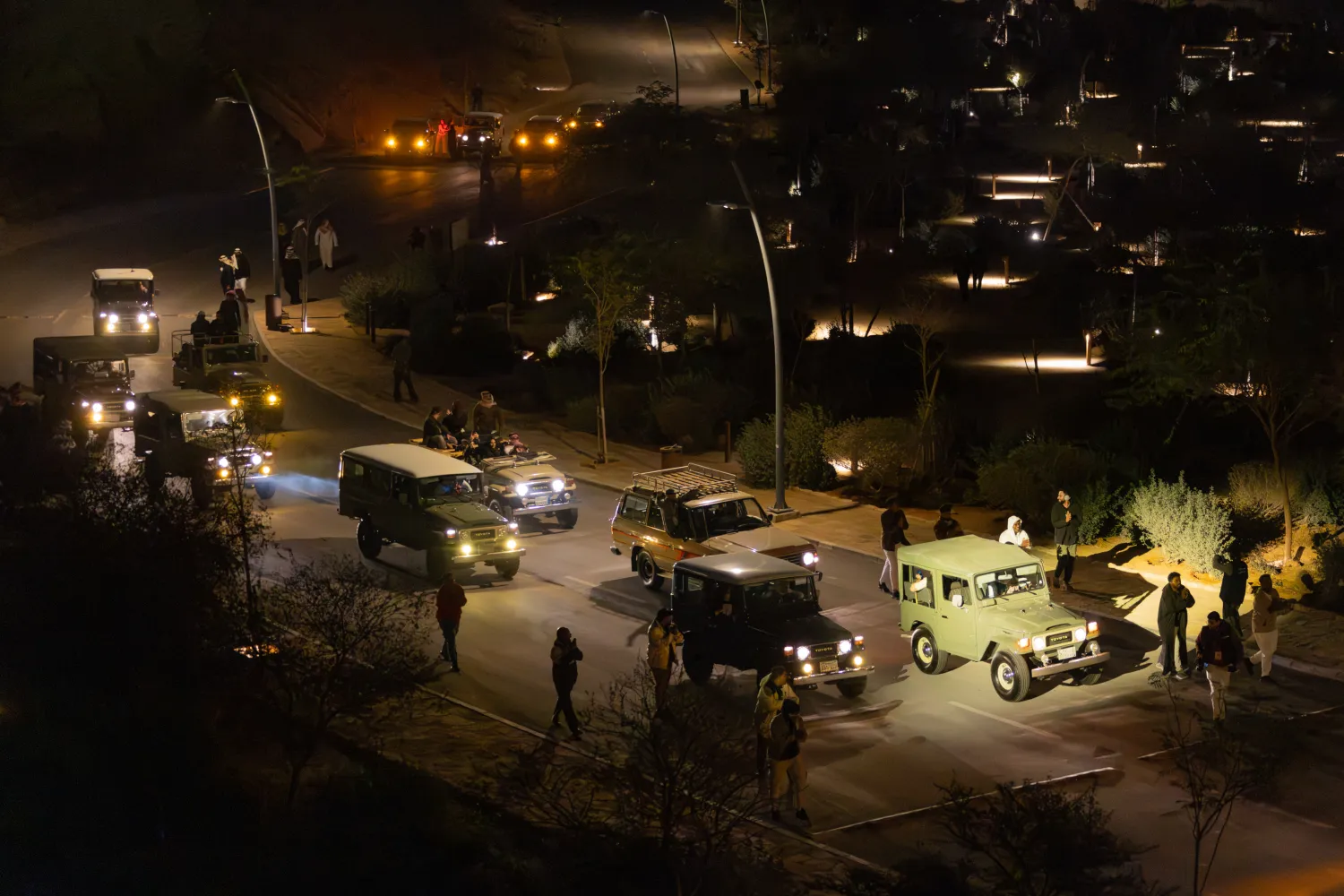
A slow-moving convoy is led through Wadi Hanifa towards the JAX District — a scene that merges heritage and natural landscape, pulsating with eager expression. Across the valley floor, vintage and new pickup trucks release their brakes and begin to slowly move after sunset, accompanied by camels and their handlers, clapping rhythmically, keeping movement paced and deliberate. The procession begins, as viewers watch in anticipation as it advances to where the Wadi ends and the district begins, culminating in its merging with hundreds of people in collective celebration, Saudi and non-Saudi communities alike, at the doors of the third edition of the Diriyah Contemporary Art Biennale.

This performative scene, led by Saudi artist 7amdan, in the heart of Diriyah, known as the birthplace of the Saudi state, is not only symbolic, but diagnostic. To understand Saudi Arabia today — its acceleration, its ambition and its demographic shifts — one must see it as continuation, rather than sudden rupture.

Yet, discourse about transformation in the Arab world often fixates on politics and economic output. Against this backdrop, what is frequently overlooked is the cultural practices that make nation-scale change sustainable. The seemingly “sudden” revival of old cities, the creation of new ones, the inward migration of talent, policy reforms and the announcements of investments have been the primary scenes driving international understandings of Saudi Arabia’s transformation. Yet, the opportunity to more accurately read this change as a part of a much larger, rhythmic “procession,” is laid bare.

The Diriyah Contemporary Art Biennale, conceived by the Diriyah Biennale Foundation, artistically directed by Nora Razian and Sabih Ahmed and titled In Interludes and Transitions, adopts procession as its opening metaphor. In Arab contexts, processions are often reduced to ritual display — pilgrims moving in unison, caravans crossing deserts, ceremonial marches through city streets. But procession has never been mere spectacle. It is infrastructure: the mechanism through which trade, belief, labor, and knowledge moved across terrain..

For centuries, the Arabian Peninsula has functioned as a corridor: between East Africa and South Asia, between the Mediterranean and the Indian Ocean, between desert interiors and maritime routes. Trade, pilgrimage, seasonal migration, and the circulation of stories formed moving networks long before oil supported economic growth. Procession was not only physical movement; it has been the layering of skills, dialects, value systems, commercial and cultural practices across generations.

That pattern continues today, if in intensified form.

Today, Saudi Arabia is growing into one of the most demographically dynamic countries in the region. Expatriates constitute a ‘minority’ of more than 13 million residents — over 30% of the population — according to the Saudi General Authority for Statistics. These are not marginal, cosmetic figures; they reflect not temporary labor influx but a structural condition in which cross-border movement is foundational to the Kingdom’s social and economic architecture.

But migration is at times framed as sudden, episodic, even opportunistic — as individuals arriving to capitalize on growth or regulatory reform — when a more accurate reading is coordinated movement at scale: capital, labor, and expertise advancing in waves.

Consider the economic transformation underway. Saudi Arabia’s Vision 2030 has committed hundreds of billions of dollars toward diversification — tourism, logistics, renewable energy, entertainment, advanced manufacturing. The non-oil sector now contributes more than 50% of Saudi GDP. Crossing this threshold marks not diversification in theory, but a measurable shift in the engine of national growth from extractive dependence to multi-sector productivity. These figures signal structural and collective reorientation rather than incremental reform.

Procession in this region has in fact always been collective. Trade caravans moved in formation; pilgrimages operated in waves; ports thrived because of overlapping routes. Contemporary economic development follows a similar logic of embeddedness: partnerships with local entities, alignment with national transformation agendas, and participation in sectors are not bureaucratic formalities, but the modern equivalent of traveling in convoy.

Procession carries memory and implies sequencing. The region’s openness to global capital is not cultural amnesia; it is consistent with centuries of exchange. Riyadh’s rapid urban transformation is layered atop older routes. Reforms are phased, sector-specific, and often geographically concentrated. Nation-scale projects like Diriyah operate as critical nodes in a larger movement of urban and economic reconfiguration, designed to continue to attract long-term talent and capital. The labor statistics reinforce this. The volume of movement reflects systemic reliance on cross-border mobility instead of temporary flux.

Procession also implies visibility. In a caravan, each participant is seen, and reputation travels quickly. Trust, responsibility and credible contribution to collective goals matter. The region’s economic model, while globally integrated, remains relational at its core.

Like all changes, transformation is not frictionless. Regulatory frameworks evolve. Processions can re-route. Those looking to understand its transformation must recognize that the route is dynamic. Short-term extraction strategies — arrive, profit, exit — misread the scale of transformation underway.

The Biennale’s invocation of interludes and transitions offers a useful corrective to simplistic growth narratives. Saudi Arabia is not simplistically in acceleration; it moves through phases: consolidation, experimentation, recalibration. Periods of pause, regulatory and fiscal review and project restructuring might appear as reversals, but are actually interludes that prepare for the next transition.

Transformation here is neither chaotic nor accidental, but sequenced. It advances in steps, sometimes rapid, sometimes measured, but rarely isolated. Those who understand the rhythm of that movement participate in its momentum.

Procession, then, is not poetic flourish. It is a practical framework of reading change. In Saudi Arabia today, transformation moves in procession. The question is not whether it is occurring, but how attentively one reads its cadence and moves within it.
Young Antelope Shot Dead at Vienna Zoo

The zoo, located within the grounds of the imperial Schoenbrunn Palace, attracted nearly two million visitors in 2024. ALEXANDER KLEIN / AFP/File
TT

Young Antelope Shot Dead at Vienna Zoo

The zoo, located within the grounds of the imperial Schoenbrunn Palace, attracted nearly two million visitors in 2024. ALEXANDER KLEIN / AFP/File

Vienna's Schoenbrunn Zoo expressed outrage on Tuesday over the death of one of its blackbuck antelope, whose males are recognizable by their large twisted horns, which was shot dead by an unknown gunman.

According to the zoo, the shot was fired from outside the enclosure overnight from Saturday to Sunday.

"The safety of people and animals is our most precious asset, and we do everything we can to ensure the highest level of security," zoo director Stephan Hering-Hagenbeck told Austria's APA news agency.

A keeper discovered the dead antelope and a veterinarian carried out an autopsy during which a suspected gunshot wound was identified, AFP reported.

The incident was reported to the police on Monday by zoo officials, and an investigation into suspected animal cruelty has been opened.

The zoo, located within the grounds of the imperial Schoenbrunn Palace, attracted nearly two million visitors in 2024.

Originally from South Asia, the blackbuck, also known as the Indian antelope, is commonly found in captivity.


Wolf Bites Woman in Shopping Area in Germany's 2nd-biggest City

12 February 2026, Baden-Württemberg, Cleebronn: A wolf is photographed in an enclosure in Baden-Wuerttemberg.  Photo: dpa
12 February 2026, Baden-Württemberg, Cleebronn: A wolf is photographed in an enclosure in Baden-Wuerttemberg. Photo: dpa
TT

Wolf Bites Woman in Shopping Area in Germany's 2nd-biggest City

12 February 2026, Baden-Württemberg, Cleebronn: A wolf is photographed in an enclosure in Baden-Wuerttemberg.  Photo: dpa
12 February 2026, Baden-Württemberg, Cleebronn: A wolf is photographed in an enclosure in Baden-Wuerttemberg. Photo: dpa

A wolf bit a woman in a shopping area in Hamburg before it was pulled out of a lake in Germany’s second-biggest city, authorities said, in what is believed to be the first such attack since wolves returned to the country in 1998.

The fire service said that the woman was taken to a Hamburg hospital after the unusual encounter on Monday evening, German news agency dpa reported. There was no immediate information on her condition Tuesday, and police didn't detail where she was bitten. It also wasn't clear what led to the attack.

The attack took place in a shopping area near the Altona station, west of the city center. Late on Monday evening, police said, officers hauled the wolf out of the Binnenalster lake in downtown Hamburg following calls alerting them to a sighting of the animal there and in other locations. Local media reported that it was taken to an enclosure in the outskirts of the city.

Officials believe it's likely that the wolf involved was the same one that was sighted in Blankenese, an outer suburb of the city, over the weekend. Experts believe that animal is a young wolf searching for a territory of its own that accidentally wandered into the city.

Hamburg's regional government noted that wolves generally avoid contact with people and dogs, and the unusual urban environment would be very stressful, The Associated Press reported.

Germany's Federal Agency for Nature Conservation said it was the first time a person was known to have been attacked by a wild wolf since the animals reappeared in the country after 150 years' absence nearly 30 years ago, dpa reported.

Wolf attacks on livestock in Europe have been a growing concern to farmers for years, however. Last year, the European Parliament voted to change wolves' status from “strictly protected” to “protected.”

Last week, the German parliament gave final approval to legislation making it easier to shoot wolves that kill or wound livestock.


Stranded Whale Frees Itself Again Off German Coast and Disappears

Seagulls fly above a humpback whale that managed to free itself overnight from a sandbank in shallow waters of Wismar Bay in the Baltic Sea, near Wismar, Germany March 31, 2026. REUTERS/Annegret Hilse
TT

Stranded Whale Frees Itself Again Off German Coast and Disappears

Seagulls fly above a humpback whale that managed to free itself overnight from a sandbank in shallow waters of Wismar Bay in the Baltic Sea, near Wismar, Germany March 31, 2026. REUTERS/Annegret Hilse

A humpback whale struggling in shallow waters off Germany's northern Baltic Sea coast has freed itself for a third time and has now disappeared, a police spokesman told AFP Tuesday.

"The whale seems to have left Wismar. However, there have been no sightings so far," the spokesman for the city's water police said.

The 13.5-meter (44-foot) long animal has been struggling in shallow waters in the area for more than a week, having first been spotted in the early hours of March 23 near the city of Luebeck.

It managed to free itself from a sandbank there but ran into further difficulty after swimming east.

It twice became stuck on sandbanks close to the city of Wismar and over the weekend experts warned that its breathing rate had reduced.

Nevertheless experts hope that the whale may be able to make it back to its natural habitat in the Atlantic Ocean.

Speaking on ZDF television on Monday, marine biologist and rescue coordinator Burkard Baschek said the lack of sightings was a good sign.

"We haven't received any further reports so far, which is good," he said, adding: "We can now only hope that it will eventually manage to make it under its own steam."

The whale is believed to be suffering from skin problems due to the lower level of salt content in the Baltic Sea compared to the open ocean.

It is possible the whale came into the Baltic following a shoal of fish or having been distracted by the noise of a submarine.
