


Eurozone Manufacturing Growth Reaches 4-Year High

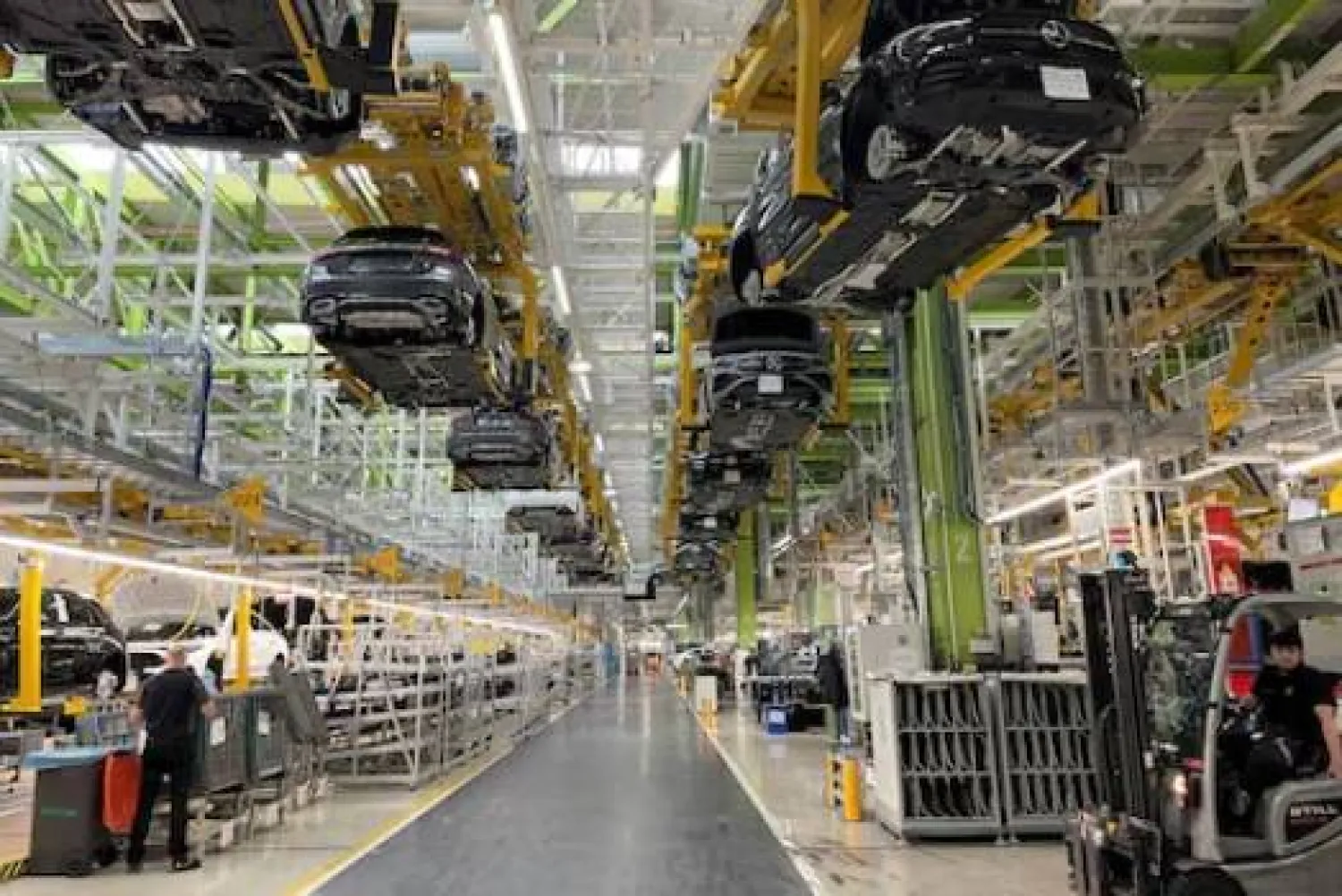
Production lines at German car manufacturer Mercedes-Benz at its factory in Rastatt (Reuters)
TT

Eurozone Manufacturing Growth Reaches 4-Year High

Production lines at German car manufacturer Mercedes-Benz at its factory in Rastatt (Reuters)

Euro zone manufacturers faced soaring input costs and supply chain disruptions in March due to the Iran war, even as underlying tepid demand threatened to undermine the sector's fragile recovery, a survey showed.

The conflict in the Middle East has disrupted global logistics networks, causing delivery delays and pushing input price inflation to its highest levels since October 2022, distorting headline growth measures.

A jump in the cost of manufacturing, driven by higher oil and energy prices, led manufacturers to respond by raising selling prices at the fastest pace ⁠in just over ⁠three years.

"It's exactly the same as during the pandemic - this is a supply shock - normally longer delivery times are associated with too much demand in a really healthy environment but in a supply shock it falsely elevates the PMI," said Chris Williamson, chief business economist at S&P Global.

"It ⁠does falsely elevate the PMI so conditions would be worse than the headline PMI indicates," he also said.

The S&P Global euro zone Manufacturing Purchasing Managers' Index rose to 51.6 in March from 50.8 in February, higher than a preliminary estimate of 51.4.

A reading above 50.0 indicates growth in activity.

The new orders sub-index - a key gauge of demand - matched February's 46-month high but growth remained modest.

Production rose for a third consecutive month, with the output sub-index edging up ⁠to 52.0 ⁠from 51.9 in February, marking a seven-month high.

New export orders stabilized after contracting for eight straight months, providing some relief to manufacturers.

Backlogs of work increased for the first time since mid-2022, signaling capacity pressures, yet companies cut jobs at a faster rate in March.

Business confidence slipped to a five-month low and remained below its long-term average as the conflict weighed on sentiment.

Germany and Italy recorded their strongest readings in 46 and 37 months respectively, while Spain was the only country in contraction territory. Greece posted the highest reading, followed by Ireland, while France's manufacturing sector stagnated.


IEA, IMF and World Bank to Coordinate Response to Middle East War's Impact

A displaced man prepares his shisha, at a temporary encampment for displaced people, amid escalating hostilities between Israel and Hezbollah, in Beirut, Lebanon, April 1, 2026. REUTERS/Raghed Waked
TT

IEA, IMF and World Bank to Coordinate Response to Middle East War's Impact

A displaced man prepares his shisha, at a temporary encampment for displaced people, amid escalating hostilities between Israel and Hezbollah, in Beirut, Lebanon, April 1, 2026. REUTERS/Raghed Waked

The heads of the International Energy Agency, International Monetary Fund, and World Bank on Wednesday said they will form a coordination group to maximize their response to the significant economic and energy impacts of the war in the Middle East.

In a joint statement, the three global bodies noted that the war had caused major disruptions in the region and triggered one of the largest supply shortages in global energy market history.

"At these times of high uncertainty, it is paramount that our institutions join forces to monitor developments, ⁠align analysis, and coordinate ⁠support to policymakers to navigate this crisis," the heads of the IMF, IEA and World Bank said.

The new coordination group will assess the severity of impacts across countries, coordinate a response mechanism, and mobilize stakeholders to deliver support to countries in need, the international bodies said.

The response mechanism could include targeted policy advice, assessment of potential financing needs ⁠and related provision of financial support, including through low or zero-percent financing, as well as unspecified risk mitigation tools, they said.

Thousands of people have been killed across the Middle East in the war, which began when the US and Israel struck Iran on February 28, triggering Iranian attacks on Israel, US bases and the Gulf states, while opening a new front in Lebanon.

Now in its second month, the conflict has spread across the region, disrupting energy supplies and threatening to send the global economy into a tailspin.

"The impact is substantial, global, and highly asymmetric, disproportionately ⁠affecting energy ⁠importers, in particular low-income countries," Reuters quoted the IMF, IEA and World Bank as saying.

They noted that the war was already resulting in higher oil, gas and fertilizer prices, while triggering concerns about food prices and affecting global supply chains of helium, phosphate, aluminum, and other commodities. Tourism had also been hit.

"The resulting market volatility, weakening of currencies in emerging economies, and concerns about inflation expectations raise the prospect of tighter monetary stances and weaker growth," the organizations said.

"We are committed to working together to safeguard global economic and financial stability, strengthen energy security, and support affected countries and people on their path to sustained recovery, growth, and job creation through reforms," they said.


Saudi Arabia: Mawani Announces Commencement of Container Terminal Operations at Jubail Port

Jubail Commercial Port. SPA
TT

Saudi Arabia: Mawani Announces Commencement of Container Terminal Operations at Jubail Port

Jubail Commercial Port. SPA

The Saudi Ports Authority “Mawani” has announced the commencement of container terminal operations at Jubail Commercial Port under a privatization contract with Saudi Global Ports (SGP), backed by private sector investments exceeding SAR2 billion ($533 million).

The new move is in line with the objectives of the National Transport and Logistics Strategy under Saudi Vision 2030, Mawani said in a statement on Wednesday.

“The commencement of operations comes as part of the implementation of the privatization contract signed between the two parties, which includes the development of infrastructure and the modernization of operational equipment,” it said.

“This includes increasing berth length from 1,000 m to 1,400 m, deepening berths from 14 m to 18 m, increasing the number of STS cranes from 6 to 10, and raising the number of RTG cranes from 13 to 29 automated, environmentally friendly cranes,” the statement added.

According to Mawani, the launch will increase the container terminal’s handling capacity from 1.5 million TEUs to 2.4 million TEUs annually, across an area of 460,000 square meters.

This will enable the terminal to accommodate large next-generation vessels, enhance operational efficiency, and reinforce Jubail Commercial Port’s position as a key logistics gateway supporting the Kingdom’s sustainable growth.

It will also strengthen operational integration with the Group’s terminals across the Eastern Coast ports.


Germany Growth Forecasts Slashed as Mideast War Hits Economy

Germany's economy is struggling with fierce Chinese competition in sectors from cars to chemicals © Ronny HARTMANN / AFP/File
TT

Germany Growth Forecasts Slashed as Mideast War Hits Economy

Germany's economy is struggling with fierce Chinese competition in sectors from cars to chemicals © Ronny HARTMANN / AFP/File

Leading economic institutes more than halved their growth forecast for Germany on Wednesday, warning that the energy shock caused by the Middle East war would hit Europe's top economy hard.

A group of leading institutes slashed their joint GDP growth forecast for 2026 to 0.6 percent, down from a September prediction of 1.3 percent.

Inflation is now forecast to rise to 2.8 percent, up from 2.0 percent, "weighing on household purchasing power".

"The energy price shock triggered by the Iran war is hitting the recovery hard," said economist Timo Wollmershaeuser of the Ifo institute, adding that increased government spending was nevertheless "preventing a stronger slide", AFP reported.

Oil and natural gas prices have surged since the end of February, when the United States and Israel attacked Iran, killed its supreme leader and plunged the Middle East into war.

Iran has since closed the Strait of Hormuz to ships of countries it considers allied with the US and Israel, effectively blocking a sea lane that normally transports about a fifth of the world's oil and liquefied natural gas.

Higher inflation in Germany would hit consumer spending, the institutes said, weighing on an already weak economy that has barely grown since a burst of pent-up demand after the Covid pandemic in 2022.

The government on Wednesday introduced rules allowing petrol stations to only raise prices once a day, at noon.

But motorist Sebastian, a 49-year-old estate agent who did not want to give his surname, told AFP at a Frankfurt petrol station that this was not enough to protect his spending power.

"Whether the price of petrol changes once a day or 10 times a day doesn't really matter," he said, adding it was "certainly not enough" to lower his costs.

Germany's economy, struggling with fierce Chinese competition in sectors from cars to chemicals, was in the doldrums even before US President Donald Trump last year imposed sweeping new tariffs before starting the Mideast war in late February.

Chancellor Friedrich Merz, who took office last May, vowed to borrow and spend hundreds of billions through a special infrastructure fund over coming years in what was dubbed a spending "bazooka" aimed at getting the economy back on its feet.

But the economists said that much of the money was simply paying for day-to-day spending.

"Government expenditure on consumption is rising much more sharply than investment," economist Oliver Holtemoeller of the Halle Institute for Economic Research said. "That was not the idea behind changing the financing rules."

The outlook for the longer term was also dire.

Citing low productivity, industrial decline and an ageing population, the institutes warned that Germany's economy would soon be unable to grow sustainably.

"We have also reassessed the structural changes in the German economy and, in particular, revised our forecast for industrial growth downwards," Wollmershaeuser said.

In an era when "demographic change is hitting with full force", he said, "potential growth will come to a standstill by the end of the decade, and we will have to get used to average GDP growth rates of zero percent".

Speaking to broadcaster Welt TV, Economy Minister Katherina Reiche said the government was working on reducing labour taxes and energy costs but that Germans would have to get used to working more over the course of their lives.

"We need to make this country vigorous again," she said. "Germany needs to get its will to win back."
