


After Gaza Devastation, Israeli Attacks on Lebanon's Health Care System Feel Familiar for Many

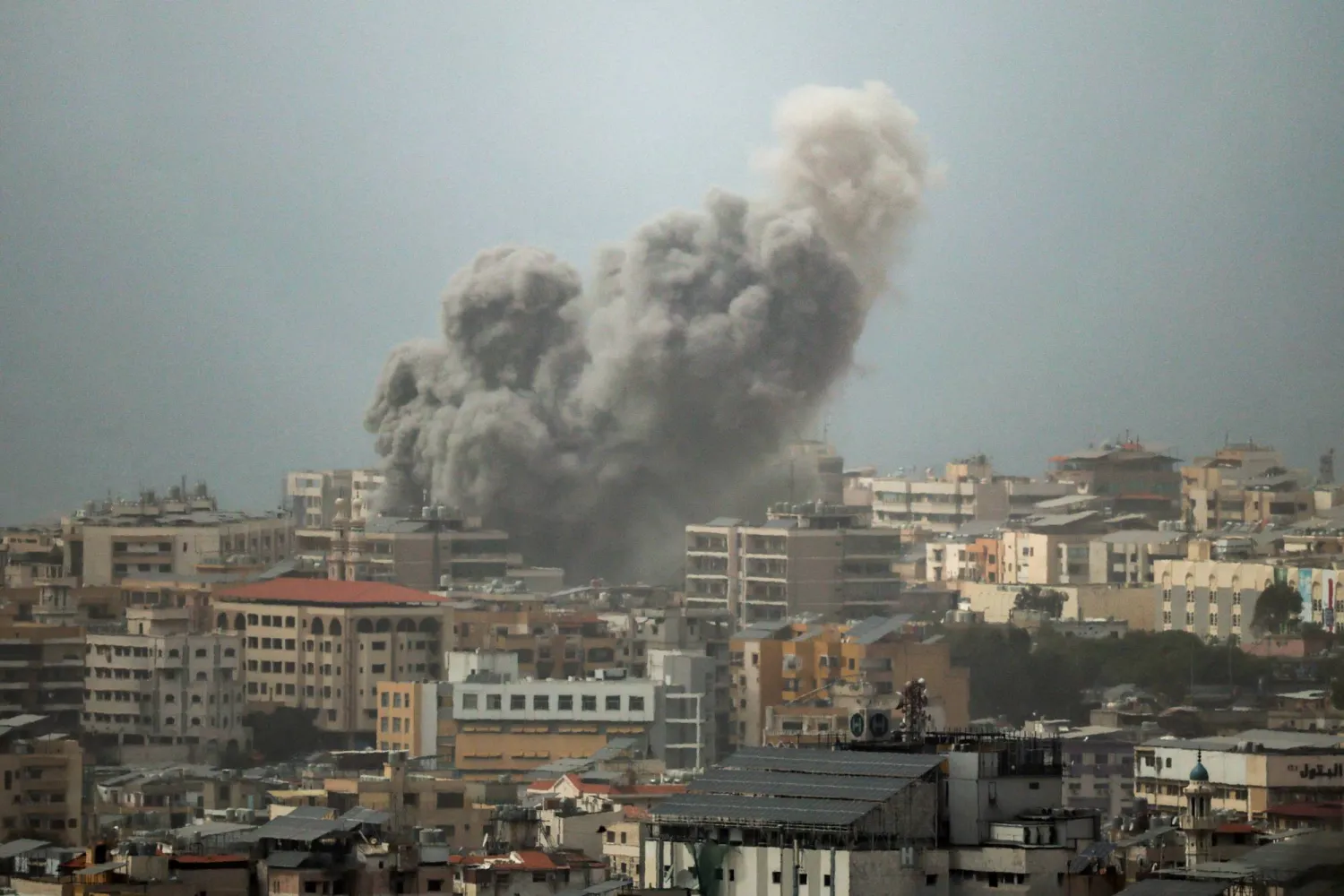
Smoke rises from Beirut's southern suburbs following an Israeli strike, amid escalating hostilities between Israel and Hezbollah, as the US-Israel conflict with Iran continues, Lebanon, April 5, 2026. REUTERS/Alkis Konstantinidis
TT

After Gaza Devastation, Israeli Attacks on Lebanon's Health Care System Feel Familiar for Many

Smoke rises from Beirut's southern suburbs following an Israeli strike, amid escalating hostilities between Israel and Hezbollah, as the US-Israel conflict with Iran continues, Lebanon, April 5, 2026. REUTERS/Alkis Konstantinidis

Two years ago, Dr. Mohammed Ziara watched Israel ravage Gaza's health care system, shelling hospitals, striking ambulances and forcing patients to evacuate.

Now Ziara — along with other medical workers, human rights groups and many civilians — warns that the same scenario is unfolding in Lebanon.

Israel is pushing deep into the southern part of the country in its campaign against the Iran-backed group Hezbollah, a powerful militant force and political party that long has exercised de facto control over much of Lebanon’s Shiite community.

To describe its strategy in this war, the Israeli military invokes the devastation it wrought in Gaza after the Hamas-led Oct. 7, 2023, attacks. Israeli warplanes dropped leaflets over Beirut last month warning that after “great success in Gaza, a new reality is coming to Lebanon, too.”

“I've lived this before,” Ziara, a burn surgeon from Gaza City, told The Associated Press on Thursday at the government hospital in the Lebanese port city of Sidon. “I cannot go back to Gaza now,” Ziara said. “But I can be here, in Lebanon.”

As it did with Hamas in Gaza, Israel accuses Hezbollah of hiding in and operating from civilian areas, and using hospitals and ambulances for military purposes. Israel has increasingly targeted first responders and medical centers, forcing several hospitals to evacuate.

“I was besieged in a hospital,” Ziara said of his work in Gaza. “I lost my brother in an airstrike. I feel what these people feel.”

An Israeli offensive threatens a health system, again Since the war between Israel and Hezbollah reignited on March 2, Israeli airstrikes have killed at least 54 health professionals as of Sunday, according to the Lebanese health ministry.

Israel has carried out 152 attacks against emergency medical workers and ambulances, and forced the closure of six hospitals and 49 health clinics through attacks or threats, the ministry says.

In Sidon, Ziara and his team from UK-based nonprofit Interburns have set up the Lebanese public health system's first specialized burn unit — a critical resource in this crisis-stricken country where the war between Israel and Hezbollah has already killed 1,461 people and wounded 4,430, according to the ministry. Israel claims to have killed hundreds of Hezbollah operatives in the latest bombardment and ground invasion.

The Israeli military argues that Hezbollah’s use of medical facilities makes them legitimate military targets under international law. It does not offer evidence to support its claims.

Hezbollah denies conducting militant activities within civilian sites. Although the group's presence in residential areas is well-documented, there has been no independent verification of its use of hospitals for military purposes.

Interburns, which trains local medics in burn care around the world, began building up the unit at Sidon Government Hospital during the 2024 Israel-Hezbollah war. Lebanese authorities asked the team to return when the war reignited last month.

As the first city just north of Israel’s evacuation zone that covers nearly all southern Lebanon, Sidon takes more wounded people every day.

The rising toll of rescue work Kamal Fakih, 27, hates when people ask him what happened on March 17.

It’s not that it pains him to recall the Israeli airstrike. It’s that he doesn’t remember anything at all. He regained consciousness a day later at the hospital in Sidon, his body burned and lacerated by shrapnel.

Once stabilized, Fakih tried to connect with the paramedic who pulled him and his friend Hassan from the burning rubble, hoping to hear his account and thank him for saving their lives. But by the time Fakih got his contact, Muhammad Tafili was already dead, killed with a fellow paramedic in an Israeli airstrike on ambulances in the southeastern village of Kfar Tebnit on March 28, according to Lebanon’s health ministry.

That same day, Israeli attacks killed seven other medics across four additional villages, the World Health Organization said. Among the dead was a medic targeted while responding to an Israeli airstrike that killed three journalists working for pro-Hezbollah TV channels. Footage of the incident shows two strikes in quick succession — the first hitting journalists in their car, the second crashing into paramedics as they rushed to the rescue.

Israel's military accused the two medics, and two of the three journalists killed, of being Hezbollah operatives. Its claim alarmed watchdogs that witnessed its similar justifications for killing more than 260 journalists and 1,700 health workers in Gaza, according to the United Nations humanitarian agency.

Although Lebanese medical workers and journalists were killed during the 2024 war with Hezbollah, “this time is different,” said Ramzi Kaiss, the Lebanon researcher at Human Rights Watch.

He pointed to a startling promise by Israeli Defense Minister Israel Katz last week that, to protect its border towns from Hezbollah rockets, Israel would flatten all the houses in southern Lebanon “in accordance with the model used in Rafah and Beit Hanoun in Gaza” — two cities that Israel almost entirely razed in its offensive against Hamas in the enclave.

“There’s a new kind of brazenness in declaring an intent to commit unlawful attacks,” Kaiss said. “It appears impunity has emboldened the Israeli military.”

Hospitals in the line of fire Sweeping Israeli evacuation orders in recent weeks have sent over 1 million Lebanese flocking north. As the south came under heavy bombardment, clinics shuttered or suspended operations. Nabih Berri Hospital was swamped by an influx of casualties. To make room, it evacuated dozens of patients.

Such transfers involve coordination with the Lebanese army, health ministry and UN peacekeeping force — a game of telephone, doctors say, that creates potentially life-threatening delays. Admitting patients isn’t easy either; the Sidon burn unit must discharge a patient to free up a bed.

But the referrals keep coming, straining a health system already crippled by economic collapse.

“The health system is on its knees,” Ziara said, as the hospital was plunged into darkness until backup generators kicked in 10 minutes later, a result of Lebanon’s long-running electricity crisis. “Now front-line hospitals are lacking staff and supplies. They're overwhelmed.”

Civilians search for answers Lebanese civilians say that Israeli bombs can come without warning and hit indiscriminately, leading to a growing feeling that Palestinians in Gaza know well — that nowhere is safe.

Mohammad Qubaisi, 53, said his neighborhood of Zuqaq al-Blat in central Beirut had not received Israeli evacuation guidance before March 18, when Israeli munitions slammed into his seventh-floor apartment.

Carrying his wife from the smoldering ruins, he shouted for his sons. His eldest, Adam, called to him. But he couldn’t hear Jad.

Qubaisi ran back into the skin-searing steam to search for his 15-year-old. When he woke up at the hospital hours later, his face raw with second-degree burns, he knew his son was gone.

The Israeli military said it was targeting Hezbollah. Qubaisi pushed back.

“These are civilian buildings, not military targets. They hit us and we still don’t know why,” he said from the Sidon hospital. “We were sleeping safely in our home, and look what happened to us.”



Türkiye-Syria Border Gate to Reopen After 12-Year Closure

The crossing, which lies just over the border from Tal Abyad in northern Syria, was closed by Türkiye in 2014. (AP)
TT

Türkiye-Syria Border Gate to Reopen After 12-Year Closure

The crossing, which lies just over the border from Tal Abyad in northern Syria, was closed by Türkiye in 2014. (AP)

One of the border crossings between Türkiye and Syria is to reopen on Tuesday, ending a 12-year closure, local officials said Monday.

The reopening of the Akcakale crossing, which sits roughly in the middle of Türkiye's 900-kilometer (550-mile) border with Syria, is the latest step in Damascus's move towards normalization with its neighbors.

The crossing, which lies just over the border from Tal Abyad in northern Syria, was closed by Türkiye in 2014 after the Kurdish-led Syrian Democratic Forces (SDF) took over the town following the defeat of the ISIS group.

Türkiye has long viewed the SDF as linked to the Kurdish militant PKK and a major threat along its southern border.

It was partially reopened in 2019 for trade, funerals and the crossing of government officials after a Turkish military operation against ISIS and Kurdish fighters.

The decision will now mean the crossing is open to civilians.

"In light of the normalization of life in the region... entry and exit procedures using passports to and from the Syrian Arab Republic via the Akcakale Land Border Crossing will start on Tuesday," the Sanliurfa governor's office said in a statement.

The move will mean six of the 12 crossings between Türkiye and Syria will be open.

Türkiye has forged close ties with Syria's new rulers, with President Ahmed al-Sharaa joining a diplomacy forum in Türkiye's southern Antalya resort in April.


Lebanon Urges US to Put Pressure on Israel to Stop Attacks and Demolitions

Smoke rises as a result of an Israeli strike on a southern Lebanon village as seen from the Upper Galilee on the Israel-Lebanon border, 11 May 2026. (EPA)
TT

Lebanon Urges US to Put Pressure on Israel to Stop Attacks and Demolitions

Smoke rises as a result of an Israeli strike on a southern Lebanon village as seen from the Upper Galilee on the Israel-Lebanon border, 11 May 2026. (EPA)

Lebanon's president has urged the United States to put pressure on Israel to cease fire and stop home demolitions in south Lebanon, the presidency said on Monday, as the death toll from Israeli attacks rose.

Lebanon's health ministry said 74 people had been killed by Israeli strikes in the last three days despite a truce announced last month in fighting between Iran-backed Lebanese group Hezbollah and the Israeli military, a spokesperson said.

Tehran said it had demanded security for Lebanon as part of a proposal for ending the wider war with the US and reopening the Strait of Hormuz. US President Donald Trump has rejected Iran's proposal.

The Hezbollah-Israel conflict reignited on ‌March 2 when ‌the group opened fire at Israel in support of Tehran.

Hostilities ‌have ⁠continued since Trump ⁠declared a ceasefire on April 16, mostly in south Lebanon, where Israel is occupying a self-declared security zone, saying it aims to guard against Hezbollah attacks.

The Lebanese health ministry spokesperson said the victims since Saturday had been killed in various Israeli strikes, including one that killed at least seven people in the southern town of Saksakiyeh.

It said 2,869 people had been killed since March 2, including 584 medics, women and minors. Its toll does not say how many combatants are among ⁠the dead.

WASHINGTON TO HOST THIRD ROUND OF TALKS

Lebanese President Joseph ‌Aoun, in a meeting with US Ambassador to Lebanon ‌Michel Issa, "stressed ... the necessity of pressure on Israel to halt fire and military operations and the destruction ‌and bulldozing of homes", the presidency said.

Israel has been demolishing villages in the ‌south, saying it is acting against Hezbollah fighters embedded in civilian areas.

Aoun and Issa also reviewed "developments related" to a third round of talks due in Washington between Lebanese and Israeli government representatives, the presidency said.

Washington last month hosted two rounds of talks between the Israeli and Lebanese ambassadors to Washington, the highest-level ‌contacts between Israel and Lebanon in decades. The US will facilitate the third round on May 14 and 15, the State Department ⁠said.

Lebanon's delegation will ⁠be headed by former ambassador to Washington Simon Karam. Aoun, who nominated Karam for the role, gave him his directives during a meeting on Saturday, the presidency said.

Beirut's decision to hold face-to-face contacts with Israel reflects a deep divide in Lebanon over Hezbollah's arsenal and the group's decision to attack Israel.

Critics accuse the group of unilaterally dragging Lebanon into war. Hezbollah has demanded the government cancel the talks.

Israel last week carried out its first strike on Beirut's Hezbollah-controlled southern suburbs since the ceasefire was declared. Israel says the strike killed the commander of Hezbollah's elite Radwan force. Hezbollah has not confirmed his death.

Israel says Hezbollah has launched hundreds of rockets and drones at Israel since March 2. Some 1.2 million people have been driven from their homes in Lebanon, many of them fleeing from the south.

Israel says 17 of its soldiers have been killed in southern Lebanon, along with two civilians in northern Israel.


Israel Sentences 2 Soldiers to Military Prison for Desecration of Christian Statue in Lebanon

Israeli troops maneuver on the Lebanese side of the border, as seen from the Upper Galilee on the Israel-Lebanon border, 11 May 2026. (EPA)
TT

Israel Sentences 2 Soldiers to Military Prison for Desecration of Christian Statue in Lebanon

Israeli troops maneuver on the Lebanese side of the border, as seen from the Upper Galilee on the Israel-Lebanon border, 11 May 2026. (EPA)

Israel’s military said Monday that two soldiers will spend weeks in military prison for the desecration of a Christian statue in southern Lebanon.

One soldier, who stuck a cigarette in the mouth of a statue of the Virgin Mary, was sentenced to 21 days and a soldier who filmed the incident was sentenced to 14 days, a military spokesperson said.

“The army views the incident with great severity and respects freedom of religion and worship, as well as holy sites and religious symbols of all religions and communities,” Lt. Col. Ariella Mazor wrote on X.

The incident came days after images of an Israeli soldier wielding an ax against a fallen statue of Jesus on the cross in the southern village of Debel sparked widespread condemnation. Soldiers who participated in hacking down the crucifix also received time in military prison.

Israeli forces occupied the area during the latest Israel-Hezbollah war, which began on March 2 when the Iran-backed Lebanese group fired missiles over the border two days after the US and Israel launched their war with Iran. Israel then launched a ground invasion of southern Lebanon and its forces have remained despite a weekslong truce.

Israel's military says it only targets buildings that were used as outposts by the Iran-backed group.

The scale of destruction has Lebanese officials and residents worried that large numbers of people displaced by the latest war will have nowhere to return if the fragile truce holds.