

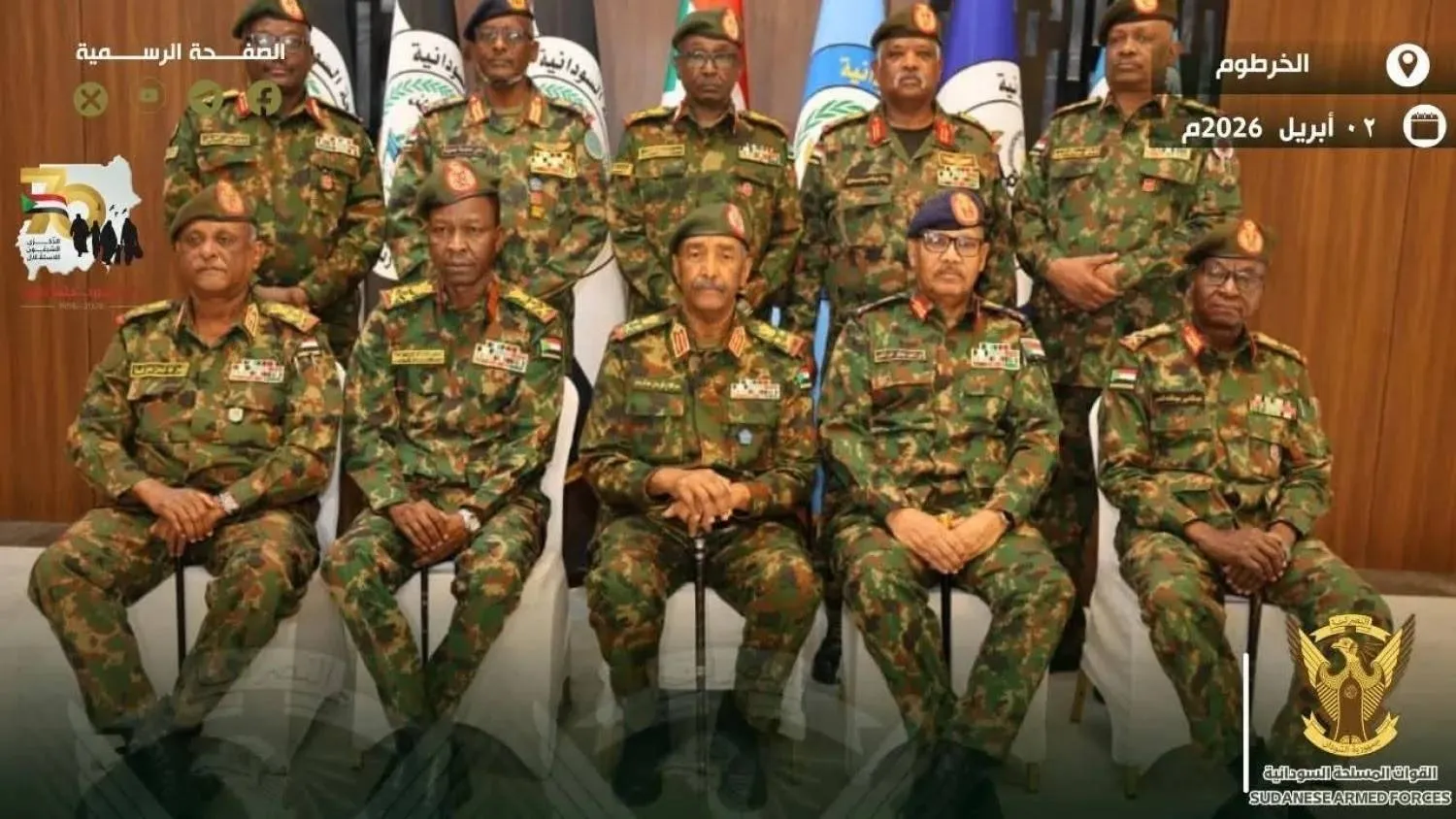

Burhan Reshuffles Sudanese Army Leadership

File photo showing Abdel Fattah al-Burhan with his aides and the chief of staff (Sudanese army)
TT

Burhan Reshuffles Sudanese Army Leadership

File photo showing Abdel Fattah al-Burhan with his aides and the chief of staff (Sudanese army)

Decisions by Sudan’s transitional Sovereign Council chief and army commander, Abdel Fattah al-Burhan, to dismiss several senior military leaders and reassign them to other top positions have fueled speculation that the moves are “not isolated” from imminent changes within the army-led governing authorities.

Al-Burhan issued a decree removing his deputy in army command, Shams al-Din Kabbashi, as well as his assistants Yasser al-Atta and Ibrahim Jaber. He followed it with another decision on the same day appointing Kabbashi, Jaber and Lt. Gen. Mirghani Idris as assistants to the army commander-in-chief.

Al-Burhan had begun the reshuffle last Thursday by appointing Sovereign Council member Lt. Gen. Yasser al-Atta as chief of staff, along with deputies drawn from senior officers across military divisions.

In this context, al-Burhan said the creation of new posts — assistants to the commander-in-chief — aims to “develop and rehabilitate military industries and enhance the capabilities of the armed forces.” He added that “leadership succession is a deeply rooted military tradition to ensure generational continuity and inject new blood to improve military performance.”

Al-Burhan denied “any regional criteria in the appointments.” He said al-Atta’s selection “was based on his field competence and his role in breaking the siege of the General Command and boosting morale,” describing him as “one of the pillars of the armed forces in resolving the Battle of Dignity and achieving victories.”

For his part, the newly appointed chief of staff, al-Atta, described the changes affecting the armed forces leadership as “routine annual measures in line with military hierarchy,” adding that he would work to develop the “joint forces” and “support forces” with the aim of integrating them into army units.

The reshuffle - the most significant within army leadership since the outbreak of war in April 2023 - is widely seen as an indication of a broader restructuring possibly involving changes to or the dissolution of the Sovereign Council, the country’s highest sovereign authority.

Under the latest decisions, al-Burhan appointed Kabbashi as assistant for construction and strategic planning affairs, Lt. Gen. Ibrahim Jaber as assistant for international relations and military cooperation, and Lt. Gen. Mirghani Idris Suleiman Idris as assistant for military industries.

For his part, crisis management and negotiation expert Maj. Gen. Amin Ismail Majzoub of the Strategic Studies and Research Center told Asharq Al-Awsat that changes to the army’s general command “are a routine procedure carried out every two years, though extensions may occur under exceptional circumstances,” referring to the ongoing war in the country.

Meanwhile, retired Sudanese army Maj. Gen. Kamal Ismail said the timing is “not appropriate” for reassignments and transfers among senior ranks, suggesting the latest reshuffle “may be the result of failure to achieve victory in the battlefield, necessitating a change in the general staff leadership to devise new plans for resilience and military progress.”


Lebanon Says Reopening Main Syria Border Crossing Closed Over Israeli Threat

Lebanese General Security members stand guard at the Masnaa border crossing with Syria in the Bekaa Valley, eastern Lebanon, 05 April 2026, (EPA)
TT

Lebanon Says Reopening Main Syria Border Crossing Closed Over Israeli Threat

Lebanese General Security members stand guard at the Masnaa border crossing with Syria in the Bekaa Valley, eastern Lebanon, 05 April 2026, (EPA)

Lebanon announced the reopening of the Masnaa border crossing with Syria starting Wednesday evening, state media said, after it had been closed for several days due to an Israeli threat to target it.

"The Masnaa crossing will be reopened as of 6:00 pm (1500 GMT) today, with strict measures in place to ensure the safety of passenger and cargo traffic, and equipped with the necessary tools to prevent any smuggling operations," the state-run National News Agency (NNA) said.

An informed Lebanese government source had earlier told AFP that "intensive efforts were made by both Lebanon and Syria to spare the crossing from the Israeli strike".

Israel threatened on Saturday to target the crossing, accusing Hezbollah of using it "for military purposes and smuggling of combat equipment", though it ultimately did not carry out the strike.

The crossing was closed on both sides as a precaution after being evacuated.

The Masnaa crossing is the main gateway between Lebanon and Syria, making it a vital trade route for both countries and Lebanon's principal overland link to the rest of the region.

The decision to reopen the crossing comes as Israel pressed its strikes on Lebanon on Wednesday, despite announcing its support for a two-week truce between Iran and the United States.


Iraq Says Israel Strikes on Lebanon Show ‘Plan to Sabotage’ Iran Truce

 Rescuers gather on a destroyed religious complex that was hit in an Israeli airstrike in the southern port city of Sidon, Lebanon, Wednesday, April 8, 2026. (AP)
Rescuers gather on a destroyed religious complex that was hit in an Israeli airstrike in the southern port city of Sidon, Lebanon, Wednesday, April 8, 2026. (AP)
TT

Iraq Says Israel Strikes on Lebanon Show ‘Plan to Sabotage’ Iran Truce

 Rescuers gather on a destroyed religious complex that was hit in an Israeli airstrike in the southern port city of Sidon, Lebanon, Wednesday, April 8, 2026. (AP)
Rescuers gather on a destroyed religious complex that was hit in an Israeli airstrike in the southern port city of Sidon, Lebanon, Wednesday, April 8, 2026. (AP)

Iraqi authorities on Wednesday condemned Israeli strikes that killed dozens in Lebanon, saying they indicated that Israel was seeking to scupper the two-week ceasefire agreed by Iran and the United States.

"The government expresses its condemnation of the brutal attacks that the Zionist occupation army committed against civilians in a number of Lebanese cities," Iraqi government spokesman Bassem al-Awadi said in a statement.

The Israeli government's "continued aggressive approach that seeks to perpetuate conflict... is evidence of its hostile plan to sabotage the truce", he added.


Israeli Forces Damage UN Convoy Vehicle in Lebanon

UNIFIL vehicles in southern Lebanon (Reuters)
TT

Israeli Forces Damage UN Convoy Vehicle in Lebanon

UNIFIL vehicles in southern Lebanon (Reuters)

Israeli forces fired warning shots at a convoy of Italian UN peacekeepers in Lebanon on Wednesday, damaging a vehicle but causing no injuries, the Italian government said.

Defense Minister Guido Crosetto said the incident was "unacceptable" while Foreign Minister Antonio Tajani said the government was seeking clarification from the Israeli ambassador.

"To reiterate, Italian soldiers in Lebanon are not to be touched," Tajani told parliament.

An Italian convoy from the United Nations Interim Force in Lebanon (UNIFIL) was carrying personnel from the town of Shama to Beirut when it was targeted by warning shots fired by the Israeli Defense Forces, Crosetto said in a statement.

The convoy immediately stopped and returned to base.

"There was only minor damage to the vehicles and no injuries were reported, but for how long?" Crosetto said.

"It is unacceptable that Italian soldiers deployed under the UN flag, tasked exclusively with guaranteeing peace and stability, should be exposed to risky situations by the Israeli army."

Israel has insisted that Lebanon is not included in the ceasefire agreed between the United States and Iran.

On Wednesday it said it had struck around 100 Hezbollah sites across Lebanon, describing the operation as the "largest coordinated strike" since the war with Iran began.

Three Indonesian peacekeepers were killed in separate incidents in southern Lebanon at the end of March, including two who died after an explosion struck a UNIFIL logistics convoy.