


Japanese Town Sours on the Crowds Coming to See Cherry Blossoms and Mount Fuji

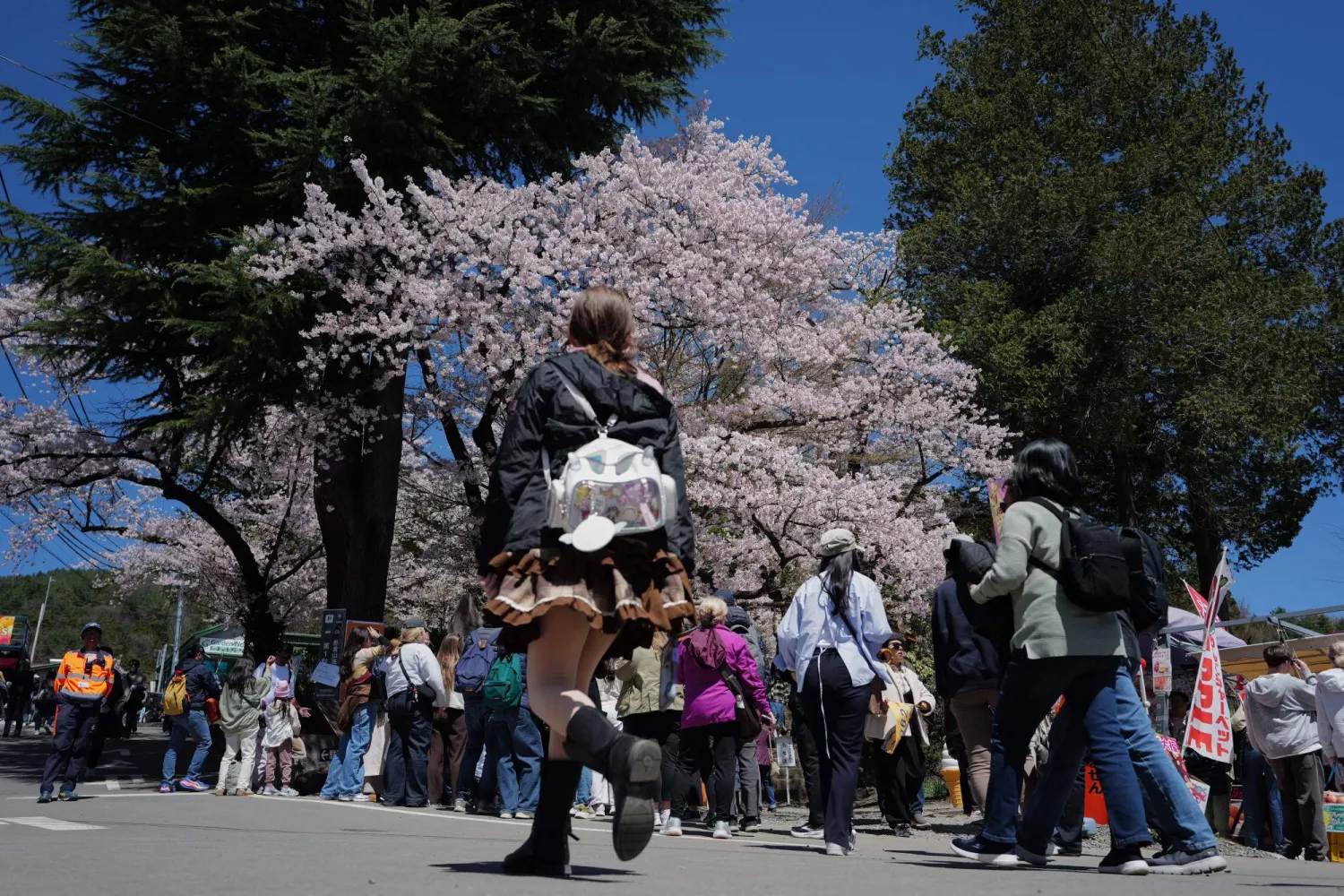
Foreign and Japanese visitors arrive at the entrance of Arakurayama Sengen Park Wednesday, April 8, 2026, in Fujiyoshida, Yamanashi Prefecture, west of Tokyo. (AP Photo/Eugene Hoshiko)
TT

Japanese Town Sours on the Crowds Coming to See Cherry Blossoms and Mount Fuji

Foreign and Japanese visitors arrive at the entrance of Arakurayama Sengen Park Wednesday, April 8, 2026, in Fujiyoshida, Yamanashi Prefecture, west of Tokyo. (AP Photo/Eugene Hoshiko)

The trouble started with a beautiful photo.

Social media was soon awash with the lovely view of Japan's snow-capped Mount Fuji looming over a red pagoda and the short-lived cherry blossoms that herald the approach of spring.

Tourists wanting a similar shot soon packed this peaceful town at the foot of the mountain. The complaints were not far behind: chronic traffic jams; piles of litter; ill-mannered foreigners knocking on doors of private homes to borrow toilets; tourists relieving themselves in front yards.

It got so bad officials in Fujiyoshida announced in February that they were canceling this year’s annual cherry blossom festival, which started as a way to promote tourism a decade ago.

What locals are calling “tourism pollution” has illuminated a broader problem for Japan: As the country's economic malaise deepens, officials are eager for the economic boost of increased tourism, even as local communities find themselves entirely unprepared for what a small army of foreign visitors means for their communities.

10,000 tourists a day 'threaten residents' daily lives' “This area is primarily an ordinary residential neighborhood, where balancing (tourism) with the safety of people's living environment has become difficult,” Masatoshi Hada, manager of the Fujiyoshida Economics and Environment Department, told The Associated Press. “We decided not to promote a festival that would invite more visitors.”

Even without the festival, foreign tourists packed the area on a sunny day in early April when cherry blossoms reached their prime. The narrow streets up to the popular Arakurayama Sengen Park were filled as the visitors lined up for a chance film the world-famous panoramic views.

In recent years, foreign tourists have exceeded 10,000 per day in the area, something that has “threatened residents’ daily lives,” the city said in a statement in February.

‘Tourism pollution’ across Japan Overtourism has also been seen in other popular destinations in Japan, like Kyoto and Kamakura. In Kyoto, locals complain of tourists with large suitcases clogging city buses.

“Tourism pollution” comes as Japan confronts a rapidly growing population of foreign workers brought in as the country's population dwindles and ages. The combination has led to xenophobia, and Prime Minister Sanae Takaichi ’s nationalistic government has proposed tougher rules on foreigners.

Even as it promises to address overtourism concerns, the government wants to boost the current level of 40 million inbound tourists to 60 million visitors by 2030.

Locals find the tourism ‘good but annoying’ Beginning April 1, at the start of the region’s cherry blossom season, Fujiyoshida increased its security guards and restricted entry of tour buses and vehicles into the scenic neighborhood, requiring visitors to reach the park on foot.

On a recent day, security guard Hiroaki Nagayama gestured to passersby so they would stay out of busy areas. He asked tourists to throw cigarette butts in designated places and tried to help the lost.

“I’m struggling. I cannot communicate with them in Japanese. Some people buy food at stalls and leave litter behind,” Nagayama says. “I think what’s happening here is a typical example of overtourism.”

Sitting on a bench outside his house just a couple of blocks away, Hitoshi Mori, 93, says having many visitors is “good but annoying.”

“It’s too crowded outside so I can only get groceries once a week and stock up on food,” he says.

Tourists enjoy the view and culture, despite crowds Tourists, meanwhile, seem delighted by the spectacular view, despite many signs popping up that order them to behave better. There are also hours-long lines to get to cherished scenic spots.

“It’s pretty (well) organized. When they let you come in, you have like five minutes to take as many pictures as you can, and it was amazing,” said Lisa Goerdert from Paris.

Vicky Tran, who came from Melbourne, Australia, with her family and friends, said they could not go all the way up to see the pagoda with Mount Fuji and the cherry blossoms, because it was too crowded. Still, she said she enjoyed the view and the neighborhood.

Overtourism dividing residents The overtourism has opened divisions between residents who want quiet and those who have started businesses using their yards to operate toll parking or setting up new shops or food stalls.

In a nearby shopping arcade that once had many closed mom-and-pop shops, business has picked up after another viral social media shot showed Mount Fuji looming over the street.
Throngs of tourists stand in the street to take photos of Mount Fuji, often blocking traffic, with frustrated vehicles honking.

The sudden flood of visitors is a huge change “for people like us who are used to a quiet suburban lifestyle,” says Masami Nakamura, who runs a decades-old school uniform shop with her husband. “I only hope the tourists respect our rules and manners.”

The crowds are a big change even for those who are seeing increased business.

“I once almost hit a tourist who jumped into the street without looking,” said Kyoko Funakubo, a 60-year-old employee at a local hotel and a part-time vendor selling Fuji-themed souvenirs. “This place used to be almost abandoned, with many shuttered shops. But now, with many stores reopened or new shops that have opened, I feel good seeing this area come alive again.”



Scientists: World's Oldest Octopus Fossil Isn't an Octopus after All

FILE -Field Museum and Chicago's skyline is seen from Soldier Field prior to an NFL preseason football game between the Chicago Bears and the Tennessee Titans, Aug. 12, 2023, in Chicago. (AP Photo/Kamil Krzaczynski, File)
TT

Scientists: World's Oldest Octopus Fossil Isn't an Octopus after All

FILE -Field Museum and Chicago's skyline is seen from Soldier Field prior to an NFL preseason football game between the Chicago Bears and the Tennessee Titans, Aug. 12, 2023, in Chicago. (AP Photo/Kamil Krzaczynski, File)

A 300-million-year-old tentacled sea creature has lost its crown as the world’s oldest octopus, after scientists found evidence that it’s not an octopus at all.

Newly published research concludes that fossilized remains listed by Guinness World Records as the earliest known octopus belong instead to a relative of a nautilus, a cephalopod with both tentacles and a shell, The Associated Press reported.

University of Reading zoologist Thomas Clements, the lead researcher behind the new findings, said the fossil, Pohlsepia mazonensis, has long been the subject of scientific debate.

“It’s a very difficult fossil to interpret,” he said. “To look at it, it kind of just looks like a white mush.

“If you look at it and you are a cephalopod researcher and you’re interested in everything octopus, it does superficially look a lot like a deep-water octopus.”

The creature, a blob about the size of a human hand, was found in the Mazon Creek area of Illinois, about 50 miles southwest of Chicago, that is rich in fossils from a period before dinosaurs walked the Earth.

Its identification by paleontologists as an octopus in 2000 upended ideas about the evolution of the eight-tentacled cephalopods, suggesting they emerged much earlier than previously thought. The next oldest-known octopus fossil is only about 90 million years old.

“It’s a huge gap,” Clements said. “And so that big gap got researchers sort of questioning, ‘Is this thing actually an octopus?”

To solve the mystery of the “weird blob,” Clements and his team used a synchrotron — which uses fast-moving electrons to create beams of light brighter than the sun — to look inside the fossil rock. They found a ribbon of teeth known as a radula that is common to all mollusks, including nautiluses and octopuses. Each row had 11 teeth. Octopuses have either seven or nine.

“This has too many teeth, so it can’t be an octopus,” Clements said. “And that’s how we realize that the world’s oldest octopus is actually a fossil nautilus, not an octopus.”

The teeth matched those of a fossil nautiloid called Paleocadmus pohli that had been found in the same area. Clements said the mistaken identification may have happened because the creature decomposed and lost its telltale shell before it was fossilized, complicating identification.

As a result of the findings published this week in the journal Proceedings of the Royal Society B, Guinness World Records said it will no longer list Pohlsepia mazonensis as the earliest known octopus.

Managing Editor Adam Millward said the scientists had made “a fascinating discovery.”

“We will be resting the original ‘oldest octopus fossil’ title and look forward to reviewing this new evidence,” he said.

Pohlsepia mazonensis is named for its discoverer James Pohl, and is in the collection of the Field Museum in Chicago.

Clements said the museum should not be disappointed by the new evidence, which means it now has “the oldest soft tissue nautilus in the world.

“The Field Museum have a small collection of these ancient nautiluses, which I think as a cephalopod worker is probably the best thing ever,” he said.

The museum has been approached for comment.


Saudi Arabia: AlUla Advances to 85th Place in IMD Smart City Index 2026

AlUla seeks to become an ideal destination for living, working and visiting. SPA
TT

Saudi Arabia: AlUla Advances to 85th Place in IMD Smart City Index 2026

AlUla seeks to become an ideal destination for living, working and visiting. SPA

AlUla has recorded the highest improvement in the IMD Smart City Index 2026, advancing from 112th place in 2025 to 85th this year, placing it among the most improved cities globally in this edition of the index.

This result reflects AlUla's ambition to become an ideal destination for living, working and visiting.

This achievement is a continuation of the comprehensive and sustainable development objectives pursued by the Royal Commission for AlUla (RCU) since its establishment, and in line with the AlUla vision, which targets the development of infrastructure, improvement of services, and enhancement of quality of life for the people and residents of AlUla, whilst preserving the unique natural and cultural environment of the governorate.

This year's edition of the index measures city performance across key pillars including quality of life, service efficiency, technology, environmental sustainability, and smart governance.

These pillars are central to the commission's priorities and are being continuously advanced in partnership with stakeholders across the public and private sectors.

On the quality of life front, RCU continues to develop services for the people and residents of AlUla, spanning education, healthcare, infrastructure, and public utilities, within an approach that balances urban development requirements with the preservation of the destination's identity.

Sustainability also serves as a foundational pillar within the comprehensive development framework for the governorate. In this regard, RCU has announced the lifting of the suspension on land sales and transactions in central and southern AlUla, a strategic step that opens the door for citizens and investors to participate in real estate activities within a regulated environment.

On the education front, RCU has established an integrated system that encompasses a language institute offering instruction in five languages, a scholarship program that has benefited more than 690 students, teacher qualification programs in which more than 800 educators have enrolled, and community activities that have engaged approximately 7,400 students.

In the area of transport, RCU has completed the expansion of AlUla International Airport, increasing its annual passenger capacity from 400,000 to 700,000, doubling the number of passport control lanes, and integrating smart technologies to enhance the passenger experience, alongside the introduction of smart mobility solutions within the governorate.

RCU continues to develop infrastructure through the construction of power stations and water storage facilities, as well as the enhancement of public utilities, all within the framework of the second masterplan, "Path to Prosperity", which aims to elevate quality of life and advance community development

This progress aligns with the objectives of Saudi Vision 2030 and reflects the accelerating transformation AlUla is undergoing across urban development and sustainability, supporting its ambitions to establish itself as a leading international cultural and tourism destination, and contributing to its growing presence on global smart city rankings.


Argentine MPs Approve Bill to Allow Mining in Glaciers

FILE PHOTO: A general view of the Perito Moreno glacier, near the city of El Calafate in the Patagonian province of Santa Cruz, Argentina April 21, 2025. REUTERS/Bernat Parera/File Photo
TT

Argentine MPs Approve Bill to Allow Mining in Glaciers

FILE PHOTO: A general view of the Perito Moreno glacier, near the city of El Calafate in the Patagonian province of Santa Cruz, Argentina April 21, 2025. REUTERS/Bernat Parera/File Photo

Argentine MPs approved a bill early Thursday promoted by President Javier Milei that authorizes mining in ecologically sensitive areas of glaciers and permafrost, and has outraged environmentalists.

The amendment to the so-called Glacier Law, which was already approved by the Senate in February, would make it easier to mine for metals such as copper, lithium and silver in frozen parts of the Andes mountains, said AFP.

The Chamber of Deputies, Argentina's lower house of Congress, approved the amendment with 137 votes in favor, 111 against and three abstentions after nearly 12 hours of debate.

Environmentalists say the reforms will weaken protections for crucial water sources.

Thousands of people took part in a demonstration on Wednesday afternoon outside parliament, marked by isolated skirmishes with police.

Some held aloft banners with slogans such as "Water is more precious than gold!" and "A glacier destroyed cannot be restored!"

Seven Greenpeace activists were arrested earlier in the day after scaling a statue outside parliament and unfurling a banner urging lawmakers "not to betray the Argentine people."

The passage of the amendment is a new coup for Milei, who pushed through looser labor laws in February despite repeated street protests.

Nicolas Mayoraz, an MP from Milei's ruling La Libertad Avanza party, assured lawmakers that combining "environmental protection and sustainable development is possible."

Environmental activist Flavia Broffoni rubbished the government's position.

"The science is clear...there is absolutely no possibility of creating what they (the government) call a 'sustainable mine' in a periglacial environment," she told AFP after addressing the protest outside parliament.

- Lithium race -

There are nearly 17,000 glaciers or rock glaciers -- a mix of rock and ice -- in Argentina, according to a 2018 inventory.

In the northwest of the country, where mining activity is concentrated, glacial reserves have shrunk by 17 percent in the last decade, mainly due to climate change, according to the Argentine Institute of Snow Science, Glaciology and Environmental Sciences.

Milei, a free-market radical who does not believe in man-made climate change, argues the bill is necessary to attract large-scale mining projects.

Argentina is a major producer of lithium, which is critical to the global tech and green energy sectors.

The Central Bank has estimated, based on industry forecasts, that the country could triple its mining exports by 2030.

"Environmentalists would rather see us starve than have anything touched," Milei has argued.

Supporters of the reform argue that it will clear up ambiguities in the current law, from 2010, on which periglacial areas -- areas on the edges of glaciers -- can be economically developed.

"We want legal certainty, we want clear definitions," Michael Meding, director of the Los Azules copper mining project in San Juan, told AFP.

Enrique Viale, president of the Argentine Association of Environmental Lawyers, told AFP that the reform threatened the water supply of "70 percent" of Argentines.

Under the current law, a scientific body designates protected glaciers and periglacial environments.

The reform would give individual provinces more powers to decide which areas need protection and which can be exploited for economic purposes.

It has been backed by the governors of northern Andean provinces with strong mining sectors, namely Mendoza, San Juan, Catamarca and Salta.