


4 Dead, 38 Rescued during Attempted Channel Crossing from France to UK

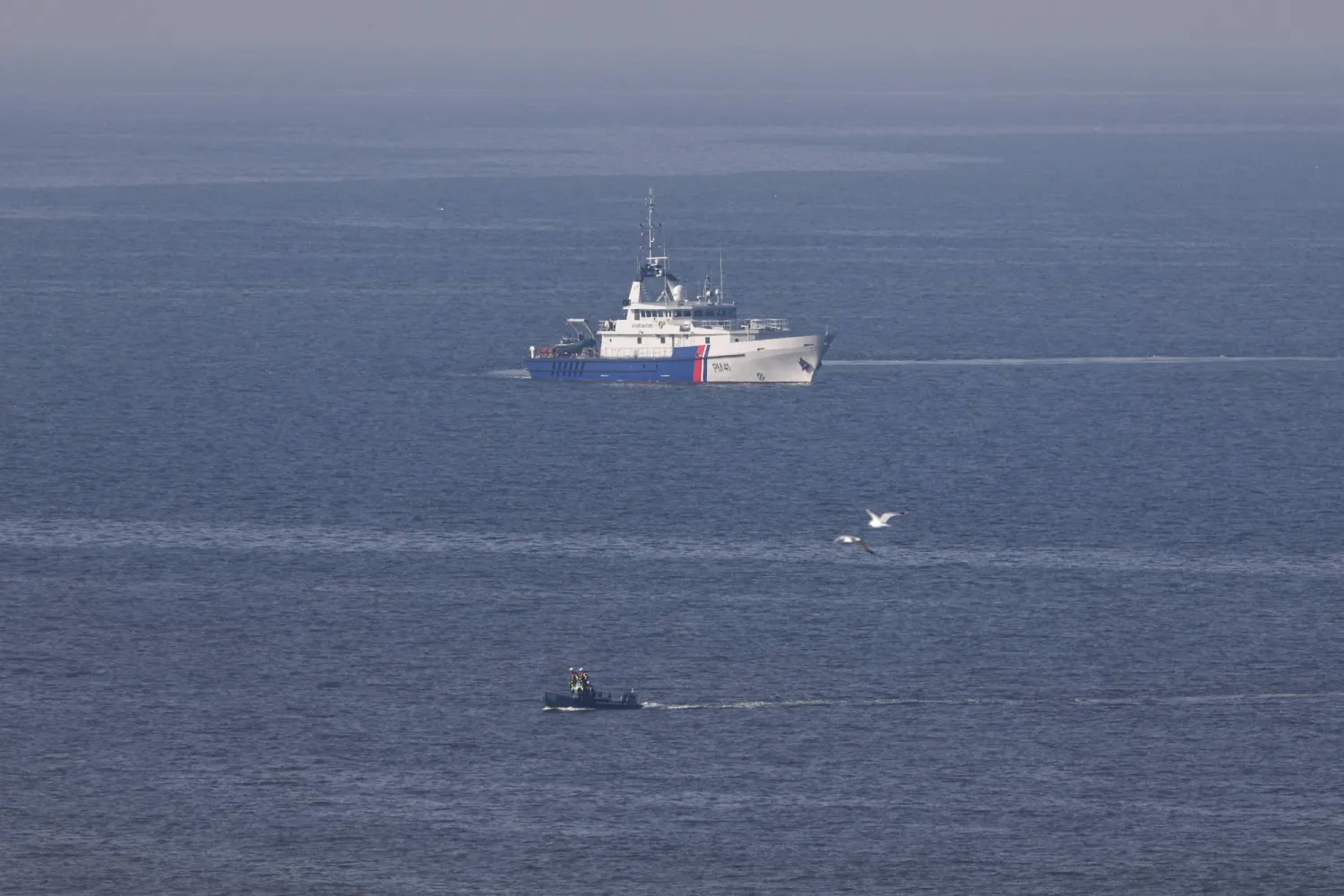
A vessel from the Maritime Affairs Department is sailing off France's Pas-de-Calais northern coastal city of Equihen-Plage after an attempt to cross the English Channel illegally turned tragic with several migrants found in cardiac arrest, on April 9, 2026. (Photo by Sameer AL-DOUMY / AFP)
TT

4 Dead, 38 Rescued during Attempted Channel Crossing from France to UK

A vessel from the Maritime Affairs Department is sailing off France's Pas-de-Calais northern coastal city of Equihen-Plage after an attempt to cross the English Channel illegally turned tragic with several migrants found in cardiac arrest, on April 9, 2026. (Photo by Sameer AL-DOUMY / AFP)

French authorities said that at least four people, two men and two women, died on Thursday as they were trying to get onboard an inflatable boat to attempt the perilous sea crossing from northern France to the UK. 

The prefect of the Pas-de-Calais region in northern France, François-Xavier Lauch, said 38 others were rescued, including one whose condition involved medical emergency. He spoke while rescue operations were still ongoing on Equihen Beach on Thursday morning. 

Lauch said migrants were carried away by dangerous currents as they were trying to embark on a “taxi-boat,” the name authorities use for small motorized boats, usually inflatable, used by traffickers to pick up people along large stretches of the northern French coast, The Associated Press said. 

Thursday's incident happened along a broad expanse of sand, backed by dunes and a forest where people attempting the perilous crossing hide out, sometimes for days at a time, as they wait for boats and suitable weather and sea conditions. Police patrol on buggies and keep watch from the remains of World War II-era bunkers but cannot prevent all departures on a beach so long. 

Attempted crossings and deaths have surged in recent days. French maritime authorities said Wednesday 102 people have been rescued in two separate operations while trying to cross the channel. Last week, two people died in a similar incident off the coast north of Calais. 

Unlike inflatable boats that migrants carry themselves into the water, so-called “taxi boats” set off largely empty from secluded spots along the coast and pick up migrants from prearranged rendezvous areas on beaches. 

An Associated Press reporter attended such scenes on Wednesday in Malo-les-Bains, near Dunkirk. 

Migrants wade into the sea, with adults carrying children in their arms or on their shoulders, then clamber aboard the inflatables that wait offshore. Once loaded up, they set off on the cross-channel journey, sometimes picking up more people along the way. 

Depending on tides, weather and police patrols, migrants sometimes have to wade far from the water’s edge, up to their torsos, to reach the boats, increasing the risk of losing their footing, being caught by currents, or wading too deep. 

Campaign groups for migrant rights have long warned that increasingly vigorous efforts by French police to prevent boat departures from beaches, including using knives to hack and puncture inflatable boats to render them unusable, are encouraging the use of “taxi boats,” which increases the risks of drownings, injuries and the need for rescues. 


Tehran: More Than 3,000 Iranians Killed During War

Men walks past an anti-USA and anti-Israel mural, in Tehran on April 8, 2026. (Photo by ATTA KENARE / AFP) /
TT

Tehran: More Than 3,000 Iranians Killed During War

Men walks past an anti-USA and anti-Israel mural, in Tehran on April 8, 2026. (Photo by ATTA KENARE / AFP) /

More than 3,000 people were killed throughout Iran during the war ⁠that began on February ⁠28, Iran's forensic chief ⁠told state media on Thursday, adding that 40% of the dead needed forensic work ⁠to be ⁠identified and returned to families.

Semiofficial news agencies in Iran published a chart suggesting the country’s Revolutionary Guard put sea mines into the Strait of Hormuz during the war, as uncertainty hangs over a two-week ceasefire and further negotiations are expected in Pakistan.

The shaky ceasefire has been largely holding between the US, Israel and Iran, although Tehran and Washington have offered vastly different explanations of the initial terms.

The chief of Iran’s nuclear agency said that protecting Tehran’s right to enrich uranium is “necessary” for any ceasefire talks with the United States.

Mohammad Eslami, who leads the Atomic Energy Organization of Iran, made the remarks to journalists in Tehran during commemorations for the late Supreme Leader Ali Khamenei.


French Military Chief Says Possible War with Russia His 'Primary Concern'

General Chief of Staff of the French armed Forces Fabien Mandon delivers remarks during the Paris Defense Strategy Forum at the Ecole Militaire (military school) in Paris on March 24, 2026. (Photo by STEPHANE DE SAKUTIN / AFP)
TT

French Military Chief Says Possible War with Russia His 'Primary Concern'

General Chief of Staff of the French armed Forces Fabien Mandon delivers remarks during the Paris Defense Strategy Forum at the Ecole Militaire (military school) in Paris on March 24, 2026. (Photo by STEPHANE DE SAKUTIN / AFP)

France's top general on Thursday said the possibility of a war with Russia in the next few years remained his "primary concern" as he defended efforts to ramp up defense spending.

The chief of the defense staff General Fabien Mandon spoke in parliament as he presented France's draft legislation to boost defense spending between 2024 and 2030.

"The persistence of a Russian threat on our continent, with the possibility of an open war, remains my primary concern in terms of military preparedness," Mandon told the defense committee of parliament's lower house during a hearing devoted to the updated military programming draft law, said AFP.

According to the draft legislation unveiled by the government on Wednesday, 36 billion euros ($42 billion) were to be added to France's defense spending, on top of the 413 billion euros ($483 billion) allocated for the period of 2024 to 2030.

Russia and Ukraine have been at war since Moscow in 2022 launched the full-scale invasion of its neighbor.

European powers, including France, have backed Ukraine with increasing supplies of weapons but have always insisted they are not directly involved in the conflict.

Citing intelligence estimates, Mandon said Russia was expected to have a bigger army and more weapons by 2030.

Russia is projected to have 1.9 million-strong army by 2030, up from 1.3 million last year, he said.

The number of Russian heavy tanks was set to rise to 7,000 in 2030 from 4,000 in 2025, while the number of combat vessels in the Russian navy was expected to be between 230 and 240, Mandon added.

"This is... based on intelligence," Mandon said. "This military planning law is crucial for the defense of our fellow citizens".

"We are in a dangerous period. We must not cause alarm, but simply raise awareness because we need this defense investment," he added.

In November, Mandon warned France must be ready to "lose its children" against the background of the threat posed by Russia, sparking an outcry.

"An unrestricted use of force" and a "terrorist threat" in the Middle East, Asia and Africa also justified the ramping up of the defenses, Mandon said, pointing to Washington's wavering commitment to Europe.

"We can no longer have the same level of confidence in the Americans' commitment to our security", he said, adding however that dialogue with US military officials remained of "high quality."


Iran Publishes Chart Showing It May Have Put Sea Mines in Strait of Hormuz as Shaky Ceasefire Holds

TOPSHOT - First responders stand amid rubble at the site of an Israeli airstrike in Beirut's Corniche al-Mazraa neighborhood on April 8, 2026.  (Photo by AFP)
TOPSHOT - First responders stand amid rubble at the site of an Israeli airstrike in Beirut's Corniche al-Mazraa neighborhood on April 8, 2026. (Photo by AFP)
TT

Iran Publishes Chart Showing It May Have Put Sea Mines in Strait of Hormuz as Shaky Ceasefire Holds

TOPSHOT - First responders stand amid rubble at the site of an Israeli airstrike in Beirut's Corniche al-Mazraa neighborhood on April 8, 2026.  (Photo by AFP)
TOPSHOT - First responders stand amid rubble at the site of an Israeli airstrike in Beirut's Corniche al-Mazraa neighborhood on April 8, 2026. (Photo by AFP)

Semiofficial news agencies in Iran published a chart Thursday suggesting the country’s paramilitary Revolutionary Guard put sea mines into the Strait of Hormuz during the war, in a message that may be intended to pressure the US as uncertainty hangs over a days-old two-week ceasefire and further negotiations are expected in Pakistan.

The shaky ceasefire has been largely holding between the US, Israel and Iran, although Tehran and Washington have offered vastly different explanations of the initial terms, The Associated Press said.

Israel insists the agreement does not apply to their war against Hezbollah militants in Lebanon and have escalated deadly strikes there, leading Iran to claim it is violating the deal. Meanwhile, Iran said it had won agreement that it would control the Strait of Hormuz, charge tolls and enrich uranium — while Trump said the deal called for the strait to be reopened and Iran to hand over its uranium stockpile.

The chart of the Strait of Hormuz was released by the ISNA news agency, as well as Tasnim, which is believed to be close to the Guard. They showed a large circle marked “danger zone” in Farsi over the Traffic Separation Scheme, which was the route ships take through the strait, the narrow mouth of the Arabian Gulf through which 20% of all oil and natural gas traded once passed.

The chart suggested ships travel further north through waters closer to Iran’s mainland near Larak Island, a route that some ships were observed taking during the war. It was dated from Feb. 28 until Thursday, April 9, and it was unclear if the Guard had cleared any mining on the route since then.

Oil rose again to above $97 a barrel and Asian stocks were trading lower Thursday on skepticism over the ceasefire. Brent crude, the international standard, was up 2.9% to $97.46 per barrel. It had fallen briefly to below $92 following the temporary ceasefire announcement. Benchmark US crude was 3.7% higher Thursday at $97.94 per barrel.

Ship-tracking data from Kpler showed only four vessels with their Automatic Identification System trackers on passed through the Strait of Hormuz on Wednesday, the first day of the ceasefire. However, that does not include so-called “dark fleet” vessels, which travel with their AIS trackers turned off. Many of those “dark fleet” ships carry sanctioned Iranian crude oil out to the open market.

Trump says US forces will remain in the area

US President Donald Trump posted a statement insisting that his surge of warships and troops will remain around Iran “until such time as the REAL AGREEMENT reached is fully complied with.”

Trump’s comments on his Truth Social platform appeared to be a way to pressure Iran.

“If for any reason it is not, which is highly unlikely, then the ‘Shootin’ Starts,’ bigger, and better, and stronger than anyone has ever seen before,” Trump wrote.

He also insisted Iran would not be able to build nuclear weapons and “the Strait of Hormuz WILL BE OPEN & SAFE.”

The US and Iran both claimed victory after reaching the ceasefire agreement, and world leaders expressed relief. But more drones and missiles hit Iran and Gulf Arab countries after the deal was announced.

Israel also intensified its attacks on the Hezbollah militant group in Lebanon on Wednesday, hitting commercial and residential areas in Beirut. At least 182 people were killed in the deadliest day of fighting there. First responders searched overnight for missing people still under the rubble after the deadly Israeli strikes.

A fragile ceasefire

The violence threatened to scuttle what US Vice President JD Vance called a “fragile” deal.

Iran's parliament speaker said Wednesday that planned talks were “unreasonable” because Washington had broken three of Tehran’s 10 conditions for an end to the fighting. In a social media post, Mohammad Bagher Qalibaf objected to Israeli attacks on Hezbollah, an alleged drone incursion into Iranian airspace after the ceasefire took effect and US refusal to accept any Iranian enrichment capabilities in a final agreement.

Iranian Foreign Minister Abbas Araghchi insisted that an end to the war in Lebanon was part of the ceasefire deal, but Israeli Prime Minister Benjamin Netanyahu and Trump said the truce did not cover Lebanon. When the deal was announced, the prime minister of Pakistan, which served as a mediator, said in a social media post that it applied to “everywhere including Lebanon and elsewhere.”

A New York-based think tank warned the ceasefire “hovers on the verge of collapse.”

The Soufan Center said Israel's strikes on Lebanon on Wednesday added to the risk the deal would fall apart.

“Even if Lebanon was formally outside the deal, the scale of Israel’s strikes was likely to be viewed as escalatory, nonetheless,” it wrote in an analysis published Thursday. “Israel’s strikes can be understood both as an effort to drive a wedge between Iran and its proxies and as a response to being allegedly sidelined in the original ceasefire discussions.”

Peace talks expected in Pakistan

The White House said that Vice President JD Vance would lead the US delegation to talks in Islamabad aimed at ending the war, which are set to start Saturday.

Iran’s negotiating team will arrive in Islamabad on Thursday night, the Iranian ambassador there said.

Reza Amiri Moghadam wrote on X that the “Iranian delegation arrives tonight in Islamabad for serious talks based on 10 points proposed by Iran,” without identifying who was on the Iranian team.

Those points include Iran enriching uranium, maintaining its control of the Strait of Hormuz and other issues that have been nonstarters in the past for Trump. The White House has repeatedly described the 10 points issued by Iran as false.

Moghadam wrote that the Iranians would come to Islamabad despite “skepticism of Iranian public opinion due to repeated ceasefire violations by Israeli regime to sabotage the diplomatic initiative,” likely referring to Israel’s strikes on Lebanon, which Israel and the US have said wasn’t included in the shaky ceasefire.
