


Hormuz Under Insurance Pressure as ‘War Premiums’ Violate Int’l Laws

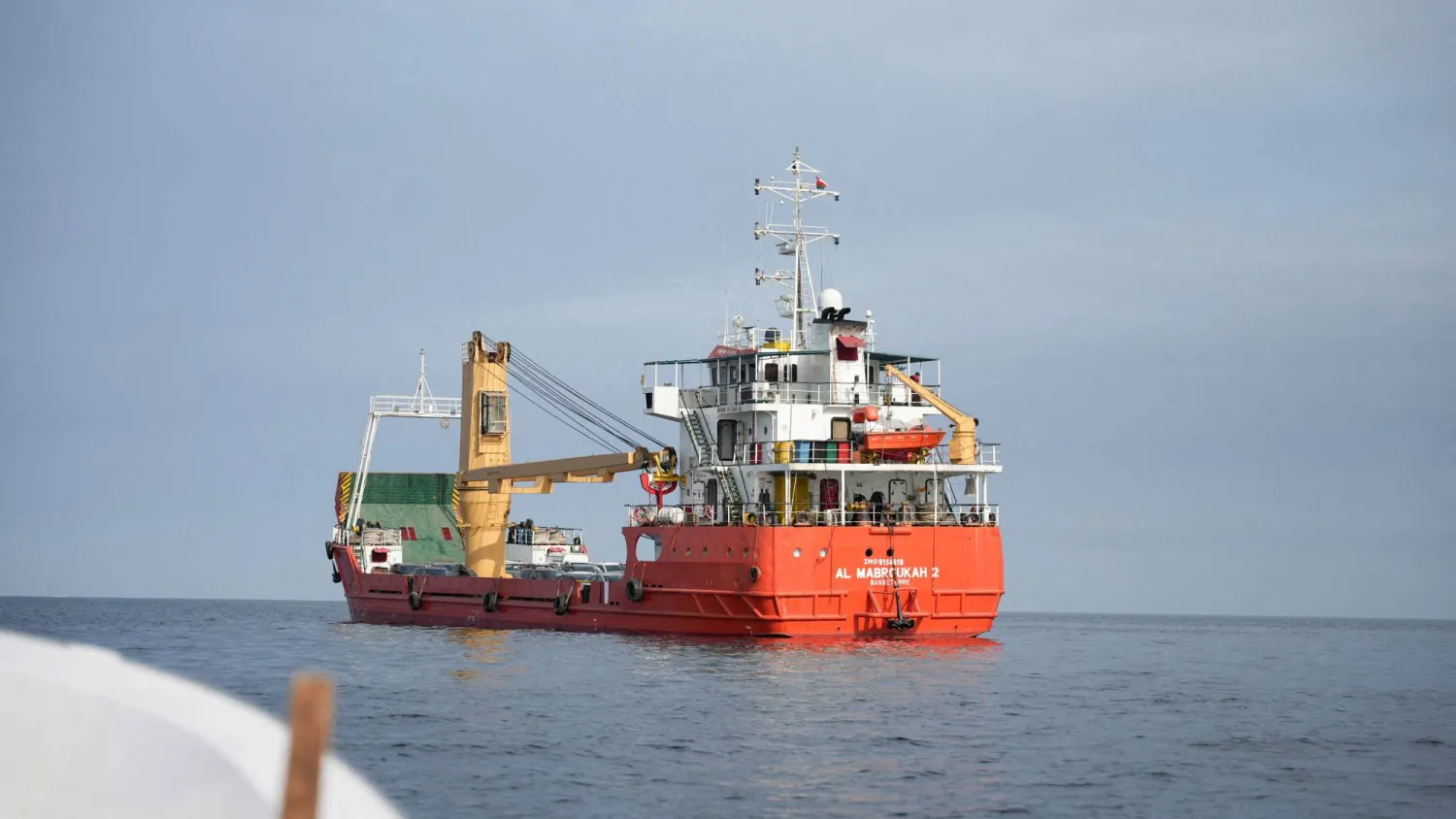
A vessel at the Strait of Hormuz, off the coast of Oman’s Musandam province, April 12, 2026. (Reuters)
TT

Hormuz Under Insurance Pressure as ‘War Premiums’ Violate Int’l Laws

A vessel at the Strait of Hormuz, off the coast of Oman’s Musandam province, April 12, 2026. (Reuters)

As military tensions flare in the Strait of Hormuz, another battle is unfolding behind the scenes, one no less dangerous. Insurance companies have emerged as key players shaping the fate of global shipping.

With premiums surging to unprecedented levels, experts told Asharq Al-Awsat the world is approaching a “moment of truth.”

The closure of the waterway threatens not only oil flows, but also bread supplies in the world’s poorest countries, while putting the international legal framework that protects trade at risk of collapse.

War risk insurance premiums in the Strait have jumped to between 1% and 7.5% of vessel value, up from less than 1% before attacks escalated. In practical terms, insurance for a single voyage of a large oil tanker worth $100 million can now range between $2 million and $9 million, compared with about $250,000 before tensions intensified.

Rabih El-Amine, head of the Lebanese Executives Council, said the Strait of Hormuz is no longer just a narrow maritime passage, about 21 miles wide, but “it has become the single lung through which the global economy breathes.”

“When that lung is threatened, it is not only oil that suffocates, but food, medicine, and hope as well,” he told Asharq Al-Awsat.

He added that the situation is alarming, not just on a theoretical level, but because its consequences are already affecting companies and markets, with marine insurance premiums rising by 30% to 120% in a matter of months.

When major insurers withdraw entirely from covering vessels forced to transit the Strait, it signals not only higher costs, but a breakdown in the entire system of commercial trust, he warned.

Numbers tell the story

El-Amine said more than 230 loaded oil tankers are currently waiting for clearance to pass through the Strait and are unable to depart.

The International Energy Agency has described the situation as the largest disruption to oil supply in the global market's history. Natural gas prices in Europe have surged by more than 70%, while jet fuel prices have climbed 95%, forcing some European airports to ration fuel.

Some estimates suggest oil could approach $200 per barrel if the closure persists.

Yet El-Amine warned that wheat and fertilizers are an even greater concern. The Gulf region is not only a global energy hub, but also a key supplier for global agriculture, with 35% of global urea exports passing through the Strait.

India imports 70% of its needs from the region. Urea prices have jumped 26% to $585 per ton, a level not seen in years.

“When fertilizer prices rise, bread prices follow,” he said. “The heaviest burden is not borne by European or American farmers, but by poor families in Africa and South Asia, where an estimated 45 million people are now on the brink of acute food insecurity.”

He added that geopolitical crises carry costs that are unevenly distributed, as negotiators debate strategic interests behind closed doors while poorer nations face soaring commodity prices.

He stressed the need for insurers, companies, and governments to shift from crisis response to disaster prevention, calling for a flexible regional insurance system, emergency financing mechanisms, and dialogue channels that prioritize food and energy security over other considerations.

Testing the legitimacy of the international system

Saeed Salam, director of the Vision Center for Strategic Studies, said the current crisis in the strait has evolved beyond a military confrontation into a test of the legitimacy of the international system.

“The precise calculations of global insurance companies have become the real driver of trade flows, outweighing international laws and agreements,” he told Asharq Al-Awsat.

According to Salam, the escalation that began in late February, followed by Iran’s closure of the strait and attacks on 19 to 20 commercial vessels that did not comply with its transit conditions, has created a state of comprehensive “economic shutdown.”

Insurance costs have risen sharply due to unprecedented risks, making navigation through Hormuz commercially unviable.

Tankers have been forced to seek longer, more expensive alternative routes, while major powers and international actors attempt to secure supply flows through exceptional interventions that have so far failed to restore confidence.

Salam said this reality undermines the maritime legal system established in 1982, exposing a wide gap between the legal right of transit passage and the threats imposed by Tehran, which he said is attempting to reshape the rules of engagement in the region.

He added that the involvement of major powers in providing government guarantees to vessels further complicates the situation, giving commercial shipping a direct political dimension and turning ships into targets in conflicts they have no stake in.

This, he warned, could fragment the global maritime system into competing spheres of influence governed by power and coercion rather than freedom of trade.

At the same time, competition among global powers has extended into the insurance and technological domains.

While Western systems attempt to manage risk at high cost, China has begun offering parallel guarantees for vessels linked to it, potentially dividing the world into rival insurance blocs aligned with geopolitical agendas.

Salam pointed to cyber threats as the most dangerous emerging front. Maritime mines are no longer the only concern, he said, as digital systems that manage ports and control vessels have become vulnerable to disruptions that can halt global supply chains within moments, risks not covered by traditional insurance contracts.

Salam said the failure of the Islamabad talks signals a prolonged period of uncertainty. Companies will need to move beyond financial hedging and adopt hybrid strategies that combine insurance, cybersecurity, and strategic alliances to navigate these risks.

“The era of safe, internationally guaranteed navigation is over,” he said. “The world is entering a new reality where threat itself becomes the governing rule in the Strait.”

He added that companies that survive will be those with high flexibility and the ability to anticipate risks, while passive waiting is a gamble that could push the global system into inevitable stagflation, at a time when securing trade routes has become the only benchmark for sustaining production and growth.


Saudi CEDA Reviews Vision 2030 Progress

Buildings are seen in Riyadh, Saudi Arabia, December 18, 2017. REUTERS/Faisal Al Nasser 
TT

Saudi CEDA Reviews Vision 2030 Progress

Buildings are seen in Riyadh, Saudi Arabia, December 18, 2017. REUTERS/Faisal Al Nasser 

Saudi Arabia’s Council of Economic and Development Affairs (CEDA) held a virtual meeting to consider a package of strategic reports outlining the Kingdom’s economic and development trajectory.

The council issued the 2025 annual report on Saudi Vision 2030, showing clear progress across its three pillars — a vibrant society, a thriving economy and an ambitious nation — while underscoring the resilience of the national economy, supported by prudent fiscal policies and solid logistics infrastructure.

The report highlighted qualitative advances during the Vision’s second phase, reflecting its flexibility and ability to adapt to changing conditions in line with its third phase. It emphasized efforts to build on gains achieved in the first two phases and accelerate implementation by sharpening priorities and advancing national programs and strategies.

Resilience amid global developments

CEDA also discussed the monthly report from the Ministry of Economy and Planning, which covered global economic developments and growth prospects in light of current regional events and their repercussions for both major and emerging economies.

The report examined the impact of geopolitical tensions on Gulf economies and supply chains, as well as their potential implications for Saudi Arabia’s economic and financial outlook. It pointed to the Kingdom’s “exceptional resilience,” supported by strong economic and fiscal policies and robust logistics infrastructure.

Public sector performance

The council reviewed a presentation by the National Center for Performance Measurement of Public Agencies (Adaa) on its 2025 annual performance report. The findings showed continued positive performance by government entities in meeting targets, reflecting stable delivery and efficient execution.

The report also outlined the center’s work in strengthening the measurement of national strategies and reviewing strategic documents to ensure that indicators and initiatives fully cover all objectives. It included results from the latest evaluation cycle of performance management practices across public entities.

CEDA also discussed a presentation by the National Center for Privatization (NCP), highlighting key results for the second half of 2025, including the performance of supervisory committees and progress on major projects. The presentation showed improved overall performance and an increase in the number of privatization projects during the period.

Grand Mosque services and infrastructure

The council discussed a presentation by the Royal Commission for Makkah City and Holy Sites on projects in the central area of the Grand Mosque in Makkah. The briefing addressed the use of advanced technologies to monitor and manage waste, measures to facilitate the movement of vehicles and goods into the central area, and steps to enhance safety procedures and intensify oversight of expansion projects to ensure the safety of worshippers.

It also outlined a three-year plan covering systems related to health, safety, security and the environment.

Governance and policy updates

Moreover, CEDA saw a report on the updated national framework for governance, risk, compliance and internal audit functions, including its pilot application across selected government entities, proposals for broader implementation and mechanisms to measure compliance.

The council also considered a number of procedural matters, including a draft national intellectual property policy.

It was briefed on the semiannual report of the ministerial committee on social support and subsidies, as well as updates from the committee on improving the balance of payments and advancing economic diversification.

Further briefings included a monthly report on progress in implementing the executive plan to host regional headquarters of international organizations, a quarterly report from the standing committee for price monitoring, and summaries of the latest consumer price index and wholesale price index reports, along with the underlying data.


1st SKorean Tanker Transits Saudi Arabia’s Yanbu in Alternative Red Sea Route

South Korean President Lee Jae Myung delivers a eulogy during a memorial service to pay tribute to the victims of the sinking of the ferry Sewol off Jin Island on South Korea's southwest coast in Ansan, south of Seoul, South Korea, 16 April 2026. EPA/YONHAP
TT

1st SKorean Tanker Transits Saudi Arabia’s Yanbu in Alternative Red Sea Route

South Korean President Lee Jae Myung delivers a eulogy during a memorial service to pay tribute to the victims of the sinking of the ferry Sewol off Jin Island on South Korea's southwest coast in Ansan, south of Seoul, South Korea, 16 April 2026. EPA/YONHAP

A South Korean oil tanker has transited the Red Sea for the first time since the effective closure of the Strait of Hormuz, Seoul's oceans ministry said on Friday.

Import-dependent South Korea has taken steps to mitigate the risks to its energy supplies since US-Israeli attacks on Iran in late February prompted Tehran to shut off access to the strait, now under a US blockade.

Seoul has sought new sources of oil and said this month that it would send five Korean-flagged ships to the Saudi Arabian Red Sea port of Yanbu to establish alternative routes.

The ministry announced on Friday the "first case of crude oil being transported into the country via the Red Sea, a detour, since the blockade of the Strait of Hormuz".

President Lee Jae Myung called it "a valuable achievement made by the relevant ministries moving as one team".

"I would like to express my gratitude to everyone who worked hard day and night despite difficult conditions, especially the sailors," he said on X.

Kang Hoon-sik, chief of staff to the president, said on Wednesday that South Korea had secured supplies of more than 270 million barrels of crude oil via routes unaffected by Hormuz crisis through the end of the year.

The figure is equivalent to more than three months of South Korea's oil needs based on last year's figures, Kang said.

The official recently returned from a trip to Kazakhstan, Oman, Saudi Arabia and Qatar in a bid to secure alternative fuel sources.


Gold Holds Steady, Eyes Fourth Weekly Gain on US-Iran Peace Deal Hopes

Samples of gold displayed in a program affiliated with the Brazilian Federal Police specializing in tracking gold in Brasilia (Reuters)
TT

Gold Holds Steady, Eyes Fourth Weekly Gain on US-Iran Peace Deal Hopes

Samples of gold displayed in a program affiliated with the Brazilian Federal Police specializing in tracking gold in Brasilia (Reuters)

Gold held largely steady on Friday and was on track for a fourth straight weekly gain, as hopes for a US-Iran peace deal eased fears of higher inflation and elevated interest rates.

Spot gold eased 0.1% to $4,784.72 per ounce by 0646 GMT, but was up about 1% so far this week. US gold futures for June fell 0.1% to $4,805.20.

A 10-day ceasefire between Lebanon and ‌Israel went ‌into effect on Thursday and US President Donald ‌Trump ⁠said the next meeting between ⁠the United States and Iran may take place over the weekend.

"Investors are now watching closely for concrete progress in US-Iran negotiations. Any progress or extension of the current fragile ceasefire could further calm oil markets and inflation fears, potentially unlocking more upside for gold," said Tim Waterer, chief market analyst at KCM Trade.

The US dollar was headed ⁠for a second weekly drop, making greenback-denominated commodities ‌more affordable for holders of other currencies, Reuters said.

Oil ‌prices fell, easing fears of higher inflation on optimism that the Iran ‌war could be nearing an end.

Concerns that higher energy prices ‌could stoke inflation and keep global interest rates higher for longer have driven down gold prices by more than 8% since the Iran war began in late February.

While gold is considered an inflation hedge, higher interest rates crimp ‌demand for the non-yielding asset.

Traders now see a 27% chance of a 25-basis-point Federal Reserve interest ⁠rate cut in ⁠December. Before the war, there were expectations of two reductions for this year.

Meanwhile, Indian banks have halted gold and silver import orders from overseas suppliers, with tons of the metals stuck at customs as a formal government order has not been issued authorizing bullion imports.

Gold demand in India was modest this week, as high domestic prices weighed on retail purchases ahead of the key Akshaya Tritiya festival weekend, while premiums in China held steady.

Spot silver rose 0.3% to $78.61 per ounce, and was headed for a fourth straight weekly gain.

Platinum fell 0.3% to $2,079.24 and palladium was down 0.5% at $1,542.50. Both the metals were on track for a third straight weekly gain.