


Al-Jadaan: Ending Conflicts, Securing Peace Are Essential to Sustainable Growth

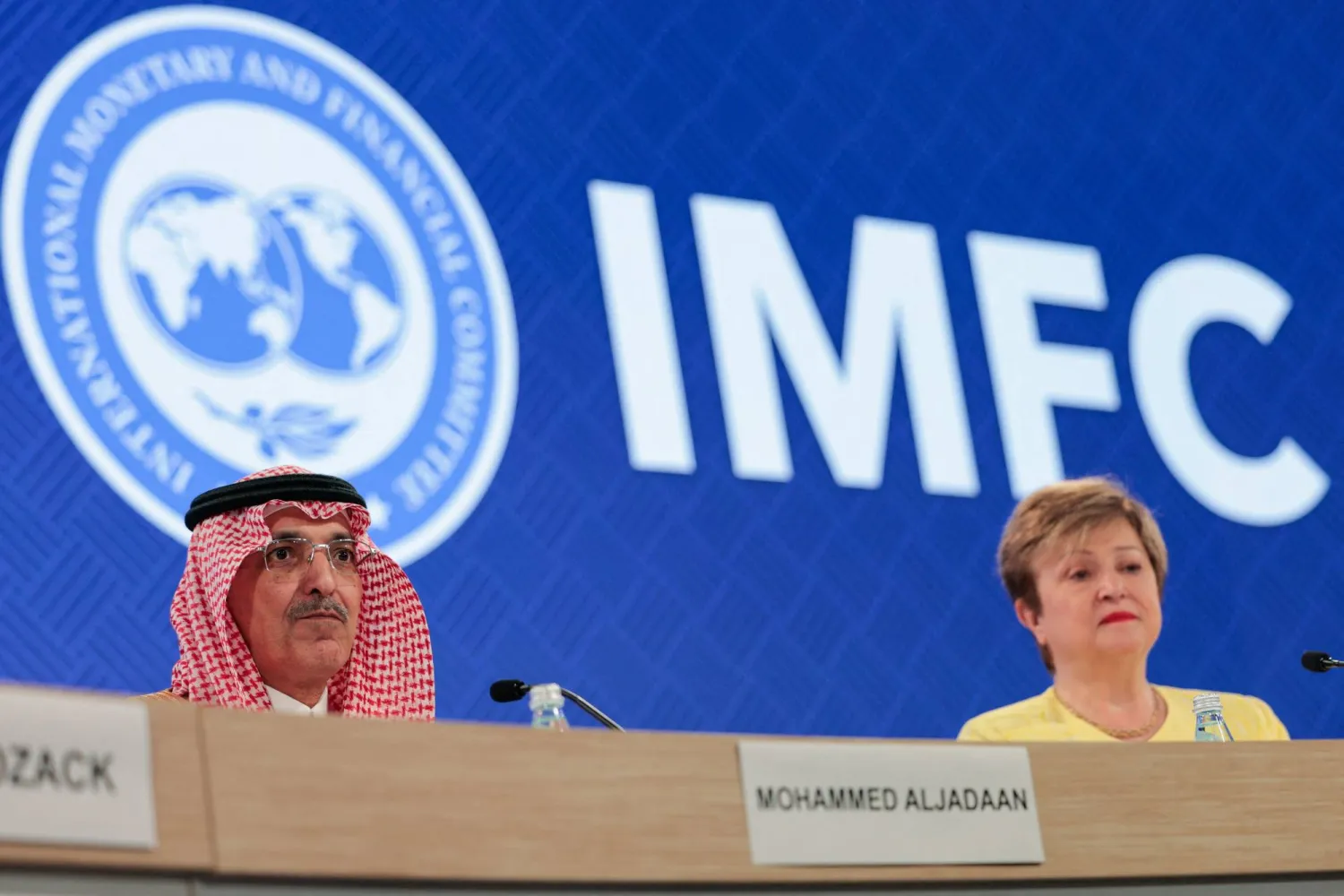
(L/R) Saudi Arabia's Finance Minister Mohammed Al-Jadaan and IMF Managing Director Kristalina Georgieva
speak during a press briefing following a meeting of the IMFC (International Monetary and Financial Committee) at the 2026 IMF and World Bank Group Spring Meetings in Washington, DC, on April 17, 2026. (Photo by Kent Nishimura / AFP)
(L/R) Saudi Arabia's Finance Minister Mohammed Al-Jadaan and IMF Managing Director Kristalina Georgieva speak during a press briefing following a meeting of the IMFC (International Monetary and Financial Committee) at the 2026 IMF and World Bank Group Spring Meetings in Washington, DC, on April 17, 2026. (Photo by Kent Nishimura / AFP)
TT

Al-Jadaan: Ending Conflicts, Securing Peace Are Essential to Sustainable Growth

(L/R) Saudi Arabia's Finance Minister Mohammed Al-Jadaan and IMF Managing Director Kristalina Georgieva
speak during a press briefing following a meeting of the IMFC (International Monetary and Financial Committee) at the 2026 IMF and World Bank Group Spring Meetings in Washington, DC, on April 17, 2026. (Photo by Kent Nishimura / AFP)
(L/R) Saudi Arabia's Finance Minister Mohammed Al-Jadaan and IMF Managing Director Kristalina Georgieva speak during a press briefing following a meeting of the IMFC (International Monetary and Financial Committee) at the 2026 IMF and World Bank Group Spring Meetings in Washington, DC, on April 17, 2026. (Photo by Kent Nishimura / AFP)

Saudi Finance Minister Mohammed Al-Jadaan said the global economy’s ability to withstand crises depends on adopting a “unified strategic vision and swift reforms,” warning that excessive market optimism may be masking serious geopolitical risks, particularly conflicts that threaten supply security.

Al-Jadaan made the remarks at a joint press conference with Kristalina Georgieva, Managing Director of the International Monetary Fund (IMF), following a meeting of the International Monetary and Financial Committee (IMFC), during the IMF–World Bank Spring Meetings.

The committee concluded its session by adopting the “Diriyah Principles,” described as a landmark framework for IMF quota and governance reform, signaling a renewed phase of multilateral cooperation amid heightened global uncertainty.

Peace as a Foundation for Sustainable Growth

Al-Jadaan said the global economy has faced repeated shocks in recent years driven by wars and conflicts, including the latest escalation in the Middle East.

Beyond the severe humanitarian toll, he said, these shocks have global economic consequences that disproportionately affect the poorest and most vulnerable populations. He cautioned that this is unfolding at a time when policy space has narrowed and international cooperation has weakened.

He emphasized that effective policy responses depend on how shocks transmit through domestic economies, requiring timely and flexible measures supported by credible frameworks and strong international coordination.

Ending wars and securing lasting peace, he said, are indispensable conditions for sustainable growth and long-term stability.

Conflict Risks and Implications for Energy Security

In its statement, the IMFC said the global economy has shown resilience despite repeated shocks, including wars and conflicts. However, it described the Middle East conflict as a significant new global shock, with its economic impact contingent on its duration, intensity, and geographic spread.

The committee noted that damage to infrastructure and disruptions to transportation already pose serious risks to the global economy, despite efforts to sustain energy flows, including rerouting shipping and trade routes to safeguard supply chains.

Members stressed that the impact of the shock varies widely across countries. A prolonged conflict could keep fuel and fertilizer prices elevated, disrupt supplies of key inputs, and intensify risks to energy and food security, global growth, inflation, and external balances.

The statement added that tighter financial conditions and potential spillovers to financial stability could further cloud the outlook. These risks are compounded by deep structural shifts in technology, demographics, and climate-related challenges that are reshaping economies and testing their resilience.

Economic and Financial Policy Priorities

Against this backdrop of heightened uncertainty, the committee said the top priority is to safeguard macroeconomic and financial stability while supporting strong, broad-based growth through credible, timely, and adaptable policies.

Central banks reaffirmed their commitment to price stability, emphasizing that independence and clear communication are essential to maintaining policy credibility and anchoring inflation expectations.

On fiscal policy, the committee said governments should calibrate spending within credible medium-term frameworks to ensure debt sustainability. Where fiscal space permits, temporary and targeted measures can be used to protect vulnerable populations.

Members also reaffirmed their commitment to international standards and to monitoring risks to financial stability. This includes strengthening oversight of systemic risks linked to artificial intelligence, nonbank financial institutions, and digital assets, while leveraging the benefits of technological innovation.

Structural Reforms and International Cooperation

The committee underscored the need to advance structural reforms to encourage private-sector investment, boost productivity, and strengthen energy security.

Members pledged continued cooperation to address excessive global imbalances and trade tensions, build more resilient supply chains, and support a fair and open global economy. They also reaffirmed exchange rate commitments made in April 2021.

The statement welcomed the IMF Managing Director’s Global Policy Agenda and highlighted the IMF’s central role in supporting countries through policy advice, capacity development, and financial assistance in coordination with other international institutions.

Supporting Vulnerable Countries and Addressing Debt

The IMFC reiterated its commitment to supporting countries in promoting stability and growth, with particular focus on low-income and fragile states affected by conflict, especially those facing rising debt pressures.

Members pledged to improve sovereign debt restructuring processes, including under the G20 Common Framework, and to advance work through the Global Sovereign Debt Roundtable.

The committee welcomed the updated “Restructuring Playbook” and called for greater transparency from all stakeholders, including private creditors.

It also urged stronger support for countries with sustainable debt facing short-term liquidity challenges, including faster implementation of the IMF–World Bank “three-pillar approach” and completion of the review of the debt sustainability framework.

Strengthening Surveillance and Lending

The committee backed efforts to enhance IMF surveillance, emphasizing analytical rigor and evenhandedness, and said it looks forward to completing the Comprehensive Surveillance Review and the review of the Financial Sector Assessment Program (FSAP).

Members also supported ongoing work to strengthen the IMF’s lending framework, including the Review of Conditionality and program design, as well as efforts to develop monetary policy frameworks for countries experiencing crises.



US Renews Russian Oil Waiver for a Month to Curb Global Energy Prices

US Treasury Secretary Scott Bessent speaks with reporters in the James Brady Press Briefing Room at the White House, Wednesday, April 15, 2026, in Washington. (AP)
TT

US Renews Russian Oil Waiver for a Month to Curb Global Energy Prices

US Treasury Secretary Scott Bessent speaks with reporters in the James Brady Press Briefing Room at the White House, Wednesday, April 15, 2026, in Washington. (AP)

Washington renewed on Friday a waiver allowing countries to buy sanctioned Russian oil at sea for about a month, even as lawmakers accused the government ‌of going easy on Moscow as its war on Ukraine grinds on.

The Treasury Department's waiver lets countries purchase Russian oil and petroleum products loaded on vessels as of Friday through May 16.

It replaces a 30-day waiver that expired on April 11 and excludes transactions involving Iran, Cuba and North Korea.

Reversal

The move is part of the administration's effort to control global energy prices that have shot higher during the US-Israeli war with Iran.

It came after countries in Asia, suffering from the global energy shock, pressed Washington to allow alternative supplies to reach markets.

“As negotiations (with Iran) accelerate, Treasury wants to ensure oil is available to those ⁠who need it,” a Treasury Department spokesperson said.

Last Wednesday, Treasury Secretary Scott Bessent said Washington would not be renewing the waiver for Russian oil and another for Iranian oil, which is set to expire on Sunday.

Global oil prices tumbled 9% on Friday to about $90 a barrel after Iran temporarily reopened the Strait of Hormuz, an oil choke point in the Gulf. But the war has already created the worst global energy supply disruption in history, the International Energy Agency has said.

The war, which enters its eighth week on Saturday, has damaged more than 80 oil and gas facilities in the Middle East, and Tehran has warned it could close the strait again if the recent US Navy blockade of Iranian ports continued.

High oil prices are a threat to President Donald Trump's fellow Republicans ahead of November's midterm elections.

Trump has also faced pressure from partner countries on the oil price.

A US source told Reuters partner countries on the sidelines of Group of 20, World Bank and International Monetary Fund meetings ‌in Washington ⁠this week had requested the US extend the waiver. Trump also spoke about oil this week in a call with Prime Minister Narendra Modi of India, a big purchaser of Russian oil.

The waiver on Iranian oil, which the Treasury Department issued on March 20, allowed about 140 million barrels of oil to reach global markets and helped relieve pressure on energy supply, Bessent said last month.

Lasting damage

US lawmakers from both political parties had slammed the administration over the sanctions waivers, saying they stood to help the economy of Iran while it was at war ⁠with the US and of Russia as it was at war with Ukraine.

The waivers could impede the West's efforts to deprive Russia of revenue for its war in Ukraine and put Washington at odds with its allies. European Commission President Ursula von der Leyen has said now is not the time to relax sanctions against Russia.

Russian President Vladimir Putin's special envoy Kirill Dmitriev ⁠said an extension of the US waiver will affect another 100 million barrels of Russian oil, bringing the total volume affected by both waivers to 200 million barrels.

Dmitriev, who travelled to the US on April 9 for meetings with members of the Trump administration ahead of the previous waiver expiry, said on his Telegram channel that the ⁠extension faced “active political opposition.”

Brett Erickson, a sanctions expert at the consulting firm Obsidian Risk Advisors, said Friday's renewal is likely not the last waiver Washington will issue.

“The conflict has done lasting damage to global energy markets, and the tools available to stabilize them are nearly exhausted,” Erickson said.


Turkmenistan, China Launch Expansion of World’s Second-largest Gas Field

Former Turkmen president Gurbanguly Berdymukhamedov and Chinese Vice Premier Ding Xuexiang applaud during a ceremony launching the fourth of seven planned development phases at Galkynysh gas field, the world's second-largest gas field in the Karakum desert about 400 kilometres (250 miles) east of the capital Ashgabat, on April 17, 2026. (Photo by AFP)
TT

Turkmenistan, China Launch Expansion of World’s Second-largest Gas Field

Former Turkmen president Gurbanguly Berdymukhamedov and Chinese Vice Premier Ding Xuexiang applaud during a ceremony launching the fourth of seven planned development phases at Galkynysh gas field, the world's second-largest gas field in the Karakum desert about 400 kilometres (250 miles) east of the capital Ashgabat, on April 17, 2026. (Photo by AFP)

Turkmenistan and China broke ground Friday on works to expand production at the giant Galkynysh gas field, strengthening Beijing's already dominant position in the secretive Central Asian nation's energy sector.

The former Soviet republic, which holds the world's fourth-largest gas reserves, has exported nearly all its production to China since 2009, when the Central Asia-China pipeline opened.

In the middle of the desert, former president Gurbanguly Berdymukhamedov -- who effectively runs the country alongside his son, President Serdar Berdymukhamedov -- formally inaugurated the launch of the fourth of seven planned development phases at Galkynysh.

The ceremony was attended by Chinese Vice Premier Ding Xuexiang, an AFP correspondent saw.

"Turkmen gas is a symbol of happiness -- it is present in every Chinese household," Ding said.

The event featured songs and dances celebrating Turkmen-Chinese friendship, staged with the lavish pomp typical of Turkmenistan's state-sponsored events.

Gurbanguly Berdymukhamedov, officially titled "Hero-Protector" and vested with sweeping powers, presided over the gathering.

Galkynysh, in the Karakum desert about 400 kilometers (250 miles) east of the capital Ashgabat, has been producing gas since 2013 and is the world's second-largest gas field, according to the British consulting firm GaffneyCline.

Expansion works are being carried out by the state-owned China National Petroleum Corporation (CNPC).

On a visit to Ashgabat the day before the ceremony, CNPC chairman Dai Houliang said "the friendship between China and Turkmenistan is as deep as the roots of a tree."


$27 Billion City to be Built East of Cairo

The project covers approximately 2.4 million square meters of land. Asharq Al-Awsat
TT

$27 Billion City to be Built East of Cairo

The project covers approximately 2.4 million square meters of land. Asharq Al-Awsat

Egypt's Talaat Moustafa Group (TMG) will build a new 1.4 trillion Egyptian pound ($27 billion) mixed-use city east of Cairo, CEO and Managing Director Hisham Talaat Moustafa said at a press conference on Saturday.

The project, called The Spine, is to be developed in partnership with ⁠the National Bank ⁠of Egypt, with a paid-up capital of 69 billion Egyptian pounds ($1.3 billion).

The project, to be built as a Special Investment ⁠Zone with TMG's Madinaty, covers approximately 2.4 million square meters of land, combining residential, commercial, hospitality, retail, entertainment, and public green space within a single continuous urban environment.

The investment is equivalent to roughly 1% of Egypt's GDP, according to Moustafa, and is ⁠projected ⁠to generate approximately 818 billion Egyptian pounds in tax revenues for the state budget over time.

The project is expected to create more than 55,000 direct jobs and hundreds of thousands of indirect positions.