


Barghouti Remains Central Figure in Palestinian Politics After 24 Years in Prison

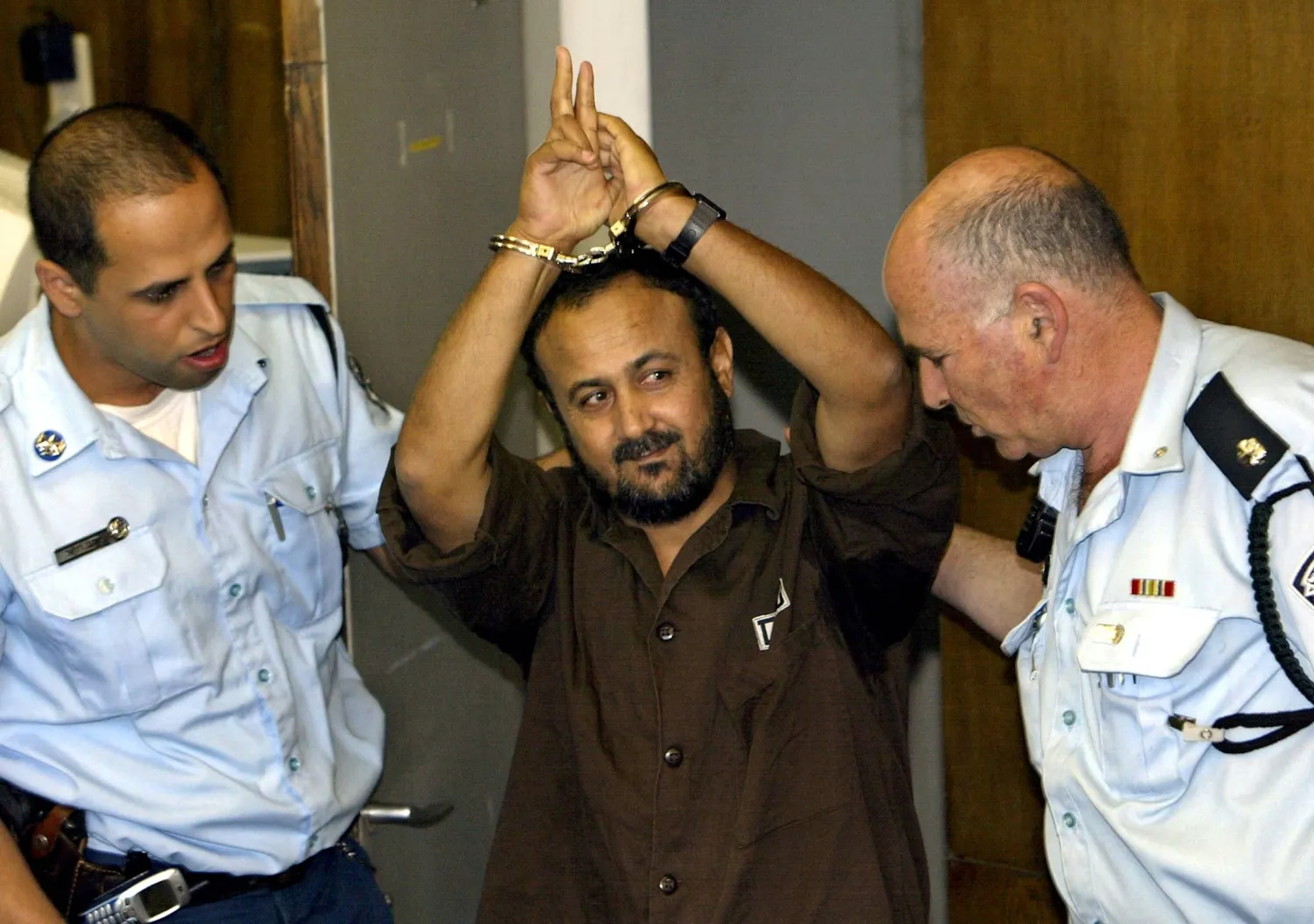
Marwan Barghouti waves as Israeli police bring him to court for a sentencing hearing in Tel Aviv, May 20, 2004. (Reuters)
TT

Barghouti Remains Central Figure in Palestinian Politics After 24 Years in Prison

Marwan Barghouti waves as Israeli police bring him to court for a sentencing hearing in Tel Aviv, May 20, 2004. (Reuters)

Twenty-four years after the arrest of Palestinian leader Marwan Barghouti, now 67, and after long stretches in solitary confinement, he remains a central figure in Palestinian politics.

His influence has outpaced that of other officials in decision-making roles, and he has topped Fatah elections in previous years, as the movement prepares for its eighth conference next month, a key test of what has changed over time.

Palestinians, the presidency, Fatah, and Barghouti’s family marked the 24th anniversary of his arrest late last week. President Mahmoud Abbas pledged to continue efforts to secure his release.

Fatah said Barghouti, known as Abu al-Qassam, had become a living symbol for Palestinians through his sacrifices, struggle, courage, and patience.

The anniversary came as a lawyer who visited Barghouti on April 12 said he had been assaulted three times in recent weeks, on March 24 and 25 and April 8, leaving him bleeding in several parts of his body without proper medical treatment.

Israeli lawyer Ben Marmarelli said Barghouti was severely beaten and left bleeding for more than two hours on one occasion. Israel’s prison service said it was “not aware” of such incidents.

Barghouti is believed to have been held in solitary confinement for two and a half years. Last year, Israel’s National Security Minister Itamar Ben-Gvir posted a video showing him confronting Barghouti in his cell, speaking in a condescending and threatening tone in what appeared to be an attempt to break him. The move backfired, drawing renewed attention to Barghouti to the point that US President Donald Trump said he was considering whether to release him.

Trump said last October he might ask Israel to release Barghouti, adding he had discussed the option with aides at the White House.

Trump’s intervention has further elevated Barghouti’s standing, with many viewing him as a potential “savior”.

Presidential contender

Informed Palestinian sources told Asharq Al-Awsat that Barghouti will almost certainly run in the next presidential election. “He will most likely be Fatah’s candidate, but even if that does not happen, he will run because he is Marwan,” the sources said.

Elections canceled at the last minute five years ago pointed to his chances. Barghouti formed a list with former Central Committee member Nasser al-Qudwa to challenge Fatah’s official slate.

The list was headed by al-Qudwa and lawyer Fadwa Barghouti, Barghouti’s wife, and included prominent figures from the movement. Barghouti’s name was not listed as he planned to run for president.

His stance underscored a rift dating back to 2005, when he briefly ran against Abbas before withdrawing, a divide that appears unresolved despite expectations of a reconciliation.

There is little sign his position has shifted, even as the broader landscape has. Since the Oct. 7, 2023, war, Israel has increased pressure on the Palestinian Authority, reshaped conditions in the West Bank, and imposed harsher measures on prisoners, including Barghouti. Israel has also rejected Trump’s remarks about his possible release.

Meanwhile, Abbas has moved to reshape the Palestinian Authority and Fatah, appointing senior Central Committee member Hussein al-Sheikh as vice president, launching reconciliation efforts, and allowing the return of previously dismissed members, including al-Qudwa, who has rejoined the Central Committee.

Abbas met Barghouti’s wife late last year and said he would continue working to secure his release.

The meeting sent a clear signal aimed at dispelling doubts over Barghouti, who enjoys strong support within Fatah. His backers present him as a unifying figure capable of bringing Palestinians together and as a potential successor to Abbas, an idea that has not previously gained traction within decision-making circles in Ramallah.

One shift since the war is that Hamas is expected to back him more strongly in any election. The group sought his release in prisoner exchange talks with Israel, placing him among five top-priority detainees, but Israel firmly refused.

Arafat loyalist

Barghouti, arrested in 2002, is serving five life sentences plus 40 years after being convicted of leading the al-Aqsa Martyrs Brigades, Fatah’s armed wing, which carried out attacks that killed Israelis during the second Palestinian uprising that began in 2000.

Before his arrest, he was close to Palestinian leader Yasser Arafat and is widely regarded within Fatah as an Arafat loyalist. This strengthens his standing among the movement’s base, though it may count against him with Israel and opponents of Arafat.

Abbas’s reconciliation push ahead of the eighth conference, scheduled for May 14, comes at a sensitive moment as he works to reorganize the Palestinian Authority and ensure a smooth leadership transition.

The conference will elect a new Central Committee, the movement’s top decision-making body, which will shape both Fatah and the broader Palestinian political landscape.

Selecting a new committee, alongside a new Palestinian National Council, will signal the scale of change and reveal the influence of key figures.

At Fatah’s seventh conference, Barghouti secured the highest number of votes, 930 out of about 1,100, underscoring his strong backing within the movement.

The upcoming conference will show whether he has maintained that standing or lost ground amid sweeping changes within the Palestinian Authority, Fatah, and Palestinian society.

His supporters had hoped he would be named vice president in recent years, but both roles went to others, with the leadership arguing the move was impractical given his imprisonment.

A source close to Barghouti said, “All Palestinians, not just Fatah members, see him as the one who can unite them, as do many countries in the region and beyond. Israel does not want that for well-known reasons.”

“His standing has not diminished over time; it has grown stronger. His presence will remain dominant. He will gain his freedom and unite the Palestinians,” he added.


Israeli Strikes Kill Six in South Lebanon

Rescuers work at the site of an Israeli strike in Kfar Jouz, Lebanon, May 11, 2026. (Reuters)
TT

Israeli Strikes Kill Six in South Lebanon

Rescuers work at the site of an Israeli strike in Kfar Jouz, Lebanon, May 11, 2026. (Reuters)

Israeli strikes on a town in southern Lebanon killed six people and wounded seven others, state media said Tuesday, as fighting continued despite a ceasefire agreement.

Lebanon's state-run National News Agency (NNA) reported that Israeli strikes Monday night hit a house in Kfar Dounine, a town about 95 kilometers (59 miles) from capital Beirut.

The NNA reported the wounded were transported to hospitals in the coastal city of Tyre.

Israel has intensified its attacks in south Lebanon as it trades fire with Iran-backed Hezbollah despite an April 17 ceasefire between Israel and Lebanon that aimed to halt the fighting.

More than 2,800 people have been killed in Lebanon since the country was dragged into the Middle East war on March 2, according to health authorities.

Lebanese leaders recently urged the US ambassador to Beirut to pressure Israel to halt its attacks during the ceasefire, though Israel has also reported coming under fire.

Israel's military said over the weekend that one of its soldiers had been killed in fighting near the border with Lebanon, bringing its losses to 18 troops and a civilian contractor since the war began.

The NNA on Tuesday reported strikes near other southern Lebanese towns, and the Israeli military ordered an evacuation of the town of Sohmor in eastern Lebanon's Bekaa valley.


Israel Increases Pressure, Widens Ambitions in Lebanon by Carrying Strikes Beyond Litani

Smoke rises following an Israeli strike in southern Lebanon as seen from Marjeyoun, May 11, 2026. (Reuters)
TT

Israel Increases Pressure, Widens Ambitions in Lebanon by Carrying Strikes Beyond Litani

Smoke rises following an Israeli strike in southern Lebanon as seen from Marjeyoun, May 11, 2026. (Reuters)

The ceasefire in southern Lebanon has not really ended the fighting between Israel and Hezbollah. Israel has continued its raids on southern villages and the Iran-backed party continues to launch attacks against Israeli forces.

The ceasefire has effectively turned into open combat that is gradually expanding from border areas towards Lebanon’s interior as Israel widens the scope of its attacks and warnings to include regions north of the Litani River. The latest warnings covered Mashghara and Qlaia in the western Bekaa.

It appears that Israel is shifting the battle from “containing the southern front” to reshaping maps across the south and western Bekaa.

Israeli media, meanwhile, reported that the military was planning “a wide ground operation in Lebanon to address Hezbollah’s ongoing violations of the ceasefire.”

A local source told Asharq Al-Awsat that Israel is effectively fully occupying 35 Lebanese towns and villages, seven others are until total siege and 82 have received evacuation warnings since the ceasefire took effect.

Retired general Naji Malaeb told Asharq Al-Awsat that the developments on the ground in Lebanon “cannot be separated from the geopolitical conflict, meaning geography is being used to serve Israel’s political and military goals.”

Israeli Prime Minister Benjamin Netanyahu wants to extend the yellow line from the Naqoura to Jabal al-Sheikh, increasing Israeli military pressure beyond the areas covered by United Nations resolution 1701 that only covers regions south of the Litani, he added.

The repeated attacks on the western Bekaa and the destruction of bridges along the Litani aim to empty these regions of inhabitants and control how the displaced return to them later, he explained.

Attacks on the towns of Mashgara, Zlaya and Sohmor are also attempts to apply direct pressure on Hezbollah’s support base, he went on to say.

“Israel views the western Bekaa as a source of logistic and human support for Hezbollah,” Malaeb said, noting that the region has long served as a transit point for weapons smuggled from Syria to the Bekaa and then the south.

“So, Tel Aviv wants to sever the link between the Bekaa and south,” he explained.

On the military escalation, he highlighted Israeli Chief of Staff Eyal Zamir’s recent remarks that Israel was not in a truce with Lebanon. “This reflects an Israeli conviction that the confrontation will remain open as long as Hezbollah retains its weapons,” said Malaeb.

“It is unfortunate that the party has not respected the Lebanese state’s decision to cease attacks, because its continued drone or rocket attacks weaken Lebanon’s diplomatic position,” he added.

“Iran is trying to tie the situation in Lebanon to the broader confrontation in the region by demanding that a ceasefire cover all fronts,” he continued. If it is successful, “then Iran would have restored its control over the south and Hezbollah’s role on the border with Israel, destroying Lebanese efforts to separate the Lebanese file from the Iranian negotiations.”

Israeli strikes on a town in southern Lebanon killed six people and wounded seven others, state media said Tuesday, as fighting continued despite a ceasefire agreement.

Lebanon's state-run National News Agency (NNA) reported that Israeli strikes Monday night hit a house in Kfar Dounine, a town about 95 kilometers (59 miles) from capital Beirut.

Israel has intensified its attacks in south Lebanon as it trades fire with Hezbollah despite an April 17 ceasefire between Lebanon and Israel that aimed to halt the fighting.

More than 2,800 people have been killed in Lebanon since the country was dragged into the Middle East war on March 2, according to health authorities.


International, Local Bodies Warn of Impending Famine in Yemen

Funding shortfall in Yemen has increased the risk of food insecurity (EPA) 
TT

International, Local Bodies Warn of Impending Famine in Yemen

Funding shortfall in Yemen has increased the risk of food insecurity (EPA) 

A number of UN, international and local bodies said Yemen is again on the brink of widespread humanitarian disaster, characterized by accelerated hunger, widespread displacement, funding shortfall, in addition to worsening economic and climate pressures that are leaving millions in deeper levels of deprivation amid ongoing political and economic instability.

UN agencies and international organizations reveal that the crisis is no longer limited to food shortages, but includes a simultaneous threat to food, shelter and income, at a time when more than a decade of conflict and economic decline continue to erode the resilience of communities in Yemen.

A recent UN report indicates that approximately 5.2 million internally displaced persons (IDPs) in Yemen are among the most severely affected by the nation's food insecurity crisis.

The reports came while the Yemeni government plans to establish the High Commission for Relief and to organize several workshops that address issues related to overlapping authorities, as announced earlier by Minister of Local Administration, Badr Basalma.

The Minister’s plan focuses on organizing relief efforts between the central government and the liberated governorates to ensure aid reaches vulnerable populations through official channels.

In its latest assessment of food security in Yemen, the World Food Program (WFP) stated that the country continues to host the fifth largest internal displacement crisis globally, exacerbated by ongoing conflict and deteriorating economic and humanitarian conditions.

“With an estimated 5.2 million IDPs, Yemen remains the fifth largest internal displacement crisis in the world. WFP remote monitoring data revealed a relative improvement in the food security among surveyed IDPs in March 2026,” it said.

WFP also noted that food consumption gaps remain notably worse among IDPs compared to residents, particularly for those living in camps.

In March, it showed, around 39% of surveyed IDPs in Yemen experienced moderate to severe hunger, double the level recorded among residents.

This trend was more pronounced among IDPs in camps (50%) compared to community-based IDPs (34%). Additionally, 17% of surveyed IDPs nationwide reported at least one member spending an entire day and night without eating, more than double the rate among residents.

Compounding these vulnerabilities, WFP said nearly one-third of IDPs nationwide live in informal displacement sites as last resort, while 92% cannot afford rent and face eviction risk.

Last week, the Executive Unit for Managing Displacement Camps in Marib governorate reported a dire, looming humanitarian crisis threatening over a quarter of a million IDPs in the province after they faced the imminent threat of losing their rented homes due to severe economic deterioration, escalating living conditions, accumulated rental debts and lack of income sources.

It showed that the most affected groups include 118,000 women, 72,000 children, and 8,200 seniors, who may find themselves homeless in the coming months.

Meanwhile, the International Organization for Migration (IOM) said last Tuesday that from January 1 to May 2, Yemen tracked 923 households (5,538 Individuals) who experienced displacement at least once, indicating that economic reasons and conflict remain the main drivers of new displacement.

The Famine Early Warning Systems Network (FEWS NET) estimated that the scale and severity of acute food insecurity are expected to remain high across Yemen through September.

It said outcomes of the Crisis, or the third level of the Integrated Food Security Phase Classification (IPC 3), are expected to remain widespread, with Emergency (IPC Phase 4) outcomes persisting in Hodeidah, Hajjah, and Taiz.

Households most likely to face Emergency (IPC Phase 4) outcomes include those with minimal income sources, the displaced, and those with limited or no access to humanitarian assistance, the Network showed.

It said funding gaps remained substantial in 2025, with only 22% of food security and agriculture requirements funded, while coverage remained similarly low in nutrition (9%) and water, sanitation, and hygiene (22%).