


European Shares Slip as Hopes for US-Iran Peace Fade

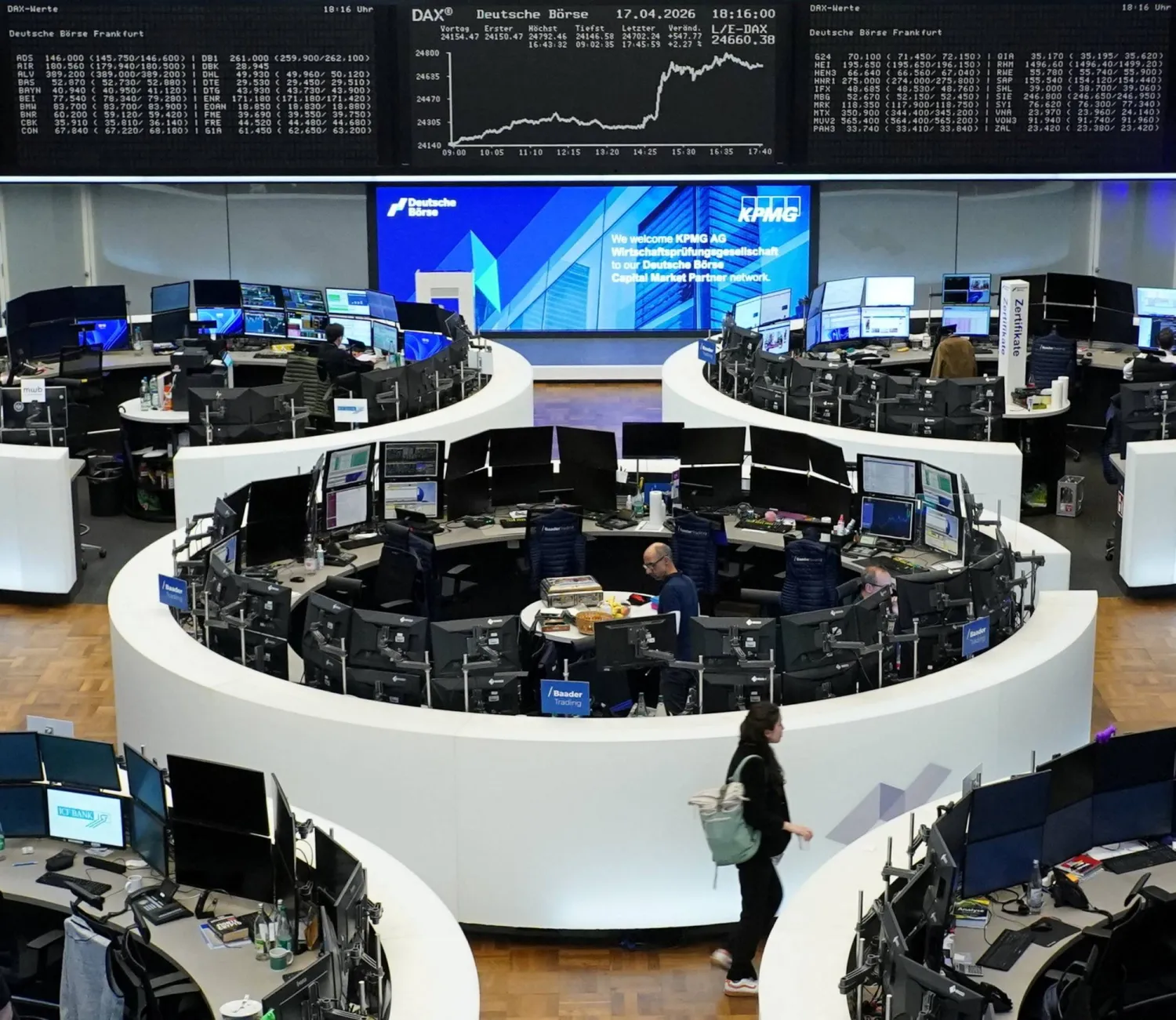
 The German share price index DAX graph is pictured at the stock exchange in Frankfurt, Germany, April 17, 2026. (Reuters)
The German share price index DAX graph is pictured at the stock exchange in Frankfurt, Germany, April 17, 2026. (Reuters)
TT

European Shares Slip as Hopes for US-Iran Peace Fade

 The German share price index DAX graph is pictured at the stock exchange in Frankfurt, Germany, April 17, 2026. (Reuters)
The German share price index DAX graph is pictured at the stock exchange in Frankfurt, Germany, April 17, 2026. (Reuters)

European ‌shares declined on Monday, as hopes for peace in the Middle East ebbed with tensions reigniting after Washington seized an Iranian cargo ship that tried to run its blockade and Tehran vowed to retaliate.

Investors have grown increasingly jittery as the US-Iran ceasefire, set to expire Tuesday, appears fragile.

Iran rejected fresh peace talks with the US just hours after President Donald Trump said he would dispatch envoys to Pakistan ‌while threatening new ‌strikes unless Tehran accepts his terms.

The ‌pan-European ⁠STOXX 600 index ⁠was down 0.8% to 621.52 points as of 0717 GMT.

Major regional markets also fell, with France's CAC and Germany's DAX down 0.9% and 1%, respectively.

The uncertainty marks a sharp reversal from Friday's optimism, when the STOXX 600 jumped more than 1% and ⁠secured its fourth consecutive weekly gain after ‌Iran declared the Strait ‌of Hormuz open.

Energy shares gained 1.9% as crude prices ‌surged., while utilities and telecommunication stocks rose 0.7% and 0.2%, ‌respectively.

Travel and leisure sector led the declines, bearing, down 2%. Banks and automobile stocks dropped 1.8% each.

Among other movers, cash logistics company Loomis was top loser on the European ‌benchmark index after Goldman Sachs downgraded the stock to "neutral" from "buy".

The setback in the ⁠Middle ⁠East conflict comes despite tentative signs of normalization at the Strait of Hormuz.

Although Iran has reimposed a closure of the critical waterway, Kpler data revealed more than 20 vessels carrying oil, metals, gas, and fertilizer passed through on Saturday - the busiest traffic day since March 1.

Elevated oil prices continue to weigh heavily on energy-dependent European economies, keeping investors cautious.

The strait is a conduit for one-fifth of global energy shipments. Brent crude futures advanced 5.3% to $95.19 a barrel after tumbling 9% on Friday.



UK Inflation Jumps in March as Middle East War Propels Energy Prices

Vehicles pass a petrol station as they make their way down the A3 during the morning rush hour near Ripley, south-west of London on April 22, 2026. (AFP)
TT

UK Inflation Jumps in March as Middle East War Propels Energy Prices

Vehicles pass a petrol station as they make their way down the A3 during the morning rush hour near Ripley, south-west of London on April 22, 2026. (AFP)

Britain's annual inflation rate jumped to 3.3 percent in March as the Middle East war sent oil and gas prices surging, official data showed Wednesday.

The Consumer Prices Index (CPI) increased from 3.0 percent in the 12 months to February, the Office for National Statistics said in a statement.

"Inflation climbed in March, largely due to increased fuel prices, which saw their largest increase for over three years," Grant Fitzner, chief economist at the ONS, said in a statement.

Finance minister Rachel Reeves reiterated the Labour government's opposition to a conflict that has increased the cost of living for millions of Britons.

"This is not our war, but it is pushing up bills for families and businesses. That's why it's my number one priority to keep costs down," Reeves said in a statement.

At 3.3 percent, the latest UK inflation figure matches the March print for the United States. But the pace of the CPI increase in the world's biggest economy was far sharper, having stood at 2.4 percent in February.

Britain's inflation rate is also much larger than in the eurozone, where annual inflation rose to 2.6 percent in March from 1.9 percent in February.

The US-Iran war began on February 28, sending energy prices rocketing.

They have since pulled back on a ceasefire that US President Donald Trump extended Tuesday. But oil and gas prices remain far above their pre-war levels as Gulf supplies remain largely blocked from transiting the Strait of Hormuz.


Pakistan Receives Additional $1 Billion from Saudi Arabia Under $3 Billion Package

The State Bank of Pakistan logo is seen at a reception desk at its headquarters in Karachi (Reuters)
TT

Pakistan Receives Additional $1 Billion from Saudi Arabia Under $3 Billion Package

The State Bank of Pakistan logo is seen at a reception desk at its headquarters in Karachi (Reuters)

Pakistan’s central bank said Tuesday it had received $1 billion from Saudi Arabia’s finance ministry as a second tranche of a recently agreed $3 billion deposit package between the two countries.

In a post on its official X account, the State Bank of Pakistan said the funds were credited on April 20, 2026. The transfer comes just days after Islamabad received a first tranche of $2 billion, which was deposited on April 15.

With this latest payment, Saudi Arabia has completed the full transfer of the agreed $3 billion support in a short period, providing immediate liquidity that strengthens Pakistan’s monetary policy flexibility.

Ongoing Saudi support

The inflow caps a week of major Saudi financial moves aimed at supporting Pakistan’s economic stability and easing balance-of-payments pressures. In addition to the new $3 billion package, Riyadh last week renewed an existing $5 billion deposit held at the State Bank of Pakistan.

Analysts say the combination of rolling over existing deposits and injecting new funds lifts total Saudi deposits at the central bank, directly bolstering foreign exchange reserves and giving Islamabad a stronger footing in ongoing negotiations with international financial institutions.

Impact on Pakistan’s economy

Saudi support is seen as a key pillar of Pakistan’s efforts to restore macroeconomic stability. The funds are expected to help stabilize the rupee against the US dollar, improve the country’s financial position and its ability to meet external obligations, and provide a buffer against external shocks and high energy costs.

The financial measures underscore the depth of the strategic partnership between Riyadh and Islamabad, and reflect Saudi Arabia’s commitment to supporting Pakistan’s economic stability as part of its broader role in promoting regional and global financial stability.


NEOM Port Reshapes Global Trade Routes from Northern Saudi Arabia

NEOM Port in Saudi Arabia (NEOM)
TT

NEOM Port Reshapes Global Trade Routes from Northern Saudi Arabia

NEOM Port in Saudi Arabia (NEOM)

On April 15, Saudi Arabia’s NEOM posted a terse but telling message on X: “Europe- Egypt- NEOM- GCC: your faster route.”

Accompanied by a map, the post traced a corridor linking Europe to Egypt’s ports of Damietta and Safaga, on to NEOM Port, then overland to Kuwait, Iraq, Bahrain, Qatar, the United Arab Emirates and Oman.

It was not a routine update. It signaled that a long-discussed trade route is now operational.

That same day, the Public Investment Fund approved its 2026-2030 strategy, outlining Saudi Arabia’s economic path to the end of the decade. NEOM said it “remains a central pillar” of that transformation, with its designation as an independent system underscoring official commitment.

The timing indicated clear alignment between the port’s rollout and the broader national strategy.

On the ground, progress is moving fast. The main container terminal, built to handle the world’s largest ships, is set to open this year with a capacity of 1.5 million twenty-foot equivalent units.

In June last year, the port received its first fully automated, remotely operated cranes, the first in the Kingdom, in what officials called a milestone for Saudi ports.

In a recent update, NEOM said the port is already operating at full capacity as a Red Sea hub, handling multiple cargo types, supported by advanced infrastructure and high operational standards. It links trade flows from the Americas, Europe and Egypt to Gulf and Iraqi markets.

A new logistics map

Abdullah Abdulrahim Almeer, an assistant professor at King Fahd University of Petroleum and Minerals and a member of the Saudi Economic Association, said NEOM’s location gives it an edge.

Unlike major Saudi ports clustered on the western coast or in the Gulf, NEOM sits at the far northwest, where Europe, the Gulf and northern neighbors converge.

He said the port can act as a “bridge port,” linking the sea and land into a single system. Its proximity to the Suez Canal and its road links to Jordan, Iraq and Gulf states strengthen its role as a future logistics hub.

“NEOM Port is not just competing with Jeddah or Dammam, it is opening a new axis that reshapes regional logistics,” he said, citing tensions in routes such as the Strait of Hormuz.

Logistics consultant Nashmi Al-Harbi said the port complements, rather than competes with, existing Saudi ports. He added that its reliance on renewable energy boosts efficiency and positions it as a sustainability leader.

Faster, leaner supply chains

Almeer said the corridor can cut shipping times by more than half. Cargo that once took 10 to 12 days to reach Gulf destinations can arrive in 4 to 6 days by combining short-sea routes with fast overland transport.

The gains come not just from distance, but from reduced waiting times, simpler procedures and less congestion.

Al-Harbi said the corridor “revolutionizes supply chain efficiency,” offering a reliable alternative amid geopolitical uncertainty.

Both said time-sensitive goods stand to gain most, including fast-moving consumer goods, fresh and refrigerated food, pharmaceuticals, spare parts, high-value electronics and advanced construction materials.

From the trial phase to the real trade

Almeer said the port has moved beyond early testing and can now support real trade flows, though it is still scaling up. He expects it to become a major regional hub as expansion continues.

Al-Harbi said the port reached an advanced operational stage in 2026, with infrastructure capable of handling regional trade, supported by advanced digital systems, automated cranes and modern road links.

Almeer pointed to the involvement of major firms such as Bahri and DFDS as evidence that global players have shifted from watching to operating, though the port is still proving itself at scale.

Al-Harbi said the interest reflects a search for safer, more reliable routes amid disruptions to global supply chains.

Driving diversification

Almeer said the Public Investment Fund’s strategy puts logistics at the heart of economic diversification. NEOM Port and the corridor directly support that goal, linking Europe, Africa and East Asia to Gulf markets by land and sea.

Supporting measures include exemptions from storage fees for up to 60 days, allowing Gulf trucks to enter empty or loaded, and launching regional storage and redistribution initiatives.

He said the impact on Tabuk will be significant, creating direct jobs in port operations and indirect roles in transport, warehousing and logistics, while opening the door for new industrial zones.

NEOM’s location near Iraq, Jordan and Kuwait strengthens its role as a regional gateway, he said, boosting Tabuk’s appeal and placing it at the center of regional and global trade.