


Tim Cook’s Time as Apple Chief Marked by Profit Absent Awe

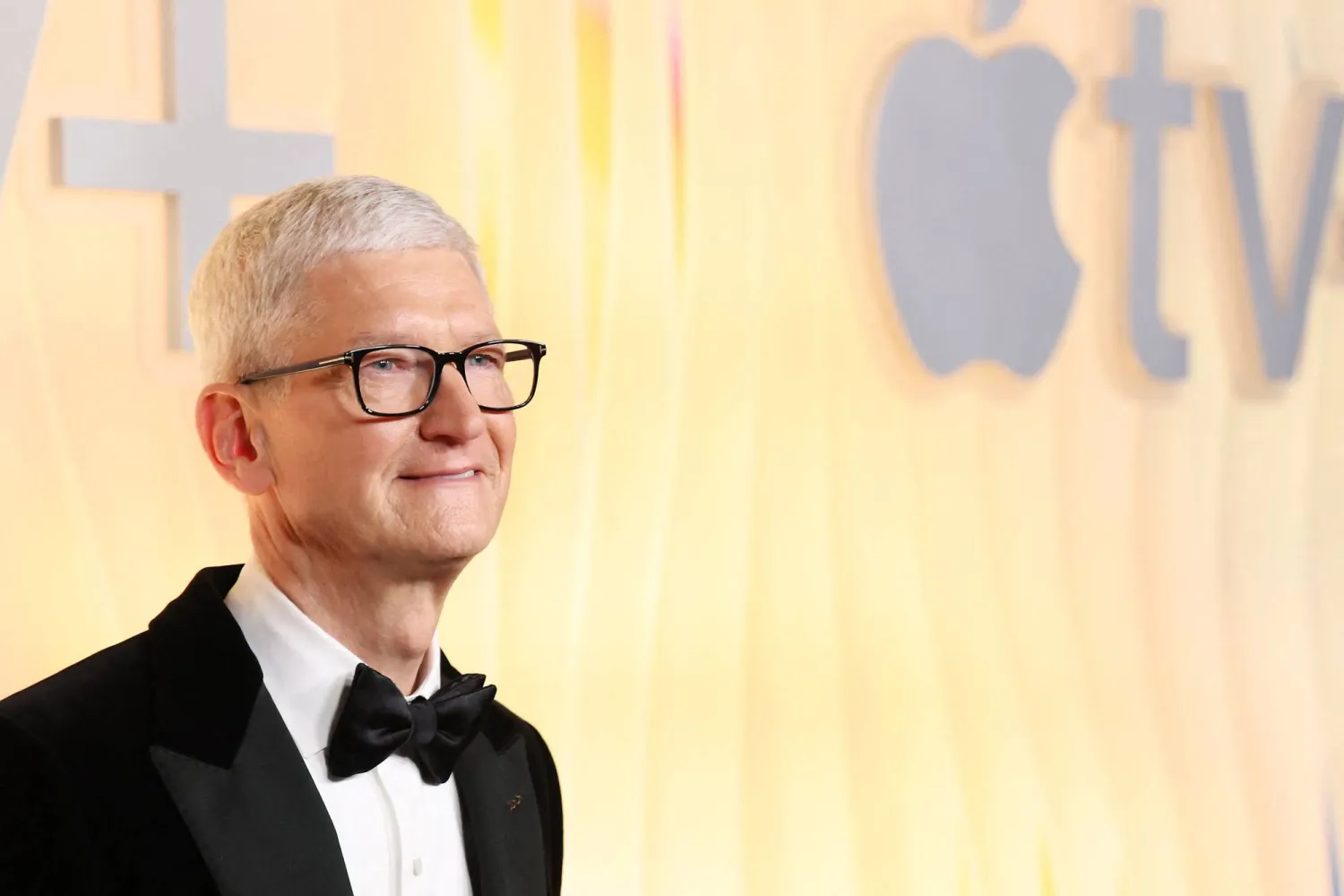
Apple CEO Tim Cook arrives for Apple TV+'s Primetime Emmy Party in West Hollywood, California, on September 14, 2025. (AFP)
TT

Tim Cook’s Time as Apple Chief Marked by Profit Absent Awe

Apple CEO Tim Cook arrives for Apple TV+'s Primetime Emmy Party in West Hollywood, California, on September 14, 2025. (AFP)

An Alabama-born engineer seen as a supply-chain savant, Tim Cook took on the daunting challenge of succeeding Apple's iconic boss Steve Jobs 15 years ago.

While Cook is not known for the culture-changing "one more thing" gadget reveals that Jobs fans came to expect, he guided the company to a stunning valuation of some $4 trillion based on its share price.

Cook built up Apple's lucrative business selling digital content and services to lovers of its devices, and his legacy is marked by the success of Apple Watch and Airpods, as well as strong ties with China as a manufacturing hub and a major market.

- iPhones galore -

Apple had a market valuation of $350 billion when Cook succeeded Jobs, who died in October 2011.

While Jobs launched the iPhone in 2007, it was then chief operating officer Cook who oversaw the supply chain that met demand while minimizing costs.

Most of the money Apple makes comes from iPhone sales.

- Slow and steady -

Since taking over for Jobs, Cook has faced pressure to show Apple could come up with "the next big thing" without its legendary co-founder.

The Apple Watch launched by Cook in 2015 became the top-selling smartwatch in the world, and he introduced the world to Airpods, wireless earbuds which went on to become sophisticated fashion statements in a sea of competition.

Cook also led a shift to Apple making custom chips, ending 20 years of dependence on outside suppliers and gaining more control of its hardware.

- Digital services -

One of Cook's profitable pivots at Apple was to sell digital content and services, from streaming music and television to cloud data storage and apps for iPhones.

By 2024, Apple's services segment accounted for nearly a quarter of its revenue.

Central to that strategy is the App Store, which Apple made the sole gateway to software on its devices, taking a cut of transactions -- and thereby drawing accusations of monopoly abuse, regulatory scrutiny in Europe and court orders in the United States to open up its platform.

- China -

Cook's reliance on China in the Apple supply chain served the company well until US President Donald Trump targeted the country for tariffs as part of a trade war.

Apple has since worked to diversify production to India, Vietnam and even the United States.

Meanwhile, smartphone competitors in China are seen as gaining an edge as shoppers there are encouraged to buy local brands.

- Stumbles -

Cook's run at the helm of Apple was far from perfect, however.

Under Cook, Apple spent billions of dollars on a self-driving electric vehicle project called "Titan" that it wound up scrapping in 2024.

An Apple Maps service launched in 2012 was so rife with errors that Cook published a letter of apology.

And, while a technical marvel, the Apple Vision Pro "spacial computing" headgear launched in 2024 with a price tag of $3,500 and has made little traction in the market.

A promised upgrade to Apple's digital assistant Siri was delayed, in what analysts called a rare stumble for the company.

And rather than relying on its own engineers to overhaul Siri, Apple has turned to Google for its AI capability.



Meta Launches WhatsApp ‘Incognito’ Mode to Address Privacy Concerns for AI Chats

A WhatsApp icon is displayed on an iPhone, Nov. 15, 2018, in Gelsenkirchen, Germany. (AP)
TT

Meta Launches WhatsApp ‘Incognito’ Mode to Address Privacy Concerns for AI Chats

A WhatsApp icon is displayed on an iPhone, Nov. 15, 2018, in Gelsenkirchen, Germany. (AP)

Meta Platforms said Wednesday it is rolling out an “incognito” mode for WhatsApp users to have private conversations with its AI chatbot, a move intended to ease privacy concerns about sensitive information that users share in chats.

The social media company said in a blog post that incognito chat mode provides a way to have private, temporary conversations with Meta AI, its artificial intelligence assistant that's been available on WhatsApp for a few years.

Messages will be processed in a “secure environment" that even Meta can't access, won't be saved by default and will disappear when exiting a session, Meta said.

Generative AI systems have been dogged by privacy concerns because the large language models that underpin these systems are trained on vast troves of data, sometimes including personal information provided by users themselves in their conversations with AI chatbots.

Rival chatbot makers already have some privacy features. Google's Gemini chatbot has the option to disable chat history and opt out of allowing one's data to be used in training its AI models. ChatGPT has similar controls.

Meta says it's rolling out incognito chats because users often ask chatbots sensitive questions or include private financial, personal, health or work data in their questions.

“We’re starting ask a lot of meaningful questions about our lives with AI systems, and it doesn’t always feel like you should have to share the information behind those questions with the companies that run those AI systems,” Will Cathcart, Meta’s head of WhatsApp, told reporters.

Incognito chat mode has safety features to prevent the chatbot from answering questions about harmful topics, Cathcart said.

It will “steer the user towards helpful information if it can and then refuse (to answer) and eventually even just stop interacting with the user completely,” Cathcart said.

Users will only be able to type in questions and get text responses; they won't be able to upload or generate images. They'll also have to confirm their age because Meta doesn't allow users under 13 on its platforms.


Singapore Needs to Attract AI Giants, Growth Committee Says

FILE - A view of the Port of Singapore Authority's Pasir Panjang Terminal is pictured on July 25, 2023. (AP Photo/Anton L. Delgado, File)
TT

Singapore Needs to Attract AI Giants, Growth Committee Says

FILE - A view of the Port of Singapore Authority's Pasir Panjang Terminal is pictured on July 25, 2023. (AP Photo/Anton L. Delgado, File)

Singapore must take action to attract leading AI firms and also build on its status as a major energy hub, a committee set up to chart new areas of growth and create jobs said in recommendations submitted to the government on Wednesday.

The proposals come as the city-state bets on artificial intelligence to transform its economy and its workforce, and as geopolitical tensions like the Iran war threaten to undermine growth and ⁠raise inflation.

Following are ⁠some of the recommendations made by the committee:

The committee said Singapore should respond to the difficult global environment by sharpening its value proposition and build agility and adaptability.

Singapore should persuade leading industries to "anchor" in the ⁠country, building on its role as a key node in supply chains for industries like semiconductors.

Promising sectors include quantum technologies and space technologies, which leverage existing capabilities in semiconductors, advanced manufacturing, aerospace and satellite systems, the committee said.

Singapore should also aim to be a "trusted hub" where AI is developed, tested and deployed, and could do this by attracting leading ⁠AI ⁠companies and talent.

Singapore should build on its role as an energy hub and build capabilities in emerging domains such as liquefied natural gas trading, as well as in hydrogen, ammonia, and sustainable aviation fuels.

Deputy Prime Minister Gan Kim Yong delivered a speech addressing the recommendations at a business federation conference on Wednesday.

He said, "In a changed world, Singapore cannot assume that yesterday's strengths will automatically become tomorrow's place."


EU Plans New Rules Targeting Addictive Design on TikTok, Meta, to Protect Children

 Instagram, TikTok, Snapchat, Kick, YouTube, Facebook, Twitch, Reddit, Threads and X applications are displayed on a mobile phone ahead of new law banning social media for users under 16 in Australia, in this picture illustration taken on December 9, 2025. (Reuters)
Instagram, TikTok, Snapchat, Kick, YouTube, Facebook, Twitch, Reddit, Threads and X applications are displayed on a mobile phone ahead of new law banning social media for users under 16 in Australia, in this picture illustration taken on December 9, 2025. (Reuters)
TT

EU Plans New Rules Targeting Addictive Design on TikTok, Meta, to Protect Children

 Instagram, TikTok, Snapchat, Kick, YouTube, Facebook, Twitch, Reddit, Threads and X applications are displayed on a mobile phone ahead of new law banning social media for users under 16 in Australia, in this picture illustration taken on December 9, 2025. (Reuters)
Instagram, TikTok, Snapchat, Kick, YouTube, Facebook, Twitch, Reddit, Threads and X applications are displayed on a mobile phone ahead of new law banning social media for users under 16 in Australia, in this picture illustration taken on December 9, 2025. (Reuters)

The European Union is working on new rules to protect children against the addictive designs of social media platforms like TikTok, Meta and X, the EU chief said on Tuesday, as the bloc toughened its stance on Big Tech.

"Sleep deprivation, depression, anxiety, self-harm, addictive behaviour, cyberbullying, grooming, exploitation, suicide. Risks are multiplying fast," European Commission President Ursula Von der Leyen said in Copenhagen.

"The question is not whether young people should have access to social media, the question is whether social media should have access to young people," Von der Leyen said, Reuters reported.

Reflecting Europe's broadside against US tech firms, Von der Leyen said the Commission would target "addictive and harmful design practices" in its Digital Fairness Act (DFA), to be proposed towards the end of the year.

BANNING MANIPULATIVE, ADDICTIVE FEATURES

The Act would ban manipulative practices, addictive features and misleading influencer marketing on digital platforms.

The risks in the digital world are "the result of business models that treat our children's attention as a commodity," she said, calling for strict limits on AI use in social media.

"The question is not whether young people should have access to social media, the question is whether social media should have access to young people," Von der Leyen said.

The Commission may propose a minimum age for platform access this summer, Von der Leyen said, adding: "We are taking action against TikTok and its addictive design, endless scrolling, autoplay and push notifications."

"The same applies to Meta, because we believe Instagram and Facebook are failing to enforce their own minimum age of 13."

Spokespeople at the three companies did not immediately respond to requests for comment.

CRACKING DOWN ON TEEN SOCIAL MEDIA USE

The new regulation will strengthen and expand the EU's Digital Services Act (DSA), which requires large platforms to do more to tackle illegal and harmful content, Von der Leyen said.

Under the DSA rules, the Commission is already investigating TikTok, X and Meta Platforms' Instagram and Facebook.

It has been investigating X over possible risks from deploying Grok in the EU, including the spread of manipulated sexualised images.

On Tuesday, Europe's top court sided with Italy's telecoms watchdog against Meta saying it should compensate publishers for using snippets of their articles.

TikTok, meanwhile, made a last-ditch attempt to scrap its designation as a "gatekeeper" under EU rules, which require it to meet tougher standards.

Europe is hardening its stance more broadly against social media, with nations from Norway and France to Turkey and Britain debating or rolling out legislation to ban or limit teenage social media use.