


Behind The Scenes: US-Israeli Military Decisions Shaping Iran's War

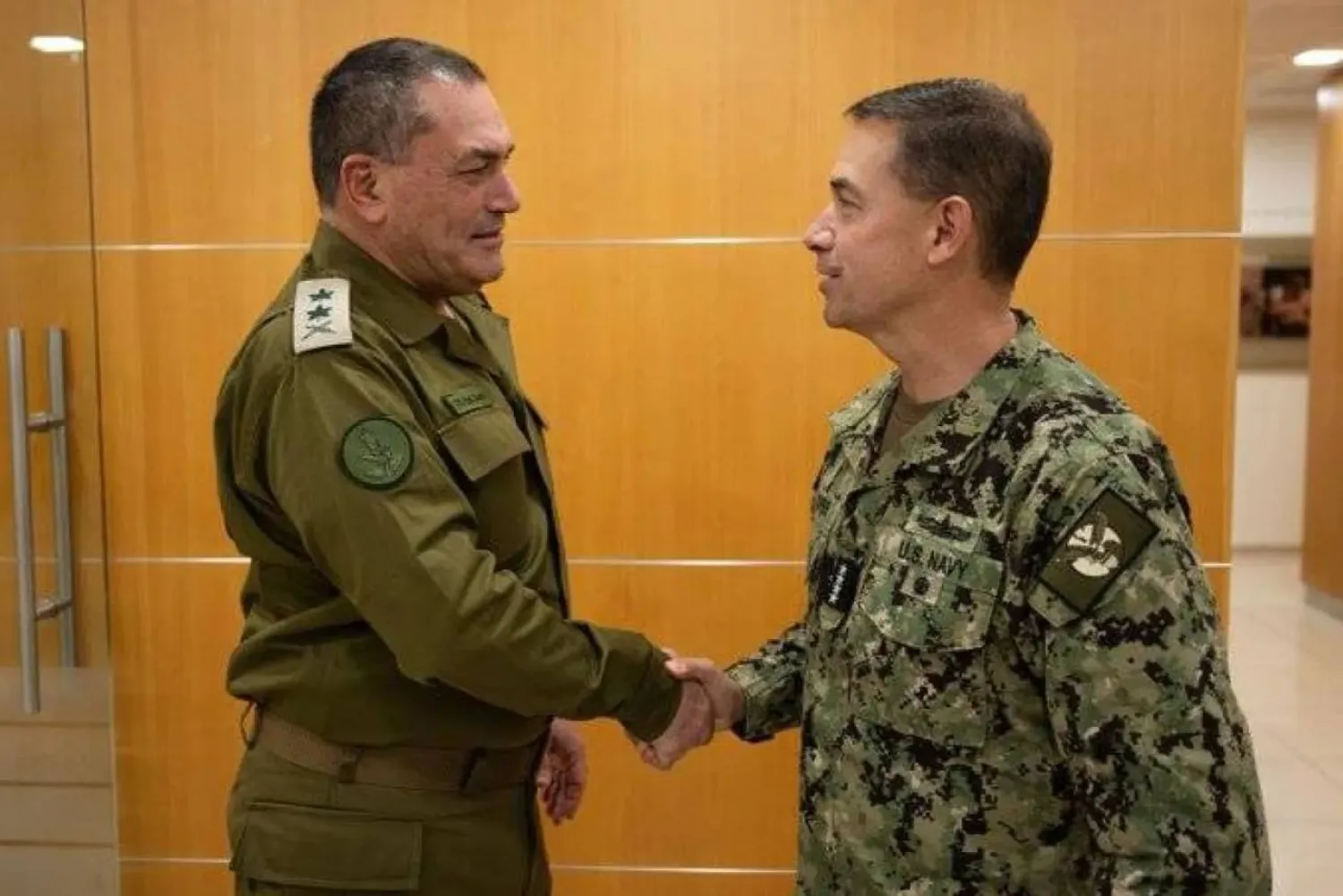
US CENTCOM chief Adm. Brad Cooper meets Israeli Army Chief of Staff Lt-Gen. Eyal Zamir during his visit to Israel (Israeli Army)
TT

Behind The Scenes: US-Israeli Military Decisions Shaping Iran's War

US CENTCOM chief Adm. Brad Cooper meets Israeli Army Chief of Staff Lt-Gen. Eyal Zamir during his visit to Israel (Israeli Army)

Although US President Donald Trump and Israeli Prime Minister Benjamin Netanyahu have made the ultimate war and ceasefire decisions regarding Iran, The Jerusalem Post revealed the details and extent to which Israeli Army Chief of Staff Lt.-Gen. Eyal Zamir, US Joint Chiefs Chairman Gen. Dan Caine, and CENTCOM Chief Admiral Brad Cooper have been the next most dominant figures.

In many ways, Zamir was key to convincing Caine and Cooper that such a war was feasible, such that they would support it, or at least not oppose it.

Caine was then critical in convincing Trump that such a war was viable, while precisely describing risks and second and third order considerations, even as the US chairman himself held doubts about significant aspects of the war, according to the Jerusalem Post.

Caine has also hovered over Trump's decisions to repeatedly announce unilateral ceasefires with Iran out of concern that any upping the ante on the military playing field could cost him in both American lives and politically.

When Netanyahu made an emergency flight to Washington to meet with Trump around 11:00 am on February 12 to try to convince him to go to war with Iran, as the US president had started to move away from that option, he presented a four-step plan.

The four steps were: First, assassinating Supreme Leader Ali Khamenei and his top military and intelligence officials. Second, pounding Iran's ballistic missile and drone capabilities. Third, helping foment an uprising within Iran against the regime, and fourth, transforming the uprising, plus possibly a ground attack by the Kurds who straddle Iran and Iraq, into regime change.

None of the three high commanders really believed in steps three or four, but Zamir was willing to roll the dice to see what might come of it, the Jerusalem Post said. Caine and Cooper were ready to go in for the first two steps and hold their noses regarding efforts at steps three and four.

It was not a coincidence that Israel was assigned to bomb Iran's top leaders and thousands of Revolutionary Guard Corps and Basij command centers and locations, as well as Iranian military threat capabilities, while US forces stayed more focused almost exclusively on Iranian capabilities.

Trump, to some extent under the influence of Caine (with Cooper supporting in the background), kept the US out of direct military involvement in regime change.

Sources have indicated to the Jerusalem Post that Israeli efforts to influence Trump and when and how to go to war have also heavily focused on Caine.

Zamir, Mossad Director David Barnea, and Israeli Army Intelligence Chief Maj. Gen. Shlomi Binder also visited Washington leading up to Netanyahu's February 12 White House sales pitch to make their case directly to a variety of officials, but collectively especially to Caine.
In some ways, Cooper was easier to convince than Caine, the report said.

This is partially true because Cooper did not try as much as his predecessor, Erik Kurilla, to influence the decision of whether to go to war or not, focusing more on being the architect of what the different options of going to war would look like.

Right Timing

Zamir was very successful in bringing on board Caine and Cooper, and then indirectly Trump, in the sense of convincing them that the timing was right.

The Post has learned that Zamir made a sophisticated and nuanced argument to Caine, Cooper, and others, which reached Trump.

The argument acknowledged that in theory Israel and the US could wait some period of months, as Iran had not yet crossed a redline threshold of a volume of ballistic missiles which the Israeli army would have trouble with. After all, Israel's original plan was not to attack Iran's ballistic missile program until sometime between June and November 2026.

However, Zamir said that Iran was racing forward too fast.

Iran was producing an additional 200-300 ballistic missiles per month. It had replaced about half of its lost missiles and half of its lost missile launchers in only eight months, getting back up to 2,500 missiles.

In Zamir's understanding, waiting another six months could mean an Iran with 3,700-4,300 missiles, and waiting another year could mean 4,900 to 6,100 missiles.

The report said it could also mean much more damage, could lead to Israeli difficulties with its volume of missile interceptors at a much earlier point, and collectively force Israel and the US to cut short their attacks on Iran's missile and other capabilities much earlier than what might make sense strategically.

Adding on that if Israel and the US wanted to take a real shot at regime change, that February was a unique moment to build on the January Iranian domestic protests, the Post understands that Zamir argued that February was a unique moment to go to war. This was true despite Israel's original plan for an attack in later 2026.

Two Main Failures

The report held Zamir, Caine and Cooper responsible for two main failures, the first being the inability to stop Iranian missiles.

It said only days into the war, Zamir, Caine, and CENTCOM were telling the public that missile fire was down 70-90%. The expectation was that within a week or two, it would be down to a drizzle. But while missile fire did drop to a medium level, the fading to a drizzle never happened.

None of the top Israeli or American officials anticipated how rapidly Iran would be able to unearth its underground missile launchers, which the allies had caused to be neutralized with cave-ins.

Pre-war estimates were that cave-ins would neutralize such missiles for the rest of the war, whereas in many cases, the Post has learned that Iran has developed bulldozer teams and techniques to uncover caved-in missile teams or silos within less than a day.

Also, Iran spread its surviving missile crews throughout its vast country, making it nearly impossible to track them down efficiently, and adjusted its missiles such that over 70% of them included cluster munitions, which the Israeli army was much less ready to defend against.

The second potential failure of Caine and Cooper relates to Hormuz.

The report found that neither Caine nor Cooper raised their voices loudly and decisively about the Hormuz nightmare scenario, again preferring to provide neutral advice to a US president, who clearly was out of his depth in aspects of this conflict.

The two of them could have seen this scenario coming, and so their choice, despite their heavy potential influence, to not raise the alarm loudly enough leaves them with some contributory fault in not better preparing Trump and the US.

The fact that the US needed to wait several weeks into the war before troops were in place to do something about Hormuz, if necessary, was a massive strategic miss.

In fact, the US could have even deployed forces into the Hormuz area the day the conflict started, as opposed to focusing on sinking large Iranian naval vessels first.

Overall, the report found that the military campaign pitched by Zamir and approved by Caine and Cooper succeeded more than might have been expected upfront, with notable exceptions regarding the continuity of medium-level ballistic missile threats and regarding Hormuz.

It said the military gains into long-standing strategic achievements is now more in the hands of the political and diplomatic leaders than the generals.



Merz Floats Sanctions Relief for Iran Peace Deal, Other EU Leaders Cautious

 Germany's Chancellor Friedrich Merz speaks during a press conference after taking part in an informal meeting of the European Council in Nicosia on April 24, 2026. (AFP)
Germany's Chancellor Friedrich Merz speaks during a press conference after taking part in an informal meeting of the European Council in Nicosia on April 24, 2026. (AFP)
TT

Merz Floats Sanctions Relief for Iran Peace Deal, Other EU Leaders Cautious

 Germany's Chancellor Friedrich Merz speaks during a press conference after taking part in an informal meeting of the European Council in Nicosia on April 24, 2026. (AFP)
Germany's Chancellor Friedrich Merz speaks during a press conference after taking part in an informal meeting of the European Council in Nicosia on April 24, 2026. (AFP)

German Chancellor Friedrich Merz suggested on Friday that the European Union could ease sanctions on Tehran as part of a comprehensive deal that would end the Iran war, but other EU leaders struck a more cautious note.

The 27-nation EU has imposed sanctions on Iran for years, including travel bans and asset freezes for senior officials and entities, in response to human rights violations, nuclear activities and military support for Russia.

US officials have suggested a ‌comprehensive deal covering Iran's ‌nuclear and missile programs and the ‌re-opening ⁠of the Strait of ⁠Hormuz could bring a lasting end to the US-Israeli war with Tehran, beyond the current ceasefire.

After an EU summit in Cyprus, Merz said the bloc could gradually ease sanctions on Iran in the event that a comprehensive agreement was reached.

European leaders have been largely sidelined in the current Middle ⁠East conflict but some European officials see ‌the bloc's sanctions as a possible ‌way for the EU to be involved in a diplomatic solution.

"The ‌easing of sanctions can be part of a process," ‌Merz told reporters after the Nicosia summit.

"No one has objected to that," he said of the summit deliberations. "It is, so to speak, part of the contribution we can make to advance this ‌process and, hopefully, lead to a permanent ceasefire."

But European Council President Antonio Costa, the chair ⁠of the summit, ⁠told a press conference after the end of the meeting: "It is too early to talk about relieving any kind of sanctions."

European Commission President Ursula von der Leyen said sanctions relief could only come after clear evidence of fundamental changes of course from Iran.

"We believe that sanctions relief should be conditional on verification of de-escalation, particularly on progress on the international effort to contain its nuclear threat, and on a change to the repression of its own people," she told the same press conference.


German Court Jails Hezbollah Supporter Over Videos Showing Weapons

Coffins sit on a trailer beneath portraits of Hezbollah fighters killed before a 10-day ceasefire was agreed between the Iran-backed militant group and Israel during a mass funeral procession in the southern village of Kfar Sir on April 21, 2026. (AFP)
TT

German Court Jails Hezbollah Supporter Over Videos Showing Weapons

Coffins sit on a trailer beneath portraits of Hezbollah fighters killed before a 10-day ceasefire was agreed between the Iran-backed militant group and Israel during a mass funeral procession in the southern village of Kfar Sir on April 21, 2026. (AFP)

A German court on Friday sentenced a supporter of Lebanon's Hezbollah party to more than three years in jail Friday over for "illegal access to weapons" and social media posts supporting the group.

Earlier in the same trial the 30-year-old was acquitted on charges of actually fighting for Hezbollah and being a member of the group.

The court in Berlin gave him a sentence of three years and nine months over social media posts he made with videos taken during a trip to Lebanon in 2023.

In the videos he was seen handling rifles and anti-tank missiles and taking part in shooting practice.

The court found he also spread propaganda videos and displayed Hezbollah symbols, such as flags and scarves.

However, the court said that the videos in question showed that the accused had had no training in dealing with the weapons and that he had acted in a "partly amateurish" fashion.

His earlier claims to have fought with the group were made up in order to impress his friends, the court found.

Hezbollah's military wing is classed as a terrorist organization by the United States, the European Union and Britain.

Germany considers Hezbollah a "Shiite terrorist organization" and in 2020 banned Hezbollah from carrying out activities on its soil.


Key Go-Between Switzerland to Reopen Embassy in Iran

 Milad telecommunication tower is seen at left in a general view of a part of Tehran, Iran, Thursday, April 23, 2026. (AP)
Milad telecommunication tower is seen at left in a general view of a part of Tehran, Iran, Thursday, April 23, 2026. (AP)
TT

Key Go-Between Switzerland to Reopen Embassy in Iran

 Milad telecommunication tower is seen at left in a general view of a part of Tehran, Iran, Thursday, April 23, 2026. (AP)
Milad telecommunication tower is seen at left in a general view of a part of Tehran, Iran, Thursday, April 23, 2026. (AP)

Switzerland said Friday it had begun sending staff back to Tehran and would gradually reopen its embassy, enabling it to continue as a facilitator for diplomatic contacts between Washington and Tehran.

For decades, neutral Switzerland has played a central role in maintaining basic diplomatic contacts between Iran and the United States.

But the country temporarily closed its embassy on March 11 days after the Middle East war erupted with the first US-Israeli attacks on Iran.

The Swiss foreign ministry said four staff had returned and insisted the channel of communication between the US and Iran had been kept open even while the mission was shut.

"The decision to gradually reopen the embassy was taken after a risk analysis and in consultation with Iran and the United States, whose interests Switzerland represents under its protecting power mandate," the foreign ministry said in a statement.

Switzerland "is prepared to provide its good offices if the parties so wish and supports all diplomatic initiatives that contribute to de-escalation and a lasting peace".

Switzerland has represented US interests in Iran since Washington broke off relations with Middle Eastern country after the 1980 hostage crisis, which came a year after the Iranian revolution.

The Swiss embassy in Tehran handles all consular affairs between the United States and Iran, including passport requests, altering civil status and consular protection for US citizens in Iran.

Under the protecting power mandate, "Switzerland can either offer to act as a go-between on its own initiative or can fulfil this function at the request of the parties concerned, provided that all those involved agree", the foreign ministry says on its website.

A ceasefire has been in place since April 8 but prospective peace talks between senior US and Iranian envoys Pakistan are hanging in the balance.

Iran has all but closed the Strait of Hormuz in retaliation for the war, while the US has imposed a blockade of its own on Iranian ports.