


Iran War Is Latest Blow to Somalia’s Malnourished Children

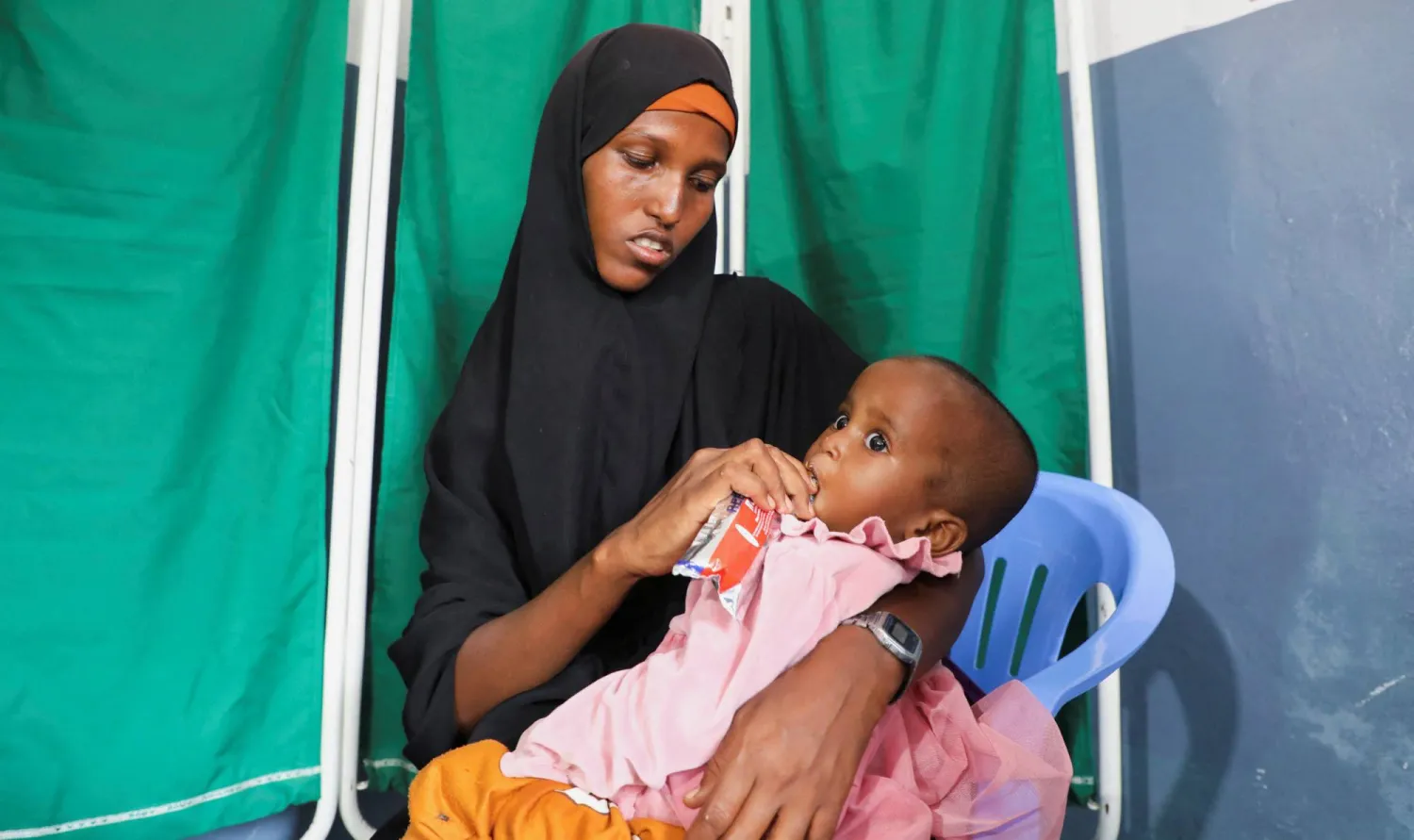
Fatima Mohamed feed Iqlas Omar Abdi, 1, with nutritious supplementary biscuit at the Daynile hospital as shortages of lifesaving therapeutic foods caused by shipping disruptions due to the Iran war have forced clinics treating severely malnourished children to turn away patients and ration supplies in drought-hit Somalia, in Daynile district of Mogadishu, Somalia April 20, 2026. (Reuters)
TT

Iran War Is Latest Blow to Somalia’s Malnourished Children

Fatima Mohamed feed Iqlas Omar Abdi, 1, with nutritious supplementary biscuit at the Daynile hospital as shortages of lifesaving therapeutic foods caused by shipping disruptions due to the Iran war have forced clinics treating severely malnourished children to turn away patients and ration supplies in drought-hit Somalia, in Daynile district of Mogadishu, Somalia April 20, 2026. (Reuters)

For Somalia's malnourished children, already suffering the twin catastrophes of looming famine and radical cuts in foreign aid, the US-Israeli war on Iran means more than soaring petrol pump prices; it is a matter of life and death.

Shortages of lifesaving therapeutic foods exacerbated by shipping disruptions are forcing clinics to turn away severely malnourished children and ration supplies, Reuters reporting shows.

Almost half a million children under 5 suffer from "severe acute malnutrition" or "wasting", the most life-threatening form of hunger, and the delays are worsening the effect of the aid reductions.

SOMALIA'S CHILDREN RELY ON EVER-SHRINKING FOOD AID

Health workers in Baidoa and Mogadishu say they have had to stretch out meagre stocks of specialized milk and nutrient-dense peanut-based paste vital to saving these children.

"Since the needs are large and we don't have a lot of supplies, we have had to keep reducing the amount we give children," nurse Hassan Yahye Kheyre said.

The 225 cartons of peanut paste remaining at his clinic, which treats more than 1,200 children, will probably be exhausted within two weeks, according to the International Rescue Committee, which supplies the facility.

"If ‌treatment is on-and-off, the ‌children will become very weak, physically and mentally. And it may not be possible to reverse it," ‌Kheyre ⁠added.

The IRC is ⁠one of three aid groups that said transport delays and rising costs linked to the war in Iran were making an already complicated situation worse.

At the clinic in the southwestern city of Baidoa, run by IRC's local partner READO, mother-of-nine Muumino Adan Aamin has been trying to get peanut paste for Ruweido, her 11-month-old daughter.

Ruweido is on a regimen of three sachets a day, but Aamin has been turned away twice because the clinic had run out each time.

Aamin nearly lost her daughter Anisa to hunger when a previous drought pushed Somalia to the brink of famine in 2017. "Just bone and skin," the toddler only survived because of peanut paste, Aamin said.

Nine years on, a new drought has pushed 6.5 million people, or one in three Somalis, ⁠into acute hunger, and aid groups are desperately trying to plug gaps.

An IRC order for peanut ‌paste that would have fed over 1,000 children got stuck two months ago in the ‌Indian port of Mundra, now congested with diverted cargoes unable to dock in the Gulf, said Shukri Abdulkadir, IRC's Somalia coordinator.

After being told that the peanut ‌paste, made in India, would take at least 30 more days to arrive, IRC cancelled the order.

It placed an emergency order for ‌400 cartons from Nairobi and is moving supplies in Mogadishu to Baidoa while awaiting them.

But the increase in freight and manufacturing costs has pushed the price of a single carton to $200 from $55, according to CARE International, whose latest order now buys enough for only 83 children rather than 300.

LIFE-SAVING FOOD AID TAKES LONGER AND COSTS MORE

In 2024, deliveries of therapeutic milk and ready-to-use therapeutic food (RUTF) from Europe to Somalia typically took 30–35 days, increasing to 40–45 days in 2025 as vessels diverted around ‌Africa owing to security threats in the Red Sea.

Since the United States and Israel attacked Iran on February 28 and Iran closed the entrance to the Gulf, a lack of ships ⁠has pushed that out to 55–65 days, ⁠said Mohamed Omar, head of Health and Nutrition at Action Against Hunger (ACF) in Mogadishu.

Meanwhile in Somalia, the IPC global hunger monitor says more than 2 million people are now in the "Emergency" phase, one level before famine.

Admissions of severely malnourished children in January-March to health centers supported by ACF were up 35% from last year.

Staff at Daynile General Hospital, which is treating 360 children for wasting, said on April 20 that they barely had enough supplies for the week.

"Some children's nutritional status has already worsened," said health and nutrition supervisor Xafsa Ali Hassan.

Somalia was not among 17 impoverished nations singled out to receive a share of this year's funds allocated to the UN Office for the Coordination of Humanitarian Affairs (OCHA) by the US, which has made the most drastic cuts among foreign aid donors.

OCHA says more than 200 health facilities have been closed and mobile teams disbanded.

It said in December that over 60,500 severely malnourished children had gone untreated as a result, and that the number could rise to 150,000 if funding gaps persisted.

Then, when the Iran war erupted, domestic fuel prices leapt 150%.

"Somalia is really hard hit by the Iran war because people are still reeling from the impact of the previous drought," said IRC's Abdulkadir. "It's very difficult for people to absorb these shocks."

OCHA has appealed for $852 million from global donors to stave off a full-blown famine.

This is far below the $1.42 billion it requested last year - yet it has still barely received 14% of this amount.



Tunisia President Sacks Energy Minister Ahead of Renewable Energy Projects Vote

Tunisian ‌President Kais Saied. (AFP)
TT

Tunisia President Sacks Energy Minister Ahead of Renewable Energy Projects Vote

Tunisian ‌President Kais Saied. (AFP)

Tunisia’s ‌President Kais Saied dismissed Energy Minister Fatma Thabet on Tuesday, amid growing controversy over renewable energy projects set to be voted on in parliament.

Saied said he had appointed Housing and Infrastructure Minister Salah Eddine ‌Zouari to ‌temporarily oversee the ministry. ‌No ⁠detailed explanation was ⁠provided for the decision.

The move comes as Saied's government seeks to pass draft laws on renewable energy, which ⁠will be put to ‌a ‌vote in parliament later on Tuesday.

The ‌projects have a planned ‌capacity of 600 megawatts, with 500 million euros ($585 million) as total investment.

The projects are ‌part of Tunisia’s efforts to expand clean energy ⁠production. ⁠Some lawmakers and political parties oppose the projects, describing them as a form of "energy colonization."

They have criticized the exclusion of the state electricity company (STEG) from the contracts, which they say were awarded exclusively to foreign firms.


Israeli Strikes on Gaza Kill Five, Including 9-Year-Old Boy, Medics Say

 Mourners react during the funeral of Palestinian child Adel Al-Najjar, who was killed today in an Israeli strike, according to medics, at Nasser Hospital in Khan Younis, in the southern Gaza Strip, April 28, 2026. (Reuters)
Mourners react during the funeral of Palestinian child Adel Al-Najjar, who was killed today in an Israeli strike, according to medics, at Nasser Hospital in Khan Younis, in the southern Gaza Strip, April 28, 2026. (Reuters)
TT

Israeli Strikes on Gaza Kill Five, Including 9-Year-Old Boy, Medics Say

 Mourners react during the funeral of Palestinian child Adel Al-Najjar, who was killed today in an Israeli strike, according to medics, at Nasser Hospital in Khan Younis, in the southern Gaza Strip, April 28, 2026. (Reuters)
Mourners react during the funeral of Palestinian child Adel Al-Najjar, who was killed today in an Israeli strike, according to medics, at Nasser Hospital in Khan Younis, in the southern Gaza Strip, April 28, 2026. (Reuters)

Israeli strikes killed five Palestinians, including a 9-year-old boy, in the Gaza Strip on Tuesday, health officials said.

Medics said an Israeli drone killed the child, Adel Al-Najjar, in eastern Khan Younis in the south of the enclave, while an Israeli airstrike targeted a vehicle in Gaza City, killing four people.

The Israeli military did not ‌immediately comment on ‌either incident.

At Nasser Hospital’s morgue, relatives arrived ‌to ⁠bid farewell to Najjar's ⁠small, white-shrouded body.

Women cried next to the body, which lay on a medical stretcher on the floor, and men held a special prayer before carrying him to the cemetery for burial.

The boy was collecting cardboard that the family uses for cooking, relatives said. There has been no electricity in ⁠Gaza since the war began in October 2023, ‌and Palestinians have complained of Israeli ‌restrictions on the entry of cooking gas.

"We don't have gas. ‌We collect cardboard to bake, they want to eat; they ‌want to drink," said one of the boy's relatives, Sabreen Al-Najjar.

Violence in Gaza has persisted despite an October 2025 ceasefire, with Israel conducting almost daily attacks on Palestinians.

At least 800 Palestinians have been ‌killed since the ceasefire took effect, according to local medics, while Israel says gunmen attacks have ⁠killed four ⁠of its soldiers over the same period.

“Isn’t it shameful what is happening to us? Isn’t it shameful that we bury our children every day, right in front of us? Isn’t it shameful? I swear to God, our hearts are breaking for these children,” another relative, Suhaib Al-Najjar, said at the morgue.

Israel and Hamas have blamed each other for ceasefire violations.

More than 72,500 Palestinians have been killed since the Gaza war began in October 2023, according to Gaza health authorities.

Hamas’ October 7, 2023, attacks on Israel killed 1,200 people, according to Israeli tallies.


Israel Says Has ‘No Territorial Ambitions’ in Lebanon, Despite Evacuations

 Smoke rises following an explosion in southern Lebanon, near the Israel-Lebanon border, as seen from northern Israel, April 28, 2026. (Reuters)
Smoke rises following an explosion in southern Lebanon, near the Israel-Lebanon border, as seen from northern Israel, April 28, 2026. (Reuters)
TT

Israel Says Has ‘No Territorial Ambitions’ in Lebanon, Despite Evacuations

 Smoke rises following an explosion in southern Lebanon, near the Israel-Lebanon border, as seen from northern Israel, April 28, 2026. (Reuters)
Smoke rises following an explosion in southern Lebanon, near the Israel-Lebanon border, as seen from northern Israel, April 28, 2026. (Reuters)

Israel on Tuesday said it was not seeking to take territory in Lebanon, as its military issued a wave of new evacuation warnings for towns and villages in the battle-scarred south. 

"Israel has no territorial ambitions in Lebanon. Our presence... serves one purpose: protecting our citizens," Foreign Minister Gideon Saar told a news conference. 

"No country would be willing to live in such a way with a gun pointed to its head," he said as the military pressed its operations in Lebanon against Iran-backed Hezbollah. 

Shortly after a ceasefire with Hezbollah came into effect on April 17, Israel declared a so-called "Yellow Line" -- a strip of Lebanese territory around 10 kilometers (six miles) deep along the border within which Israeli troops are operating. 

"In a reality where Hezbollah and other terror organizations -- including Palestinian terror groups -- are dismantled, Israel will have no need to maintain its presence in these areas," he added. 

Despite the ceasefire, Israel and Hezbollah have both engaged in fighting, trading blame over violations of the fragile truce. 

Tuesday's evacuation warning was aimed at residents in more than a dozen villages and towns, urging them to immediately head northwards. 

"Out of concern for your safety, you are required to evacuate your homes immediately and move... towards the Sidon District," the military's Arabic-language spokesman Avichay Adraee wrote on X. 

Shortly afterwards, Lebanon's state media reported that Israel carried out airstrikes across the south, hitting targets including the named areas. 

It also said at least one Israeli demolition operation was taking place in the south. 

All the areas listed for evacuation appear to be outside or on the border of the "Yellow Line". 

In two incidents earlier on Tuesday, the military said it intercepted "a suspicious aerial target" in an area where troops were operating. 

It also said a soldier had been severely injured and another lightly hurt a day earlier "as a result of an explosive drone impact", branding it a new ceasefire violation by Hezbollah. 

Israeli Prime Minister Benjamin Netanyahu said Monday that Hezbollah's rockets and drones remained a key threat requiring ongoing military action. 

Hezbollah drew Lebanon into the Middle East war on March 2 by firing rockets towards Israel to avenge the killing of Iranian supreme leader Ali Khamenei.