



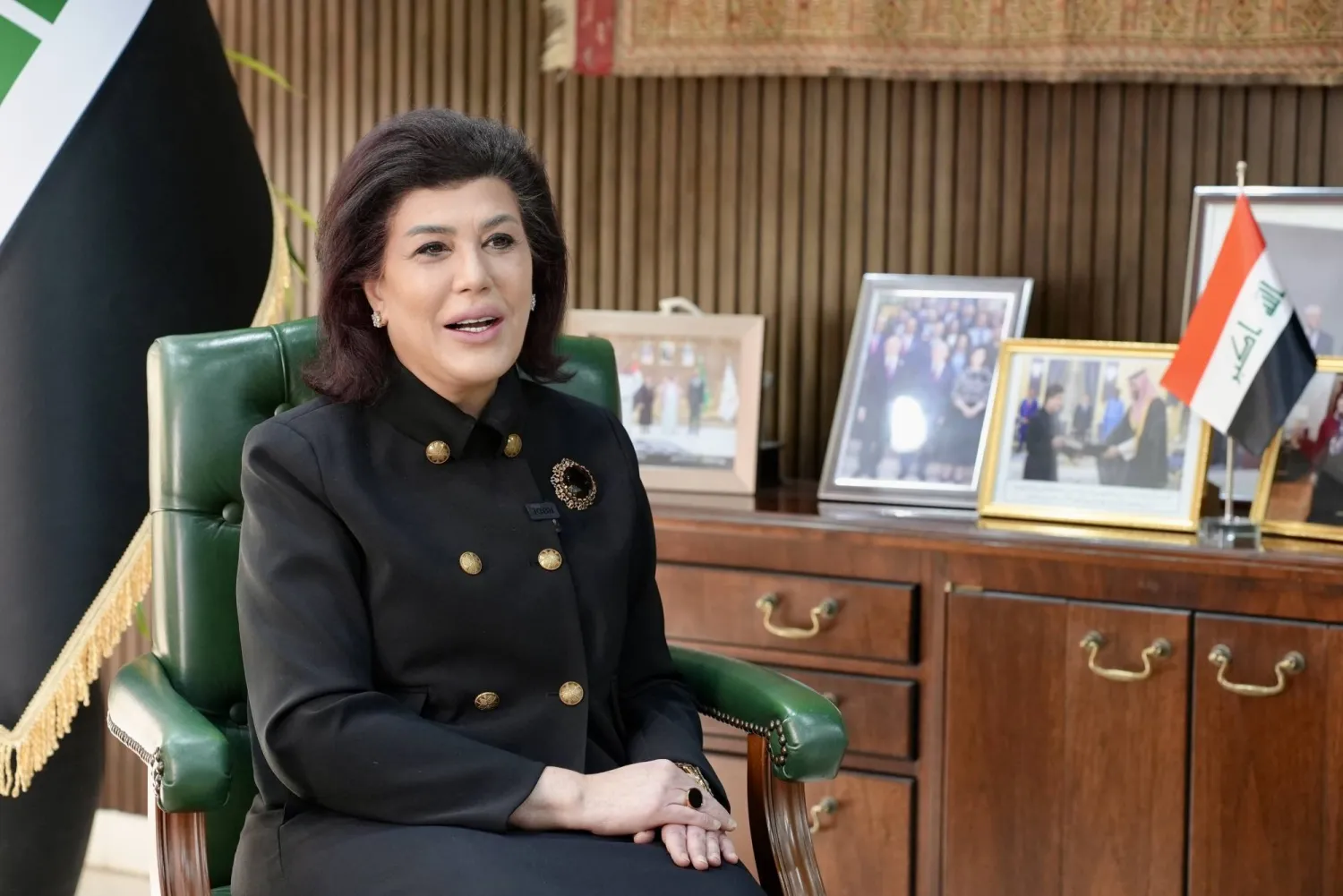

Iraq’s ambassador to Saudi Arabia Safia Taleb Al-Suhail said the number of Iraqi pilgrims this year has reached around 41,000, with their convoys beginning to arrive in Saudi Arabia at a rate of about 1,500 pilgrims per day through the Jadidat Arar border crossing in the north of the Kingdom, within an integrated system of services.
Al-Suhail confirmed, in statements to Asharq Al-Awsat, that coordination between Baghdad and Riyadh is taking place at the highest levels, through the ministries of Hajj and Umrah and interior in both countries, to discuss security arrangements and ensure the transport of pilgrims until they perform their rituals with ease and reassurance.
The ambassador explained that Iraq’s adoption of exclusively land transport this year came out of concern for pilgrims’ safety in light of current regional conditions, and to avoid any emergency that could hinder their completion of the pilgrimage, praising the Jadidat Arar crossing and the facilities and advanced infrastructure it provides.
41,000 pilgrims
Safia Al-Suhail said Iraq’s quota for this season amounts to 41,000 pilgrims, according to available information, in addition to 200 doctors, as announced by the official authorities in the Iraqi Hajj and Umrah Commission.
She noted that this quota includes pilgrims from all Iraqi provinces and the Kurdistan Region, along with accompanying administrative, medical, guidance, and media staff.
Adoption of land transport
The ambassador said Baghdad adopted this season the option of transporting pilgrims exclusively by land through the Jadidat Arar crossing in northern Saudi Arabia, a decision taken out of concern for pilgrims’ safety and in line with the current realities in the region.
She added: “The first convoys of Iraqi pilgrims departed on the evening of Sunday, April 26, and their first groups were received under the supervision of Prince Faisal bin Khalid, Governor of the Northern Borders Region, who gives this matter continuous attention that we highly appreciate, as he, along with officials in Arar, ensured that the reception of Iraqi pilgrims was at the highest level of hospitality, facilitation, and services.”
Jadidat Arar crossing
Al-Suhail praised the Jadidat Arar crossing, noting that it “features advanced infrastructure that we personally reviewed along with embassy staff, including a Hajj hall exceeding 9,000 square meters, with a capacity of up to 20,000 pilgrims per day, 68 passport counters, six inspection points, in addition to an integrated medical and security system operating around the clock.”
She noted that “transport is proceeding at a rate of about 1,500 pilgrims per day, via convoys of modern, air-conditioned buses, and rest stations along the route inside Saudi territory, within a fully equipped tent city prepared by Saudi Arabia’s Ministry of Hajj and Umrah according to the highest standards, providing accommodation, meals, healthcare, and places for prayer.”
Coordination with the Saudi side
Al-Suhail stressed that relations between Iraq and Saudi Arabia are long-standing and well established, bringing together ties of religion, neighborliness, kinship, and shared interests, with the leaders of both countries keen to maintain and develop them across various fields, noting that the Hajj file holds a special place in this relationship as a matter with religious and humanitarian dimensions that rises above any other consideration.
She pointed out that Iraq was the first among more than 150 countries to sign the Hajj arrangements agreement for the 1447 AH season with Saudi Arabia’s Ministry of Hajj and Umrah, a step reflecting the depth of coordination and the keenness of both brotherly countries to remove obstacles for pilgrims, according to the ambassador.
She added: “Coordination this season has taken place at the highest levels between Iraq’s Supreme Hajj and Umrah Commission and Saudi Arabia’s Ministry of Hajj and Umrah, and in parallel between the interior ministries of both countries, as the Iraqi interior minister held extensive meetings to discuss security preparations and ensure the transport of pilgrims, attended by the head of the Supreme Hajj and Umrah Commission, the head of the Border Ports Authority, operations commanders, and provincial police leaders, in cooperation with their counterparts on the Saudi side.”
According to the ambassador, “coordination included securing the land routes inside Iraq up to the Arar crossing, after which the Saudi side assumes responsibility from the crossing to the holy sites, within an integrated framework that reflects what can be described as ‘fraternal security coordination between the two neighboring countries.’”
Preparing a tent city to accommodate pilgrims
Regarding facilities, she commended the efforts made by the Kingdom under the leadership of the Custodian of the Two Holy Mosques King Salman bin Abdulaziz and the Crown Prince in serving pilgrims, noting that services include streamlined customs and passport procedures, round-the-clock health and emergency services, full logistical support, transport and guidance services, in addition to a tent city designated to accommodate pilgrims, affirming that Saudi personnel working at the crossing are playing a notable role.
She affirmed that the Iraqi diplomatic mission, in coordination with the consulate general in Jeddah and the Iraqi Hajj mission, is following up on pilgrims’ affairs and providing the necessary consular and administrative services.
Al-Suhail recalled, in her remarks on the land route, the “Zubaydah Trail,” one of the oldest Hajj routes in Islamic history, associated with Zubaydah bint Jaafar, wife of Caliph Harun al-Rashid, who devoted her wealth to developing it and providing water for pilgrims between Kufa and Makkah.
In conclusion, the ambassador affirmed that Iraq, with its government, people, and religious authorities, places the Hajj journey above all considerations and works in a spirit of partnership with Saudi Arabia to ensure that this season is smooth, safe, and successful, God willing.


