

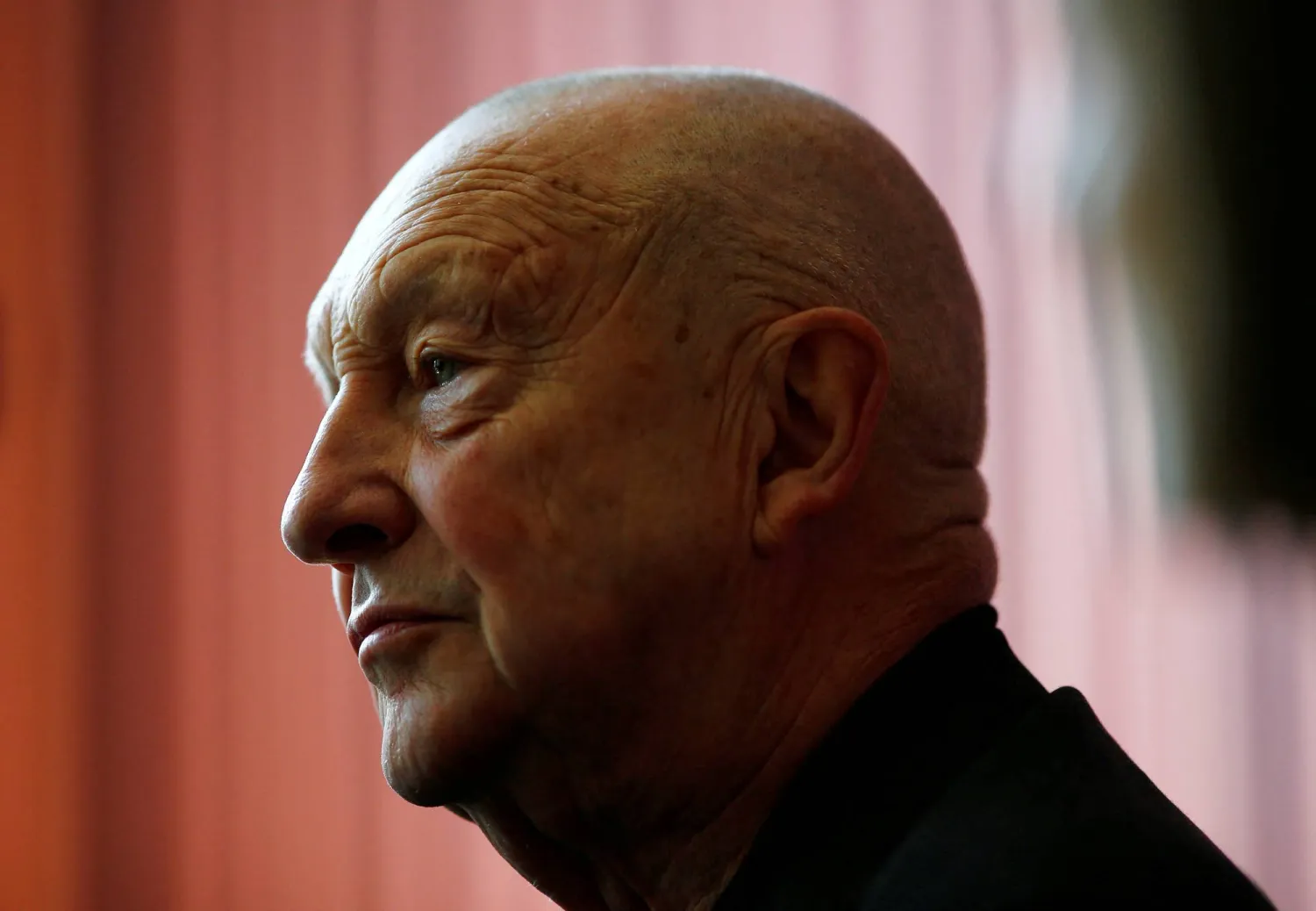

Georg Baselitz, the German Painter Who Turned Postwar Art Upside Down, Dies at 88

German artist Georg Baselitz attends the opening of his exhibition "The Heroes" (Die Helden) at the Staedel museum in Frankfurt, Germany June 29, 2016. (Reuters)
TT

Georg Baselitz, the German Painter Who Turned Postwar Art Upside Down, Dies at 88

German artist Georg Baselitz attends the opening of his exhibition "The Heroes" (Die Helden) at the Staedel museum in Frankfurt, Germany June 29, 2016. (Reuters)

Georg Baselitz liked to insist — sometimes as a taunt, ‌sometimes as a shield — that he did not know how to paint. That he had "no talent".

Rejected at 17 by the Dresden Academy of Fine Arts, he talked his way into an academy in East Berlin only to be expelled two semesters later for "sociopolitical immaturity".

"I was stupid," he recalled. "I was uneducated, but I was a rebel."

From that rebellion, Baselitz forged a career that made the child of Nazi Germany, schooled under Soviet communism, into one of the defining artists of postwar Germany.

The painter and sculptor, known for his depictions of raw bodies and inverted landscapes, has died at the age of 88, Germany's Die Welt newspaper reported on Thursday. No cause of death was given.

A REBEL SHAPED BY TWO DICTATORSHIPS

Georg Baselitz was born Hans-Georg Bruno Kern on January 23, 1938, in the Saxon village of Deutschbaselitz, a name he later adopted.

His father, a village schoolteacher and Nazi Party member, recorded Hans-Georg's birth in his diary. Inexplicably, he recorded the birth of none of his other four children, the Sächsische Zeitung daily reported in 2018.

After the war, ‌his father was ‌barred from teaching. Baselitz's mother took over his duties at the school.

Baselitz spent his childhood ‌amid ⁠the unforgiving discipline of ⁠Nazi Germany, and his adolescence amid the rubble and ideological re-education of the country's Soviet occupation zone.

"I was born into a destroyed order, a destroyed landscape, a destroyed people, a destroyed society," he later recalled. "And I didn't want to reestablish an order: I had seen enough of so-called order. I was forced to question everything, to be 'naive', to start again."

After he was expelled from the East Berlin academy, he moved to West Berlin, where he finished his studies and absorbed modernism in a way that felt, he said, like a sudden intake of oxygen.

He recalled the shock of first seeing works by Jackson Pollock and other abstract expressionists — evidence, in his telling, that ⁠the United States had a serious culture despite what he had been taught.

But rather than ‌imitate an American style, Baselitz turned back to German sources, drawing on expressionism, ‌folk traditions and imagery often dismissed by critics as ugly or even "degenerate".

SCANDAL AS A CALLING CARD

At a 1963 solo show in Berlin, authorities ‌seized two of his paintings on obscenity grounds. The episode made Baselitz famous.

The early pictures, marked by raw bodies, stunted masculinity and abrasive humor, were widely seen as provocation.

Supporters and museum curators have also framed them as a blunt report on postwar German life: damaged, compromised and struggling to find a new footing.

That sensibility carried into his mid-1960s "Heroes" paintings, which presented hulking, battered figures that looked less like victors than survivors ‌stumbling out of a defeated national myth.

But Baselitz's most recognizable works came in 1969, when he began painting motifs upside down.

After earlier experiments that fractured or partially inverted figures, he ⁠produced fully inverted works including "The ⁠Wood on Its Head" and "The Man by the Tree".

He did not simply flip finished images, he composed and painted them inverted from the start.

That approach altered how viewers read his works. By disrupting recognition, it forced attention onto the mechanics of painting — its color, balance and composition.

"An object painted upside down is suitable for painting because it is unsuitable as an object," Baselitz said.

The inversions made Baselitz an international figure in the 1970s and 1980s, as the market and institutions that once treated him as scandalous increasingly positioned him as a pillar of European postwar art.

His public reputation, however, did not settle into quiet respectability.

He repeatedly sparked backlash with remarks about female painters, including a widely reported claim that women "don't paint very well".

He also confronted the limits Germany's history places on gesture and imagery: a wooden sculpture shown at the 1980 Venice Biennale was widely read as evoking a Nazi salute, a reading he denied.

He was married to Johanna Elke Kretzschmar, known as Elke, with whom he had two sons.

In later life, Baselitz painted huge canvases from his wheelchair and moved his brushes and paints in a rolling cart.

"The sensible thing, in my situation, would naturally be to say: 'I stick to small formats'," he told Spanish newspaper El Pais at age 87. "But of course I don't do what's sensible. What's right for me is the nonsensical."




French Artist Begins Giant ‘Cave’ Art Inflation Over Paris’ Oldest Bridge

People walk along the Seine river next to "The Pont Neuf Cave," an inflated art installation by French street artist JR, on Paris' oldest bridge, the Pont Neuf, Thursday, May 21, 2026, which will be open to the public from June 6-28. (AP Photo/Michel Euler)
TT

French Artist Begins Giant ‘Cave’ Art Inflation Over Paris’ Oldest Bridge

People walk along the Seine river next to "The Pont Neuf Cave," an inflated art installation by French street artist JR, on Paris' oldest bridge, the Pont Neuf, Thursday, May 21, 2026, which will be open to the public from June 6-28. (AP Photo/Michel Euler)

The oldest bridge in Paris has begun to vanish this week, as the artist JR — who is known as the “French Banksy” — began inflating a giant “cave” over the Pont Neuf.

The monumental, rocky illusion is swallowing the 17th-century landmark, which has carried Parisians across the Seine for more than 400 years. By Thursday, it looked as if a prehistoric cliff had risen in the heart of the city.

The inflation process, which was carried out overnight — after being delayed by bad weather — is the most dramatic stage yet of a project more than a year in the making.

One of the most ambitious public artworks Paris has seen in decades, which has been funded by the sale of JR’s work and a handful of corporate partners, does not open to the public until June 6.

“We’re about to leave something pretty incredible in the middle of Paris,” JR told The Associated Press earlier this year at his studio in the city’s east, wearing his trademark hat and shades.

The transformation of the bridge has been documented by the AP since March with time-lapse cameras, including one fixed on a rooftop terrace high above the river, watching the bridge slowly disappear day by day.

From the outside, the installation looks like a rocky mass that “literally” breaks the landscape, said JR, who is famous for pasting enormous photographs on buildings, walls and rooftops around the world. This time he wanted Parisians to do something unusual on their busiest bridge: stop.

Visitors will be able to walk for free through a long, dark tunnel that lets in no daylight and where, according to JR, people “will lose track of time.”

The numbers are startling. The structure is 120 meters (393 feet) long and 18 meters (59 feet) tall — which is as high as a six-story building.

Yet it is built almost entirely from air — 80 fabric arches filled with 20,000 cubic meters of it — and weighs only about five tons. The fabric was hand stitched by 25 artisans in a village in Brittany.

Nothing digs into the historic stone.

Cut the air and the cliff would sink like a held breath — a collapse JR’s engineers spent weeks rehearsing in a hangar at Orly airport to be sure that if the power ever failed, the rock would come down gently.

The artwork, called La Caverne du Pont Neuf, is a tribute to a Parisian artistic legend.

In 1985, artist Christo and his wife, Jeanne-Claude, wrapped the same bridge in pale golden fabric — 13 kilometers of rope, a decade of arguing with city hall, three million visitors in two weeks. The act helped invent the idea of monumental art in modern cities.

A square beside the bridge now carries their names.

“It’s pretty hard to go after them,” JR said.

His idea, he said, is to bring “mineral and nature” back to the heart of the city. He is not covering the bridge but undressing it — sending the dressed stone back to the limestone quarries from which Paris itself was cut.

The cave is also a warning. JR built it as a nod to Plato’s allegory, in which prisoners mistake shadows on a wall for the real world.

“What are our caves today? Our phones,” he said. “Because we believe that our algorithm on social media is the reality.”

Then he walks straight into the contradiction: to enter his cave about screens, visitors raise their phones.

The tech company Snap has built an augmented-reality layer that shows what the eye cannot.
The sound is a low, mineral hum from Thomas Bangalter, formerly of Daft Punk — who was 10 the year Christo wrapped the bridge.

The cave will be open around the clock from June 6-28, closing the bridge to traffic and visible from the quays, from passing boats, even from the top of the Eiffel Tower.

It will coincide with Paris Fashion Week, World Music Day and the all-night Nuit Blanche arts festival.

When it comes down, the fabric will be reused or recycled. Air, JR likes to say, leaves no scar.
Then, like the golden wrapping 40 years before, the cave will be gone — and the Pont Neuf, older than the republic and older than the revolution, will reappear exactly as it was.


Winston Churchill's 'Playful' Paintings Go on Show in London

The 'Winston Churchill: The Painter' exhibition opens on Saturday at the Wallace Collection in London. Justin TALLIS / AFP
TT

Winston Churchill's 'Playful' Paintings Go on Show in London

The 'Winston Churchill: The Painter' exhibition opens on Saturday at the Wallace Collection in London. Justin TALLIS / AFP

As Britain's wartime leader, Winston Churchill was known for his stirring speeches, but a new London exhibition explores another side to his creativity -- as a passionate and prolific artist.

The exhibition opening Saturday at the Wallace Collection will be the most significant display of the statesman's paintings for more than 60 years, including over 50 canvases, many of them rarely seen in public.

Churchill first tried painting during World War I after he resigned from the government over the 1915 failed Dardanelles naval attack.

This was a "very difficult time in his life" when "he suddenly finds himself with all this unwanted leisure time", Lucy Davis, co-curator of the exhibition, told AFP.

"And he discovered painting as a way of releasing the stress, the anguish that the situation had caused him."

The museum presents a chronological survey starting with his first paintings, created with advice from renowned artist John Lavery, then canvases painted in the 1920s at Chartwell, the country house where Churchill lived with his family.

Largely self-taught while associating with well-known painters, Churchill quickly became interested in landscape painting and drew inspiration from holidays in the south of France to create brightly colored canvases dominated by blues and ochre.

- 'Loved the light' -

Churchill "saw painting as a spur to travel" and "just loved the light and warmth and atmosphere, which he captures so beautifully", said Davis.

A whole room is dedicated to canvases inspired by trips to Morocco, including "The Tower of the Koutoubia Mosque", the only painting that Churchill did during World War II. A gift to US President Franklin D. Roosevelt, the painting recently belonged to Hollywood star Angelina Jolie.

The exhibition ends with the postwar period when Churchill, defeated in a general election, began painting again and continued until his death in 1965, with some of his works going on display at the Royal Academy.

Churchill had previously shown paintings at various galleries, but always under an assumed name.

As a statesman, Churchill went down in history for his wartime leadership, but as an artist, he had little interest in depicting current world events, the curator stressed.

"He was a wartime leader. He was known for these very stirring wartime speeches. But in these paintings, you really see his joie de vivre, his witty side, his playful side."

One painting at the exhibition is an exception: "The Beach At Walmer", painted in 1938 as fears grew of imminent war.

It shows a sandy beach in southern England with bathers paddling. But in the foreground, a black cannon points at the sea, suggesting a looming threat.


Saudi Heritage Commission Discovers Abbasid-Era Gold Jewelry in Qassim

The Saudi Heritage Commission logo
TT

Saudi Heritage Commission Discovers Abbasid-Era Gold Jewelry in Qassim

The Saudi Heritage Commission logo

Saudi Arabia’s Heritage Commission announced the discovery of a collection of Abbasid-era gold jewelry at the archaeological site of Diriyyah in Qassim Region during the fourth season of excavation and survey work.

The discovery includes 100 gold pieces adorned with floral and geometric motifs, along with architectural remains from the Abbasid period, including stone foundations, mud walls, pottery, and metal tools.

The findings indicate human settlement dating back to the late third century AH and highlight the site’s historical importance along pilgrimage and trade routes.

The discovery reflects the Heritage Commission’s ongoing efforts to document and preserve the Kingdom’s archaeological heritage, supporting cultural development goals aligned with Saudi Vision 2030.