Oil Extends Slide as Trump Indicates Possible Iran Peace Deal

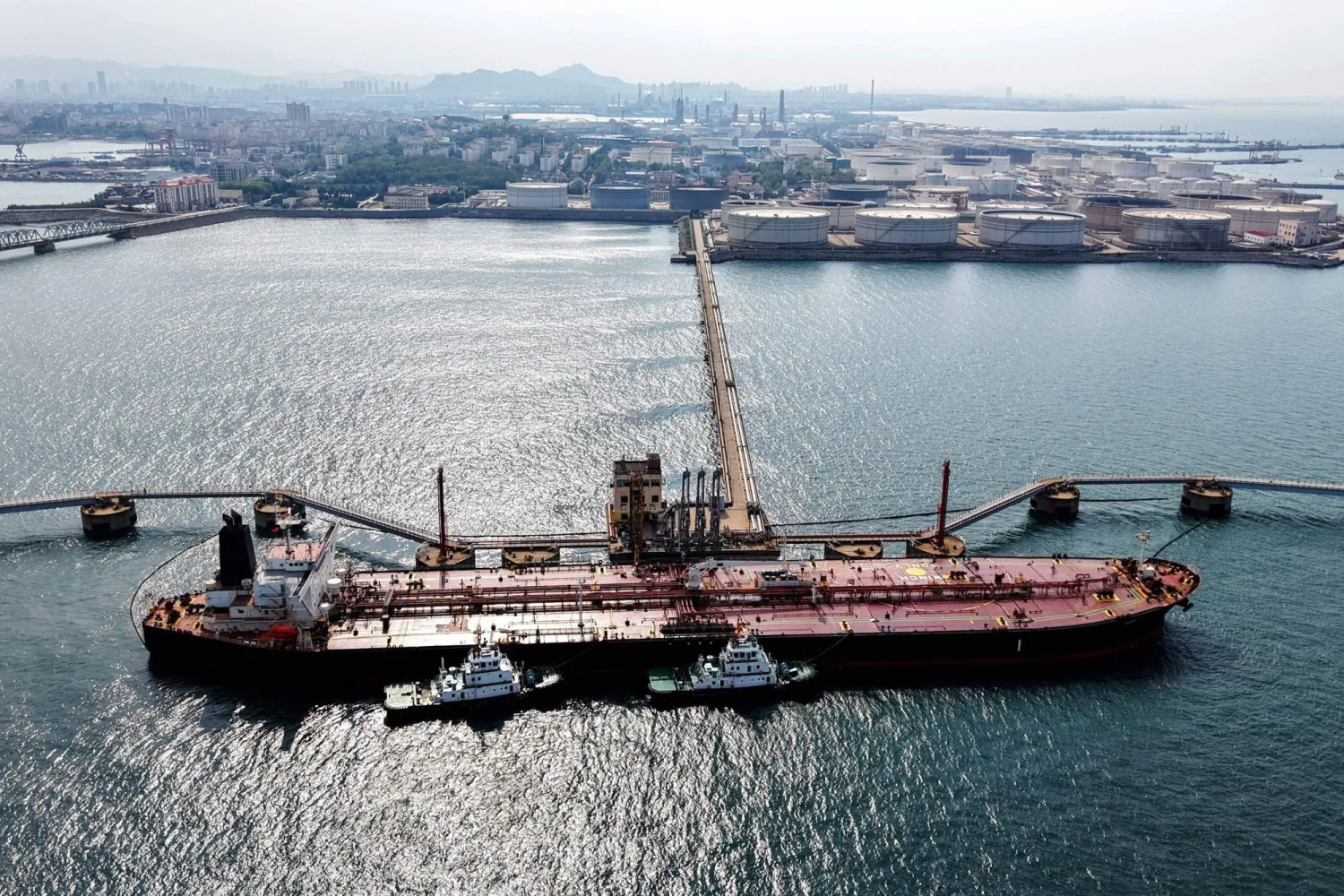
A crude oil tanker unloads at the oil terminal of the port in Qingdao, in China's eastern Shandong province on April 28, 2026. (Photo by CN-STR / AFP) / China OUT
TT

Oil Extends Slide as Trump Indicates Possible Iran Peace Deal

A crude oil tanker unloads at the oil terminal of the port in Qingdao, in China's eastern Shandong province on April 28, 2026. (Photo by CN-STR / AFP) / China OUT

Oil prices fell for a second day on Wednesday on expectations bottled-up supply from the key Middle East producing region could resume flowing after US President Donald Trump indicated a possible peace deal may be reached to end the war with Iran.

Brent crude futures fell $1.89, or 1.7%, to $107.98 a barrel as of 0340 GMT, after dropping 4% in the previous session. US West Texas Intermediate futures eased $1.83, or 1.8%, to $100.44, after settling down 3.9% the day before.

On Tuesday, Trump unexpectedly said he would briefly pause an operation to help escort ships through the Strait of Hormuz, citing ‌progress toward ‌a comprehensive agreement with Iran, without giving details on the ‌agreement. ⁠There was no ⁠immediate reaction from Tehran.

"This signals potential de-escalation and raises hopes for the release of stranded vessels inside the Gulf, which could gradually bring supply back to the market," said Anh Pham, senior research specialist for oil at LSEG.

Pham added that prices remain elevated with both Brent and WTI staying above $100 per barrel as prospects for a peace deal remain uncertain, while it will take time ⁠for trade flows to be fully restored even if a ‌deal is reached.

Trump said the US Navy ‌would continue its blockade of Iranian ports. The supply loss to the global ‌market has pushed prices higher with Brent trading last week at its ‌highest since March 2022.

"We have mutually agreed that, while the Blockade will remain in full force and effect, Project Freedom ... will be paused for a short period of time to see whether or not the Agreement can be finalized and signed," Trump wrote ‌on social media.

Trump's announcement came only hours after US Secretary of State Marco Rubio briefed reporters on the effort, ⁠announced on Sunday, to ⁠escort stranded tankers through the strait.

On Monday, the US military said it had destroyed several Iranian small boats, as well as cruise missiles and drones, while guiding two vessels out of the Gulf through the strait. The Strait of Hormuz closure has drawn down global inventories as refineries try to make up the production shortfall.

US crude oil inventories fell for a third week, while gasoline and distillate stocks also declined, market sources said on Tuesday, citing American Petroleum Institute figures.

Crude stocks fell by 8.1 million barrels in the week ended May 1, the sources said. Gasoline inventories fell by 6.1 million barrels, while distillate inventories fell by 4.6 million barrels compared to a week earlier, the sources said.


IMF Chief Georgieva Says War’s 'Adverse Scenario' Already in Effect

FILE PHOTO: Managing Director of the International Monetary Fund (IMF) Kristalina Georgieva takes part in "Debate on the Global Economy" during the 2026 annual IMF/World Bank Spring Meetings in Washington, D.C., US, April 16, 2026. REUTERS/Ken Cedeno/File Photo
TT

IMF Chief Georgieva Says War’s 'Adverse Scenario' Already in Effect

FILE PHOTO: Managing Director of the International Monetary Fund (IMF) Kristalina Georgieva takes part in "Debate on the Global Economy" during the 2026 annual IMF/World Bank Spring Meetings in Washington, D.C., US, April 16, 2026. REUTERS/Ken Cedeno/File Photo

The head of the International Monetary Fund on Monday warned that inflation was already picking up and the global economy could face a “much worse outcome” if the war in the Middle East drags into 2027 and oil prices hit around $125 per barrel.

IMF Managing Director Kristalina Georgieva said the continuation of the war meant that the global lender's “reference scenario” assuming a short-lived conflict - which forecast a minor growth slowdown to 3.1% and a minor increase in prices to 4.4% - was no longer possible.

“This scenario, with every day that passes, is further and further behind in the rear-view mirror,” Georgieva said.

The continuation of the war, a forecast of ⁠an oil price around or above $100 per barrel, and rising inflationary pressures meant the IMF's “adverse scenario” was already in effect, she said.

Long-term inflation expectations remained anchored and financial conditions were not tightening, but that could change if the war continued, she told a conference hosted by the Milken Institute.

“Now, if this continues into 2027 and we have oil prices of $125 more or less, then we have to expect a much worse outcome,” she said.

“Then we are going to see inflation climbing up and then inevitably, inflation expectations would start de-anchoring.”

The IMF last month issued three scenarios for the global GDP growth path in 2026 and 2027 amid massive uncertainty over the war in the Middle East - the main “reference forecast,” a middle “adverse scenario” and the much worse “severe scenario.”

The ⁠adverse scenario forecast global growth slowing to 2.5% in 2026 and headline inflation of 5.4%. The severe scenario forecast growth of just 2% and headline inflation of 5.8%.

Georgieva said the IMF was carefully tracking the slow-moving impact of the conflict on supply chains, with fertilizer already ⁠30% to 40% more expensive, which would drive food prices up between 3% and 6%. Other industries could also be affected.

“What I want to stress is that is really serious,” she said, expressing concern that many policymakers were still acting as ⁠if the crisis would end in a couple of months and were putting in place measures to cut the impact on consumers and business, which was keeping demand for oil high.

“Don't throw gasoline on fire,” she said. “Everybody in this room knows that if your supply shrinks, your demand has to follow.”


Russia’s LNG Exports up 8.6% in January to April, Data Shows

A general view of the liquefied natural gas plant operated by Sakhalin Energy at Prigorodnoye on the Pacific island of Sakhalin, Russia July 15, 2021. (Reuters)
TT

Russia’s LNG Exports up 8.6% in January to April, Data Shows

A general view of the liquefied natural gas plant operated by Sakhalin Energy at Prigorodnoye on the Pacific island of Sakhalin, Russia July 15, 2021. (Reuters)

Russia's ‌exports of liquefied natural gas rose 8.6% in January to April to 11.4 million metric tons from the same period last year due to supplies from the Arctic LNG 2 project, which reached 1 million tons in the first four months of the year, preliminary LSEG data ‌showed on Tuesday.

US ‌sanctions against Moscow over ‌the ⁠Ukraine conflict have restrained ⁠Russian LNG exports, particularly from the Arctic LNG 2 plant, where operations have been hindered owing to difficulty securing buyers.

In April alone, total Russian exports of LNG rose ⁠13.2% from a year ago to ‌2.92 million ‌tons.

Data also showed that Russian LNG ‌exports to Europe in January to April ‌jumped 20.8% year-on-year to 6.4 million tons. In April, they rose to around 1.6 million tons from 1.2 million tons ‌a year earlier.

In January, EU countries gave their final ⁠approval ⁠to ban Russian gas imports by late-2027.

Total exports from Novatek's Yamal LNG plant in the January to April period fell by 1.5% year-on-year to 6.5 million tons.

Asia-oriented Sakhalin-2, controlled by Gazprom, exported 3.7 million tons in the first four months of the year, up from 3.6 million tons during the same period last year.


G7 Trade Ministers Set to Meet but Not Discuss Latest US Tariff Threat

Discussion of the repercussions of the Middle East war is expected to dominate an informal session on Tuesday. Ludovic MARIN / AFP/File
TT

G7 Trade Ministers Set to Meet but Not Discuss Latest US Tariff Threat

Discussion of the repercussions of the Middle East war is expected to dominate an informal session on Tuesday. Ludovic MARIN / AFP/File

G7 trade ministers are set to meet in Paris on Tuesday and Wednesday to discuss issues such as critical minerals and small packages but will not directly address the latest US threat to impose additional tariffs on European vehicles.

The second meeting of trade ministers under the French G7 presidency is taking place as the global economy has been upended by the closure of the Strait of Hormuz, through which a fifth of the world's oil normally flows, said AFP.

Discussion of the repercussions of the Middle East war is expected to dominate an informal session on Tuesday, according to the office of France's junior trade minister Nicolas Forissier.

Meanwhile President Donald Trump's threat last Friday that he will hike US tariffs on cars and trucks from the European Union will likely be addressed separately.

US Trade Representative Jamieson Greer is expected to meet with EU Trade Commission Maros Sefcovic in the French capital.

They also have a meeting scheduled with Forissier and French Economy Minister Roland Lescure.

The US and EU struck a deal last summer to cap US tariffs on EU autos and parts at 15 percent, which is lower than the 25-percent duty that Trump imposed on many other trading partners.

In late March, EU lawmakers gave their green light to the bloc's tariff deal with Trump, but with conditions. It must still be approved by member countries.

"Our position for the moment is not to overreact," said Forissier's office.

"We will discuss it among Europeans when the time comes, but in any case not within the framework of the G7," it added.

"This agreement is useful and we must continue to implement it."

- Four priorities -

On Wednesday the trade ministers of the G7 nations (Britain, Canada, France, Germany, Italy, Japan and the United States) are expected to discuss the four priorities set by the group's French presidency.

The first is find a collective and effective response to industrial overcapacity that undermines free trade.

Even if the discussion doesn't formally target China, the country's subsidizing of certain sectors has created trade tensions for years.

A second priority is economic security, in particular securing and diversifying supplies of critical minerals that are indispensable in producing strategic products such as computer chips, electric vehicle batteries and super magnets.

France favors creating a system of groups of producing, processing and consuming nations that share a commitment to implementing good practices.

- Small parcels, big problem -

The ministers will also touch on the failure in March of the latest round of World Trade Organization negotiations, with the body's role as a trade referee having been paralyzed by the United States for years.

"The goal is for this organization to be better suited to current challenges," Forissier's office said.

The ministers will also discuss cross-border sales via e-commerce sites which have generated huge volumes of small parcels that escaped customs duties and posed unfair competition to local retailers.

The US last year suspended the tariff exemption on small parcels valued at less than $800 and the EU will this summer put in place a flat-rate customs duty on packages valued at under 150 euros.

The summit of G7 heads of state and government is scheduled for June 15 to 17 in the eastern town Evian along the shore of Lake Geneva.