
Saudi Cabinet Affirms Need to Spare Region Further Tension

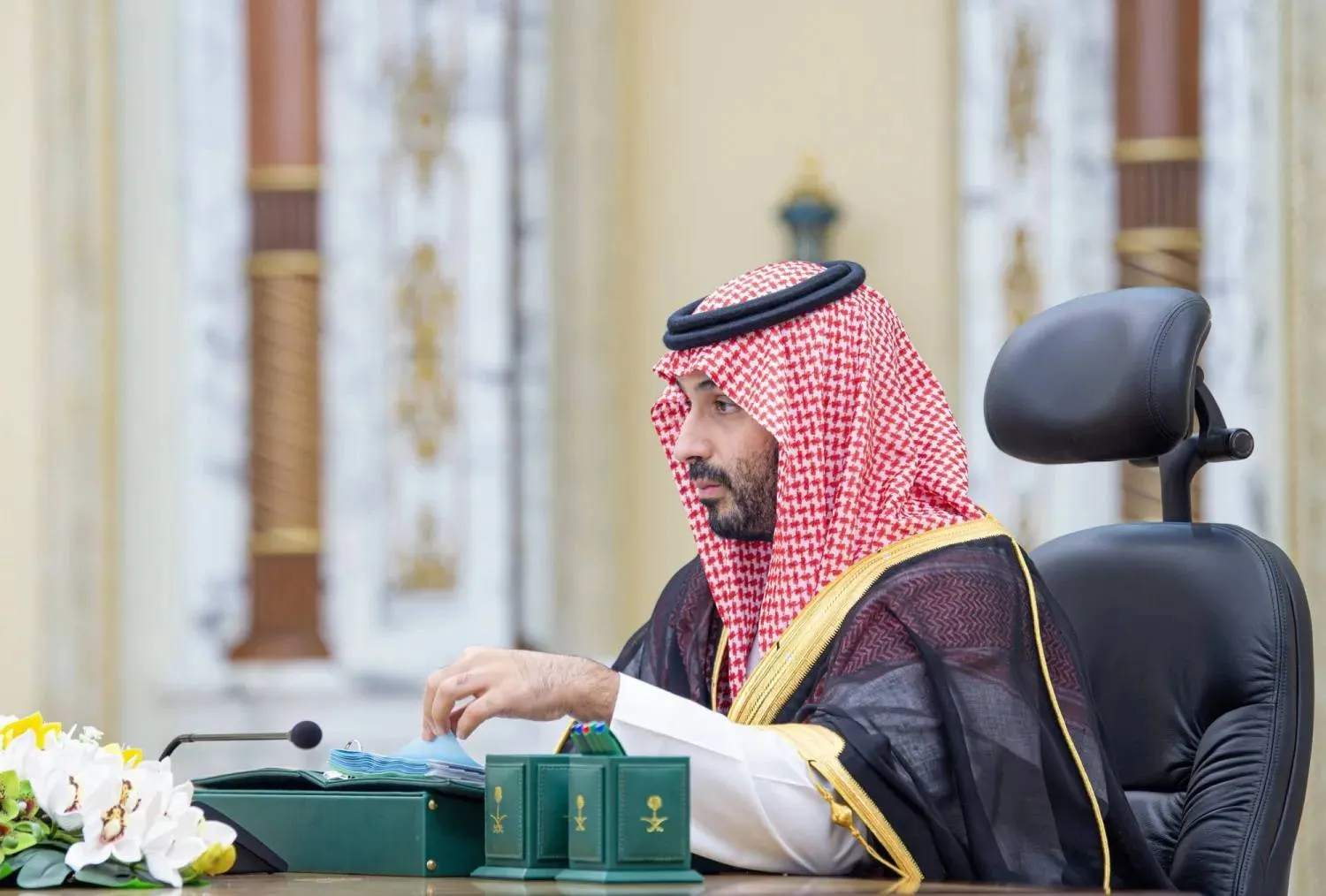
Prince Mohammed bin Salman bin Abdulaziz Al Saud chairs a cabinet session in Jeddah on Tuesday (SPA) 
TT

Saudi Cabinet Affirms Need to Spare Region Further Tension

Prince Mohammed bin Salman bin Abdulaziz Al Saud chairs a cabinet session in Jeddah on Tuesday (SPA) 

The Saudi Cabinet on Tuesday reviewed the latest regional developments, stressing the need for de-escalation and supporting Pakistani mediation and diplomatic efforts to reach a political solution that spares the region further tension and instability.

A cabinet session, chaired by Crown Prince Mohammed bin Salman bin Abdulaziz Al Saud in Jeddah, also reiterated the importance of restoring the freedom of international navigation in the Strait of Hormuz to its normal state as it was before February 28, ensuring the safe and unhindered passage of ships.

During the session, the Crown Prince briefed the ministers on the contents of messages received by Custodian of the Two Holy Mosques King Salman bin Abdulaziz Al Saud and himself from Zimbabwe’s President Emmerson, Rwanda’s President Paul Kagame, Uzbekistan’s President Shavkat Mirziyoyev and Japan’s Prime Minister Sanae Takaichi.

He also informed the session of his recent phone call with Emirati President Sheikh Mohamed bin Zayed Al Nahyan, during which he condemned the Iranian attacks targeting the UAE and affirmed Saudi Arabia’s support for the UAE in its defense of its security and stability.

The Cabinet reviewed the outcomes of Saudi Arabia’s participation in regional and international meetings, underscoring the Kingdom’s commitment to sustained cooperation with brotherly and friendly nations. It reaffirmed its support for enhanced coordination across a range of fields and issues of mutual interest, with the aim of strengthening collective response mechanisms and addressing shared global challenges.

At the domestic level, the Cabinet reviewed the performance indicators of several key sectors in light of the accelerated implementation of strategies and initiatives. It also noted the significant growth in local content, the expansion of national supply chains, and the continued strengthening of their competitiveness.

The Cabinet then reviewed the launch of “Saudi Environment Week 2026” as a continuation of national efforts in environmental protection. These efforts have delivered notable results, including a fourfold increase in protected areas, the rehabilitation of more than one million hectares of degraded land, the planting of 159 million trees using renewable water sources, the reintroduction of thousands of endangered wildlife species, and leadership in regional and international initiatives with lasting sustainable impact.

The Cabinet then authorized the Culture Minister, or a deputy, to discuss and sign with the Jordanian and Moroccan sides two draft memoranda of understanding (MoUs) between the King Salman Global Academy for Arabic Language and both the Jordan Academy of Arabic Language and the Academy of the Kingdom of Morocco in the field of serving and promoting the Arabic language.

It approved an agreement between the Saudi and Indian governments on mutual exemption from short-stay visa requirements for holders of diplomatic, special, and official passports.

Among other decisions, the Cabinet approved an MoU for cooperation between the Saudi and Pakistani ministries of justice, and another MoU between the Saudi Ministry of Industry and Mineral Resources and Brazil's Ministry of Mines and Energy for cooperation in the field of mineral resources.

Also, it permitted an MoU between the High Commission for Industrial Security and Naif Arab University for Security Sciences in the field of industrial security and an MoU between the Saudi Food and Drug Authority (SFDA) and the Halal Accreditation Agency of Türkiye.

The Cabinet then authorized the Saudi Authority of Internal Auditors (SAIA) to discuss and sign with the French Institute of Internal Audit and Control (IFACI) a draft MoU for cooperation in internal auditing, governance, risk, and compliance and approved an MoU between the Agricultural Development Fund of Saudi Arabia and the International Fund for Agricultural Development (IFAD) for cooperation in developing the agricultural sector.


Arab Parliament Speaker Stresses Need for Solidarity to Confront Regional Challenges

Arab Parliament Speaker Stresses Need for Solidarity to Confront Regional Challenges
TT

Arab Parliament Speaker Stresses Need for Solidarity to Confront Regional Challenges

Arab Parliament Speaker Stresses Need for Solidarity to Confront Regional Challenges

Speaker of the Arab Parliament Mohammed Al-Yamahi stressed the importance of solidarity, unity of ranks, positions, and voices, and strengthening consensus among Arab countries in addressing the growing challenges and risks facing the region, which require greater solidarity, cohesion, and joint Arab action now more than ever.

He made the remarks today during the preparatory committee meeting for the Eighth Conference of the Arab Parliament and Speakers of Arab Councils and Parliaments, which is being held in partnership with the Arab Inter-Parliamentary Union, SPA reported.

Al-Yamahi explained that this year's conference is being convened at a critical and exceptional stage for the Arab nation, requiring the highest levels of coordination, consultation, and unified positions on issues and challenges affecting the Arab world's present and future.

He noted that the conference will address several strategic issues, foremost among them the serious developments surrounding the Palestinian cause, the Arab world's primary concern.

It will also discuss recent highly dangerous security developments in the region and Iranian attacks against Arab states, as well as the topic of enhancing Arab digital sovereignty, which has emerged as a strategic issue driven by rapid digital transformation.

He said the issue calls for the development of a unified Arab parliamentary vision that protects Arab interests, strengthens digital security, and supports sustainable development efforts.


Saudi FM Holds Talks with Turkish, Kyrgyz Counterparts

Saudi Minister of Foreign Affairs Prince Faisal bin Farhan bin Abdullah chairs his delegation's a meeting of foreign ministers from Egypt, Saudi Arabia, Türkiye, and Pakistan, at Tahrir Palace in Cairo, Egypt, Sunday, June 21, 2026. (AP)
TT

Saudi FM Holds Talks with Turkish, Kyrgyz Counterparts

Saudi Minister of Foreign Affairs Prince Faisal bin Farhan bin Abdullah chairs his delegation's a meeting of foreign ministers from Egypt, Saudi Arabia, Türkiye, and Pakistan, at Tahrir Palace in Cairo, Egypt, Sunday, June 21, 2026. (AP)

Saudi Minister of Foreign Affairs Prince Faisal bin Farhan bin Abdullah received on Wednesday a telephone call today from his Turkish counterpart Hakan Fidan.

They discussed regional developments and issues of mutual interest.

Prince Faisal also held telephone talks with his Kyrgyz counterpart Zheenbek Kulubaev.

Pince Faisal congratulated him on the election of Kyrgyzstan as a non-permanent member of the United Nations Security Council for the 2027–2028 term, hoping it will contribute in supporting the council’s efforts to promote international peace and security.

They also reviewed bilateral relations and ways to strengthen them across various fields and discussed regional and international developments and efforts made in this regard.


Mohamed bin Zayed, Rubio Discuss Middle East Developments

United Arab Emirates President Sheikh Mohamed bin Zayed Al Nahyan and US Secretary of State Marco Rubio meet on Wednesday. (WAM)
TT

Mohamed bin Zayed, Rubio Discuss Middle East Developments

United Arab Emirates President Sheikh Mohamed bin Zayed Al Nahyan and US Secretary of State Marco Rubio meet on Wednesday. (WAM)

United Arab Emirates President Sheikh Mohamed bin Zayed Al Nahyan received in Abu Dhabi on Wednesday US Secretary of State Marco Rubio, who is visiting the UAE as part of a tour of the Middle East.

They reviewed strategic cooperation between the UAE and US and discussed ways to further strengthen coordination across various fields in support of shared interests, reported the UAE’s state news agency WAM.

The meeting addressed regional and international issues of mutual concern, with a focus on developments in the Middle East.

Sheikh Mohamed bin Zayed and Marco Rubio underscored the importance of advancing the foundations of security, stability, and lasting peace across the region.

The meeting was attended by Sheikh Khaled bin Mohamed bin Zayed Al Nahyan, Crown Prince of Abu Dhabi; Sheikh Tahnoon bin Zayed Al Nahyan, Deputy Ruler of Abu Dhabi and National Security Adviser; Sheikh Abdullah bin Zayed Al Nahyan, Deputy Prime Minister and Minister of Foreign Affairs; Sheikh Mohammed bin Hamad bin Tahnoun Al Nahyan, Adviser to the UAE President; and a number of officials.