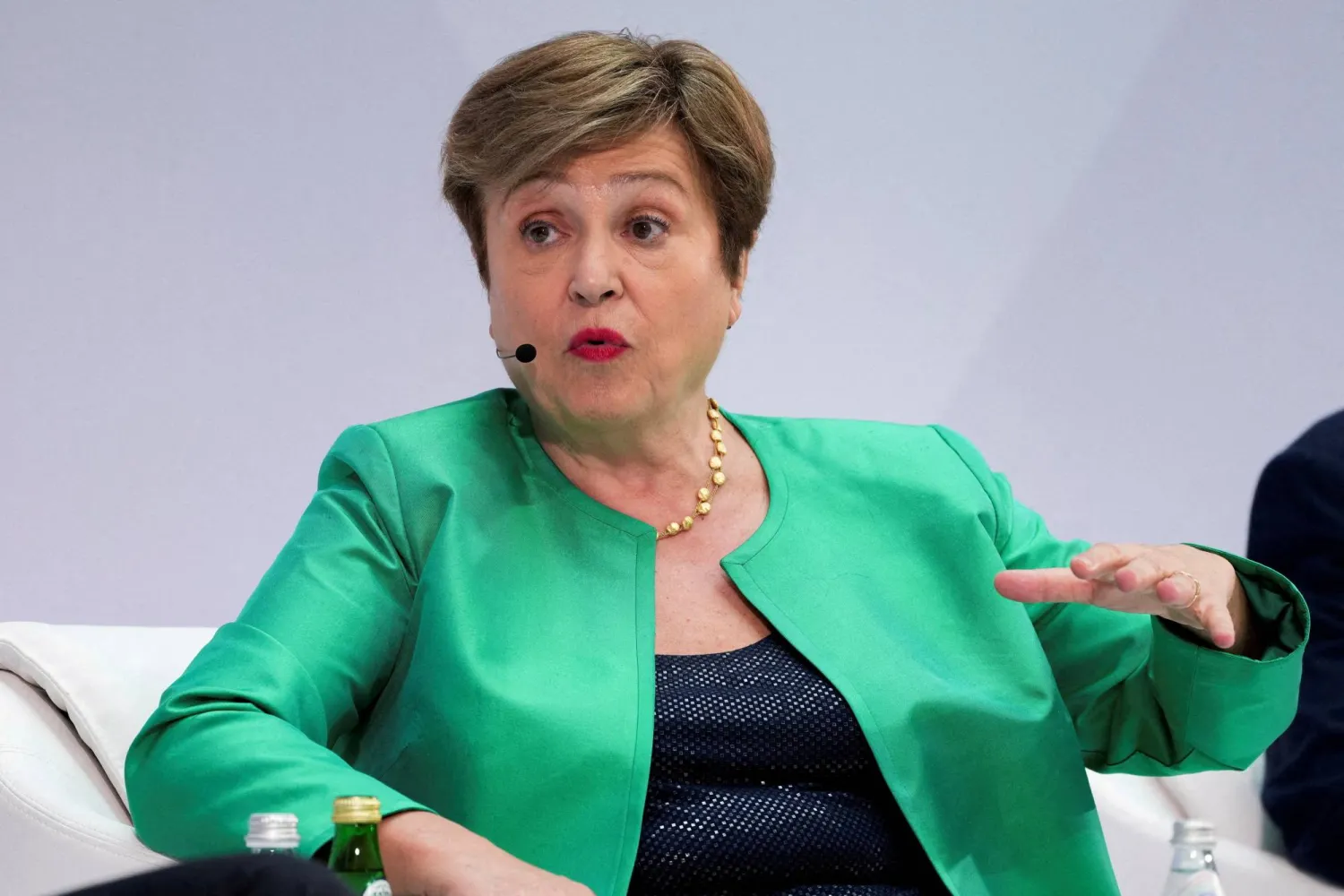
IMF Chief Georgieva Says War’s 'Adverse Scenario' Already in Effect

FILE PHOTO: Managing Director of the International Monetary Fund (IMF) Kristalina Georgieva takes part in "Debate on the Global Economy" during the 2026 annual IMF/World Bank Spring Meetings in Washington, D.C., US, April 16, 2026. REUTERS/Ken Cedeno/File Photo
TT

IMF Chief Georgieva Says War’s 'Adverse Scenario' Already in Effect

FILE PHOTO: Managing Director of the International Monetary Fund (IMF) Kristalina Georgieva takes part in "Debate on the Global Economy" during the 2026 annual IMF/World Bank Spring Meetings in Washington, D.C., US, April 16, 2026. REUTERS/Ken Cedeno/File Photo

The head of the International Monetary Fund on Monday warned that inflation was already picking up and the global economy could face a “much worse outcome” if the war in the Middle East drags into 2027 and oil prices hit around $125 per barrel.

IMF Managing Director Kristalina Georgieva said the continuation of the war meant that the global lender's “reference scenario” assuming a short-lived conflict - which forecast a minor growth slowdown to 3.1% and a minor increase in prices to 4.4% - was no longer possible.

“This scenario, with every day that passes, is further and further behind in the rear-view mirror,” Georgieva said.

The continuation of the war, a forecast of ⁠an oil price around or above $100 per barrel, and rising inflationary pressures meant the IMF's “adverse scenario” was already in effect, she said.

Long-term inflation expectations remained anchored and financial conditions were not tightening, but that could change if the war continued, she told a conference hosted by the Milken Institute.

“Now, if this continues into 2027 and we have oil prices of $125 more or less, then we have to expect a much worse outcome,” she said.

“Then we are going to see inflation climbing up and then inevitably, inflation expectations would start de-anchoring.”

The IMF last month issued three scenarios for the global GDP growth path in 2026 and 2027 amid massive uncertainty over the war in the Middle East - the main “reference forecast,” a middle “adverse scenario” and the much worse “severe scenario.”

The ⁠adverse scenario forecast global growth slowing to 2.5% in 2026 and headline inflation of 5.4%. The severe scenario forecast growth of just 2% and headline inflation of 5.8%.

Georgieva said the IMF was carefully tracking the slow-moving impact of the conflict on supply chains, with fertilizer already ⁠30% to 40% more expensive, which would drive food prices up between 3% and 6%. Other industries could also be affected.

“What I want to stress is that is really serious,” she said, expressing concern that many policymakers were still acting as ⁠if the crisis would end in a couple of months and were putting in place measures to cut the impact on consumers and business, which was keeping demand for oil high.

“Don't throw gasoline on fire,” she said. “Everybody in this room knows that if your supply shrinks, your demand has to follow.”


Saudi Arabia’s Money Supply Breaks $882 Billion Barrier for 1st Time in History

The Saudi capital, Riyadh (SPA)
TT

Saudi Arabia’s Money Supply Breaks $882 Billion Barrier for 1st Time in History

The Saudi capital, Riyadh (SPA)

Saudi Arabia’s money supply surpassed the $882 billion mark for the first time in its history at the end of March 2026, as broad money (M3) rose to SAR3.307 trillion ($882 billion), according to data from the Saudi Central Bank (SAMA).

The record increase in liquidity comes in line with the Kingdom’s accelerating economic growth under its Vision 2030 program. Annual growth in money supply reached 8.25 percent, compared with SAR3.055 trillion in March 2025, reflecting strong financial activity and robust capital spending.

Analysts attributed the continued upward trend since the start of the year to faster financing of major projects and growth in credit extended to the private sector, boosting money circulation within the domestic economy.

On a monthly basis, money supply increased by around SAR18 billion from February 2026, when it stood at SAR3.289 trillion, extending its upward trajectory since the beginning of the year.

Time and savings deposits recorded the strongest growth among liquidity components, rising from SAR1.075 trillion in March 2025 to SAR1.243 trillion, an annual increase of more than 15.6 percent.

The sharp rise was attributed to growing savings awareness among individuals and companies, as well as the attractiveness of deposit returns amid elevated interest rates, prompting customers to favor longer-term savings instruments to secure stable returns.

By contrast, currency in circulation outside banks grew by around 2 percent year-on-year, increasing from SAR251.5 billion to SAR256.4 billion, indicating the success of the Kingdom’s strategy to promote digital payments and reduce reliance on cash transactions.

Demand deposits rose from SAR1.461 trillion to SAR1.504 trillion, marking annual growth of nearly 3 percent and reflecting sufficient immediate liquidity to cover private-sector operating needs and daily consumer spending.

Other quasi-monetary deposits increased year-on-year from SAR266.8 billion to SAR302.9 billion over the same period.


Saudi Q1 Budget: Strategic Spending of $103 Billion Strengthens Economic Resilience

 The Saudi capital (Reuters) 
 The Saudi capital (Reuters) 
TT

Saudi Q1 Budget: Strategic Spending of $103 Billion Strengthens Economic Resilience

 The Saudi capital (Reuters) 
 The Saudi capital (Reuters) 

Saudi Arabia’s first-quarter 2026 budget performance figures showed the government remained firmly committed to development and social spending, with total expenditure surging 20 percent year on year to about SAR387 billion ($103.2 billion), compared with SAR322 billion in the same period a year earlier.

The spending drive reflects a broader strategy to strengthen the Kingdom’s economic resilience, going beyond traditional support measures to focus heavily on securing supply chains, localizing strategic industries and building financial buffers aimed at shielding domestic growth from external geopolitical shocks.

Revenue resilience and growing non-oil income

Saudi Arabia’s Finance Ministry said in its quarterly report that total revenue reached SAR261 billion ($69.6 billion). Although overall revenue edged down 1 percent due to a roughly 3 percent decline in oil revenue to SAR145 billion ($38.6 billion), non-oil revenue maintained positive momentum, rising 2 percent annually to SAR116 billion ($30.9 billion).

Taxes on goods and services remained the largest contributor to non-oil revenue at SAR74.9 billion ($20 billion), underscoring the success of policies aimed at diversifying income sources and reducing direct exposure to oil-market volatility.

The figures highlight the Saudi economy’s ability to maintain stable cash flows despite turbulence in global markets, resulting in a budget deficit of SAR126 billion ($33.6 billion), which the ministry described as a necessary investment to support future growth.

According to the International Monetary Fund (IMF), the impact of the war on Saudi Arabia appears less severe than on other Gulf states despite downgraded forecasts. The Saudi economy is still expected to grow by 3.1 percent after a 1.4-percentage-point cut from the IMF’s January projections, indicating the region’s largest economy remains capable of absorbing external shocks.

The World Bank, meanwhile, forecast Saudi Arabia’s budget deficit would narrow to 3 percent of gross domestic product in 2026, while the current account is expected to post a surplus of 3.3 percent, compared with an earlier forecast of a 2.7 percent deficit.

Finance Minister Mohammed Al-Jadaan has previously said not all budget deficits should be viewed negatively, distinguishing between what he described as “good” and “bad” deficits. He said a “bad” deficit fails to generate growth and merely increases future liabilities, while a “good” deficit finances strategically important projects that stimulate growth, including infrastructure, logistics, airports, ports and railway networks that encourage private-sector investment and help lower financing costs.

Social stability as the first line of defense

The 12 percent increase in spending on health and social development to SAR81 billion ($21.6 billion) reflected what officials described as a preemptive policy aimed at shielding citizens from the effects of global inflation driven by wars and geopolitical tensions.

Similarly, the allocation of SAR31 billion ($8.2 billion) for social benefits is intended to preserve purchasing power, helping explain why inflation remained moderate at 1.8 percent and point-of-sale transactions rose 4.4 percent despite regional instability.

At the same time, spending on infrastructure and transport rose sharply by 26 percent to SAR12 billion ($3.2 billion), supporting Saudi ambitions to become a global logistics hub linking continents.

Public debt management and financing sources

The report also highlighted what it described as efficient management of financing requirements during the first quarter of 2026. The entire deficit of SAR125.7 billion ($33.5 billion) was financed through debt issuance without drawing on government reserves, which stood at SAR400.9 billion ($106.9 billion).

The approach is consistent with the Finance Ministry’s stated policy of preserving reserves as a pillar of fiscal strength while managing deficits through diversified financing tools under a medium-term debt strategy aimed at keeping debt levels at about 32.7 percent of GDP.

Total public debt reached SAR1.667 trillion ($444.6 billion) at the end of the first quarter. Domestic debt accounted for SAR1.042 trillion ($278.1 billion), while external debt stood at SAR624.4 billion ($166.5 billion).

International markets continued to show strong confidence in the Saudi economy. A dollar-denominated bond sale in early January worth $11.5 billion attracted more than $28 billion in orders, as the ministry pursued plans to raise between $14 billion and $17 billion in international borrowing this year while gradually slowing the pace of sovereign bond sales abroad.

The current account balance stood at SAR67.7 billion ($18 billion) at the end of the same period.

Confidence indicators and private-sector momentum

The positive performance extended beyond public finances to broader macroeconomic indicators pointing to strong economic resilience. Foreign reserve assets rose 10 percent to SAR1.786 trillion ($476.2 billion) by the end of February 2026.

The labor market also showed structural gains, with the number of Saudi nationals employed in the private sector increasing by about 139,500 workers, bringing the total number of Saudis employed in the sector to 2.5 million.

Momentum in the private sector was reinforced by an 8.8 percent rise in bank lending to businesses, reflecting confidence among banks and investors in the Kingdom’s economic outlook.

Digital transformation and monetary stability

As part of the shift toward a digital economy, e-commerce sales surged 42.6 percent, while point-of-sale transactions increased 4.4 percent to reach SAR189.7 billion ($50.5 billion).

Despite the strong pace of economic activity, inflation remained relatively stable at 1.8 percent, helping protect purchasing power and support household financial stability.

With the purchasing managers’ index remaining above the neutral threshold at 53.7 points and industrial production rising 9.8 percent, official reports expect Saudi gross domestic product to expand by about 4.6 percent in 2026, driven by the combined strength of oil and non-oil activities under continuing structural reforms.


Gold Jumps 2% on Weaker Dollar, Middle East Peace Hopes

An employee displays gold bars at the Korea Gold Exchange store in Seoul (AFP)
TT

Gold Jumps 2% on Weaker Dollar, Middle East Peace Hopes

An employee displays gold bars at the Korea Gold Exchange store in Seoul (AFP)

Gold prices rose 2% on Wednesday, buoyed by a weaker dollar, while softer oil prices eased fears of inflation and higher-for-longer interest rates, amid hopes of a US-Iran peace deal.

Spot gold was up 2% at $4,647.09 per ounce, as of 0415 GMT. US gold futures for June delivery rose 2% to $4,658, Reuters reported.

US President Donald Trump said on Tuesday he would briefly pause an ⁠operation to help ⁠escort ships through the Strait of Hormuz, citing progress toward a comprehensive agreement with Iran.

Gold gained as "oil prices retreated on reduction in geopolitical risk premium, after the US confirmed that the ongoing fragile ceasefire between Iran is still intact, despite the skirmish that was seen at the start of this week," ⁠said Kelvin Wong, a senior market analyst at OANDA.

The US dollar and crude oil prices eased after Trump indicated that a possible peace deal may be reached to end the war with Iran.

US Secretary of State Marco Rubio told reporters on Tuesday that "operation Epic Fury is concluded," adding that "we're not cheering for an additional situation to occur."

"Any signs of re-escalation of tension between the two of them, you will see gold prices seeing some form of profit-taking, or for short-term speculators ⁠to unwind ⁠their near-term net long position in gold," Wong said.

A weaker US currency makes dollar-priced metals cheaper for holders of other currencies.

Elevated crude oil prices can stoke inflation, increasing the likelihood of higher interest rates. While gold is considered an inflation hedge, high interest rates make yield-bearing assets more attractive, weighing on its appeal.

Investors await the US non-farm payrolls release later this week, which will test whether the economy remains resilient enough to keep the Federal Reserve's monetary policy on hold.

Spot silver rose 3.4% to $75.62 per ounce, platinum gained 2.4% to $1,999.95, and palladium was up 2.6% at $1,524.59.