


Asia Gets First Mexican Fuel Oil Cargo in 9 Months

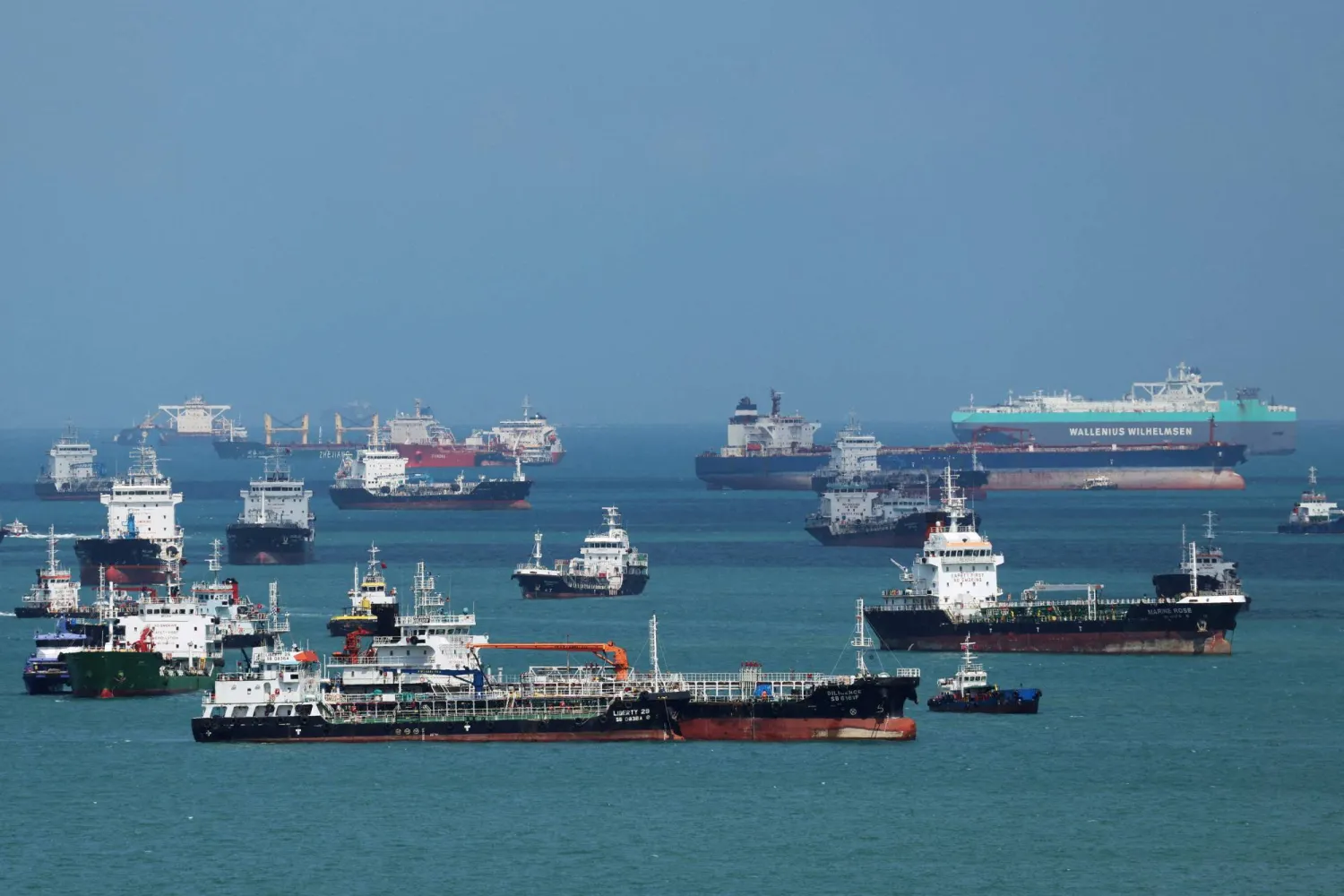
FILE PHOTO: Oil tankers in the Singapore Strait in Singapore March 17, 2026. REUTERS/Edgar Su/File Photo
TT

Asia Gets First Mexican Fuel Oil Cargo in 9 Months

FILE PHOTO: Oil tankers in the Singapore Strait in Singapore March 17, 2026. REUTERS/Edgar Su/File Photo

Asia received its first fuel oil cargo from Mexico in nine months on Thursday, with more to follow, as higher Asian prices draw supply after the loss of Middle East cargoes due to the Iran war, according to industry sources and shipping data.

The incoming cargoes from Mexico will ease some concerns about declining inventories in Asia's trading and bunkering hub Singapore, after the Iran conflict choked off most fuel oil supplies from key exporters in the Middle East like Iraq and ⁠Kuwait via the Strait of Hormuz, according to Reuters.

Suezmax tanker Orion, carrying about 160,000 metric tons (1 million barrels) of Mexican high-sulphur fuel oil (HSFO) loaded from the Salina Cruz refinery on the Pacific coast, reached Singapore on May 7, according to traders and ship-tracking data from Kpler.

PMI, the trading arm of Mexican state energy company Pemex, offered another 150,000-ton HSFO cargo to Asia for June delivery via a tender that closed on May 6 with bids valid until May 8, a Singapore-based trader familiar with the matter said. PMI is expected to award the tender later on Friday.

Fuel oil traders said that strong Asian prices are pulling cargoes to Asia while there is ⁠excess supply in the Americas.

“Mexican fuel barrels have to search for more optimal economics due to an influx of Venezuelan oil into the US Gulf Coast,” said Emril Jamil, senior analyst for crude and fuel oil at LSEG.

Most of Mexico's fuel oil exports typically land in the US or the Caribbean Islands, Kpler data showed.

Neither Pemex nor its trading ⁠arm immediately responded to a request for comment.

Traders in Asia have been looking for more arbitrage supplies from the West after the Middle East supply disruption.

The arbitrage is open with front-month 380-cst HSFO East-West spread at near $60 a ton this week, ⁠more than double the level before the conflict, LSEG data showed.

The spread breached $80 a ton on March 9 following the Middle East war, the data showed, a level last seen in September 2019.

A wider East-West price ⁠spread, which measures the price difference between Asian fuel oil versus supply from the Americas and Europe, typically makes it more attractive for cargoes to be shipped from the West to Asia.



Germany's March Exports Rose Despite Fall of Industrial Output

A general view of the Port of Hamburg, in Hamburg, Germany, October 9, 2023. REUTERS/Wolfgang Rattay
TT

Germany's March Exports Rose Despite Fall of Industrial Output

A general view of the Port of Hamburg, in Hamburg, Germany, October 9, 2023. REUTERS/Wolfgang Rattay

German exports rose unexpectedly in March, official data showed on Friday, lifted by higher demand from Europe, as industrial output fell despite a forecast rise, dampened by a drop in energy production.

German exports rose 0.5% in March over the previous month, boosted by an increase of 3.4% in shipments to other European Union countries, the federal statistics office said. Analysts polled by Reuters had expected a 1.7% decrease.

“The string of positive figures ⁠continues,” said VP Bank economist Thomas Gitzel, after the statistics office reported on Thursday higher-than-expected growth in March industrial orders.

The rise in new orders makes the drop of 0.7% in industrial production reported on Friday tolerable, he added.

Analysts polled by Reuters had expected a 0.5% increase.

The statistics office attributed the output decrease to a drop in energy production and in machinery and equipment manufacturing.

“These strong orders are expected to boost industrial production - and, by extension, exports - in the coming months,” Gitzel said, though he warned the well-being of German industry hinged on ⁠how much longer the Iran war will persist.

Sentiment indicators point to a second-quarter contraction in industrial output, because of high energy prices and supply bottlenecks resulting from the blockade of the Strait of Hormuz, said Commerzbank analyst Joerg Kraemer.

A 7.9% month-on-month slump in exports to the United States in ⁠March also showed a clear drag on trade, added Gitzel.

The United States remains the biggest destination for German goods despite the slump, receiving shipments of German goods worth 11.2 billion euros in March.

Imports surged in ⁠March, rising 5.1% compared with expectations for an increase of only 0.8%.

Most imports came from China, accounting for goods worth 15.6 billion euros ($18.31 billion) and marking a 4.9% increase on ⁠the month.

As a result, the foreign trade surplus narrowed more than expected, to 14.3 billion euros ($16.80 billion), from 19.6 billion the month before.


Dollar Set for Second Straight Weekly Fall despite US-Iran Clashes

US dollar banknotes (Reuters)
TT

Dollar Set for Second Straight Weekly Fall despite US-Iran Clashes

US dollar banknotes (Reuters)

The dollar was down and heading for a second straight weekly fall on Friday as investors stayed cautiously optimistic about a swift end to the Middle East conflict, after President Donald Trump said the ceasefire remained in place despite renewed US-Iran hostilities.

The two sides have occasionally exchanged fire since the ceasefire took effect on April 7, with Iran hitting targets in Gulf countries.

Analysts flagged that oil prices were modestly higher, a fragile ceasefire broadly held and reports indicated that US-Iran talks were continuing, according to Reuters.

They also noted that positioning has returned to historical averages and is no longer as supportive for the dollar as it was a few weeks ago.

“The hope for risk bulls is still that China is adding pressure on the US to reach some kind of deal in the Gulf before the 14-15 May Trump-Xi summit,” said Francesco Pesole, forex strategist at ING.

“The outlook is looking quite binary from here for the dollar, with the reaction in equities still likely to have a bigger bearing than oil volatility on the dollar,” he added.

Stocks were down in Europe but US stock index futures rose on Friday as a recovery in chipmakers helped offset worries about renewed US-Iran tensions.

The dollar index measured against key peers fell 0.28% at 97.96, after hitting 97.623 earlier this week, its lowest level since February 27, a day before the war started. It was set for a weekly drop of 0.22% after falling 0.31% the previous week.

Investors flocked to the safe-haven dollar and sold currencies of oil-dependent economies such as Japan and the euro area after oil prices surged following Iran’s effective closure of the Strait of Hormuz.

Markets are also bracing for the US non-farm payrolls report later on Friday, and it may take an outlier number, particularly a sufficiently weak one, to really move the dial on dollar volatility.

"An unchanged unemployment rate and labour force participation rate are also expected, so the report should not alter the outlook for the Fed," said Volkmar Baur, forex analyst at Commerzbank.

The euro was up 0.35% at $1.1765, poised to end the week a touch firmer.


FAO: World Food Prices Rise to More Than Three Year High in April

People buy food at Ningxia Night Market in Taipei, Taiwan May, 6, 2026. REUTERS/Ann Wang
TT

FAO: World Food Prices Rise to More Than Three Year High in April

People buy food at Ningxia Night Market in Taipei, Taiwan May, 6, 2026. REUTERS/Ann Wang

World food prices climbed in April to their highest in more than three years, with vegetable oils particularly elevated due to the Iran war and the effective closure of the Strait of Hormuz, the United Nations Food and Agriculture Organization (FAO) said on Friday.

FAO Chief Economist Máximo Torero said vegetable oil prices are being driven by elevated energy costs that are in turn raising demand for biofuels made using organic materials, such as oil-rich ⁠plants.

He added, however, ⁠that despite war-linked disruptions, agri-food systems were showing resilience, with cereal prices having increased only moderately thanks to adequate supplies from previous seasons.

The FAO Food Price Index, which measures changes in a basket of globally traded food commodities, rose for a third consecutive month in April to average 130.7 points, the UN agency said, up ⁠1.6% from its revised March level and the highest since February 2023.

The index hit a peak of 160.2 in March 2022 after the start of the Ukraine war, Reuters reported.

The FAO's April vegetable oil price index rose 5.9% month-on-month to its highest since July 2022 as a result of increased soy, sunflower, rapeseed oil and palm oil prices, the latter, notably, underpinned by biofuels policy incentives.

By contrast, April cereal prices rose just 0.8% from March and were up 0.4% from a year ago, reflecting modestly higher prices for ⁠the likes ⁠of wheat and maize linked to weather concerns, rising fertilizer costs and increased biofuels demand.

There are expectations for reduced 2026 wheat plantings, the UN agency said, as farmers shift to less fertilizer-intensive crops given prices for the inputs have surged.

Elsewhere, April meat prices rose 1.2% month-on-month to a record high amid limited slaughter-ready cattle in Brazil, the FAO said, while sugar dropped 4.7% thanks to forecasts for ample supply in Brazil, China and Thailand.

In a separate report, the FAO slightly raised its 2025 global cereal production estimate to a record 3.040 billion metric tons, 6% above levels seen in the prior year.