Hapag-Lloyd Posts Q1 Net Loss on Severe Weather, Iran War Disruptions

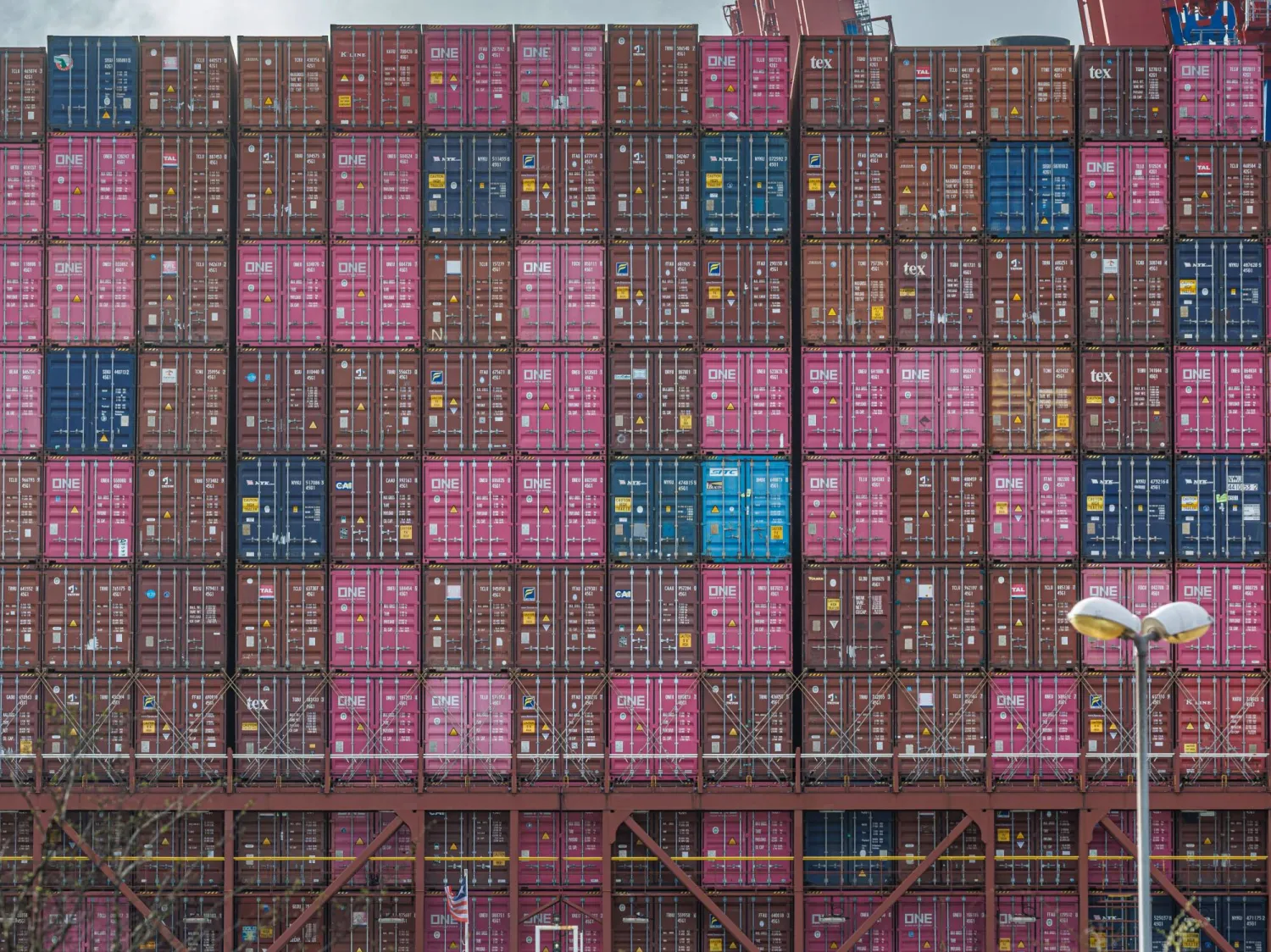
FILED - 25 March 2026, Hamburg: Containers are stacked at the stern of a container ship. Photo: Markus Scholz/dpa
TT

Hapag-Lloyd Posts Q1 Net Loss on Severe Weather, Iran War Disruptions

FILED - 25 March 2026, Hamburg: Containers are stacked at the stern of a container ship. Photo: Markus Scholz/dpa

German shipping group Hapag-Lloyd on Wednesday reported a first-quarter loss, citing the impact of lower freight rates and operational disruptions stemming from severe weather conditions and the blockage of the Strait of Hormuz on the back of the Iran war.

The group posted a net loss of 219 million euros ($257.00 million) ⁠compared to a ⁠profit of 446 million euros in the first three months of 2025, Reuters reported.

Hundreds of commercial vessels and up to 20,000 seafarers have been unable to transit the Strait ⁠of Hormuz, a vital energy-trade waterway that has been virtually closed since the US and Israel began attacks on Iran in February.

"The first quarter of 2026 was unsatisfactory for us, with weather-related supply chain disruptions and pressure on freight rates leading to significantly lower results," Chief Executive Rolf Habben ⁠Jansen ⁠said in a statement.

The group confirmed its outlook for 2026 earnings before interest, tax, depreciation, and amortization (EBITDA) between $1.1 billion and $3.1 billion and earnings before interest and tax (EBIT) between a loss of $1.5 billion and a profit of $0.5 billion, saying it would focus on "rigorous cost management" in the context of volatile markets.


US-Saudi Business Council Unveils Powerhouse Board of Directors

Chair of the Corporate Board of the Olayan Group Lubna Olayan
TT

US-Saudi Business Council Unveils Powerhouse Board of Directors

Chair of the Corporate Board of the Olayan Group Lubna Olayan

The US-Saudi Business Council (USSBC) has announced the appointment of its significantly expanded and reconstituted Board of Directors, featuring an unprecedented lineup of global industry leaders.

“This strategic move underscores the Council’s revitalized mission to deepen and diversify economic ties between the United States and Saudi Arabia by leveraging expertise from critical sectors shaping the global economy,” USSBC said in a statement on Tuesday.

Co-Chaired by Chair of the Corporate Board of the Olayan Group Lubna Olayan, and Jane Fraser, Chair and CEO of Citi, the new Board brings together influential figures across finance, energy, technology, travel, defense, infrastructure, consumables and advanced industry.

“Their collective leadership will uniquely position the Council to drive innovation, investment and strategic partnerships aligned with US economic priorities, Saudi Arabia’s Vision 2030 and the evolving global landscape,” the statement added.

The newly appointed US members include:
Ruth Porat, President and Chief Investment Officer of Alphabet and Google
Brian Moynihan, Chair and CEO of Bank of America
Brendan Bechtel, Chairman and CEO of Bechtel Corporation
Larry Fink, Chairman and CEO of BlackRock
Mike Wirth, Chair and CEO of Chevron
Chuck Robbins, Chair and CEO of Cisco
James Quincey, Executive Chair of The Coca-Cola Company
Noel Wallace, Chair, President and CEO of Colgate-Palmolive
Ed Bastian, CEO of Delta Air Lines
Jim Fitterling, Chair and CEO of Dow
Darren Woods, Chair and CEO of ExxonMobil
Jenny Johnson, CEO of Franklin Templeton
Chris Nassetta, President and CEO of Hilton
Vimal Kapur, Chair and CEO of Honeywell
James Taiclet, Chair, President and CEO of Lockheed Martin

FILE - Jane Fraser, CEO, Citigroup, speaks during a Senate Banking, Housing, and Urban Affairs Committee oversight hearing to examine Wall Street firms on Capitol Hill, Wednesday, Dec. 6, 2023 in Washington. (AP Photo/Alex Brandon, File)

They are joined by leaders from key sectors driving Saudi Arabia’s economic transformation, including:
Tareq Amin, CEO of Humain
John Pagano, CEO of Red Sea Global and Managing Director of AlUla Development Company
Kamal Bahamdan, CEO of Safanad
Tareq AlSadhan, CEO of Saudi National Bank
Abdullah Al Zamil, Chair of SENAAT (formerly Zamil Industries)

The Board also retains long-serving members Amin Nasser, President and CEO of Aramco, Robert Wilt, CEO of Ma’aden, Rami Al Turki, President and CEO of Alturki Holding, and Charles Hallab, President and CEO of the US-Saudi Business Council.

“This Board represents an extraordinary alignment of global leadership at a pivotal moment in the bilateral relationship, one that is consistent with a reinvigorated and reimagined role for the Council in the US-Saudi partnership,” said Hallab.

“Their collective expertise across areas critical to both economies positions the Council to advance bilateral trade, investment, and business collaboration like never before. We are very excited for the next chapter, and we are also deeply grateful to our long-serving Board members for their commitment and contribution to the Council’s mission over the years.”

Olayan said she looked forward to translating the partnership into a meaningful collaboration, and long-term value for the two countries’ economies.

As for Fraser, she said: “The caliber of leaders joining our board signals the significant momentum of the US–Saudi business partnership.”

The formation of the Board comes at a time of accelerating economic engagement between the US and Saudi Arabia.

“With a refined and revitalized mission, the US-Saudi Business Council is reinforcing its role as a leading platform for private-sector leadership and engagement—strengthening connectivity between US and Saudi businesses, enabling strategic partnerships, and supporting the expansion of bilateral trade and investment,” USSBC said.


TotalEnergies, QatarEnergy and ConocoPhillips Sign Deal to Review Offshore Block in Syria

An oil tanker en route to the Syrian port of Tartus (Reuters)
TT

TotalEnergies, QatarEnergy and ConocoPhillips Sign Deal to Review Offshore Block in Syria

An oil tanker en route to the Syrian port of Tartus (Reuters)

French oil major TotalEnergies, QatarEnergy and ConocoPhillips have signed a deal with the Syrian Petroleum Company to launch a technical review of the offshore Block 3 area near the Syrian city of Latakia, TotalEnergies said on Tuesday.

The memorandum of understanding “covers a technical review by the partners of the offshore area and establishes a framework for technical and commercial discussions related to exploration activities on this block,” the company said in a statement.

In 2011, Total of France stopped oil production in Syria in compliance with the EU sanctions imposed on the government of former president Bashar Assad.

“We are pleased to enter into this new partnership with the Syrian Petroleum Company with which we had a long and fruitful relationship from 1988 to 2011, and we look forward to cooperating with QatarEnergy and ConocoPhillips to assess Syrian offshore exploration opportunities in the Mediterranean Sea,”, said Julien Pouget, Senior Vice President Middle East and North Africa Exploration & Production at TotalEnergies.

On Monday, the Syrian Petroleum Company said it has identified an offshore site for its first deep-water oil and gas exploration project with US major Chevron and Qatar’s UCC Holding,
The move is part of a broader push by Syria’s new government to attract foreign investment into the country’s ⁠battered energy sector after years of civil war and sanctions.

State-owned SPC said that the company, together with Chevron and UCC Holding, had completed identification of the offshore block, paving the way to finalize contracts and start technical operations this summer, according to Reuters.

Chevron signed a preliminary agreement in February with SPC and ⁠UCC Holding to evaluate offshore oil and gas exploration in Syrian waters, the US company’s entry into Syria’s eastern Mediterranean offshore sector.


Saudi Telecom Sector Reaps Returns from Cloud Investments

STC’s pavilion at the LEAP international conference in Riyadh. (file photo)
TT

Saudi Telecom Sector Reaps Returns from Cloud Investments

STC’s pavilion at the LEAP international conference in Riyadh. (file photo)

Saudi Arabia’s telecom sector entered a new stage of financial and operational maturity in the first quarter of 2026, as growth moved beyond subscriber gains and became increasingly driven by returns from investments in digital technology and cloud computing.

Major operators demonstrated strong resilience in absorbing financing pressures and turning national digital transformation projects into sustainable cash flows, reinforcing the sector’s role as one of the Saudi economy’s strongest non-oil drivers.

Combined profits of listed telecom companies rose 6% year on year to 4.78 billion riyals, $1.27 billion, from 4.51 billion riyals a year earlier. Sector revenue reached about 27.64 billion riyals, $7.37 billion, reflecting strong operating momentum at the start of the year.

Digital leadership

The sector has four listed companies. Three of them end their fiscal year in December: Saudi Telecom Co., STC, Etihad Etisalat, Mobily, and Mobile Telecommunications Co. Saudi Arabia, Zain KSA. The fourth, Etihad Atheeb Telecommunication Co., GO, ends its fiscal year in late March.

STC remained the sector’s dominant profit driver, accounting for about 77% of total earnings. It reported the highest net profit in the first quarter, at 3.7 billion riyals, up 1.3% from a year earlier, supported by continued growth in operating revenue and digital services.

Mobily came second, with a profit of 880 million riyals, up 15% year on year, driven by stronger operational efficiency and customer growth.

Zain KSA recorded the sector’s fastest profit growth, with earnings rising more than 116% to 201 million riyals, supported by better operating performance and continued cuts in financing costs.

Operational efficiency

Financial markets analyst and Saudi Economic Association member Dr. Sulaiman Al-Humaid Al-Khaldi told Asharq Al-Awsat that STC’s dominance reflects its strong financial performance and its continued shift from a traditional telecom operator into an integrated digital technology group.

He said STC’s profit growth was driven by higher operating revenue, expansion in digital services, data centers, and cloud computing, and sustained growth in business and higher-margin technology services.

Al-Khaldi said telecom companies lifted first-quarter profits by focusing on operational efficiency, controlling expenses, improving cost management, and benefiting from infrastructure built in recent years. Continued demand for data services, 5G, and digital solutions in the Saudi market also supported results.

He said STC is one of the market’s giants, with a brand value of more than 66 billion riyals ($17.6 billion). It ranks second in Saudi Arabia after Saudi Aramco, whose brand value reached $47.3 billion in the latest Brand Finance report for 2026.

Al-Khaldi expects telecom companies’ profits in 2026 to exceed last year’s levels, saying the sector is entering a stronger financial phase as Saudi Arabia’s digital transformation accelerates and spending on technology, artificial intelligence, and cloud services rises.

He said these trends give telecom companies greater room to boost revenue and reach historic profitability levels, especially as companies such as STC expand into high-return technology and investment sectors and strengthen their position as the region’s largest digital and technology enabler.

The combined profits of the three largest companies stood at 18.9 billion riyals, $5 billion, at the end of 2025, compared with 28.39 billion riyals, $7.6 billion, in 2024.

Improved financial efficiency

G World Chief Executive Mohamed Hamdy Omar told Asharq Al-Awsat that the sector’s first-quarter performance reflected healthy operational growth and improved financial efficiency, not a passing accounting boost.

He said the figures showed companies benefited from steady demand for core services, faster growth in digital services, and easing pressure from financing and costs.

Omar said STC has become the sector’s main engine, showing a strong ability to convert operational growth into real profit. He attributed this to the company’s diversified portfolio, which now extends beyond telecoms into multiple sectors, leaving its assets under management highly diversified.

He said Mobily benefited from stronger operational efficiency, with profit margins rising in the first quarter as financing costs fell and net profit reached 880 million riyals. Zain showed the clearest improvement in growth terms, as net profit jumped to 201 million riyals on better operating performance and lower financing burdens.

Omar cited three main reasons behind the sector’s profits.

The first was continued growth in operating revenue, particularly at STC, whose results pointed to expanding digital businesses and a growing role in the digital economy.

The second was stronger efficiency and cost control, visible at Mobily through improved profit margins and a sharp drop in capital expenditure compared with the previous quarter, and at Zain through lower financing costs and better operating profitability.

The third was a relatively better financing environment, which helped some companies ease pressure on net profit as some interest and financing burdens declined. STC also showed strong operating cash flows, improving both the quality and size of earnings.

Omar expects the sector to remain on a moderately positive path, but with less momentum than the jump some companies recorded in the first quarter.

He said STC appears best placed to sustain momentum because of its diversified income streams and strong digital businesses. Mobily, he said, must maintain operational discipline and expand its customer base to preserve growth.

Zain’s continued improvement will depend on turning lower financing costs into sustainable operating profits, he said, while pressures linked to investment, depreciation, and amortization could later slow the pace of gains.