


Formation of Lebanese-Syrian Higher Business Council to Revive Economic Relations

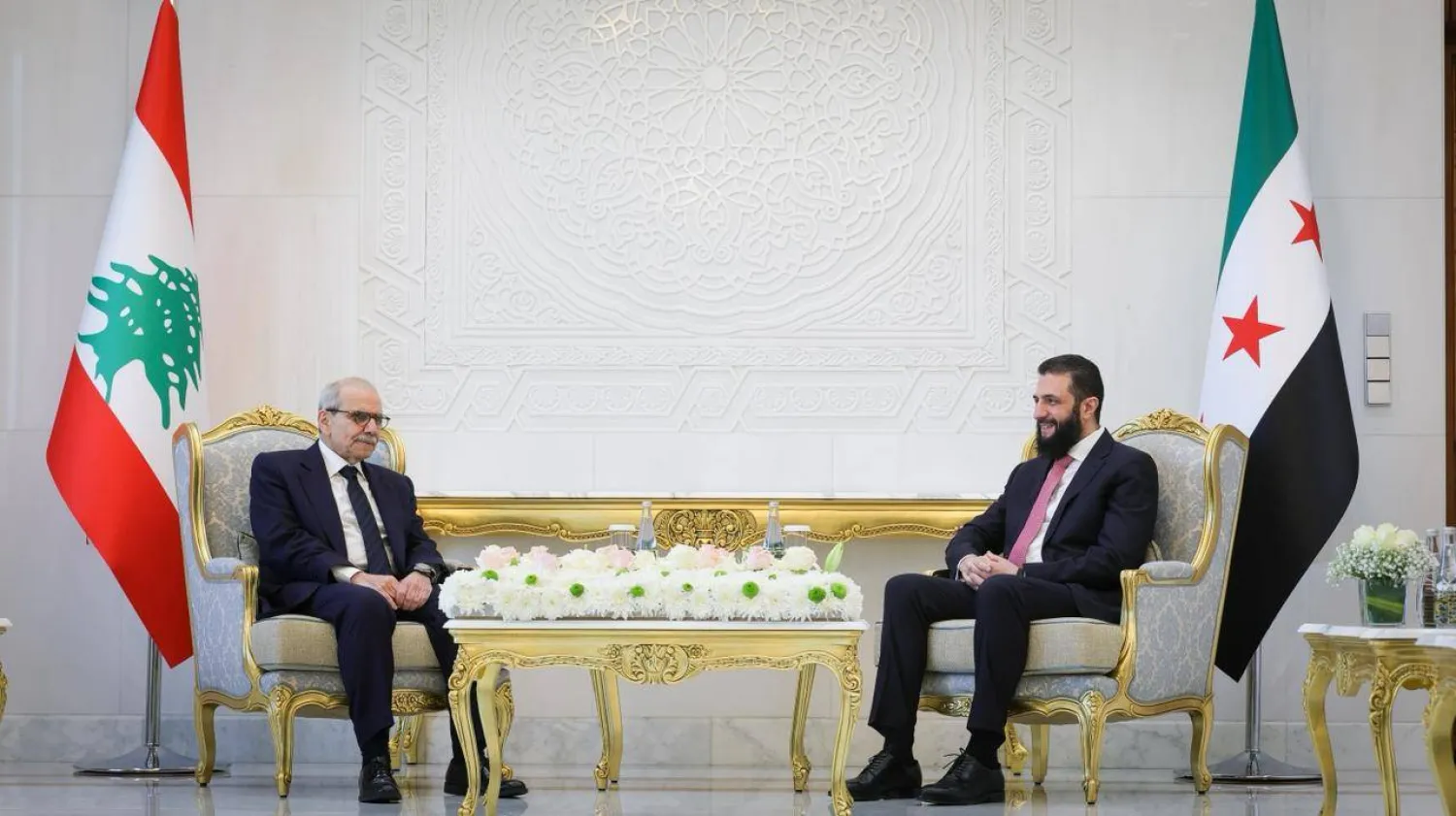
Syrian President Ahmed al-Sharaa and Lebanese Prime Minister Nawaf Salam in Damascus (Lebanese Prime Minister’s Office)
TT

Formation of Lebanese-Syrian Higher Business Council to Revive Economic Relations

Syrian President Ahmed al-Sharaa and Lebanese Prime Minister Nawaf Salam in Damascus (Lebanese Prime Minister’s Office)

Lebanon and Syria are expected in the coming weeks to translate the agreements and understandings reached during the recent visit of the Lebanese prime minister to Damascus into a series of measures and decisions to be issued successively, underscoring a clear decision by both states to move their relationship to a new level of cooperation and coordination after years of a strained relationship that negatively affected both sides.

Among the most prominent steps already under way is the formation of the “Lebanese-Syrian Higher Business Council,” aimed at revitalizing economic and trade relations between the two countries and involving the private sector.

Economy and Trade Minister Amer Bisat explained that “talks on establishing this council began some time ago, and it was agreed that its first meeting would be held at the end of June.” He noted that “it will comprise representatives from the private sector, while the Economy Ministry will oversee it, support and monitor its work, help set its agenda, and provide guidance.”

Bisat stressed to Asharq Al-Awsat the “importance of Lebanese-Syrian relations given that the two countries are bound by geography and history, and therefore advancing these relations is a strategic objective for our government.”

He added: “Institutional economic relations with Syria require modernization, or even a rebuild from scratch. It can now be said that matters have been placed on the right track, and we have embarked on a path that may be long.”

Bisat said the Syrian state had met Lebanon’s desire to improve bilateral relations with “welcome, commitment, and positive will,” explaining that “both sides are convinced that Syria’s success is part of Lebanon’s success, and vice versa, and that the relations being built today are based on shared interests, new and healthy foundations, and mutual respect.”

Abolishing the Higher Council

In October 2025, Syria announced the suspension of the Lebanese-Syrian Higher Council, a body established under the “Treaty of Brotherhood, Cooperation and Coordination” between Lebanon and Syria, signed in 1991. The treaty marked “a major turning point” in relations between the two countries, as it entrenched “Syrian tutelage” over Lebanon, which continued until the withdrawal of Syrian troops in 2005.

According to an official Lebanese source, the treaty and the council “are effectively no longer in existence, although legal steps are still expected to be taken in this regard.”

Professor Maroun Khater, a writer and researcher in financial and economic affairs, said that “talk of establishing a new higher business council between Lebanon and Syria goes beyond the technical economic dimension to reopening the broader question of the nature of bilateral relations themselves.”

He noted that “Lebanon’s experience with the Lebanese-Syrian Higher Council, which emerged under the Brotherhood, Cooperation and Coordination Agreement signed in 1991, remained highly controversial in Lebanon because of the major imbalance in power relations and the political and security overlap that, in most cases, undermined the concept of a normal relationship between two independent states.”

“Based on that,” he added, “no new economic or institutional framework can succeed unless it begins with a deep critical review of the experience of those agreements and the flaws that accompanied their implementation.”

He continued: “Any attempt to conclude new agreements or establish modern frameworks for cooperation will remain incomplete unless the issue of revoking and abolishing the Brotherhood, Cooperation and Coordination Agreement in its current form, which is unfair to Lebanon, is clearly addressed.”

Organizing Economic Relations

Khater stressed to Asharq Al-Awsat that “the need to organize economic relations between the two countries is realistic and necessary given geography and the deep strategic economic interconnection.”

He explained that “higher business councils are usually established to provide a permanent institutional platform for dialogue between the public and private sectors and to follow up on issues related to trade, investment, energy, transport, border crossings, and customs coordination, in addition to removing obstacles to the movement of goods and capital.”

As for the outstanding economic issues between the two countries, Khater said they are “numerous and accumulated, foremost among them the smuggling of weapons, goods, and money, as well as illicit trade through illegal crossings and tunnels, which has drained the Lebanese economy for decades.”

He added that the issue of overland transit, which represents a vital artery for Lebanese exports to the Gulf, also remains key.

“Energy, and the imports of gas and electricity through Syrian territory, also stands out, in addition to customs cooperation, fees, and financial coordination, which has become complicated and opaque following the international sanctions previously imposed on Syria,” he said.

“Among the most prominent issues are the exchange of security information and the issue of Syrian refugees, which remains one of the most sensitive matters given the heavy economic, social, and financial repercussions it has imposed on Lebanon,” he added.


Attention Shifts to Lebanon’s Iqlim al-Tuffah amid Israeli Military Moves

Israeli heavy machinery bulldozes houses in al-Mansouri, as seen from Hinniyeh, southern Lebanon, September 19, 2026. (Reuters)
TT

Attention Shifts to Lebanon’s Iqlim al-Tuffah amid Israeli Military Moves

Israeli heavy machinery bulldozes houses in al-Mansouri, as seen from Hinniyeh, southern Lebanon, September 19, 2026. (Reuters)

Military operations have escalated over the past few hours amid Israeli discussions regarding a transition to a "new phase" of occupation in southern Lebanon. Attack helicopters and tanks have been redeployed alongside airstrikes, artillery fire, and heavy weaponry sweeps.

Amid ongoing airstrikes, demolition operations, and movements on the ground, a critical question is being raised in Lebanon: Is the Israeli escalation limited to intensifying military pressure, or is it paving the way for a shift in the nature of operations and occupation in the South?

While the new date for the Lebanese-Israeli negotiations has not yet been set, the head of the Lebanese negotiating delegation, Simon Karam, is expected to visit the Vatican, where he will meet with Secretary of State Cardinal Pietro Parolin and Foreign Minister Paul Richard Gallagher to discuss the negotiation file and the role the Vatican could play in supporting this path, informed sources told Asharq Al-Awsat.

Lebanese President Joseph Aoun was in Rome recently where he discussed the negotiations.

On the ground, Israeli attacks continued in the South on Sunday where an Apache helicopter struck a commercial center on the Shokin-Mayfadoun road in the Nabatieh region, while heavy machine-gun sweeps targeted the towns of Beit Yahoun, Serbine, and Wadi Zibqeen.

An ambulance crew survived an airstrike that targeted a building while personnel were in the area conducting a field inspection following a previous raid, resulting in damage to shops and residential apartments in the targeted building.

An Israeli Merkava tank also targeted the town of Hadatha with four shells, before Israeli forces advanced toward a center in the town and set fire to the location. The Israeli army also demolished a number of houses in the town of al-Mansouri on Sunday.

The Israeli army announced that it attacked Hezbollah targets in southern Lebanon, stating that the strikes came in response to the launch of an explosive-laden drone toward its forces during the past night.

Retired general and military expert Hassan Jouni said the recent Israeli operations could either be part of routine maneuvers or aimed at finalizing operations in the al-Mansouri area.

This comes as the Israeli army announced it is nearing the completion of its phase focused on destroying Hezbollah’s infrastructure in the region.

Consequently, the central question following the conclusion of this phase focuses on what Israel's next move will be, Jouni told Asharq Al-Awsat.

"According to Israeli sources and official positions, discussions are underway regarding a redeployment of the army into positions currently under preparation,” he added.

This would consolidate the Israeli military presence and its defensive positions in the buffer zone and along the borders of the Yellow Line, he said.

However, Israeli operations, particularly Saturday's targeting of the Jabal al-Rihan region and its surroundings, Jabal Safi, and Sejod, are troubling indicators regarding the potential launch of a military offensive in the Iqlim al-Tuffah region, which lies geographically north of Ali al-Taher, added Jouni.

He explained that "Iqlim al-Tuffah is historically considered one of the last areas in southern Lebanon to house Hezbollah logistics bases. This raises the question of whether Israel has decided to continue operations and expand into this area, and whether Saturday’s actions will pave the way for an escalation or if the army was consolidating its defensive positions.”


Halt of Iranian Flights Sparks Debate within Iraq’s Ruling Coalition

 Iraqi Prime Minister Ali al-Zaidi meets with US President Donald Trump in New York on September 23, 2026. (Iraqi government)
Iraqi Prime Minister Ali al-Zaidi meets with US President Donald Trump in New York on September 23, 2026. (Iraqi government)
TT

Halt of Iranian Flights Sparks Debate within Iraq’s Ruling Coalition

 Iraqi Prime Minister Ali al-Zaidi meets with US President Donald Trump in New York on September 23, 2026. (Iraqi government)
Iraqi Prime Minister Ali al-Zaidi meets with US President Donald Trump in New York on September 23, 2026. (Iraqi government)

The Iraqi government's decision to enforce the US Treasury Department's ban on Iranian aviation remains highly contentious, as factions within the ruling Coordination Framework refuse to comply despite Baghdad's officially declared commitment to the policy.

According to a government source, Baghdad has received a serious American warning against receiving any Iranian airline at Iraqi airports. The government of Prime Minister Ali al-Zaidi had, however, requested that Washington grant it an exemption from the flight ban for certain airports, including Najaf airport, for humanitarian reasons.

According to an informed political source, "Iraq is currently caught between the American hammer and the Iranian anvil."

The source told Asharq Al-Awsat that "the situation in reality appears extremely difficult, as complying with Tehran's desire to completely ignore the flight ban could result in sanctions that Iraq can no longer tolerate.”

“This is particularly critical given that a shipment of US dollars is scheduled to arrive in Baghdad soon, as part of successful talks held by al-Zaidi with the US administration, specifically President Donald Trump, during his participation in the United Nations General Assembly meetings,” it added.

According to the informed political source, "leaders of the Coordination Framework are attempting to strike a middle ground during their discussions with and in the presence of al-Zaidi, in terms of not going too far in defying the US decision, while simultaneously declaring their support for the PM’s efforts to secure a single exemption, even if only for Najaf airport."

A government source confirmed on Sunday that Baghdad "has received a serious and direct American warning that continuing to receive any Iranian airline at Iraqi airports exposes the airport, as well as the entities and companies providing services to these flights, to US sanctions."

"The Americans made it clear to the Iraqi government that the punitive measures will not be limited solely to the sanctioned Iranian airlines, but could also extend to any entity or airport providing services or facilitating the operation of those companies' flights, including landing, ground handling, refueling, and other services,” it said.

"This warning has left the government with a single option: to avoid exposing Iraqi airports, the aviation sector, and the operating entities to US sanctions,” it continued.

"The decision was not linked to an Iraqi political stance regarding air traffic with Iran, but rather came as a result of the legal and economic risks resulting from US sanctions,” it explained.


Syrian Security Forces Arrest Official Responsible for Torture of Child Hamza al-Khatib in Daraa

Hamza al-Khatib became a symbol of the Syrian revolution. (SANA)
TT

Syrian Security Forces Arrest Official Responsible for Torture of Child Hamza al-Khatib in Daraa

Hamza al-Khatib became a symbol of the Syrian revolution. (SANA)

Syrian Internal Security Forces arrested Brig. Gen. Jaber Mehrez Ibrahim, who served as commander of the 138th Air Defense Brigade in the town of Saida during the era of the deposed regime, following a precise surveillance and tracking operation, reported Syria’s state news agency SANA on Sunday.

Records and preliminary investigations showed that Ibrahim was involved in issuing orders to kill and arrest people and suppress protesters, as well as participating in military campaigns targeting villages and towns in eastern Daraa countryside, pursuing civilians and targeting their homes.

Investigations also indicate that he was directly responsible for the Saida Housing massacre, in which nearly 120 people were killed, and that his name was linked to systematic arrests and torture involving a large number of people from the province, including child martyr Hamza al-Khatib.

The ousted regime arrested al-Khatib, 13, in the early days of the Syrian uprising that erupted in the city of Daraa on March 18, 2011. He died under torture in detention.

On May 21, 2011, al-Khatib’s tortured and mutilated body was returned to his family, weeks after his arrest during an anti-government demonstration.

His death, alongside the torture of other children and teenagers arrested for writing anti-Assad graffiti, triggered widespread protests and a brutal crackdown by government forces.

Following the ouster of the regime in December 2024, the new authorities launched a crackdown against former officials and military personnel. Ibrahim’s arrest is part of these ongoing prosecutions over allegations of abuses committed during the former regime's years in power.
