Iraqi Parliament Set to Vote on Al-Zaidi's Government

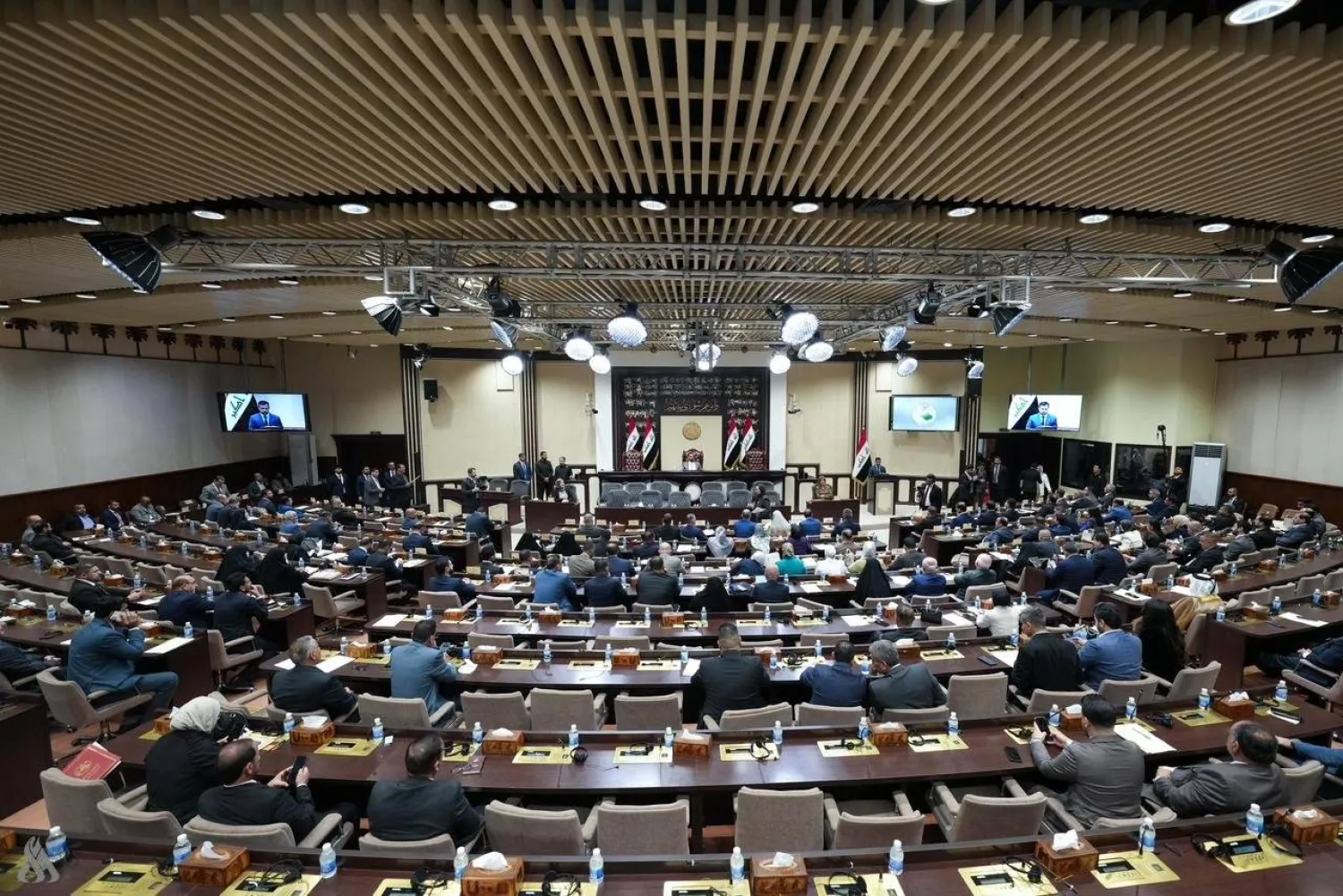
An Iraqi parliament session in Baghdad, March 2026. (INA)
TT

Iraqi Parliament Set to Vote on Al-Zaidi's Government

An Iraqi parliament session in Baghdad, March 2026. (INA)

Iraq’s parliament is scheduled to vote on Thursday on the cabinet lineup proposed by Prime Minister-designate Ali Falih Al-Zaidi, amid ongoing political disputes over key ministries and newly proposed posts.

Parliament’s media office said the agenda for session No. 24 includes a single item: a vote on “the government program and cabinet of Prime Minister-designate Ali Falih Al-Zaidi,” signaling efforts by political blocs to move forward with approving the new government despite lingering divisions, particularly within the Shiite Coordination Framework alliance.

Political and parliamentary sources said negotiations were continuing over several sovereign ministries, four deputy prime minister posts and two proposed new ministries, as pressure mounted to finalize the government before the Eid holiday to avoid a political vacuum or possible security escalation.

A source familiar with the talks told Asharq Al-Awsat that most lawmakers had not yet reviewed the résumés of ministerial nominees, despite constitutional requirements that they be distributed to parliament members before the confidence vote.

“Most lawmakers are not part of the negotiations taking place among bloc leaders, which are focused mainly on dividing ministerial quotas under the points system, while disagreements continue over some sensitive positions,” the source said.

Despite a relatively calm political atmosphere ahead of the session, political sources spoke of possible “last-minute surprises,” citing disputes within some parties over government priorities, particularly the issue of restricting weapons to state control.

A politician familiar with the negotiations noted that some leaders within the Coordination Framework had become less enthusiastic about backing Al-Zaidi than they were at the start of his nomination process, partly because of his pledge to place all weapons under state authority and concerns over his future relationship with armed factions allied to the coalition.

Some factions believe Al-Zaidi enjoys “clear international and American support,” the source said, referring to statements by Western officials in recent weeks that have fueled fears among some political groups that the next government could adopt a tougher stance on weapons outside state control.

Local media reports said resistance by some armed factions to disarm was one of the main reasons for delays in finalizing the cabinet, while political analysts also pointed to disputes among parties over the allocation of ministries.

A committee formed by the Coordination Framework has discussed the issue of weapons control with Al-Zaidi, while some armed groups continue to reject disarmament because of uncertainty over the future of their arsenals, the source added.

On the Sunni side, political factions appeared close to finalizing their ministerial share. Media linked to the Taqaddum party led by Mohammed Al-Halbousi circulated names of nominees and details of the distribution of ministries among Sunni blocs.

According to the reports, Taqaddum would receive the education and industry ministries, in addition to a deputy prime minister post, while the commerce ministry would go to the Al-Siyada party led by Khamis Al-Khanjar. The defense ministry would be assigned to the Hasm alliance headed by Thabit Al-Abbasi, and the planning ministry to the party of Muthanna Al-Samarrai.

Among Kurdish parties, there are signs that the Kurdistan Democratic Party would receive the foreign ministry and a deputy prime minister position, while the Patriotic Union of Kurdistan would take the construction and justice ministries.

In his first public comments on the government formation process, Al-Zaidi said he would “not respond to any personal demands” while selecting ministers, adding that he had secured Kurdish backing following meetings in Erbil.

Al-Zaidi said he aimed to form “a strong and solid economic government,” signaling that economic and development issues would be prioritized by his cabinet.


Palestinian Fatah Party to Elect Leaders for First Time in Decade

President Mahmoud Abbas presiding over a meeting of Fatah's 'Revolutionary Council' (Archive - WAFA)
TT

Palestinian Fatah Party to Elect Leaders for First Time in Decade

President Mahmoud Abbas presiding over a meeting of Fatah's 'Revolutionary Council' (Archive - WAFA)

Palestinian president Mahmoud Abbas's Fatah movement is due on Thursday to elect a new central committee for the first time in 10 years, as it faces existential challenges in the wake of the Gaza war.

During the three-day general conference, the movement will vote on the central committee, its highest leadership body, even as analysts warn of Fatah's diminishing legitimacy in the face of endemic corruption and its lack of progress on Palestinian statehood -- especially amid an intensified Israeli settlement drive, reported AFP.

The committee is expected to play a key role in the post-Abbas era, with some wondering whether the 90-year-old leader might finally step down after more than two decades at the helm, despite the lack of a clear heir apparent.

The conference comes as the Palestinian national movement is facing some of "the most serious challenges in our struggle", said Jibril Rajoub, the current secretary general of the committee.

He expressed hope that the conference, repeatedly delayed, would contribute to "ensuring and protecting the establishment of a Palestinian state on the world's agenda and protecting the Palestine Liberation Organization as the sole legitimate representative of the Palestinian people".

Fatah has historically been the main component of the PLO, which includes most Palestinian factions but excludes Hamas and Islamic Jihad groups.

In recent decades, Fatah's popularity and influence have dwindled amid internal divisions and growing public frustration over the stagnation of the Israeli-Palestinian peace process.

The sense of disappointment led to a surge in support for rival Hamas, which made huge political gains in the occupied West Bank in 2006 elections that it won handily, before going on to expel Fatah from the Gaza Strip almost entirely after a bout of factional fighting.

Hani al-Masri, director of the Palestinian Center for Policy Research and Strategic Studies (Masarat), told AFP that Fatah now merely uses the PLO to provide itself with legitimacy, "a legitimacy that is eroding in the absence of a unified national project, elections and national consensus".

He added that Thursday's conference was overshadowed by competition over seats on the central committee, "while the national project is conspicuously absent from the discussions".

Rajoub nonetheless declared that the conference was a first step towards "putting the Palestinian house in order, to build a partner for establishing a (Palestinian) state".

- Succession -

The conference will be held over three days, with approximately 2,580 Fatah members participating, the majority of them in Ramallah, though several hundred are also spread across Gaza, Cairo and Beirut.

They are expected to elect 18 representatives to the central committee and 80 to the movement's parliament, known as the revolutionary council.

Fatah is the main party within the Palestinian Authority (PA), which has been touted abroad as a natural partner in rebuilding and running the Gaza Strip after Israel's devastating war with Hamas there.

But Fatah remains marginalized in the territory, and Israeli Prime Minister Benjamin Netanyahu has repeatedly vowed that it, the PA and Hamas will have no role in post-war governance.

Despite repeated declarations from the movement that it is working as a "united front", major figures will be absent from Thursday's conference, notably Nasser al-Qudwa, a key Palestinian leader who is boycotting the gathering.

"This conference is illegitimate, and this leadership that has usurped power is illegitimate and its time is up," said Qudwa, a nephew of late Palestinian leader Yasser Arafat.

Key figures competing to replace Abbas include Rajoub and PA deputy Hussein al-Sheikh.

Also missing is Marwan Barghouti, who is considered a uniquely unifying Palestinian leader often cited as a possible successor to Abbas, but is serving a life sentence in Israeli prison after being found guilty of involvement in deadly attacks.

Meanwhile, the president's eldest son, Yasser Abbas, is on the ballot to join the central committee, having risen in prominence over recent years after he was named the president's special representative despite largely residing in Canada.

Al-Masri said the president's son's bid for a seat "indicates a trend towards dynastic succession", which is "extremely dangerous for Fatah, the Palestinian Authority and the Palestinian cause".


Israel’s Army Strikes South Lebanon, Israeli Civilians Injured in Hezbollah Drone Attack

Smoke rises from the site of an Israeli airstrike that targeted the southern Lebanese village of Deir El Zahrani on May 13, 2026. (Photo by Kawnat HAJU / AFP)
TT

Israel’s Army Strikes South Lebanon, Israeli Civilians Injured in Hezbollah Drone Attack

Smoke rises from the site of an Israeli airstrike that targeted the southern Lebanese village of Deir El Zahrani on May 13, 2026. (Photo by Kawnat HAJU / AFP)

Israel's military said it launched strikes against Hezbollah targets across southern Lebanon on Thursday, hours before US-brokered talks between the two countries were set to begin in Washington.

"The IDF has begun striking Hezbollah terror infrastructure sites in several areas in southern Lebanon," the military said after issuing evacuation warnings for a number of villages in the area.

Also Thursday, a Hezbollah drone strike injured several Israeli civilians, the Israeli military said.

"A short while ago, an explosive drone that was launched by the Hezbollah terrorist organization fell within Israeli territory, near the Israel-Lebanon border," the military said.

"As a result, several Israeli civilians were injured and evacuated to receive medical treatment at the hospital."


Somalia is in a Deadly Drought again. Most Humanitarian Aid Isn't there this Time

The World Food Program’s Assistant Executive Director for Program Operations, Matthew Hollingworth, talks to civilians during his visit to a camp for the internally displaced people to assess the knock on effects from the escalation in the Middle East, alongside drought and sharp cuts in humanitarian funding that are worsening hunger, in Kahda district of Mogadishu, Somalia May 7, 2026. REUTERS/Feisal Omar
TT

Somalia is in a Deadly Drought again. Most Humanitarian Aid Isn't there this Time

The World Food Program’s Assistant Executive Director for Program Operations, Matthew Hollingworth, talks to civilians during his visit to a camp for the internally displaced people to assess the knock on effects from the escalation in the Middle East, alongside drought and sharp cuts in humanitarian funding that are worsening hunger, in Kahda district of Mogadishu, Somalia May 7, 2026. REUTERS/Feisal Omar

Most of Abdi Ahmed Farah’s hundreds of goats have died. It has not rained steadily in this part of Somalia for three years, something the 70-year-old never thought possible.

He is in debt from buying water. The reservoir outside his tent is nearly empty. His family is down to one meal a day: rice with sugar and oil. The youngest of his 22 children was born three weeks ago and his wife produces only occasional drops of breast milk.

“I have considered abandoning my family because I cannot provide for them,” said Farah, sitting in front of dwindling food supplies, as if on guard.

Yet another drought is affecting millions of people across Somalia, one of the world's most vulnerable countries to climate shocks. Some rivers are dry. Crops have withered. Experts say the drought could be among the worst in Somali history, The Associated Press said.

The crisis is compounded by aid cuts, most dramatically by the Trump administration, and rising prices from the Iran war. Somalia buys most of its fuel from the Middle East, and 70% of its food is imported.

Production of staple crops of maize and sorghum in the October-December rainy season was the lowest on record in Somalia, according to the UN Food and Agriculture Organization.

Food security experts warn that nearly a half-million children might face severe acute malnutrition, the harshest kind. That would be higher than the number of children requiring treatment for it during droughts in 2011 and 2022, according to UNICEF.

‘It’s a repeated climate shock' "2026 is the worst year on record for Somalia in terms of drought,” said Hameed Nuru, the UN World Food Program director for Somalia. “Children have started dying.”

The Somali government and United Nations estimate that 6.5 million people face crisis levels of hunger, representing a third of the country’s population and a 25% increase since January.

Aid agencies are trying to maximize resources, and the Somali diaspora is sending money to help, but humanitarian workers warn it is not enough.

“This drought is not just another cycle of dry season. It’s a repeated climate shock with shrinking humanitarian support,” said Mohamed Assair, a manager with Save the Children in Puntland, a semi-autonomous region.

People drank dirty rainwater and got sick

Farah once had 680 goats, but a lack of food and water as well as diseases exacerbated by drought have claimed all but 110 of them, barely clinging to life.

“There is no market for my goats because they are so thin. Previously we would trade them for rice, but now we can’t,” he said. Farah’s family has been at a site outside Usgure village for 10 days. Almost a dozen goat carcasses lie nearby.

In Usgure, home to 700 families, community leader Abshir Hirsi Ali said the local economy has collapsed because they rely on pastoralists like Farah. Shops have closed and food rations have run low.

A recent, brief shower brought puddles of dirty rainwater. “Some families were so desperate they drank it ... now there is a high number of people with fever,” Ali said.

Save the Children occasionally brings free water to Usgure, but private water trucks have quadrupled their prices and the cost of a 50-kilogram (110-pound) bag of flour has increased by a third, to $40.

“I’m not only afraid for my family but the future of the whole village,” said Muhubo Tahir Omar, a 47-year-old mother of 11 children.

Omar, like other parents, had sold her goats to pay for school fees, “but when we didn’t pay, the teachers left.” Her last goat is now sick.

‘Conflict made our situation even worse’ Decades of conflict in Somalia have displaced millions of people. The drought has displaced another 200,000 this year, the UN estimates.

Some families flee across harsh landscapes with limited supplies.

“People are on the move ... and when people move, people die,” said Kevin Mackey, the Somalia director for humanitarian group World Vision. He recently met people who had walked for nine days to get aid in Dollow in the south.

Around 80 families live in a displacement camp outside Shahda village in Puntland.

Shukri, a 20-year-old mother of four, usually can eke out one meal a day from handouts. Now there is nothing to eat and limited access to clean water.

“The children got diarrhea (from dirty water) and malnourishment worsened,” said Shukri, who gave only her first name. “I know a few people who have died.”

Many people head to Mogadishu, the capital, where food also remains scarce.

Fadumo, a 45-year-old mother of seven, moved there from Lower Shabelle, where livelihoods were already threatened by al-Qaeda-linked al-Shabab militants.

“The water sources we depended on for farming, including the river, dried up,” Fadumo said. “Conflict made our situation even worse, forcing us to flee."

‘The outlook is deeply concerning’ Drought ravaged Somalia in 2022 and an estimated 36,000 people died, according to the UN. Now the kind of aid that was rushed to respond to such crises is shrinking.

“Unless there is a sudden and substantial response from donors, the outlook is deeply concerning. A drought of similar severity in 2022 received a response five times greater than what we are seeing,” said Antoine Grand, head of the International Committee of the Red Cross in Somalia.

Aid funding to Somalia dropped to $531 million in 2025 in large part because of aid cuts by the United States, which had been Somalia's top donor. In 2022, aid funding was nearly five times as much at $2.38 billion.

WFP said it intended to help 2 million people with food aid this year but has reached only 300,000 because of funding gaps.

A center at the hospital in Qardho, Puntland, treats children with severe acute malnutrition. But therapeutic milk is now rarely in stock, and nurses resort to homemade alternatives such as cow's milk, said director Shamis Abdirahman.

The center receives around 15 children a month, but they expect more as displaced people arrive.

One 4-year-old, Farhia, weighs a scant 7.5 kilograms (16.5 pounds). Her eyes are sunken and her bones are prominent under her skin.

Her family fled to Qardho when all of their goats died, said her mother, Najma.

“I don’t know what to hope for, or see how we can get back to what we had,” she said.