

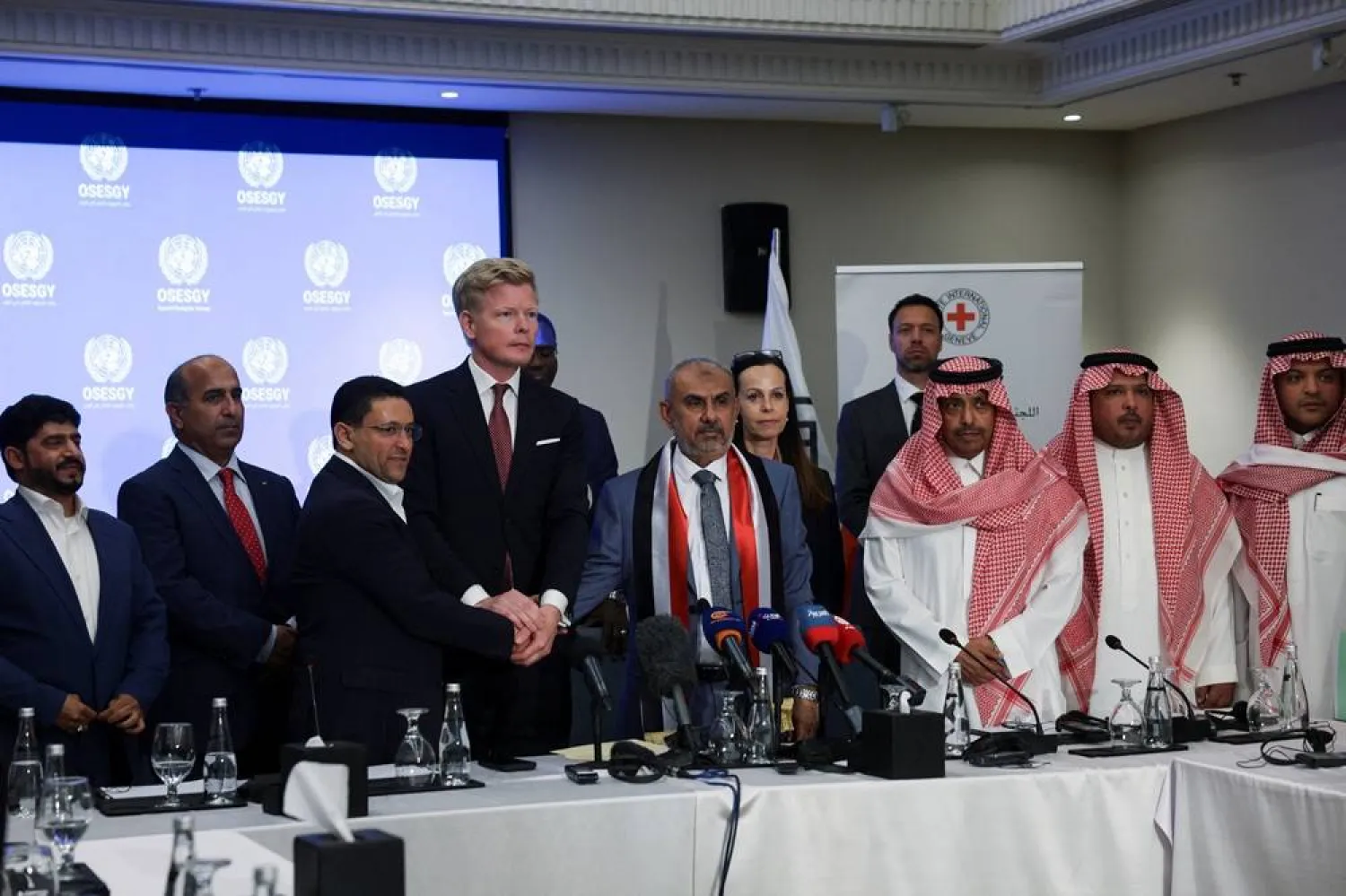

Yemen Govt Agrees Largest Prisoner Exchange with Houthis

Hans Grundberg, UN Special Envoy for Yemen, poses for a photo as members of the Supervisory Committee on the Detainees Release Agreement attend the closing ceremony of a meeting between the legitimate Yemeni government and the Houthis, in Amman, Jordan, May 14, 2026. (Reuters)
TT

Yemen Govt Agrees Largest Prisoner Exchange with Houthis

Hans Grundberg, UN Special Envoy for Yemen, poses for a photo as members of the Supervisory Committee on the Detainees Release Agreement attend the closing ceremony of a meeting between the legitimate Yemeni government and the Houthis, in Amman, Jordan, May 14, 2026. (Reuters)

Yemen's legitimate government and the Iran-backed Houthi militants agreed Thursday to free more than 1,600 detainees in the largest swap during Yemen's 11-year war.

The deal was signed in Amman, Jordan, after 14 weeks of negotiations observed by UN officials and the International Committee of the Red Cross. The swap built on previous understandings that started from Muscat in late 2025 and included indirect negotiations rounds in Riyadh, before culminating in an agreement in Jordan.

UN Secretary-General António Guterres welcomed the deal and called on the parties to move swiftly toward implementing it so families could soon be reunited, a UN spokesperson said.

UN Special Envoy for Yemen Hans Grundberg said the deal covered the largest release of “conflict-related detainees.” An ICRC in a statement said both sides agreed on the identities of the detainees to be released, and added that the Geneva-based organization is ready to facilitate their repatriation.

The head of the government delegation, Yahya Kazman, said in a post on X that a “number of politicians and media professionals" held by the Houthis will also be released. He did not give details.

It was not immediately clear when the release would start.

Guterres also called on the government and the Houthis to build on the positive momentum generated by the deal and to engage constructively toward an inclusive political process for a just and lasting peace in Yemen, Guterres’ deputy spokesperson Farhan Haq said.

“The Secretary-General further urges the Houthis to immediately and unconditionally release all arbitrarily detained personnel from the United Nations, NGOs, civil society and diplomatic missions,” Haq said.

Sustained diplomacy

“These negotiations have been extraordinarily complex,” Grundberg told reporters. “They required persistence, flexibility, and willingness by all sides.”

He said the agreement demonstrated that sustained diplomacy could still produce results despite years of conflict and mistrust.

“This outcome is a clear demonstration of what sustained and determined negotiations can produce,” he added. “It proves that when the parties choose to engage in dialogue, they can deliver on the priorities that weigh most heavily on Yemeni families and build confidence for the wider peace process.”

Grundberg also renewed calls for the release of UN personnel and others arbitrarily detained in Yemen.

“I hope that today’s momentum can help advance the release of UN and other colleagues who remain in arbitrary detention,” he said.

Some 1,100 of the almost 1,700 detainees are Houthi-affiliated, while seven Saudis and 20 Sudanese are among the 580 detainees that will be released by the other side.

'Major breakthrough'

The government delegation said the deal calls for the release of 1,750 detainees, including 27 members of the Arab Coalition forces. It said the development was a “real changing point in this complex humanitarian file.”

A government statement said the negotiations faced major hurdles and complications but a “national and humanitarian approach” ensured their success.

It hailed the role played by Saudi Arabia, Jordan and the ICRC in the file.

The swap agreement includes mutual prisoner and detention center visits after the exchange is complete in what was seen as an efforts to build trust between the two the government and Houthis.

In Houthi-held Sanaa, head of the Houthis’ Supreme Political Council Mahdi al-Mashat welcomed the agreement, saying the militants have offered “all facilitations” to ensure its success, reported Houthi media.

He claimed that the prisoner file had always been a top priority for the Houthis, vowing to pursue the release of remaining detainees by all possible means.

Observers said the swap was a new test for the Yemeni parties to translate humanitarian understandings into tangible steps on the ground, given the failure of previous swaps due to various differences.

International mediators are hoping the implementation of the latest swap will generate a positive conditions that would push forward the stalled political process.



Israel Threatens to Sue NYT Over Report on Sexual Abuse of Palestinian Inmates

The NYT report described "a pattern of widespread Israeli sexual violence against men, women and even children -- by soldiers, settlers, interrogators in the Shin Bet internal security agency and, above all, prison guards". (WAFA)
TT

Israel Threatens to Sue NYT Over Report on Sexual Abuse of Palestinian Inmates

The NYT report described "a pattern of widespread Israeli sexual violence against men, women and even children -- by soldiers, settlers, interrogators in the Shin Bet internal security agency and, above all, prison guards". (WAFA)

Israel on Thursday threatened to take The New York Times to court over a piece it published denouncing allegedly widespread sexual abuse against Palestinian detainees.

Prime Minister Benjamin Netanyahu and Foreign Minister Gideon Saar have ordered the "initiation of a defamation lawsuit against The New York Times", according to a joint statement issued by their offices.

The offices said that the piece by Nicholas Kristof, a prominent opinion columnist, was "one of the most hideous and distorted lies ever published against the State of Israel in the modern press, which also received the backing of the newspaper".

Kristof's investigation is based on testimonies gathered in the Israeli-occupied West Bank from 14 men and women who said that they had been sexually assaulted by Israeli settlers or members of the security forces.

The report described "a pattern of widespread Israeli sexual violence against men, women and even children -- by soldiers, settlers, interrogators in the Shin Bet internal security agency and, above all, prison guards".

The New York Times responded that any legal claim over the "deeply reported opinion column" lacked merit.

"This threat, similar to one made last year, is part of a well-worn political playbook that aims to undermine independent reporting and stifle journalism that does not fit a specific narrative," Danielle Rhoades Ha, a spokesperson for the newspaper, said in a statement.

Kristof's piece said there was no evidence that Israeli leaders ordered rapes.

The Israeli foreign ministry alleged that Kristof had based his piece "on unverified sources tied to Hamas-linked networks".

It also accused the paper of deliberately timing the publication to "undermine" an independent Israeli report on Hamas sexual violence perpetrated during its October 7, 2023, attack on Israel, which was published on the same day.

Israeli forces have detained thousands of Palestinians in the West Bank since Hamas's 2023 attack, which triggered the war in Gaza.

The United States has high protections for journalistic expression, with libel suits needing to prove that information was purposefully untrue and with harmful intent.

President Donald Trump and his allies have nonetheless filed a number of lawsuits against media outlets, some of which have reached settlements rather than risk repercussions from his administration.


Yemen Consolidates Int’l Partnerships to Support Development, Stability and Services

Al-Alimi praised the existing partnership between the Yemeni government and UN agencies. Photo: Al-Alimi's official website
TT

Yemen Consolidates Int’l Partnerships to Support Development, Stability and Services

Al-Alimi praised the existing partnership between the Yemeni government and UN agencies. Photo: Al-Alimi's official website

The Yemeni government has consolidated efforts with its international partners to gradually transition from the emergency response phase toward recovery and institution-building.

Its efforts have also focused on improving basic services, empowering local authorities, developing the transport and infrastructure sectors, and facilitating the work of international organizations operating in the country.

The head of the Presidential Leadership Council, Rashad Al-Alimi, met this week with Peter Hawkins, the Resident Representative of the United Nations Children’s Fund (UNICEF).

They discussed UNICEF’s interventions in humanitarian fields, particularly in the sectors of health, education, child protection, combating malnutrition, immunization against deadly diseases, and psychological support.

They also tackled environmental health programs and efforts to build the capacities of local authorities in operating and managing water systems and reservoirs.

Al-Alimi praised the existing partnership between the government and UN agencies, foremost among them UNICEF’s presence in Yemen since the 1970s and its continued role in supporting Yemeni children and families.

He also lauded its valued interventions aimed at mitigating the repercussions of the humanitarian crisis caused by the Iran-backed Houthi militias.

Al-Alimi referred to the Houthi coup, which he said had led to the collapse of the humanitarian protection network and turned millions of children into direct victims of the conflict through recruitment and deprivation of education and essential vaccines.

He also pointed to the destruction of infrastructure and the national economy caused by the militias’ coup.

Al-Alimi stressed the importance of building on the existing partnership with UN organizations to expand humanitarian and development interventions related to children.

He particularly highlighted the areas of school feeding, support for education and prevention of school dropout, water and environmental health, primary healthcare, and psychosocial support programs, while stressing the need to broaden their impact across all parts of the country.

He also hoped for a gradual shift from an emergency-response approach toward a more sustainable framework that supports recovery and the rebuilding of institutions and essential services.

Al-Alimi commended donor countries and entities supporting UNICEF programs in Yemen, foremost among them Saudi Arabia and international partners that continue to support the Yemeni people.

He renewed the commitment of the state and government to providing all means of protection and facilitation for humanitarian and UN organizations, and to ensuring a safe environment for their work. He considered humanitarian action an essential partner in protecting society and preserving stability.

He also reiterated full support for the humanitarian community and for aid workers and UN staff arbitrarily detained by the Houthis, describing their detention as a flagrant violation of international law and all national norms.

As part of the Yemeni government’s efforts to engage with the international community, the temporary capital, Aden, witnessed a series of meetings between officials and representatives of the United Nations, the European Union, and the World Food Programme.

The meetings reflected a government approach aimed at expanding international partnerships and linking humanitarian aid to more sustainable development projects, amid the ongoing economic and humanitarian crisis exacerbated by the war and the Houthi coup.


Palestinians in Gaza Mark Anniversary of 1948 Mass Expulsion and Say Today's Catastrophe is Worse

Palestinians attend a rally marking 'Nakba' day in the West Bank city of Ramallah, 12 May 2026. EPA/ALAA BADARNEH
TT

Palestinians in Gaza Mark Anniversary of 1948 Mass Expulsion and Say Today's Catastrophe is Worse

Palestinians attend a rally marking 'Nakba' day in the West Bank city of Ramallah, 12 May 2026. EPA/ALAA BADARNEH

Blink and you might miss the few stone walls that are all that’s left of the village that Yusuf Abu Hamam’s family was forced to flee when he was an infant in 1948.

The village, al-Joura, was demolished by the Israeli military at the time. It has since vanished under neighborhoods of the southern Israeli city of Ashkelon and the grounds of a national park.

The neighborhood where Abu Hamam’s family ended up — and where he spent most of his life — now lies also largely in ruins. Buildings in the Shati Camp in the northern Gaza Strip have been razed and wrecked by Israeli bombardment and demolitions during the past 2½ years of war, The Associated Press said.

On Friday, Abu Hamam and millions of Palestinians mark the 78th anniversary of the Nakba, Arabic for “catastrophe,” referring to the mass expulsion and flight of some 750,000 Palestinians from what is now Israel during the 1948 war surrounding Israel’s creation. It’s the third commemoration of the Nakba since the war in Gaza began.

The 78-year-old Abu Hamam, one of a dwindling number of Nakba survivors, says the current war is an even greater catastrophe.

More than six months after an October ceasefire, he and the rest of Gaza’s more than 2 million people are now crammed into less than half of the 25-mile-long strip along the Mediterranean coast, surrounded by an Israeli-controlled zone encompassing the rest of the territory.

“There is no country left,” Abu Hamam said, speaking next to his home, which was heavily damaged by Israeli shelling earlier in the war. “A square kilometer and a half extending from the sea, this is what we are living in ... It’s indescribable, unbearable.”

What was the Nakba? For Palestinians, the Nakba meant the loss of most of their homeland. Some 80% of the Palestinians who lived in the area that became Israel were driven from their homes by forces of the nascent state before and during the war. The fighting began when Arab armies attacked following Israel’s establishment as a home for Jews in the wake of the Holocaust. Palestinians who remained behind hold Israeli citizenship.

After the war, Israel refused to allow Palestinian refugees to return to ensure a Jewish majority within its borders. Palestinians became a seemingly permanent refugee community that now numbers some 6 million, with most living in refugee camps in the Israeli-occupied West Bank, Lebanon, Syria, Jordan and Gaza.

Around 530 Palestinian villages in what became Israel were destroyed, according to the Palestinian Bureau of Statistics.

Abu Hamam’s birth village was one of them. Al-Joura was seized by the Israeli military as it advanced against Egyptian forces in November 1948. Soldiers were ordered to destroy every home in al-Joura and neighboring villages to ensure their Palestinian populations couldn’t come back, according to military archives cited by Israeli historian Benny Morris.

Refugees swelled the population of the tiny patch of territory along the southern coast that became the Gaza Strip. They stayed in tent camps, run by a newly created UN agency for Palestinians, UNRWA, which provided aid and schooling. Those camps, like Abu Hamam’s Shati Camp, grew into dense urban neighborhoods over the decades, before many were flattened during the latest Gaza war by Israeli bombardment.

In Gaza, Palestinians live a new Nakba

The ancestors of Ne’man Abu Jarad and his wife, Majida, were already living in what would become the Gaza Strip in 1948. They both recall stories from their families about refugees streaming in by foot from areas further north, like the village Abu Hamam came from.

Though they avoided the original Nakba, there was no escaping from what Majida now calls “our Nakba.”

Their hometown has been wiped off the map. Over the past year, Israeli bulldozers and controlled detonations have razed nearly every building in the northern Gaza towns of Beit Lahiya and Beit Hanoun. A new Israeli military base stands about 700 meters (765 yards) from where the Abu Jarads’ house once stood, according to satellite photos.

Also gone is the southern Gaza city of Rafah, once home to a quarter million people, and other villages and neighborhoods located in the Israeli-held half of the Gaza Strip. The military says it is destroying positions used by Hamas and preparing the area for reconstruction. Satellite photos show nearly every structure reduced to rubble.

Over the last 31 months of war, the Abu Jarads and their six daughters have been displaced more than a dozen times as they fled Israeli bombardment and offensives. They currently live in a camp in the southern city of Khan Younis. Their tent offers little shelter from biting winter winds or summer heat, Majida said.

Their daughters have been out of school for over two years now.

“The Nakba of ’48, I don’t think it can be compared to our Nakba,” Majida said. “In ’48, they say people were displaced once and settled in one place, and they are still there until now. But our Nakba, honestly, is more severe because our displacement has happened multiple times. There is no stability.”

Around 90% of Gaza’s more than 2 million people have lost their homes, according to UN estimates, with most of them now sheltering in huge tent camps with rat infestations and pools of sewage. They are dependent on aid to survive.

Israel’s offensive has killed over 72,700 Palestinians, according to local health officials. It was triggered by Hamas’ Oct. 7, 2023, attack on southern Israel that killed some 1,200 people. Militants also abducted 251 hostages.

In the northern West Bank, tens of thousands of Palestinians are entering their 15th month of displacement, after the Israeli military ordered them out of their refugee camps as it launched an operation it said was targeting militant groups.

Since then, troops have demolished or heavily damaged at least 850 structures across the refugee camps of Nur Shams, Jenin and Tulkarem, according to an analysis of satellite imagery by Human Rights Watch released in December.

Saving what was lost, again and again

The 1948 Nakba also brought the loss of Palestinians’ history, as those fleeing struggled to keep hold of the documents and possessions tying them to their homes.

One of the largest archives of Palestinian documents dating back to the Nakba belongs to UNRWA.

UNRWA staff members, who fled their offices in Gaza after Israel ordered the north evacuated, had to leave behind the agency’s extensive archive.

The staff then launched a mission to rescue the most crucial documents — birth, death and marriage certificates and refugee registration cards, according to Juliette Touma, a former senior UNRWA official.

Without those documents, Palestinians could lose their rights and refugee status. Staffers crammed their personal suitcases full of papers and carried them through checkpoints and out of the territory, Touma said.

The current war has cost Palestinians in Gaza what little remained of their personal histories. Majida’s parents’ home in Beit Hanoun was destroyed, and with it family photos.

“There is nothing left,” she said.

Abu Hamam, too, says everything has been lost.

“When this war came, it devoured trees, stones and people,” he said. “Entire families were erased from the civil registry. Hundreds of families are still buried under the rubble.”
