


Oil Gains after Trump Says Xi Agrees Iran Cannot Have Nuclear Weapons

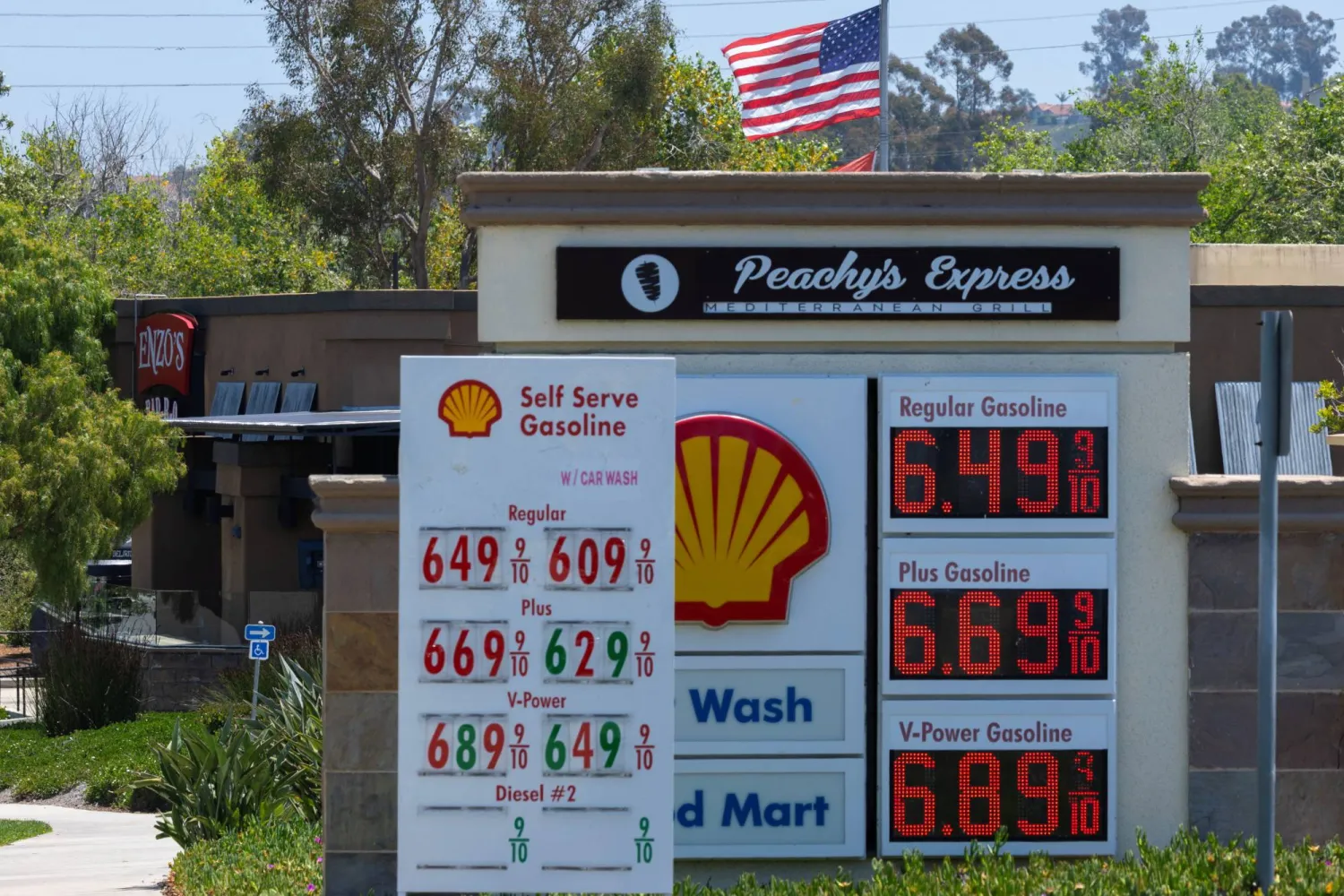
The current price of gasoline is shown at a gas station in Encinitas, California, US, May 11, 2026.  REUTERS/Mike Blake
The current price of gasoline is shown at a gas station in Encinitas, California, US, May 11, 2026. REUTERS/Mike Blake
TT

Oil Gains after Trump Says Xi Agrees Iran Cannot Have Nuclear Weapons

The current price of gasoline is shown at a gas station in Encinitas, California, US, May 11, 2026.  REUTERS/Mike Blake
The current price of gasoline is shown at a gas station in Encinitas, California, US, May 11, 2026. REUTERS/Mike Blake

Oil prices gained about 2% after US President Donald Trump said he and China's Xi Jinping agree Iran cannot have nuclear weapons and as concerns persisted over ship attacks and seizures despite Tehran saying about 30 vessels crossed the Strait of Hormuz.

Brent crude oil futures were up $1.77, or 1.67%, to $107.49 a barrel at 0642 GMT. Prices hit a session high of $107.99 earlier in the day.

US West Texas Intermediate futures were up $2.13, or 2.11%, ‌to $103.30 a ‌barrel.

For the week, Brent has climbed nearly 6%, ‌while ⁠WTI has jumped more ⁠than 7%, on uncertainty over the shaky ceasefire in the Iran conflict.

Trump said his patience with Iran is running out and he had agreed in talks with Xi that Tehran cannot be allowed to have a nuclear weapon and must re-open the Strait of Hormuz.

Xi did not comment on his discussions with Trump about Iran, although China's foreign ministry issued a statement.

"This conflict, which ⁠should never have happened, has no reason to continue," ‌the ministry said.

"With the Beijing summit not ‌delivering any breakthrough on Iran, market focus is back on the deadlock and ‌a blockaded Strait, with a tail risk of renewed military escalation," said Vandana ‌Hari, founder of oil market analysis provider Vanda Insights.

Among deals the market was looking for from the summit, Trump said China wants to buy oil from the United States.

In incidents around the Strait of Hormuz, a ship was reported seized by Iranian ‌personnel off the United Arab Emirates and headed for Iranian waters on Thursday, and an Indian cargo vessel carrying ⁠livestock from ⁠Africa to the UAE was sunk on Wednesday in waters off the coast of Oman.

The White House said Trump and Xi had agreed on the need to keep the shipping lane open.

Iran's Revolutionary Guards said 30 vessels had crossed the Strait of Hormuz since Wednesday evening, still far short of 140 that were typical daily before the war, but a substantial increase if confirmed.

Yang An, analyst at Haitong Futures, said the main driver of oil prices was still tight supply.

"Oil prices swung several times yesterday but still closed near the day's high," he said.

"Ships passing through the strait eased some market concerns, but not enough to change the strong trend driven by tight supply."



Ministry of Tourism Highlights Investment Opportunities at FHS Saudi Arabia 2026

The Ministry highlighted Saudi Arabia’s growing appeal as a tourism investment destination and showcased the wide range of opportunities emerging across the Kingdom’s rapidly developing tourism sector. (SPA)
TT

Ministry of Tourism Highlights Investment Opportunities at FHS Saudi Arabia 2026

The Ministry highlighted Saudi Arabia’s growing appeal as a tourism investment destination and showcased the wide range of opportunities emerging across the Kingdom’s rapidly developing tourism sector. (SPA)

Saudi Arabia’s Ministry of Tourism participated in the Future Hospitality Summit (FHS) Saudi Arabia 2026, held in Riyadh from June 22 to 24, bringing together investors, developers, operators, and leading global brands from across the hospitality and tourism sectors.

Through its participation as the Strategic Enabler of the Kingdom's premier hospitality investment forum, the Ministry highlighted Saudi Arabia’s growing appeal as a tourism investment destination and showcased the wide range of opportunities emerging across the Kingdom’s rapidly developing tourism sector, reported the Saudi Press Agency on Wednesday.

In his opening address, Deputy Minister for Tourism Destinations Enablement Eng. Mahmoud Abdulhadi said: “Saudi Arabia is not asking investors to invest in a promise. It is inviting them into a market already moving at scale.”

Highlighting the breadth of this opportunity, he added: “Saudi tourism is not built on one project, one city, or one market segment. It is a national portfolio of destinations shaped for diverse demand.”

Abdulhadi also participated in a fireside chat titled “From Opportunity to Bankability: Saudi Tourism’s Next Investment Chapter,” where he stressed that Saudi Arabia’s tourism sector has entered a new phase focused on elevating the quality of the visitor experience.

“My advice to investors is simple: come, explore, and engage with the ecosystem. The opportunity is not only in building assets, but in creating high-quality experiences for the traveler,” he said.

Throughout the three-day event, the Ministry of Tourism presented Saudi Arabia’s evolving tourism landscape, highlighting its efforts to foster an investment-enabling environment and unlock new opportunities across the Kingdom’s destinations in support of Saudi Vision 2030 and the sector’s long-term growth.

The Ministry also introduced local and international investors to its targeted incentive programs and initiatives designed to support their investment journey, most notably the Tourism Investment Enablers Program (TIEP) and the Hospitality Investment Enablers (HIE) initiative.

During FHS, the Ministry launched the Global Investment in Saudi Tourism report, which highlights key growth indicators in the sector, the expansion of leading global hospitality brands in the Saudi market, and ongoing efforts to strengthen the Kingdom’s position as a premier global destination for tourism investment.

The Ministry of Tourism’s participation in FHS Saudi Arabia 2026 forms part of its ongoing efforts to engage local and international investors and partners, unlock high-quality investment opportunities, and support private sector participation in the development of the tourism industry, advancing the objectives of the National Tourism Strategy and Saudi Vision 2030.


Gold Drops Below Key $4,000 Level as Dollar Firms, Rate Hike Bets Rise

FILED - 16 March 2023, Bavaria, Munich: FILE PHOTO - Gold bars and coins lie on the table at the Precious metal dealership Pro Aurum. Photo: Sven Hoppe/dpa
TT

Gold Drops Below Key $4,000 Level as Dollar Firms, Rate Hike Bets Rise

FILED - 16 March 2023, Bavaria, Munich: FILE PHOTO - Gold bars and coins lie on the table at the Precious metal dealership Pro Aurum. Photo: Sven Hoppe/dpa

Gold prices fell more than 3% and traded below a key psychological level of $4,000 per ounce, under pressure from a firmer US dollar and growing expectations of interest rate hikes.

Spot gold fell 3.4% to $3,968.41 an ounce as of 1312 GMT, after hitting its lowest level since November 2025.

US gold futures declined nearly 4% to $3,984.40.

The US dollar firmed, making dollar-priced bullion more expensive for holders of other currencies.

Traders have ramped up bets on US interest rate hikes this year after the US central bank struck a hawkish tone at its latest policy meeting and as fears of inflationary pressures stemming from the Iran war persist.

"The market pricing a rate hike as soon as September due to a hawkish Fed, a surging dollar at 13-month highs combined with lower inflation expectations are putting heavy pressure on precious metals," Tai Wong, an independent metals trader, said.

"For gold, there is support just under $3,900 and central bank purchases continue, so a collapse is unlikely, but expect a potentially long period of consolidation as the gold trade is now out of favor," he added.

Gold becomes less attractive to investors when interest rates rise because it offers no yield.

Spot gold, which scaled a record peak of $5,594.82 in late January, has since shed over $1,600 an ounce.

ING analysts cut their gold forecasts, now expecting prices to average $4,300 an ounce in the third quarter of 2026 and $4,600 in the fourth, compared with their previous projections of $4,850 and $5,000, respectively, according to Reuters.

Investors are also awaiting US Personal Consumption Expenditures data, the Fed's preferred inflation measure, due on Thursday for further signals on the monetary policy outlook.

More hawkish signals from Fed officials or economic data that supports the argument for higher rates may translate to further downside risk for gold, said Lukman Otunuga, senior research analyst at FXTM.

Among other metals, spot silver fell 6% to $58.28 per ounce after hitting its lowest level since December 2025.

Platinum lost 4.3% to $1,580.76, and palladium dropped 4.9% to $1,177.50.


Oil Extends Slide to More than 1% on Expectations of Smoother Crude Flows via Hormuz

Storage tanks for crude oil, gasoline, diesel, and other refined petroleum products in Carson, California (Reuters)
TT

Oil Extends Slide to More than 1% on Expectations of Smoother Crude Flows via Hormuz

Storage tanks for crude oil, gasoline, diesel, and other refined petroleum products in Carson, California (Reuters)

Oil prices fell more than 1% on Wednesday, extending this week's losses to hit fresh four-month lows on signs that more oil tankers are set to move out of the Strait of Hormuz.

Brent crude futures were down $1.37, or 1.8%, at $75.71 a barrel by 0805 GMT. US West Texas Intermediate slipped by $1.08, or 1.5%, to $72.13.

Brent touched a low of $75.60, its weakest level since February 27, the day before the initial US-Israeli strikes on Iran. WTI fell as low as $72.03, the weakest since March 3.

"While there are early encouraging signs of increased tanker activity, the market is pricing in the broader scenario of Iranian oil re-entering the global market and the Strait of Hormuz normalising," said Tim Waterer, chief market analyst at KCM Trade.

"If sanctions are eased, Iranian production and exports could ramp up relatively quickly given the substantial amount stored on tankers — we are likely talking weeks rather than months," Waterer added, Reuters reported.

Prices have also come under pressure this week from the 60-day sanctions waiver Washington granted Tehran after initial peace talks, allowing Iran to sell oil, and from an easing of hostilities in Lebanon, with prices approaching pre-war levels.

Ship-tracking data showed that three stranded supertankers passed through the strait on Tuesday. The UN shipping agency said an evacuation plan is under way to enable hundreds of stranded ships to sail through the strait after the US-Iran ceasefire deal.

On Tuesday, Oman and Iran agreed to press on with discussions about managing navigation in the strait. US Secretary of State Marco Rubio said that any attempt by Iran to levy transit fees would violate international law.

Uncertainty remains over the durability of the accord, however. US President Donald Trump said on Tuesday that Iran had agreed to nuclear inspections into "infinity", though Tehran said it had made no such concession.

"Markets are currently assigning too much confidence to a favorable outcome without fully discounting the risks associated with unresolved nuclear issues and inspection disputes," said Mark Malek, CIO at Siebert Financial.

Investors are also watching how quickly Middle Eastern producers can restore exports and whether more ships will enter the region.

Meanwhile, US crude stocks fell by 765,000 barrels in the week to June 19, market sources said, citing data from the American Petroleum Institute.

Nine analysts polled by Reuters estimated, on average, that crude inventories fell by about 4.5 million barrels in the past week.