
Saudi Journalism Pioneer Mohamed Ali Hafez Passes Away

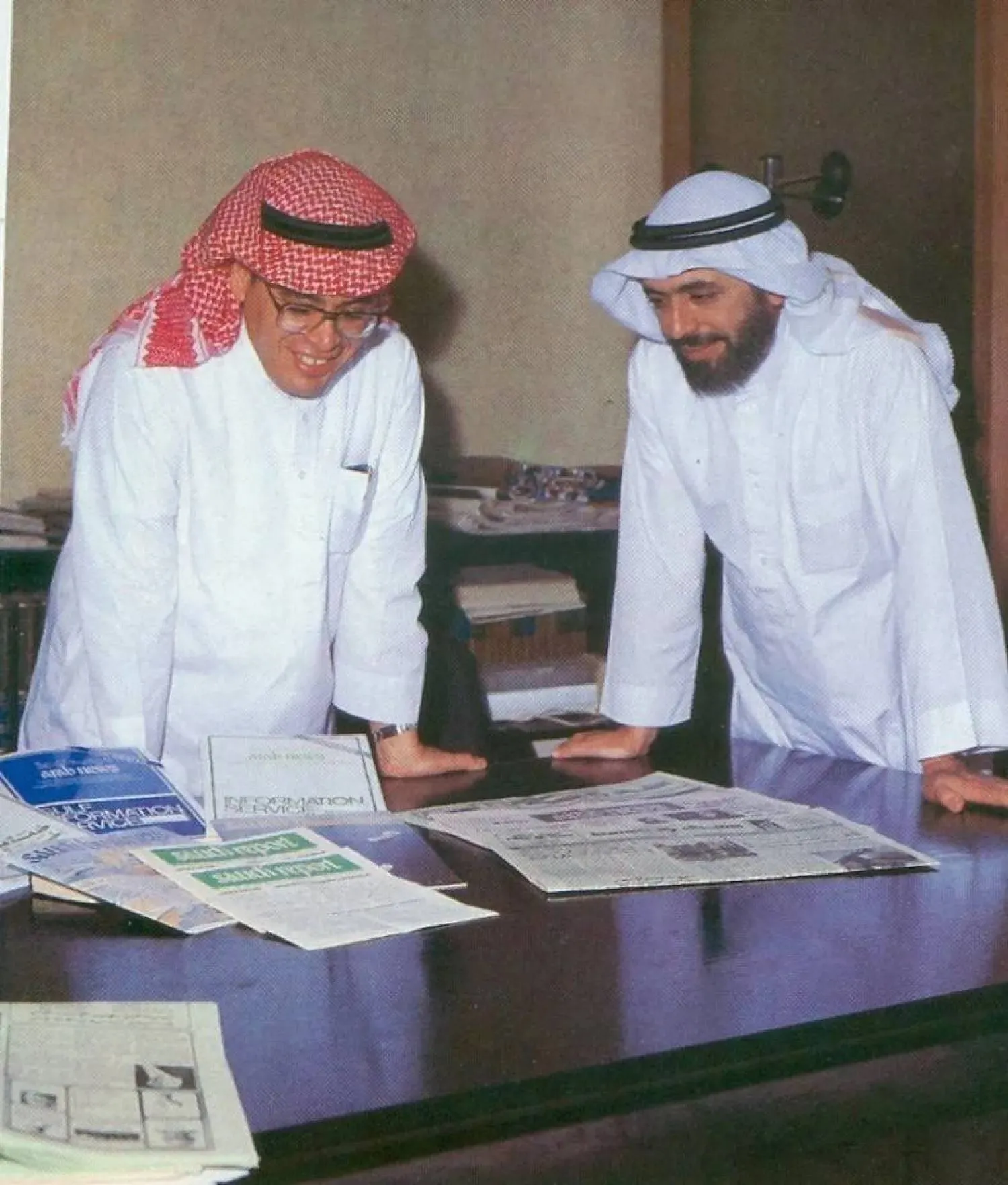
Publishers Hisham and Mohamed Ali Hafez look through publications. 
TT

Saudi Journalism Pioneer Mohamed Ali Hafez Passes Away

Publishers Hisham and Mohamed Ali Hafez look through publications. 

Veteran Saudi publisher and media pioneer Mohamed Ali Hafez passed away on Sunday afternoon after a long career of influence and innovation that helped shape modern journalism in Saudi Arabia and the Arab world.

Together with his brother Hisham Ali Hafez, who died on Feb. 26, 2006, Mohamed Ali Hafez was regarded as one of the leading figures in the publishing industry in the Middle East. The two brothers played a central role in taking Saudi media to unprecedented global horizons and establishing one of the region’s most influential publishing institutions.

Mohamed Ali Hafez belonged to the Hafez family, whose name became closely tied to the rise and development of Saudi journalism. The family’s media journey began with his father and uncle, Ali and Othman Hafez, who founded Al-Madina newspaper on April 7, 1937.

Considered one of Saudi Arabia’s earliest newspapers, Al-Madina became a true reflection of the aspirations of the Kingdom’s youth and the generations that accompanied its modern renaissance. Ali Hafez served as editor-in-chief until 1962, and the newspaper became a journalistic school that produced Mohamed and Hisham Ali Hafez, along with a generation of Saudi journalists.

Following in his father’s footsteps, Mohamed Ali Hafez assumed the editorship of Al-Madina after undergoing journalistic training in Egypt at the Akhbar Al-Yom publishing house under the supervision of its founder, Mustafa Amin.

At the age of 25, he became the youngest editor-in-chief of a Saudi newspaper, serving in the position until 1964.

Like their father and uncle before them, Mohamed and Hisham Ali Hafez formed a journalistic partnership that contributed significantly to the development of Arab media and publishing. The brothers succeeded in injecting a modern spirit into Arab journalism.

The defining turning point in Mohamed Ali Hafez’s career came when he decided to take Saudi media beyond local and regional boundaries and establish a media industry capable of competing with the world’s leading press institutions, not only in the Arab world. He also sought to break the monopoly of traditional Arab capitals over regional media influence.

That vision materialized with the launch of Asharq Al-Awsat from London as the first international Arabic-language newspaper to be printed and distributed simultaneously in several world capitals, a milestone that elevated Saudi media into the ranks of major international institutions.

The launch of Asharq Al-Awsat was preceded by the founding of Arab News, the first Saudi English-language daily newspaper.

Under the umbrella of the Saudi Research and Marketing Group - now the Saudi Research and Media Group (SRMG) - which he helped establish and served on its boards, Mohamed Ali Hafez and his brother built a vast publishing network that issued dozens of publications in multiple languages, including Arabic, English and Indian languages.

His entrepreneurial vision also extended to establishing supporting companies in printing, marketing, advertising, media services and technology.

SRMG went on to become the largest integrated Arab media group and one of the world’s leading media institutions, providing publishing, broadcasting, distribution, printing, advertising and intellectual production services targeting audiences across the Arab world and internationally.

With the group’s major expansion since 2022, SRMG forged global media partnerships, most notably with Bloomberg and The Independent, alongside the launch of Asharq News and several digital platforms focused on news, sports, entertainment and technology.

Mohamed Ali Hafez was a journalist by instinct and a media visionary by intuition. He possessed an exceptional ability to recognize defining moments that shape events.

His initiative with his brother to establish Saudi publications in London in the mid-1970s was followed by the creation of an integrated media network that remains among the largest media institutions in the world.

Despite his extensive administrative and founding responsibilities, Mohamed Ali Hafez never abandoned writing. Readers knew him as a distinguished columnist with sound judgment through his famous daily column “Sabah Al-Khair” (“Good Morning”), which appeared in the pages of Al-Madina, Okaz, Asharq Al-Awsat and Aleqtisadiah newspapers.


Kuwait Condemns Drone Attack on Saudi Arabia Launched from Iraq

(Kuna)
(Kuna)
TT

Kuwait Condemns Drone Attack on Saudi Arabia Launched from Iraq

(Kuna)
(Kuna)

Kuwait strongly condemned on Monday the drone attack launched from Iraqi airspace against the Kingdom of Saudi Arabia, which was successfully intercepted, the Saudi Press Agency said.

The Kuwaiti Ministry of Foreign Affairs stated that the attack represents a continuation of a series of flagrant violations of international law and relevant Security Council resolutions, particularly Resolution 2817, undermining regional security and stability.

The ministry also reaffirmed Kuwait’s support for Saudi Arabia in all measures it takes to preserve its security and stability and safeguard its territory.


Saudi Adviser Hassan Yassin, Testament to Kingdom’s Modern History, Passes Away

The late Hassan Yassin speaking during a television interview (Rotana TV screen grab) 
TT

Saudi Adviser Hassan Yassin, Testament to Kingdom’s Modern History, Passes Away

The late Hassan Yassin speaking during a television interview (Rotana TV screen grab) 

Saudi adviser Hassan bin Youssef Yassin passed away after a life closely intertwined with the history and development of Saudi Arabia, during which he witnessed the reigns of successive Saudi kings and devoted his life to serving the Kingdom.

He represented the continuation of a family legacy rooted in the career of his father, Sheikh Youssef Yassin, the close political adviser to King Abdulaziz Al Saud, founder of the modern Saudi state, and one of the prominent figures of the Kingdom’s founding political and diplomatic era.

Born in Makkah around 1934, Hassan Yassin began his professional career as director of the office of Saudi Oil Minister Abdullah Tariki before going on to establish the Saudi media office in Washington.

Yassin combined politics, history and media throughout his career, reflecting the broad intellectual outlook that distinguished his father. He was also among the opinion writers for Asharq Al-Awsat newspaper.

He belonged to the first generation of Saudis educated abroad, studying at Brooklyn University in the United States during the 1950s before returning to Saudi Arabia to work in the oil sector.

During the 1960s and 1970s, he lived in Washington, where he founded the Saudi media office and developed extensive relationships with members of the US House of Representatives and Senate, as well as senior American officials.

He invested those ties in support of Saudi positions and policy issues, leaving a notable impression on diplomatic circles in the US capital.

Hassan Yassin received his early education in Makkah and Taif before enrolling at Victoria College in Egypt, one of Alexandria’s oldest and most prestigious English-language schools. There, he studied in the same classroom as Jordan’s late King Hussein.

During his childhood and youth in Riyadh, Yassin became closely connected to the social environment surrounding King Abdulaziz because of his father’s role as adviser to the founder king.

He spent part of his childhood in the mud-brick homes of Al-Murabba district, while leisure during that period often took the form of desert outings to Jabal Abu Makhrouq, Riyadh’s oldest park, rising about 50 meters above the surrounding landscape.

His father, Youssef Yassin, emerged as one of the influential political figures in King Abdulaziz’s inner circle and contributed to both domestic and foreign policy.

He accompanied the founder king on his early journeys to the Hijaz region, witnessed the handover of Jeddah in 1925 and participated, alongside a group of advisers, in administering the city during the early years of Saudi unification.

Against the backdrop of his father’s long public career, Hassan Yassin grew up immersed in the details and inner workings of Saudi politics from an early age.

He became familiar with many of the pivotal moments that shaped the establishment and evolution of the Kingdom, and his role deepened further through his close association with former Saudi Foreign Minister Prince Saud Al Faisal and his involvement in major and sensitive political issues.

Yassin recorded his memories and experiences in memoirs published in English, documenting many of the milestones and events he witnessed throughout his life.

With his passing on Sunday, he left behind the legacy of a long national and professional journey marked by service, dedication and achievement.


Saudi KSrelief Launches 'Sallat Al-Khair' Program to Support Food Security in Gaza

The “Sallat Al-Khair” program aims to support food security in Gaza. (SPA)
TT

Saudi KSrelief Launches 'Sallat Al-Khair' Program to Support Food Security in Gaza

The “Sallat Al-Khair” program aims to support food security in Gaza. (SPA)

Saudi Arabia’s King Salman Humanitarian Aid and Relief Center (KSrelief) launched the “Sallat Al-Khair” program in Khan Younis to support food security in Gaza, reported the Saudi Press Agency on Monday.

The move is part of the Saudi campaign to assist the Palestinian people, benefiting families and the most vulnerable groups.

The initiative falls within the framework of the humanitarian and relief programs implemented by Saudi Arabia through KSrelief to support the Palestinian people during various crises and to improve their living conditions.