



Saudi Arabia’s AlUla, the World’s Largest Living Museum, Marks Int'l Museum Day

The Royal Commission for AlUla continues its efforts to protect and promote human heritage on a global scale, reinforcing AlUla’s position as a leading cultural destination. (SPA)
TT

Saudi Arabia’s AlUla, the World’s Largest Living Museum, Marks Int'l Museum Day

The Royal Commission for AlUla continues its efforts to protect and promote human heritage on a global scale, reinforcing AlUla’s position as a leading cultural destination. (SPA)

Saudi Arabia's Royal Commission for AlUla (RCU) is marking International Museum Day, observed annually on May 18, as part of its continued efforts to reinforce AlUla’s position as the world’s largest living museum and a global cultural destination that preserves a civilizational legacy spanning thousands of years, within a comprehensive development vision focused on heritage conservation and cultural and economic growth.

The occasion underscores the role played by RCU in safeguarding human heritage and preserving historical and natural sites, while strengthening AlUla’s presence on the global cultural map through the development of an integrated ecosystem of archaeological sites and cultural experiences that embody the meeting point between history and innovation.

These efforts align with the objectives of Saudi Vision 2030 to develop the cultural sector, diversify the national economy, and reinforce the Kingdom’s status as a leading global destination for culture, heritage, and tourism.

RCU is continuing its efforts to develop and preserve historical and archaeological sites in accordance with the highest international standards. At the forefront is Hegra, the first Saudi site inscribed on UNESCO’s World Heritage List, featuring monumental Nabataean tombs carved into sandstone outcrops that reflect the prosperity of the Nabataean civilization and AlUla’s historic significance along ancient caravan routes.

RCU is also working to highlight the cultural significance of Dadan, one of the oldest Arab kingdoms in northwest Arabia, through archaeological conservation programs, scientific research and development projects aimed at deepening understanding of the site’s historical legacy and enhancing accessibility for visitors and researchers alike.
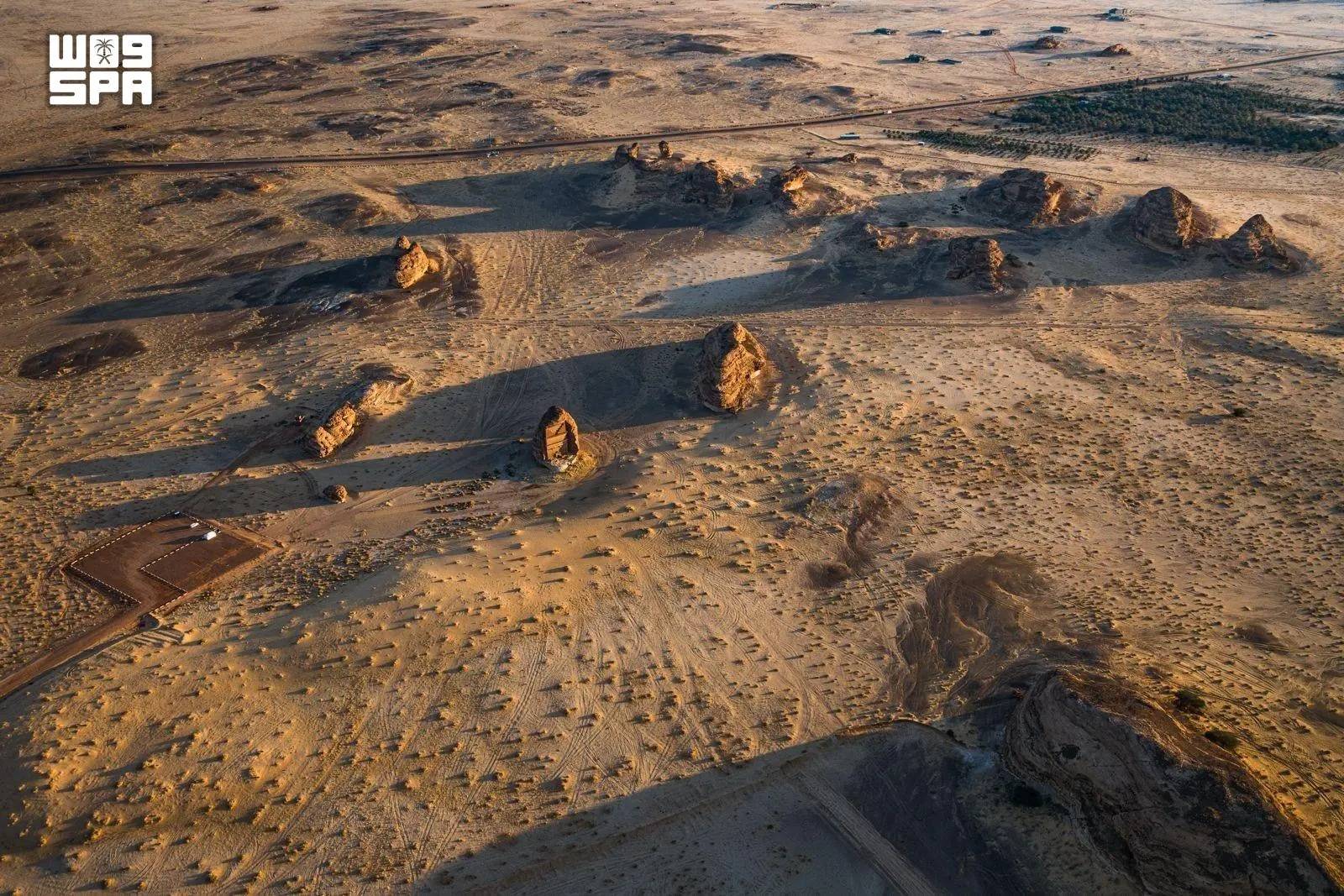
RCU is continuing its efforts to develop and preserve historical and archaeological sites in accordance with the highest international standards. (SPA)

As part of its commitment to safeguarding human heritage, RCU has given special attention to Jabal Ikmah, recognized as one of UNESCO’s Memory of the World sites for its thousands of ancient inscriptions and writings documenting various aspects of social, religious and economic life in ancient civilizations, making it a living testament to the depth of AlUla’s cultural heritage.

This cultural momentum forms part of RCU’s strategy to deliver an exceptional cultural tourism experience, where archaeological landmarks integrate seamlessly with development projects, reflecting the convergence of past and present in a continuously evolving civilizational landscape.

Through its local and international partnerships, the Royal Commission for AlUla continues its efforts to protect and promote human heritage on a global scale, reinforcing AlUla’s position as a leading cultural destination that celebrates history, nature and humanity, while presenting a global model for sustainable development founded on balancing progress with the preservation of cultural heritage.



Medieval Book in Rome Has Been Hiding the Oldest English Poem

From left, Elisabetta Magnanti, Mark Faulkner of Dublin's Trinity College, Andrea Cappa and Valentina Longo of Rome's National Central Library examine a manuscript containing a rare, long-lost copy of Caedmon's Hymn — the first poem ever written down in Old English — at Rome's National Library, Thursday, May 8, 2026. (AP Photo/Andrea Rosa)
TT

Medieval Book in Rome Has Been Hiding the Oldest English Poem

From left, Elisabetta Magnanti, Mark Faulkner of Dublin's Trinity College, Andrea Cappa and Valentina Longo of Rome's National Central Library examine a manuscript containing a rare, long-lost copy of Caedmon's Hymn — the first poem ever written down in Old English — at Rome's National Library, Thursday, May 8, 2026. (AP Photo/Andrea Rosa)

The researchers in Ireland looked at their computer screen, marveling at a medieval book tracked down in a Roman library. They flipped through its digitized pages and found their sought-after treasure: the oldest surviving English poem.

“We were extremely surprised. We were speechless. We couldn’t believe our eyes when we first saw that,” Elisabetta Magnanti, a visiting research fellow at Trinity College Dublin's school of English, told The Associated Press.

What's more, she said, the poem was within the main body of Latin text: "It was extraordinary.”

Composed in Old English by a Northumbrian agricultural worker in the 7th century, "Caedmon’s Hymn" appears within some copies of the “Ecclesiastical History of the English People,” written in Latin by a monk and saint known as the Venerable Bede. His history is one of the most widely reproduced texts from the Middle Ages, with over 200 manuscripts, according to Magnanti's colleague Mark Faulkner, an associate professor of medieval literature at Trinity.

He considers Caedmon’s poem to be the start of English literature.

The manuscript he and Magnanti found is one of the oldest, dating from the 9th century. Two earlier copies contain the poem in Old English, but as afterthoughts — translated from Latin and scrawled into the margin by later scribes or appended but not within the text's main body, according to the researchers.

The discovery sheds light on the English language's wide diffusion, long before what was previously understood, Faulkner said in Rome, where the duo had traveled to view the text in person for the first time.

“Prior to the discovery of the Rome manuscript, the earliest one was from the early 12th century. So this is three centuries earlier than that. And so it attests to the importance that was already being attached to the English in the early 9th century,” Faulkner said.

And it's something of a miracle they uncovered it at all.

The book had a long and twisted provenance Caedmon is said to have composed the poem while working at Whitby Abbey in North Yorkshire, after guests at a feast began reciting poems, Faulkner said.

“Embarrassed that he didn’t know anything suitable, Caedmon left the feast and went to bed," he said. "A figure then appeared to him in his dreams telling him to sing about creation, which Caedmon miraculously did, producing the nine-line hymn."

Some 1,400 years later, this copy of his poem resurfaced in Rome’s main public library — but not before crossing the Atlantic Ocean at least twice and changing hands even more times.

Monks transcribed this copy of Bede's history in the scriptorium of the Benedictine abbey of Nonantola, one of the most important transcription centers during the Middle Ages, located near modern-day Modena in northern Italy, according to Valentina Longo, curator of medieval and modern manuscripts at Rome's National Central Library.

In the 17th century, as the abbey's importance declined, its vast collection of manuscripts was shifted to another abbey in Rome, then moved to the Vatican and finally on to a small church.

Along the way, some of the texts went missing, only to emerge in the early 19th century in the possession of famous international collectors, Longo said.

This copy of Bede's history went to renowned English antiquarian Thomas Phillipps. He fell on hard times, selling off bits and pieces of his collection, and Swiss bibliophile Martin Bodmer secured the book. From there, somehow, it arrived in New York City, in the trove of Austrian-born rare bookseller H.P. Kraus during the 20th century.

Italy's culture ministry was scouring the world for the Nonantola abbey's missing manuscripts, snapping them up in auctions and from collectors around the world. It bought the copy of Bede's history from Kraus in 1972, Longo said, and since then the illustrious text has remained in Rome's library — but received scant notice.

Enter Magnanti, who had spent over four years studying Bede’s history and was compiling a catalog of extant copies.

“I knew that the book was listed in the library’s catalog, so I was almost certain that the book was, in fact, still here," she said. “I realized that, because of the very complex history of this book, no big scholar had really looked at it. So it had been virtually unstudied."

She emailed the library, which confirmed the book was in its stacks. Three months later, she received digital images of the entire manuscript.

The library is making more rare books available The library has digitized the entire Nonantolan collection and it is freely accessible through the website, Longo said.

It's part of a massive project by the library to make thousands of rare books and manuscripts available to researchers around the world, according to Andrea Cappa, the library's head of manuscripts and the rare books reading room.

“The discovery made by the experts of Trinity College is just one starting point, a single manuscript that might pave the way for countless other discoveries, in countless other fields, through international cooperation like this,” Cappa said.


Cultural Fund, Investment Ministry Promote Saudi Film Sector at Cannes Film Festival

Attendees included international investors, studios, production companies, and investment fund managers. SPA
TT

Cultural Fund, Investment Ministry Promote Saudi Film Sector at Cannes Film Festival

Attendees included international investors, studios, production companies, and investment fund managers. SPA

The Cultural Development Fund, in partnership with the Ministry of Investment and Riviera Content Fund, organized a special event alongside the 79th Cannes Film Festival to attract international investment into Saudi Arabia’s rapidly growing film sector.

The event also aimed to highlight the achievements of Riviera Content Fund, the Kingdom’s first Saudi film investment fund.

Cultural Development Fund CEO Majed bin Abdulmohsen Al Hugail said the Saudi film industry has evolved into a fully integrated ecosystem and is now more attractive for investment than ever before.

He also showcased the sector’s strong investment potential, supported by expanding infrastructure, advanced regulations, creative talent, and financing solutions.

The event also highlighted Riviera Content Fund’s investments exceeding SAR54 million from a total capital of SAR375 million.

Attendees included international investors, studios, production companies, and investment fund managers.

The initiative supports Saudi Arabia’s efforts to strengthen the cultural economy, empower local talent, and attract high-value investments in line with Vision 2030.


Literature Commission Inaugurates Saudi Pavilion at Doha International Book Fair 2026

The Kingdom's participation reflects the integration of national efforts in the cultural sector - SPA
TT

Literature Commission Inaugurates Saudi Pavilion at Doha International Book Fair 2026

The Kingdom's participation reflects the integration of national efforts in the cultural sector - SPA

The Literature, Publishing and Translation Commission inaugurated the Kingdom of Saudi Arabia's pavilion today at the Doha International Book Fair 2026, held from May 14 to 23, 2026, reflecting the Kingdom's growing presence in the publishing sector and the regional and global cultural landscape, SPA reported.

CEO of the commission Dr. Abdullatif Alwasel affirmed that the commission seeks, through its participation, to promote Saudi literary and intellectual production, highlight the development of the literature, publishing, and translation sectors in the Kingdom, and raise awareness of the Saudi cultural scene through an accompanying cultural program featuring panel discussions and poetry evenings with leading Saudi authors and intellectuals, addressing literature, publishing, and translation issues and spotlighting Saudi cultural achievements and their impact on the Arab and international stage.

The Kingdom's participation reflects the integration of national efforts in the cultural and knowledge sector, led by the commission with the participation of several entities.