Archives Interrupted: Vintage Pics Show Gaza 'We No Longer Know'https://english.aawsat.com/features/5276156-archives-interrupted-vintage-pics-show-gaza-we-no-longer-know
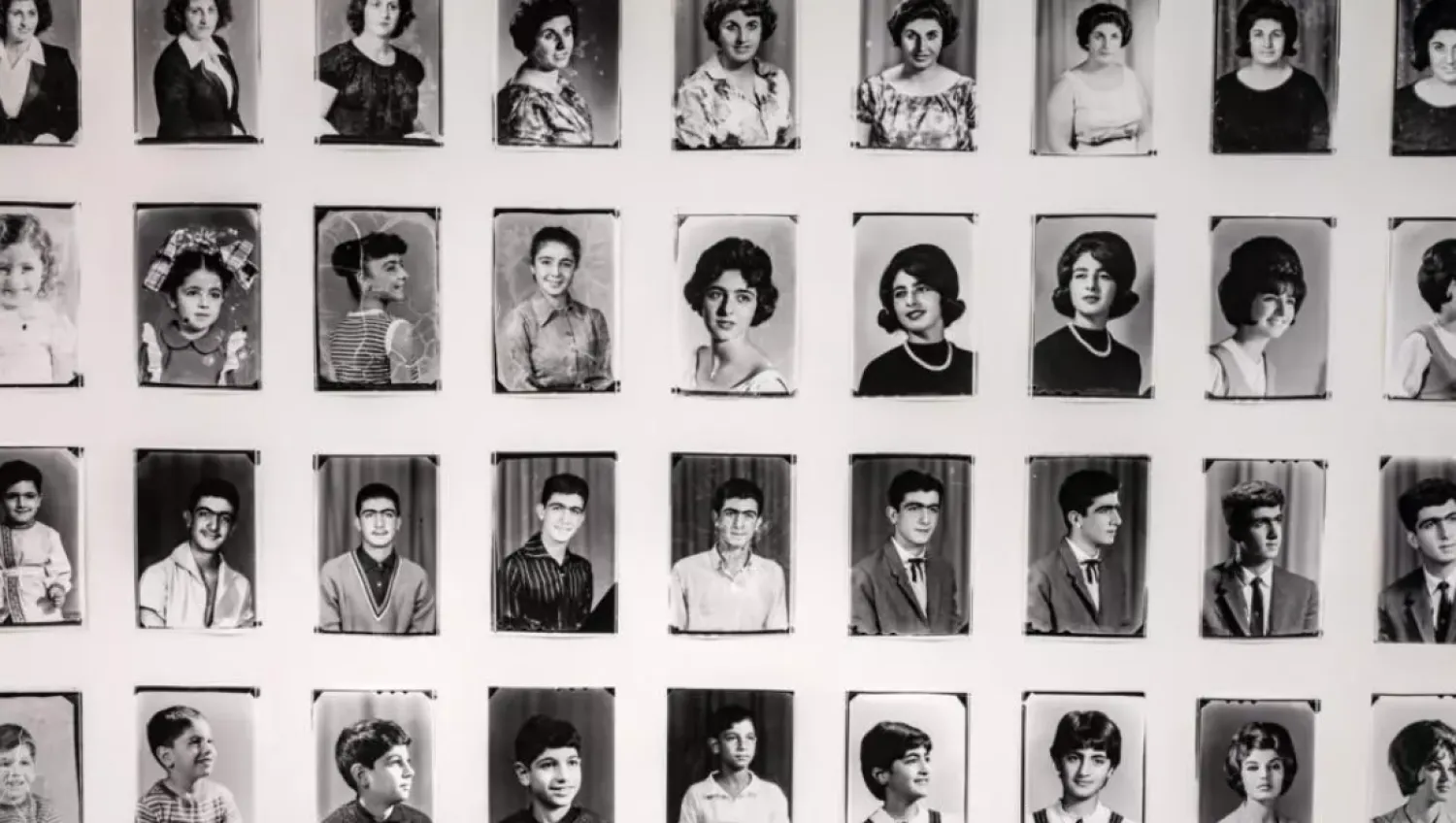
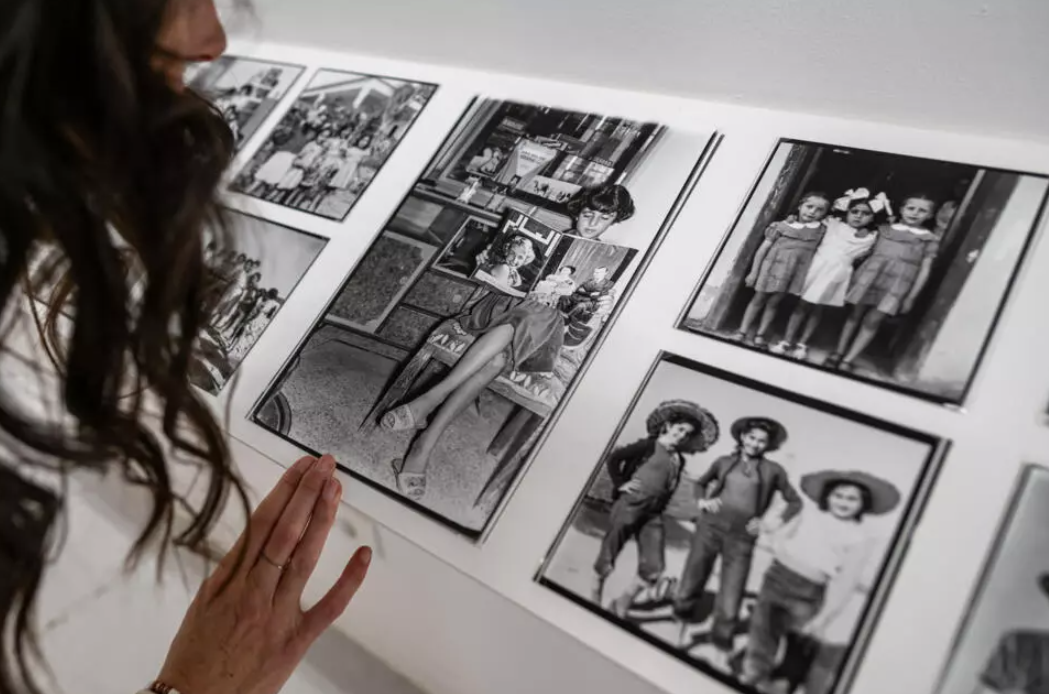
When Kegham Djeghalian photographed daily life in Gaza last century, the Palestinian territory was synonymous with Hollywood-inspired brides, fancy dress parties and excursions to smoke a hookah at the beach.
They are images from a time far removed from the rubble and tent cities of the now war-ravaged Gaza Strip.
"It's a Gaza we no longer know. A joyful Gaza, one full of hope, connected to the world, with trains and an airport," said his grandson, who has curated a show of his work in France's southern city of Marseille.
Djeghalian survived the Armenian genocide of 1915 -- a term strongly denied by Türkiye -- then settled in Gaza, opening the city's first ever photo studio in 1944.
He refused to leave, despite the recurring conflicts hitting the small territory wedged between Egypt and what became Israel in 1948, spending four decades capturing images of the Palestinian society that had adopted him, up until his death in 1981.
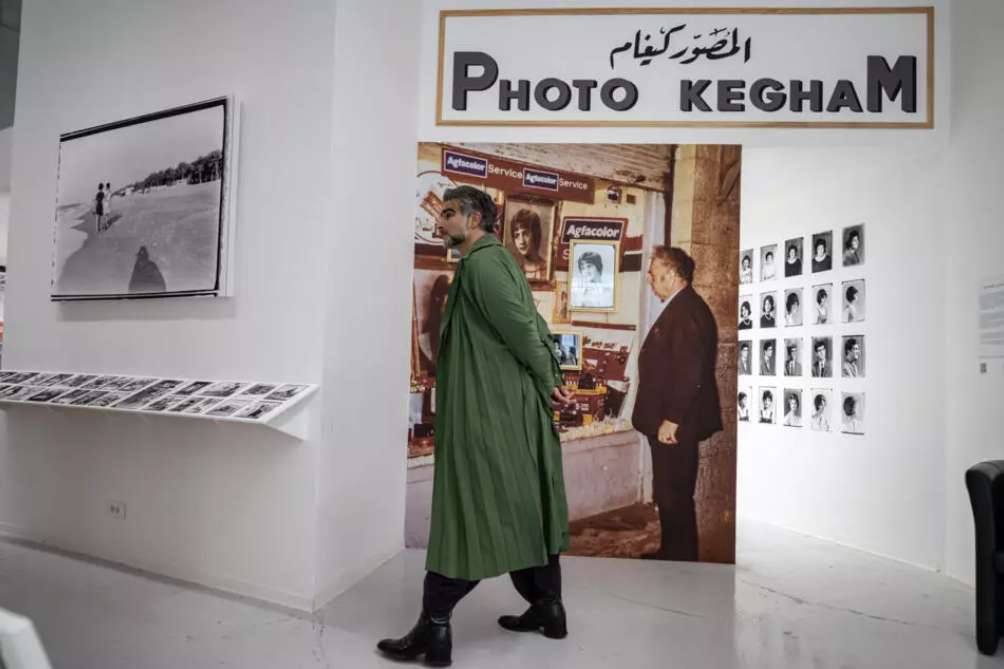
Some 300 of his surviving photographs are on show in Marseille until September.
In one image, children have clambered onto each other to form a human pyramid in the courtyard of a school for Palestinian refugees displaced after the creation of Israel.
In another, women with voluminous hair blowouts pose smiling next to a sewing machine.
In a third, French philosophers Jean-Paul Sartre and Simone de Beauvoir have just stepped off a small propeller plane.
The photograph has no caption, but the pair visited the Gaza Strip in March 1967 shortly before Israel seized the coastal territory in the Six-Day war.
"I grew up with family stories about Kegham, the Gazan photographer who survived the Armenian genocide," the curator, who inherited the same name as his grandfather and calls himself Kegham Jr, told AFP.
The 41-year-old professor of visual culture, who spent part of his childhood in Egypt, says his father discovered over 1,000 photo negatives "by chance" in 2018 in three red boxes at the back of a cupboard in the family's Cairo apartment.
They included studio portraits and family photos, images of children on balconies and at the beach, and crowds in the streets.
"We see a diverse society: Armenians, Greeks, Palestinians, Bedouins. But also those displaced in 1948," said Kegham Jr.
Today two-thirds of Gaza's population are descendants of Palestinian refugees, according to the United Nations.
Kegham Jr said he did not want any captions or context to the pictures in the exhibition titled "Photo Kegham of Gaza: Unboxing", which is to travel to Bristol in the United Kingdom in October.
The "interrupted and unfinished" archives thus illustrate "a rupture of histories, shattered by war, by genocide, by occupation", he said.
Kegham Jr was unable to visit Gaza, with the territory under blockade since Hamas seized control in 2007, and then a devastating war ravaging the territory after the Palestinian Islamist militant group attacked Israel in October 2023.
To complete his photo collections, the grandson reached out to a Palestinian called Marwan al-Tarazi who held part of the archives after his brother inherited the studio.
A part of the exhibition dubbed "Zoom call" shows screenshots of their conversation in 2021.
The collaboration was interrupted when, in October 2023, Israeli strikes killed Tarazi, his wife and grandchild, he said.
In front of the images at the Marseille Photography Centre, Houri Varjabedian, a 70-year-old Marseille resident hailing from an Armenian family in Lebanon, said it felt like looking into a family album.
Her maternal grandfather, a dentist in the Ottoman army, had himself been photographed in Gaza, she said.
She said it was heartbreaking to see "those wonderful palm trees, that beach".
"It's a bit terrible given the current events," she added.
Thousands of Young Sailors Adjust to Iran War Aboard USS George Washingtonhttps://english.aawsat.com/features/5325645-thousands-young-sailors-adjust-iran-war-aboard-uss-george-washington
Night Aircraft Handling Officer Breana Royston and AE1 Andrew Schmucker coordinate aircraft positioning aboard the USS George Washington in the Arabian Sea, September 13, 2026 (Reuters)
Thousands of Young Sailors Adjust to Iran War Aboard USS George Washington
Night Aircraft Handling Officer Breana Royston and AE1 Andrew Schmucker coordinate aircraft positioning aboard the USS George Washington in the Arabian Sea, September 13, 2026 (Reuters)
An emergency alert blares from a loudspeaker, and Damon Dennard and other sailors on the deck of the aircraft carrier USS George Washington are scrambling. Dennard, 23, is readying bombs for loading onto aircraft as his crewmates race to their positions.
“It has been eventful,” said Dennard, an aviation ordnanceman airman apprentice. Once the alert ends, he takes a breath, sits on one of the bombs and jokes that he probably expected an easier deployment.
“It’s crazy, but at the end of the day, it’s work. That’s all.”
Dennard was one of dozens of sailors Reuters spoke with in September on a rare visit to a US warship that is central to the Iran war.
The visit began at a particularly tense moment, just three days after the US military blew up five Iranian oil tankers in retaliation for Iran targeting a US Navy warship.
The George Washington’s mission near the Strait of Hormuz which has no defined end-date came as a surprise to the crew, who were deployed from Japan at the end of August to relieve another carrier.
The aircraft carrier is effectively a floating city of around 5,000 personnel, each with their own mission, from Majesta Ochoa, who operates a cash register, to Lieutenant Commander Brody Samaha, a “shooter” who helps oversee the launch of aircraft from the carrier’s catapults.
But there is a sense of synchronization as the sailors go about their jobs, crew say.
The aircraft carrier is effectively a floating city of around 5,000 personnel, each with their own mission, from Majesta Ochoa, who operates a cash register, to Brody Samaha, a “shooter” who helps oversee the launch of aircraft from the carrier’s catapults.
“It’s a dance, with lots of people checking each other,” Samaha said, before adding that the flight deck is also a “very dangerous place to be. It’s very unforgiving.”
Ouija Board
Breana Royston, the night aircraft handling officer, or ‘NACHO,’ has a unique perspective over the dangerous maneuvering on the flight deck.
Her job is to supervise aircraft movement, including bringing fighter jets up to the flight deck and back down to the hangar bay via massive elevators.
To do that, she uses what’s known in Navy parlance as a “ouija board” — a real-time model of the deck, with miniature aircraft all lined up in their current positions. It looks a little like a strategy board game.
“We’ve been on our toes the last week, maneuvering and everything — with everything that's going on,” Royston said, adding it’s been “kind of crazy, really busy.”
“It’s nerve-wracking, but it’s fun,” she said.
The Iranian government has repeatedly condemned US military actions in the Strait of Hormuz. On September 25, the Iranian foreign minister said the insecurity prevailing in the strait was the “direct result of the aggressive actions of the United States and the Israeli regime.”
The war began in February with joint strikes on Iranian targets by the US and Israel. US President Donald Trump has said many times the conflict would soon be over, but it persisted for longer than initially expected.
In August, in response to reports of deteriorating conditions, low morale and suicide attempts on the Lincoln, US Secretary of Defense Pete Hegseth said the accounts “misrepresented” the reality, praising sailors who endure austere conditions.
Extended Deployments Pose Strain on Crew
Still, extended deployments can pose enormous strain on crews’ mental health, particularly in wartime, and are a challenge for any navy. Sailors must maintain a state of alert and readiness, heightened in the case of the George Washington due to the threat of drone and missile attack from Iran.
“Morale is really important to us,” said Rear Admiral Jeffrey Heames, the commander of Carrier Strike Group 5.
Heames talked about ensuring the ability of the crew to contact home and receive mail.
“Some of those things affect how sailors hold up out in this kind of environment,” Heames said. “They are huge focus areas for me.”
Reuters spoke with Seaman Deandre Cook as he checked in with his wife back home on a video call. She was holding one of their young daughters on her hip.
It was hard being away from his family, Cook said, but added: “The distance makes the relationship stronger.”
Growing Up
As jets thundered off the carrier’s deck above them, hundreds of members of the George Washington’s crew gathered for a ceremony to mark the 25th anniversary of the September 11, 2001 attacks — an event many of them were too young to remember.
Al Qaeda’s attacks on New York and Washington propelled the US into two decades of war that sent troops to Afghanistan, Iraq, Syria and elsewhere. Many supporters of Trump had hoped Middle East wars were a thing of the past.
After a sailor sang the national anthem, the chaplain on board, Ben Garrett, delivered a prayer as the assembled crew bowed their heads.
“Help us honor those who have gone before us,” Garrett said.
Garrett later told Reuters that many of the crew members are still learning the basics of growing up, including skills like patience, managing relationships and career expectations.
“A huge percentage of this ship are between the ages of 19 and 24 years old,” said Garrett, a Roman Catholic priest. “So they’re trying to figure out being an adult while they’re out here.”
Sometimes sailors enlist to get away from a small town or a situation back home, Garrett added.
Lieutenant Commander Brian Lasley said there were more people on the George Washington than back in his hometown of Fredericktown, Missouri, whose population was 4,429 in the 2020 census.
Camren Pollard, 24, an interior communications electrician third class, said he joined the Navy on a spur-of-the-moment decision after seeing older coworkers unhappy in his previous job. “I wanted to change things in my life,” he said.
“My mom freaked out more than anything. My little brother thought it was kind of cool.” For Pollard, however, “I don’t think about it a whole lot. It’s work for me.”
US-led Troops Exit Iraq: What's Next for Pro-Iran Groups?https://english.aawsat.com/features/5324163-us-led-troops-exit-iraq-whats-next-pro-iran-groups
A giant Iraqi flag hangs off the reconstructed 12th century "Hadba" leaning minaret at the historic Great Mosque of al-Nuri in the old city of Mosul on September 29, 2026 as Iraq marks the withdrawal of the US-led anti-ISIS coalition forces from the country. (Photo by Zaid AL-OBEIDI / AFP)
US-led Troops Exit Iraq: What's Next for Pro-Iran Groups?
A giant Iraqi flag hangs off the reconstructed 12th century "Hadba" leaning minaret at the historic Great Mosque of al-Nuri in the old city of Mosul on September 29, 2026 as Iraq marks the withdrawal of the US-led anti-ISIS coalition forces from the country. (Photo by Zaid AL-OBEIDI / AFP)
With the US-led anti-extremist coalition leaving Iraq, Baghdad faces mounting pressure to rein in Tehran-backed armed groups, a difficult task in a country long caught between its allies, the US and Iran.
Prime Minister Ali al-Zaidi, who assumed power earlier this year with the United States' blessing, has pledged that after the coalition exits on Wednesday, pro-Iran groups would hand over their weapons to the state.
But the issue has proven far more complicated than simple announcements, said AFP.
Iraq has long been a proxy battleground for the US and Iran, with each interfering in major political decisions and government formation.
The ongoing Middle East war, during which Iran-backed groups in Iraq targeted US facilities there and around the region hundreds of times, has deepened Iraq's entanglement.
- 'Tricky' -
Several senior Iraqi officials told AFP that Iran will not accept that the factions hand over their weapons, especially amid the regional war, and its officials have clearly relayed the message.
"If there's a deal between the US and Iran, I think that this whole issue becomes very easy to deal with," Iraqi political analyst Sajad Jiyad said.
But Jiyad said "Iran has been very clear that while there is a conflict going on, they cannot give up their strategic capabilities", including the Iraqi groups and "their ability to attack US interests in Iraq and the region".
It is, however, a "tricky situation", because Iran doesn't want an "unstable Iraq", he added.
"Iran's agenda is to reach a deal with the US, so that these groups will naturally reduce their visibility and activity," without giving up capabilities.
The factions also want assurances that the US won't target them before they consider surrendering their weapons.
But if no progress is forthcoming in terms of disarming these groups, then "the US is not going to make a longer-term commitment of not targeting them", he said.
It will continue on its usual paths: diplomatic and economic pressure through sanctions, and occasional strikes.
- 'Liability' -
The US-led coalition deployed to Iraq and Syria in 2014 to fight the ISIS group, which seized large swathes of both countries and committed atrocities.
Both the coalition and Tehran-backed groups fought ISIS, their common enemy.
After ISIS's defeat in Iraq in 2017, those groups demanded the withdrawal of US troops and began targeting them with drones and missiles, triggering US retaliatory strikes that killed several of their commanders over the years.
US pressure on successive Iraqi governments to disarm the factions mounted, especially after they intervened in support of Palestinians during the Gaza war in 2023, and later backed Tehran in the Middle East war.
Political analyst Jiyad said little should be expected after the coalition's pullout.
"We are not going to get disarmament... but there has to be some sort of progress and some plan," he said.
"What is probably going to happen is the process begins" towards a solution, but it will require time and "trust-building measures".
The Tehran-backed groups feel the government is unable to protect them from the US, and the government sees them as a "liability," he added.
- No plan -
While some groups said they would disarm, other powerful factions refuse to do so.
But the government "does not even have a plan" for how it is going to disarm them, a diplomatic source in Baghdad said.
Two senior politicians told AFP that Zaidi, a newcomer to politics, had repeatedly said he was ready to "confront" the groups if they don't disarm.
For weeks, tensions grew until an unannounced truce was reached, with the intervention of senior politicians who are now hoping to work out a deal.
An Iraqi official said that "the issue needs time to reassure the factions, and prevent any confrontation between Iraqi forces and the armed groups".
Kazem al-Fartoussi, spokesperson for the Kataeb Sayyid al-Shuhada armed group, said the factions don't want a confrontation with the state because "there will be no winners".
But "our weapons are precious, so we have said these weapons are in exchange for sovereignty," including the withdrawal of foreign troops and an end to American political and economic interference.
Fartoussi said the factions are in talks with the government about "regulating" their weapons, as well as their relationship with the state, but he doesn't trust the US.
For the Americans and Israelis, their objective is "nothing other than eliminating the factions, not the weapons," Fartoussi said.
If the issue is the factions' "existence", then "we reject any discussion".
Israel Obliterates South Lebanon's Architectural Heritagehttps://english.aawsat.com/features/5323773-israel-obliterates-south-lebanons-architectural-heritage
Israel Obliterates South Lebanon's Architectural Heritage
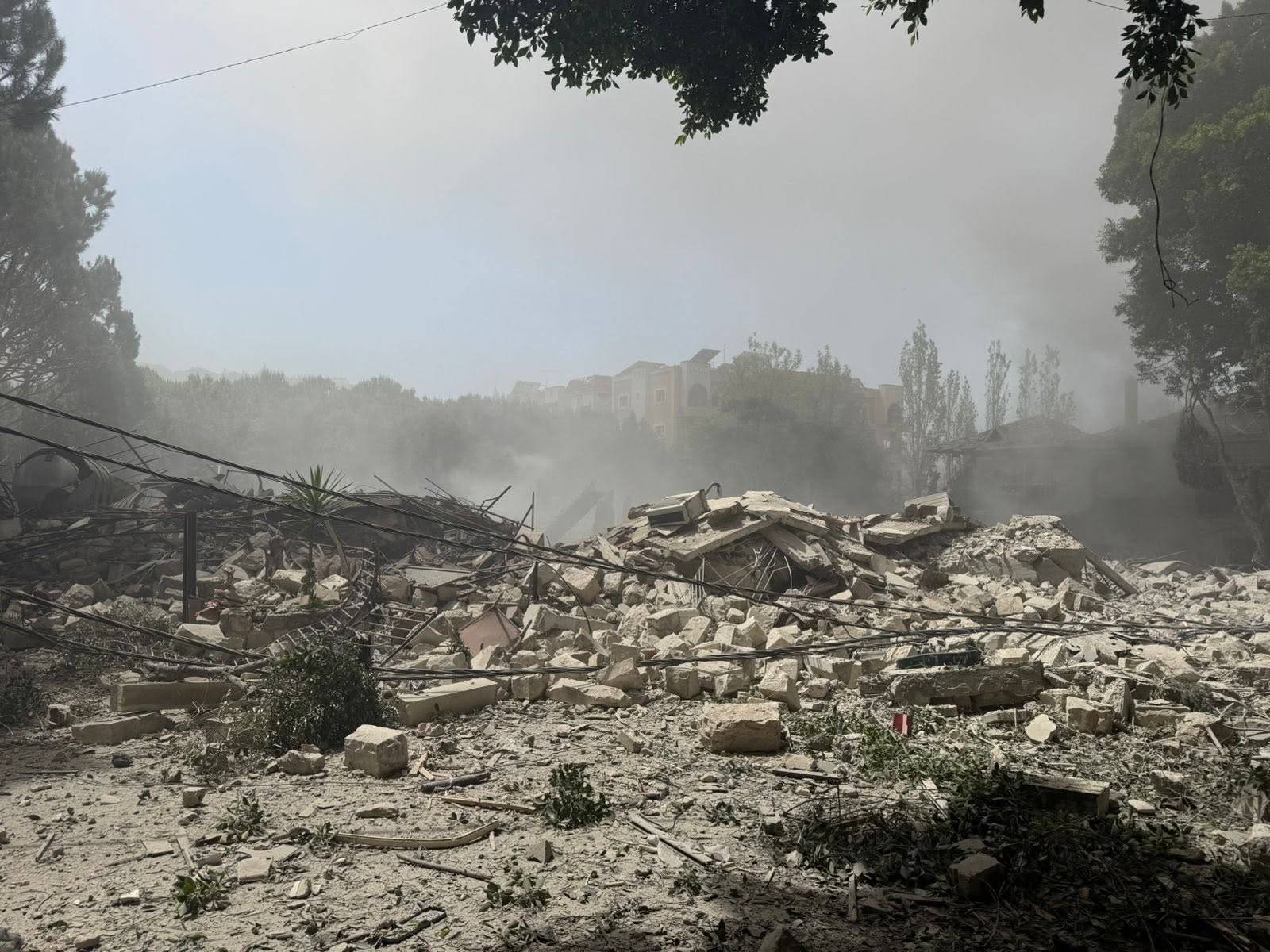
The residence of Said Shahine, father of Ghaleb and Fahmi Shahine, which was completely destroyed in the city of Nabatieh (Kamel Jaber archive)
Daily attacks around the city of Nabatieh and the town of Kfar Rumman have not stopped the Zein family from launching work to restore “what can be restored” of the home of Youssef Bek Zein, which was damaged by intensive Israeli strikes several months ago.
Descendants of one of Nabatieh’s best-known political families see preserving their heritage as an act of defiance against Israel, which they say is erasing physical traces and memories from the land and seeking to eliminate historic homes with distinctive architecture, political family residences, and urban and historical landmarks of all kinds across South Lebanon.
During the two large-scale wars Israel waged on South Lebanon, airstrikes and demolitions wiped out dozens of heritage landmarks, including political family homes whose architecture and libraries documented periods of Jabal Amel’s political history over the past two centuries.
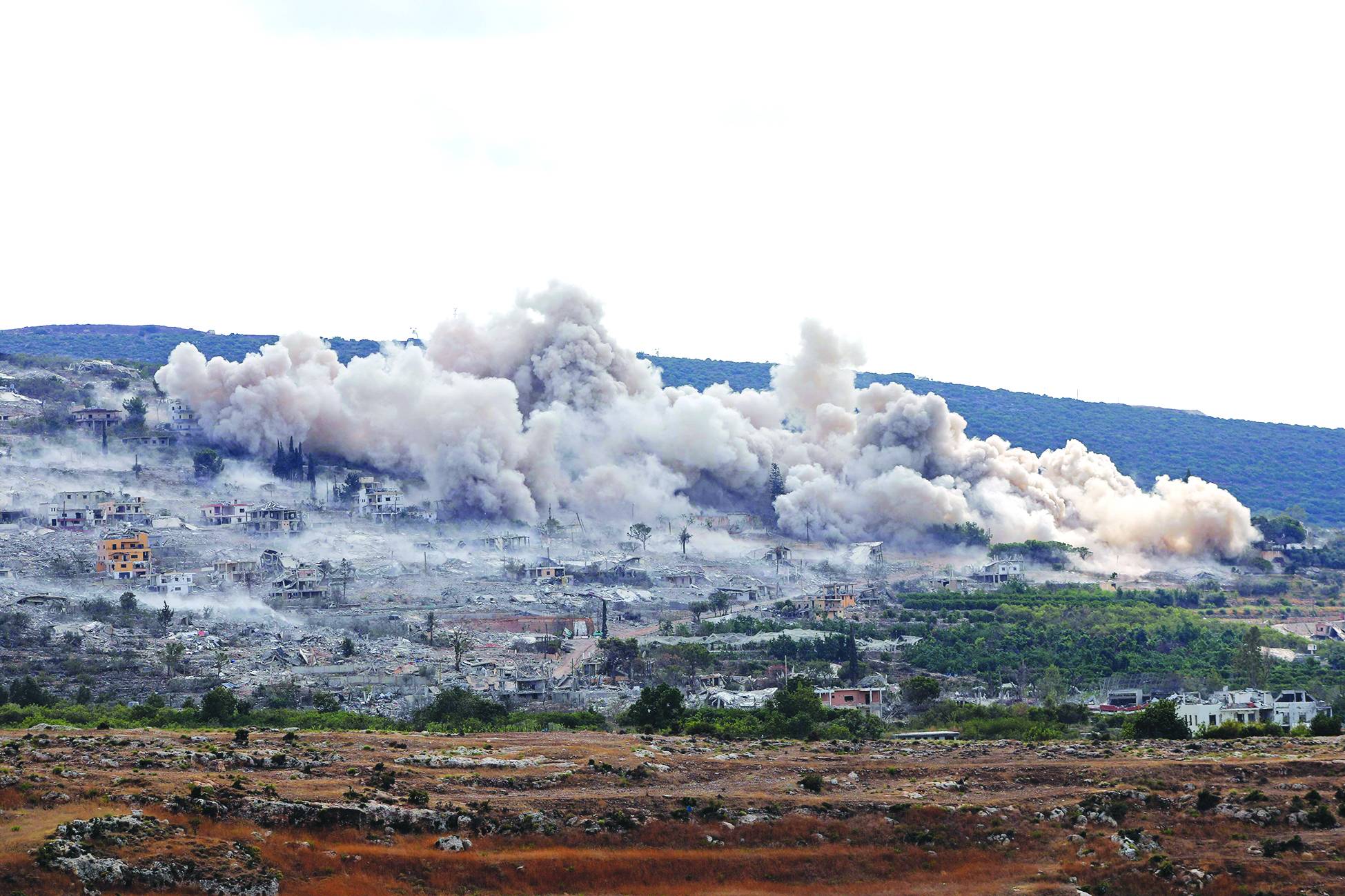
This photograph taken from the southern Lebanese village of Hanniyeh shows smoke rising from the site of a series of Israeli controlled explosions in the nearby village of al-Mansouri on September 28, 2026. (Photo by Kawnat HAJU / AFP)
In Nabatieh alone, Israeli bombardment razed 147 homes between 80 and 110 years old. Some had developed from houses originally built 200 years ago. They included heritage properties belonging to local political leaders, ministers and lawmakers who had played roles in Nabatieh and its surroundings over past decades.
The damage also extended to political family residences around Nabatieh, including the Asaad family home in Taybeh. Local activists say many old houses were razed along with it, including the home of Khalil Abdallah in Khiam, one of the region’s most prominent historical leaders, built in 1862.
Abdel Aziz Zein’s Home: A Cultural Role
The home of Youssef Bek Zein, heavily damaged by Israeli bombardment, is now among the last remaining heritage landmarks and architectural witnesses in the Nabatieh area following the loss of the Abdel Aziz Zein residence.
In recent years, that residence had become a cultural hub in the region. His son, Dr. Saad Zein, expanded it to host cultural and community activities.
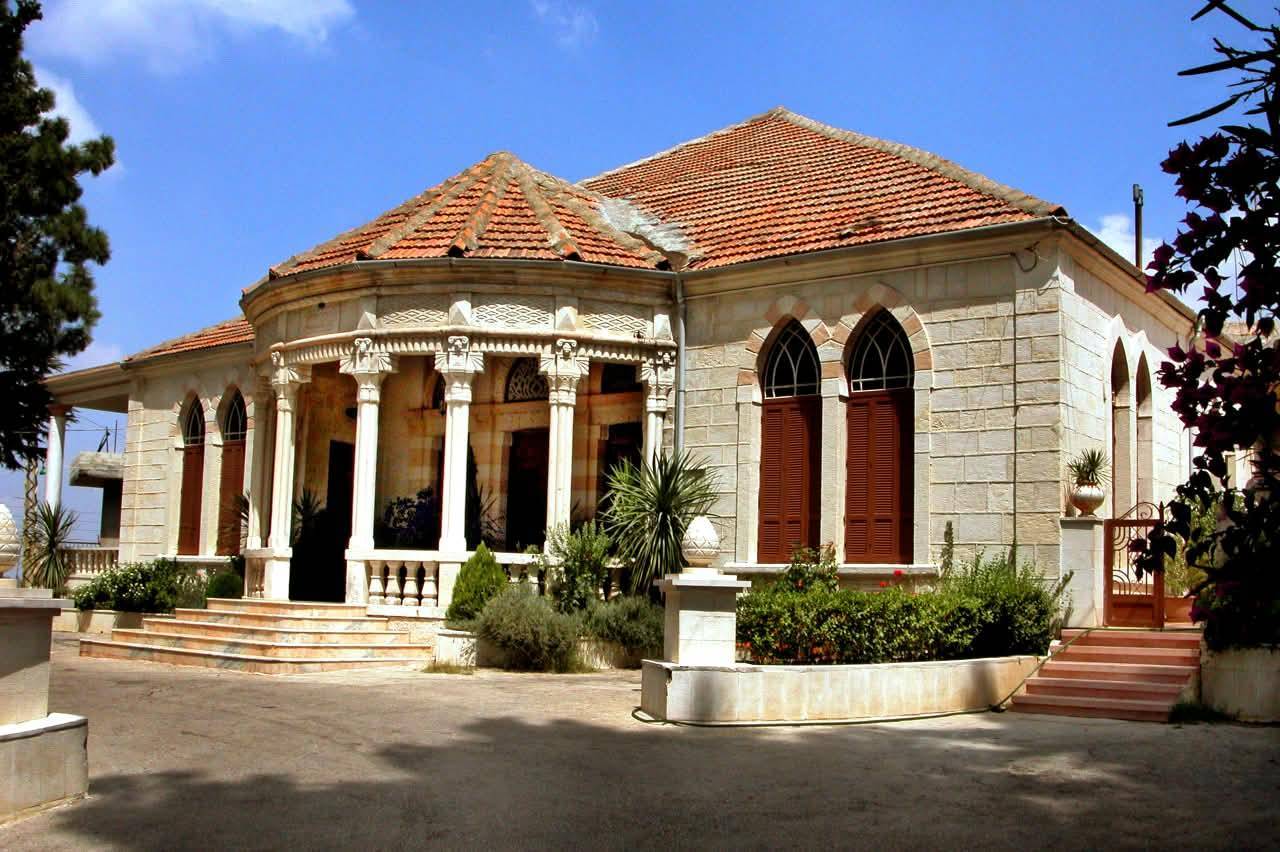
“My family home, the Abdel Aziz Zein residence, was more than 80 years old,” Dr. Saad Zein told Asharq Al-Awsat. “An Israeli strike completely demolished the house and wiped out all its features — not only its architecture, but also its cultural role.”
The Abdel Aziz Zein residence (Saad Zein archive)
Zein said the house had served as a venue for cultural and social activities since at least 2000. He had established a small museum there documenting the history of Jabal Amel, and the house “became a cultural destination in the region.”
The residence was later expanded to include gardens and a diwaniya, a traditional reception space that is a central feature of southern Lebanese architecture. In recent years, it became known as the “Saad Zein House.”
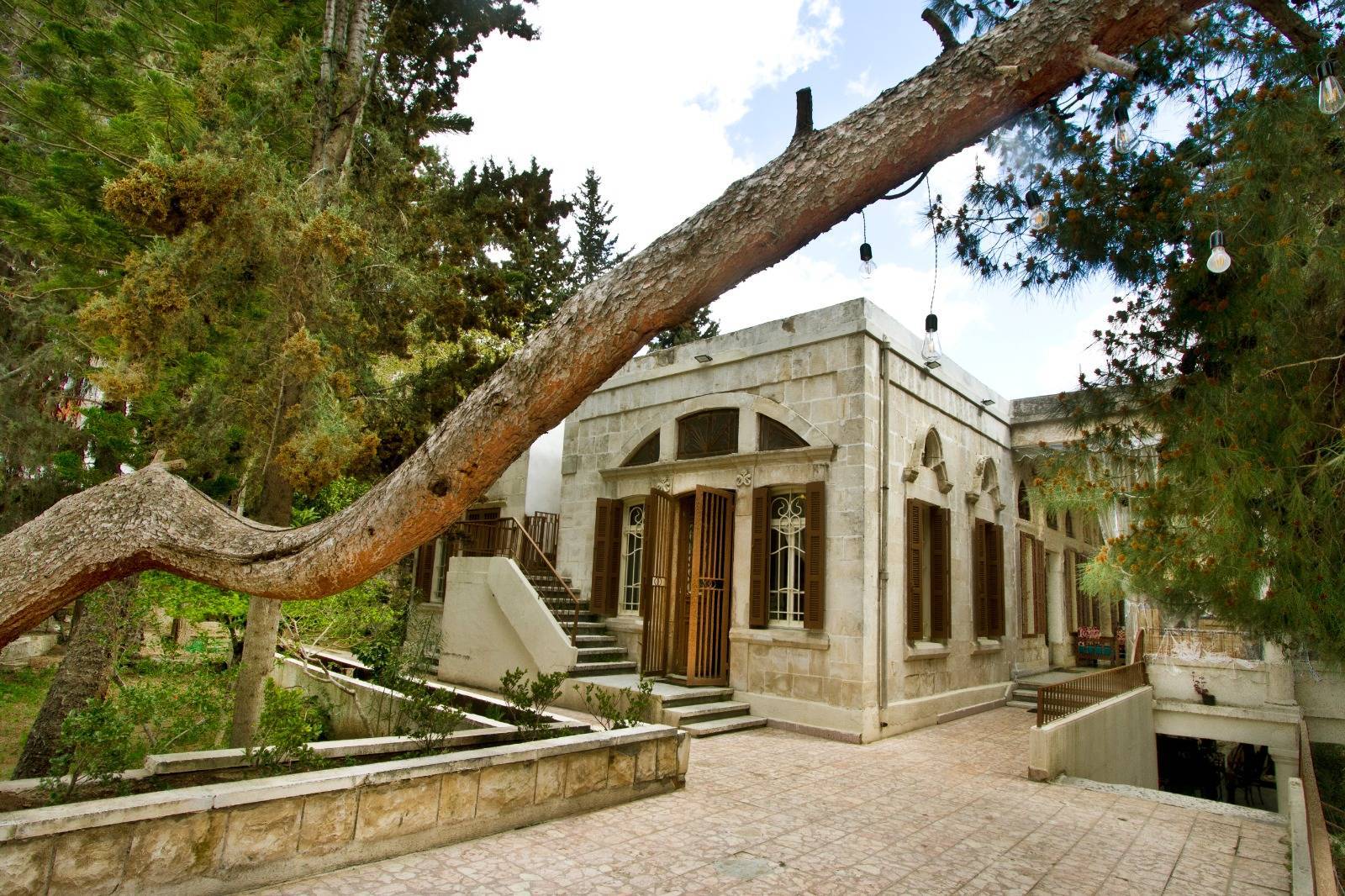
The strike on the large residence also damaged the adjoining Zein family home. That residence had been a center of political and social leadership for more than a century. Built 150 years ago, it housed the Ottoman governor in the 19th century before ownership passed to the Zein family and Youssef Bek Zein took up residence there.
Even the Family Tombs Were Hit
Zein entered parliament after the proclamation of Greater Lebanon in 1924, and his family became one of Jabal Amel’s most prominent political families during the last century. Its parliamentary representation continued uninterrupted until 2018.
“The Youssef Bek Zein residence was severely damaged. The roof, courtyard and family tombs were hit, including Youssef Bek’s grave,” Dr. Saad Zein stated.
“We are now working intensively and quickly to restore the house so it can be usable again and remain a witness to a political era, given that the family is one of Jabal Amel’s founding families and has maintained a cultural, developmental and social presence — a role that continues with me and my uncle.”
Zein stressed that the targeting of political homes and urban and historical landmarks “aims to erase traces and memories from the land in order to sever the Lebanese people’s connection to their homes, land and heritage.”
Deliberate and Systematic Destruction
Cultural and social figures in Nabatieh broadly agree that what occurred during the wars of 2024 and 2026 amounted to the “systematic destruction of memory without any actual justification.”
They argue that the concentrated bombardment and leveling of longstanding family homes historically associated with political positions opposed to Hezbollah contradicts the Israeli military’s assertion that its strikes target only Hezbollah facilities and headquarters.
One particularly notable case was the leveling of the home of former lawmaker Habib Sadek, founder of the Cultural Council for South Lebanon, in Kfour, west of Nabatieh.
Sadek was among South Lebanon’s best-known political and cultural activists. He served in parliament in 1992 and was one of the most prominent chroniclers of Israeli violations in the south since the 1940s. He encouraged the publication of works sponsored by the Cultural Council and combined a political career with his work as a writer, poet and thinker.
Manuscripts Documenting Violations
Kamel Jaber, head of the Cultural Council’s Nabatieh branch, told Asharq Al-Awsat that after Sadek’s home in Khiam was demolished in 1977, the area remained under occupation until 2000 and the family was forced to live between Beirut and Nabatieh.
“The family was determined to build a house outside the city resembling the homes of southerners — meaning it would have a garden surrounded by pine trees, with roses blooming in it,” Jaber said.
“Sadek paid particular attention to a diwaniya on the lower floor of the house, where he kept many of the manuscripts he had presented through various radio programs, as well as writings from the 1960s and 1970s. He also created extensive libraries in the diwaniya containing books, manuscripts and the rest of his cultural legacy.”
Jaber said Sadek was “one of the most prominent cultural figures who wrote and published works and books about the south, documenting violations and various forms of Israeli occupation, whether related to ambitions over water, geography or other issues, and produced studies showing the harm inflicted on the south through occupation.”
From that perspective, Jaber said the targeting of the house “was a targeting of Habib Sadek, his role, legacy and career.” He ruled out any security-related reason for striking the house, which he said was “closed and checked daily by a caretaker.”
Erasing Architectural and Political Heritage
The devastation is viewed locally as part of an effort to eliminate Nabatieh’s urban, architectural and political heritage.
After the 2024 war, cultural figures in the city launched an initiative, involving civil society groups in cooperation with the municipality, to document heritage buildings lost to Israeli bombardment. The survey was updated just two weeks before this article was written.
It found that 147 homes had been completely razed, leaving only a very small number of such buildings standing.
During the 2026 war, what remained of the Fadl al-Fadl house in the Manshieh district was demolished. The house was built late in the last century and designed by an Egyptian architect. General Gouraud visited it in the 1920s during a trip to the south while serving as French high commissioner in Lebanon.
The home of former lawmaker Mohammed Bek al-Fadl, meanwhile, lost large sections after strikes hit its surroundings in 2024. The house is 102 years old. Jaber, who works to document local memory through a civil society organization in Nabatieh, said its new owner had decided to restore it.
The home of Mohammed Bek al-Fadl (Kamel Jaber archive)
Erasing Cultural Memory
Nabatieh residents see the campaign as targeting architecture that embodies the area’s cultural heritage and its social, political and urban memory.
In Nabatieh, Israeli strikes completely leveled the residence of the late minister and lawmaker Rafik Shahine, as well as the home of Said Shahine, father of lawmakers and ministers Ghaleb and Fahmi Shahine.
Other buildings lost in the strikes had been regarded as architectural masterpieces, including the palace of Dr. Bahjat al-Mirza, considered one of the city’s most beautiful homes because its facades featured carvings in stone. Mirza was among Nabatieh’s first physicians in the 20th century to open his home to provide medical care to residents.
Mahmoud Shahine’s house was also razed in 2026. The building had served as a school during the last century and was among the houses constructed on the remains of older homes built some 200 years ago.
On Sept. 6, 2026, an Israeli strike leveled the home of Dr. Adnan Sharif, a century-old architectural landmark.
The home of Dr. Adnan Sharif (Kamel Jaber archive)
The home of former lawmaker Anwar Sabbah, father of Sadek Sabbah, director of Sabbah Brothers television production company, was also demolished. Built on a hill in Nabatieh in the early 1990s, it was separate from the family residence in the city, which remained standing.
Strikes also razed Ghandour Hospital, one of the main hospitals that provided medical services to the Nabatieh area during the period of occupation beginning in the 1980s.
A War on History
Israeli strikes did not only target houses and mansions but also hit archaeological and heritage sites across the south.
A market dating to the Mamluk era in Nabatieh was heavily bombarded, leaving part of it in ruins. The capital of an ancient column was dislodged at a UNESCO-listed site in the southern coastal city of Tyre.
A religious site known as “Shamoun al-Safa,” visited by both Muslims and Christians in the southern town of Shamaa, was also razed, as was Shamaa’s Crusader castle.
There is also no information about the condition of “Ain al-Fawqa” in Taybeh after the area surrounding it in the town square was devastated. The water collection spring was built in a spiral form and contains architectural features resembling examples from the Roman and Byzantine periods. It was restored during the Ottoman era.
Culture Minister Ghassan Salame told Reuters last month that historic towns outside the designated area were pummeled with airstrikes, including Tyre and Nabatieh.
Heavy bombing hit the town of Tebnin, prompting fears that its Crusader fortress was also damaged, Salame said.
"Heritage is not only Roman and Phoenician antiquities,” he added. “Heritage is also historic buildings, archaeological sites, and buildings with a cultural function."
He expressed concern that the Israeli campaign could completely erase centuries of Lebanese history.
UNESCO, meanwhile, said in a statement that it was concerned about the situation in Tyre, a World Heritage site under the agency’s enhanced protection.
It added it was deeply concerned by reports of damage to Shamaa Castle in South Lebanon and fighting near Beaufort Castle, denouncing what it described as “unlawful attacks on cultural property.”
لم تشترك بعد
انشئ حساباً خاصاً بك لتحصل على أخبار مخصصة لك ولتتمتع بخاصية حفظ المقالات وتتلقى نشراتنا البريدية المتنوعة