


Netanyahu Seeks Alternatives to Control over Palestinian Antiquities

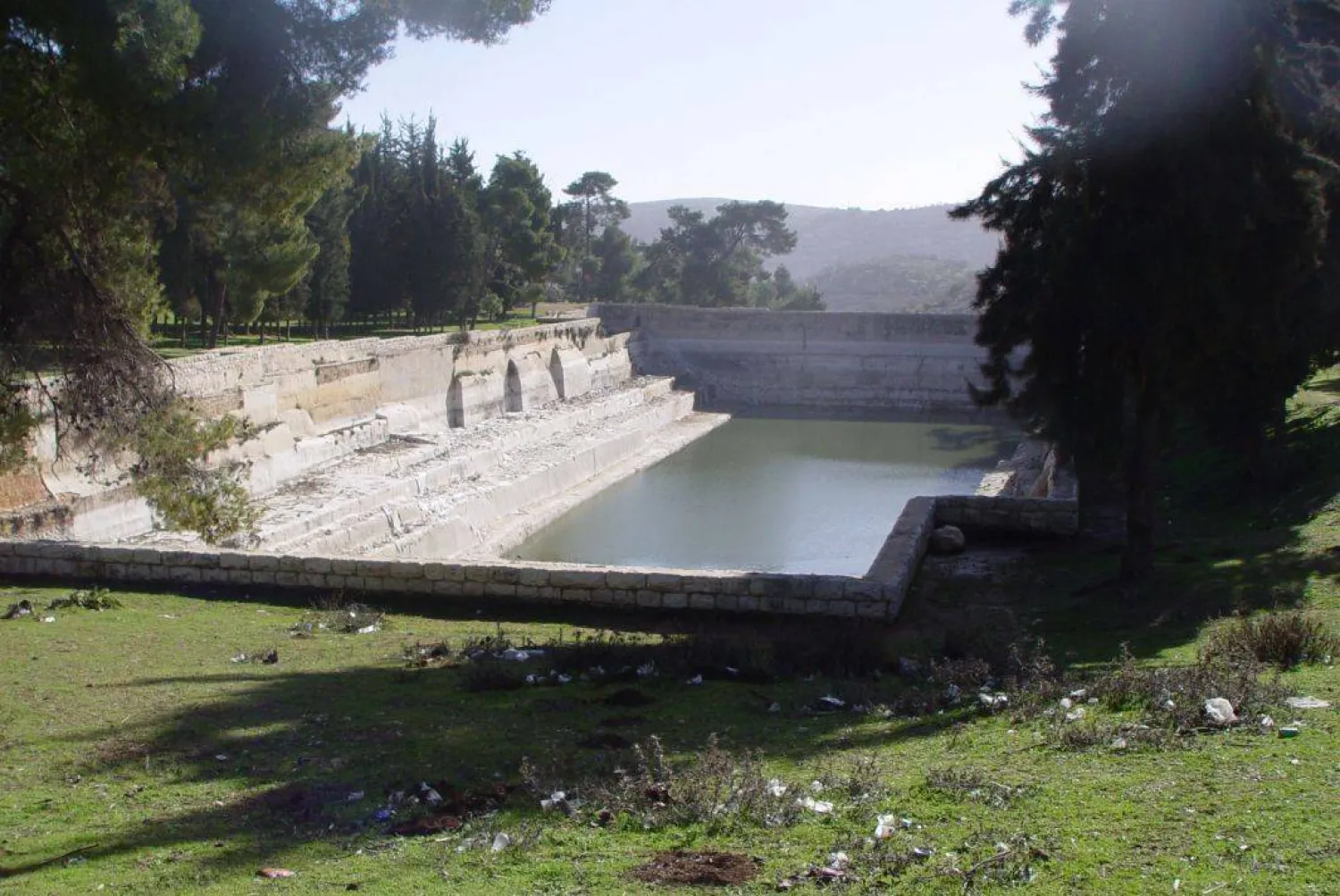
One of the historic Solomon’s Pools in Bethlehem, which Israeli Finance Minister Bezalal Smotrich has vowed to take control of. (Bethlehem Municipality)
TT

Netanyahu Seeks Alternatives to Control over Palestinian Antiquities

One of the historic Solomon’s Pools in Bethlehem, which Israeli Finance Minister Bezalal Smotrich has vowed to take control of. (Bethlehem Municipality)

Israeli Prime Minister Benjamin Netanyahu has ordered a comprehensive review of a controversial Antiquities Authority bill for the West Bank and Gaza Strip, and instructed Cabinet Secretary Yossi Fuchs to look for “alternatives” to the draft law, which is now being debated by the Knesset Education Committee, after security and professional bodies warned of “serious international damage.”

Hebrew media outlets quoted Israeli sources on Tuesday as saying Netanyahu was effectively obstructing the bill because it threatens Israel’s foreign relations, making the chances of passing any version of it before the current Knesset is dissolved “slim.”

Netanyahu’s position followed warnings from legal and security officials against the law, which establishes a “civil heritage authority” in the West Bank and Gaza Strip.

The Knesset plenum approved the bill in its first reading this month. The legislation would give the Antiquities Authority, once established, absolute authority over archaeological sites in the occupied West Bank. The scope was later expanded to include the Gaza Strip.

Palestinian antiquities under an Israeli minister

The bill, submitted by Likud lawmaker Amit Halevi, whose party is led by Netanyahu, calls for establishing an “Antiquities Authority” under the responsibility of Israel’s “heritage minister.”

It would be “fully responsible for handling all heritage and antiquities affairs in the area,” with powers including land confiscation, archaeological excavations and their management, and law enforcement. The powers of the “archaeology officer” in the army’s Civil Administration would be transferred to it.

The Knesset Education and Culture Committee is discussing the bill to draft its final version and submit it for a second and third reading. During that process, disputes emerged and Netanyahu intervened.

A representative of Israel’s National Security Council confirmed on Tuesday that Netanyahu “authorized the Cabinet secretary to examine the matter and submit the findings to him.”

A representative of Israel’s Foreign Ministry who attended the Knesset Education Committee on Tuesday also confirmed this, telling members that “the prime minister authorized the Cabinet secretary, and alternative options to the law are currently being examined.”

Asked about the Foreign Ministry’s position, he said: “It is too early to express a position.”

Netanyahu’s stance confused the proposal’s supporters and those who had pushed for it.

Education Committee Chairman Zvi Sukkot said that the law was getting promoted in the committee.

‘A violation of law’

Tami Sela, the legal adviser to the Knesset Education Committee, submitted a legal opinion stating that the bill violates international law, raises legal difficulties, and could be interpreted as creeping annexation.

“This is an unusual proposal and an unprecedented one, as an Israeli civil authority that is not part of the Israeli military would be granted powers in Palestinian territories and over their residents,” she said.

“In addition, the proposed law contradicts the Oslo Accords and constitutes a violation of the rules of international law.”

Sela noted that military authority in the West Bank is considered temporary, and that “passing this law could strengthen claims of a gradual annexation process.”

In addition to Sela, security officials opposed the law. The Israeli army said it “would harm the standing of military and security officials, and would be viewed internationally as a step involving de facto annexation.”

The Israel Academy of Sciences and Humanities also appealed to Netanyahu to prevent the law from passing.

According to the Academy, the passage of the law will be viewed in political and academic circles as the annexation of Judea and Samaria.

This will undoubtedly lead to an immediate deterioration in Israel’s international relations in the field of archaeology and will also affect other areas of science and research.

The council of the Israel Antiquities Authority submitted a similar position paper, warning that “the bill could cause significant damage to academic relations with international bodies.”

It said the legislation “will be interpreted as a violation of international law, and will severely harm Israeli archaeologists’ membership in international organizations and research cooperation, including important excavation projects in the country.”

Israeli media outlets, including The Times of Israel, said the antiquities bill will most likely not be brought to a final vote in the plenum before the Knesset is dissolved.

The Times of Israel said the Knesset plenum convened on Tuesday with no bills on its agenda.

The coalition currently cannot rely on the support of the ultra-Orthodox parties in the Knesset, which led the campaign to dissolve the Knesset, to back its legislation.

This is the first time the Knesset has attempted to give a civil authority powers over Palestinian Authority territory and its residents.

It comes as the Israeli government has pushed a series of laws that would weaken and dismantle the Palestinian Authority and expand Israeli powers in the West Bank.

Smotrich enters Solomon’s Pools

Ignoring Netanyahu and the criticism, Israeli Finance Minister Bezalel Smotrich entered the archaeological area of Solomon’s Pools in Bethlehem on Monday and vowed to take control of it.

Speaking from the site, Smotrich said: “Transferring these pools and this heritage achievement to the terrorist Palestinians was a mistake. It should not have been transferred to Area A for them to desecrate. We will restore the area. I have taken it upon myself to rebuild these pools and open them to visitors. This is a historic matter and a matter of Zionist heritage. We will succeed, God willing, and we will achieve this important goal.”

Solomon’s Pools are among the most important historical, archaeological, and water landmarks in Palestine. They are located southwest of Bethlehem and consist of three very large heritage pools.

The Palestinian Ministry of Awqaf and Religious Affairs condemned Smotrich’s move, stressing that the area is “purely Islamic endowment property.”

“This incursion represents a blatant attack on endowment properties, and a desperate attempt to impose a new colonial reality and falsify the historical and Islamic identity of the area,” it said.

The ministry called on the international community, rights institutions, and UNESCO to intervene immediately to stop what it called this arrogance.


Wife of Iraqi Official Accused of Corruption Allegedly Burns Millions of Dollars in Clay Oven

Iraqi Prime Minister Ali al-Zaidi. (AP) 
TT

Wife of Iraqi Official Accused of Corruption Allegedly Burns Millions of Dollars in Clay Oven

Iraqi Prime Minister Ali al-Zaidi. (AP) 

As the Iraqi government intensifies its anti-corruption campaign, the arrests of senior officials across several ministries have been accompanied by allegations that read almost like fiction.

Two senior officials from the Oil and Electricity Ministries have reportedly confessed to embezzling millions of US dollars and billions of Iraqi dinars, as well as participating in what authorities describe as one of the country’s largest money-laundering operations.

The officials and their alleged backers—widely known in Iraq as the “whales of corruption”—are now at the center of a widening investigation.

At the same time, social media platforms and local news outlets have been awash with stories about how illicit wealth was concealed, whether in fortified homes or on private estates.

One of the most widely circulated claims alleges that the wife and sister of former Oil Ministry official Adnan al-Jumaili burned more than $5 million and billions of Iraqi dinars in a traditional clay oven at a family farm in Salahuddin province before security forces arrived to conduct a search.

An Iraqi source told Asharq Al-Awsat that teams from the Integrity Commission, headed by Mohammed Ali al-Lami and operating under directives from Prime Minister Ali al-Zaidi, have not officially confirmed whether large sums of money were actually destroyed or whether additional cash was found at specific homes and orchards.

According to the source, recovered funds have been deposited in the state treasury pending further investigations into whether the confessed crimes were carried out independently or on behalf of a broader network.

“The scale of these funds and the manner in which they were obtained leave no doubt that those responsible, enjoyed protection from powerful figures,” the source said. “They may have been little more than front men.”

Iraq’s judiciary has issued arrest warrants for the wife and sister of detained former Oil Ministry undersecretary Adnan Mohammed Mahmoud al-Jumaili, accusing them of burning billions of dinars and more than $5 million before security forces reached the property.

According to a statement from the Supreme Judicial Council, headed by Faiq Zaidan, investigators seized assets linked to al-Jumaili valued at roughly $10 million, in addition to real estate, gold and weapons. Al-Jumaili served as undersecretary for refining affairs at the Oil Ministry.

The statement said preliminary investigations uncovered nearly 40 properties in Baghdad, Salahuddin and Erbil, along with approximately $10 million in cash and 3 billion Iraqi dinars.

Authorities also confiscated about 1.5 kilograms of gold jewelry and large quantities of light and medium weapons. Investigations remain ongoing to identify all individuals and entities connected to the case.

From “Most Honest Employee” to Corruption Suspect

Days after al-Jumaili’s arrest, authorities detained Alaa Samir al-Jubouri, director general of the Middle Electricity Distribution Company and the recipient of Iraq’s 2023 “Most Honest Employee” award. Interior Ministry reports said he was caught in possession of tens of billions of Iraqi dinars.

Following al-Jumaili’s arrest, Communications Minister Mustafa Sanad accused him on Facebook of acting as a conduit for political-party corruption and the sale of government posts within the Oil Ministry.

Commenting on the broader anti-corruption drive, Ghaleb al-Daami, a media professor at Mustansiriyah University, said the campaign reflects an unprecedented level of coordination among the government, judiciary and Integrity Commission.

“This is the first time since 2003 that state institutions have worked together in this way,” al-Daami told Asharq Al-Awsat. “In the past, conflicts between executive and judicial authorities often undermined accountability. Today, the process appears markedly different.”


Lebanese President Discusses Israel Truce with Senior US, Qatari Officials

Israeli military vehicles maneuver on the Lebanese side of the Israel-Lebanon border, as seen from the Upper Galilee, in northern Israel, 21 June 2026. (EPA)
TT

Lebanese President Discusses Israel Truce with Senior US, Qatari Officials

Israeli military vehicles maneuver on the Lebanese side of the Israel-Lebanon border, as seen from the Upper Galilee, in northern Israel, 21 June 2026. (EPA)

Lebanese President Joseph Aoun spoke with senior US and Qatari officials on Monday about consolidating a ceasefire in Lebanon and forming a "de-confliction cell", his office said, after US-Iran negotiations in Switzerland. 

Fighting between Israel and Hezbollah, which drew Lebanon into the Middle East war on March 2 with rocket fire at Israel in support of its backer Iran, has repeatedly threatened to derail regional peace efforts. 

After a first round of talks in Switzerland on ending the regional conflict, mediators Pakistan and Qatar said on Monday that Tehran and Washington had agreed to set up a "de-confliction cell" with Lebanon "to ensure the adherence of the termination of military operations" there. 

Aoun received "a telephone call from US Vice President JD Vance, senior adviser to the US president Jared Kushner, and the Qatari Prime Minister" Sheikh Mohammed bin Abdulrahman Al Thani, a statement from the Lebanese presidency said. 

They discussed "the issue of consolidating the ceasefire in Lebanon, stopping the Israeli military escalation, and steps that should be taken in this regard, including the possibility of forming a cell for this purpose", the statement added. 

After the talks in Switzerland, Iran's Foreign Minister Abbas Araghchi wrote on X: "1st real test: Lebanon de-confliction cell." 

The talks came after Washington and Tehran last week signed a memorandum of understanding to end the broader Middle East war that includes "an immediate and permanent termination of military operations on all fronts, including in Lebanon". 

Israeli strikes and clashes with Hezbollah late last week threatened to derail the deal, but fighting in Lebanon has been paused since Saturday evening, after Iran said it had closed the strategic Strait of Hormuz again in response to Israel's attacks. 

Prime Minister Benjamin Netanyahu said on Sunday that Israeli forces would remain in southern Lebanon "as long as necessary", while Hezbollah chief Naim Qassem rejected any Israeli "security zone" inside Lebanon. 

Defense Minister Israel Katz said Israeli forces had standing orders to act against any threat they encountered inside Lebanon. 

Israel also said all war-related restrictions in its northern border areas were lifted from Monday morning. 

The developments come ahead of a fifth round of direct talks between Lebanese and Israeli officials in Washington set to begin on Tuesday. 

Lebanese authorities are seeking the withdrawal of Israeli troops from the country and have sought to separate the negotiations from the US-Iran deal, to determine the future of ties between the two nations after decades of hostilities. 


Palestinian Media Says Israel Holding Bodies of Two Teens Killed in West Bank

 A Palestinian woman walks at a market near the Ibrahimi Mosque in the old city of Hebron, in the Israeli-occupied West Bank, June 17, 2026. (Reuters)
A Palestinian woman walks at a market near the Ibrahimi Mosque in the old city of Hebron, in the Israeli-occupied West Bank, June 17, 2026. (Reuters)
TT

Palestinian Media Says Israel Holding Bodies of Two Teens Killed in West Bank

 A Palestinian woman walks at a market near the Ibrahimi Mosque in the old city of Hebron, in the Israeli-occupied West Bank, June 17, 2026. (Reuters)
A Palestinian woman walks at a market near the Ibrahimi Mosque in the old city of Hebron, in the Israeli-occupied West Bank, June 17, 2026. (Reuters)

Israeli authorities are holding the bodies of two Palestinian teenagers shot dead near a West Bank settlement, Palestinian media reported Monday, while the military said the pair were killed after throwing Molotov cocktails.

Official Palestinian news agency Wafa identified the two as Reda Sami Awad, 15, and Arafat Ismail Awad, 19.

"Israeli forces are holding their bodies," Wafa said.

According to Israel's military, soldiers opened fire late Sunday on a group of people burning tires and hurling petrol bombs towards the settlement.

Two were killed and a third was "neutralized", the military said.

It said the incident occurred during a "counter-terrorism operation" in the area.

Israel has occupied the West Bank since 1967. More than 500,000 Israeli settlers live in the territory, excluding east Jerusalem, among some three million Palestinians.

The United Nations recently warned that settler violence against Palestinians has reached record levels, with an average of six attacks daily causing casualties or damage.

Violence has escalated in the West Bank since the start of the Gaza war, which was triggered by an unprecedented attack on Israel by the Palestinian movement Hamas on October 7, 2023.

Israeli soldiers or settlers have killed at least 1,082 Palestinians since then, including both gunmen and civilians, according to an AFP tally based on Palestinian health ministry data.

Official Israeli figures show at least 46 Israelis, both civilians and soldiers, have been killed in Palestinian attacks or during Israeli military operations in the same period.