


Think It’s Hot Now? The Next Five Years Will Smash Records, UN Says

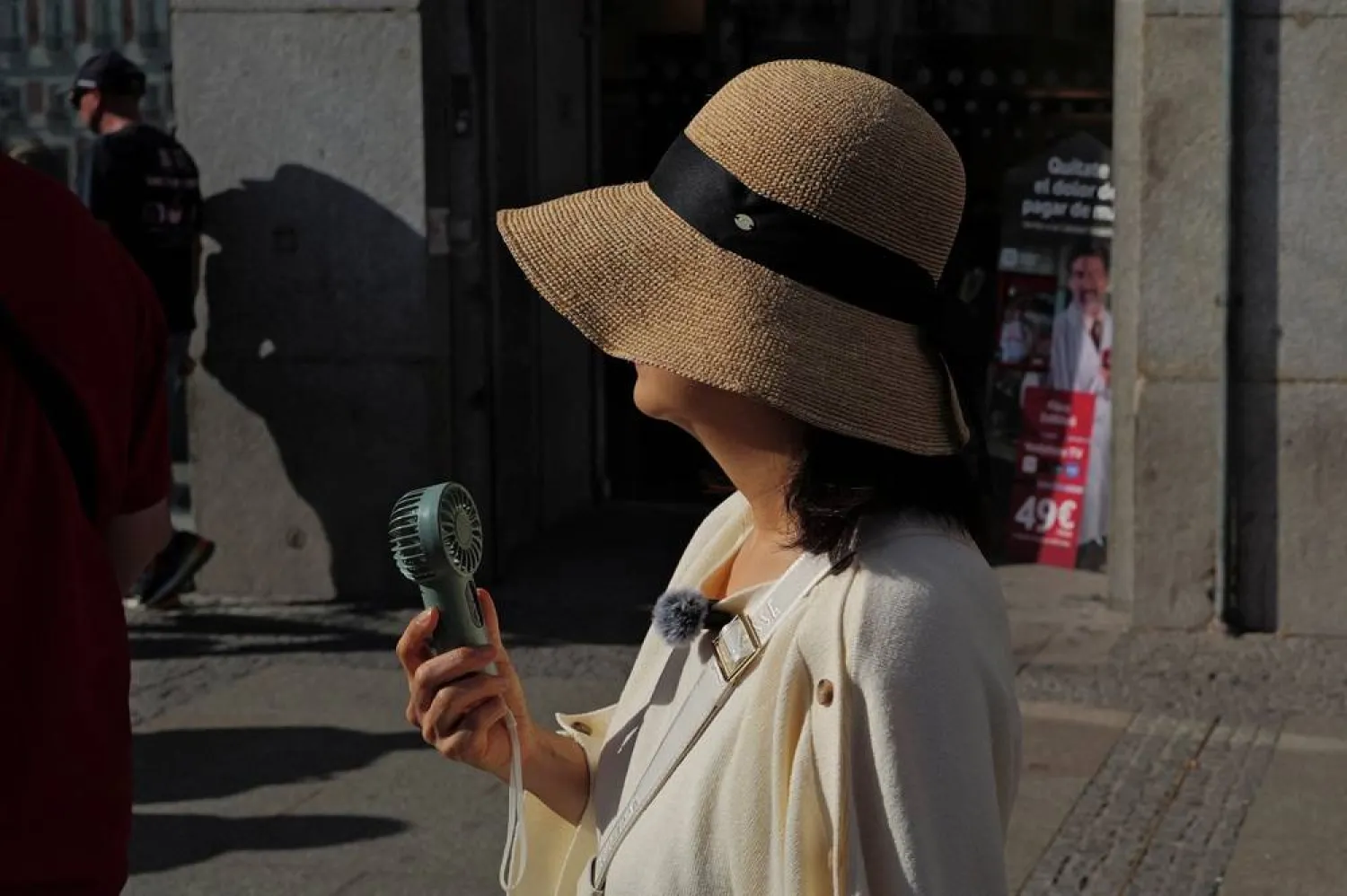
 A woman uses a portable fan as she walks at Plaza Puerta del Sol during a spring heatwave in Madrid, Spain, May 27, 2026. (Reuters)
A woman uses a portable fan as she walks at Plaza Puerta del Sol during a spring heatwave in Madrid, Spain, May 27, 2026. (Reuters)
TT

Think It’s Hot Now? The Next Five Years Will Smash Records, UN Says

 A woman uses a portable fan as she walks at Plaza Puerta del Sol during a spring heatwave in Madrid, Spain, May 27, 2026. (Reuters)
A woman uses a portable fan as she walks at Plaza Puerta del Sol during a spring heatwave in Madrid, Spain, May 27, 2026. (Reuters)

In the next five years, the Earth is overwhelmingly likely to surge again and again past the international climate threshold set as safe and shatter its hottest-year record along the way, according to new United Nations climate projections.

The World Meteorological Organization also forecasts an overheating Arctic that warms nearly 3 degrees Fahrenheit (1.66 degrees Celsius) between now and 2030 and a dangerous drought with potential wildfires for the Amazon, a crucial part of Earth's natural defenses to lessen human-caused climate change. A hotter globe from the burning of coal, oil and gas means more extreme weather including floods, droughts and heat waves, scientists said.

The projections by the UN climate agency and the United Kingdom's Meteorological Office said there's a 75% chance that the average global temperature between 2026 and 2030 will exceed 1.5 degrees Celsius (2.7 degrees Fahrenheit) since pre-industrial times. That threshold is the agreed-upon limit of warming — averaged over 20 years — set in 2015 by the Paris climate agreement.

A UN science report a few years later detailed how exceeding that 1.5 mark means more likely death, danger and species loss. Even though it's only a few tenths of a degree, some of the planet's ecosystems, such as coral and glaciers, can't handle the strain.

Passing warming limit has consequences, but no cliff

There’s a 91% chance that at least one of the next five years will shoot past the 1.5-degree threshold and an 86% chance that one of those years will smash the record for Earth’s hottest year set in 2024, the WMO report said. The WMO projects each year between now and 2030 to be between 1.3 degrees Celsius (2.3 degrees Fahrenheit) and 1.9 degrees Celsius (3.4 degrees Fahrenheit) since the late 1800s.

“It’s important to note that (1.5) is not kind of a cliff edge that we’re going to fall off,” said report co-author Melissa Seabrook, a climate scientist at the UK Meteorological Office. “Every kind of 0.1 of a degree has more and more severe impact.”

She pointed to unprecedented May heat in Europe this week.

An entire year or more above the 1.5 degree mark “means a whole range of extreme weather events, probably many so hot/wet/dry that it exceeds anything we’ve experienced in the past and thus crucially, anything our city planning, agriculture etc. has anticipated,” Imperial College of London climate scientist Friederike Otto, who wasn’t part of the report, said in an email. “This will mean many people will lose their lives, we are in for a lot of food price shocks, and more intense wildfires.”

Nearly all the shorter-term forecasts call for a strong El Nino — a natural warming of parts of the central Pacific that alters weather worldwide and spikes global temperatures — to form soon. The WMO report said it could stretch all the way to 2028. Because of that, Seabrook said 2027 will likely break the 2024 heat record.

And if the next five years do average more than 1.5 degrees Celsius since pre-industrial times, that means Earth will have warmed a quarter of a degree Celsius (0.45 degrees Fahrenheit) in a decade, which is faster than the previous rates of warning. Those were closer to two-tenths of a degree Celsius per decade.

Climate scientists are debating whether global warming is accelerating, “which obviously is quite scary,” and if these projections come true, it would give additional evidence to those who see a speeded-up rate of change, Seabrook said.

Accelerating warmth forecast in the Arctic

The projections, based on the averaging of about 200 runs of computer simulations using 13 different climate models from various countries, show warming in the Arctic rising 3.5 times faster than the rest of the globe, because there's less ice and snow that had been reflecting solar radiation to space, Seabrook said. It becomes a vicious cycle.

“As the temperature warms, more sea ice melts, the worse this makes it,” Seabrook said.

Winters in the Arctic from 2020 to 2025 on average were 2.1 degrees Fahrenheit (1.2 degrees Celsius) warmer than the 1991-2020 average. The WMO projects the next five winters will average 5.1 degrees Fahrenheit (2.8 degrees Celsius) warmer than that recent normal, Seabrook said.

The report also forecasts Arctic sea ice to continue to shrink in the summer.

Amazon may get drier, sparking fire worries

The report calls for even warmer and unusually dry conditions in the Amazon basin, and that could be devastating for both local residents and the planet as a whole, Seabrook said.

People rely on the Amazon for water and the hotter, drier conditions should increase wildfire risk, Seabrook said, threatening to turn the Amazon, which now sucks heat-trapping carbon dioxide out of the atmosphere, into a region that worsens the problem.

Africa's Sahel area, which has been extra dry, is likely to get more than normal rain and that could lead to flooding, Seabrook said.

United Nations officials said efforts to curb climate change haven't been enough.

“Despite the progress of recent years, it’s clear that global heating is still outpacing global efforts to contain it, and the baking temperatures in Europe, India and elsewhere show yet again the brutal human and economic impacts of humanity still burning colossal amounts of coal, oil and gas,” UN climate chief Simon Stiell said about the WMO report.

“Whether it’s extreme heat, mega-storms, floods, massive wildfires or droughts hitting food supply and prices,” he said, “every nation is already paying a huge price from this global climate crisis.”


Bird Nests of Fiber-Optic Cables Show War’s Impact on Ukraine

Bird's nests made with fragments of optic fiber, which were found by a Ukrainian serviceman on the front line and then passed to the National Museum of the History of Ukraine in the Second World War, lie on a table in a museum, amid Russia's attack on Ukraine, in Kyiv, Ukraine June 23, 2026. (Reuters)
TT

Bird Nests of Fiber-Optic Cables Show War’s Impact on Ukraine

Bird's nests made with fragments of optic fiber, which were found by a Ukrainian serviceman on the front line and then passed to the National Museum of the History of Ukraine in the Second World War, lie on a table in a museum, amid Russia's attack on Ukraine, in Kyiv, Ukraine June 23, 2026. (Reuters)

Woven from fiber-optic cable and grass, a small bird's nest found near the front line of the war in Ukraine shows how the more than four-year-old conflict is reshaping the natural environment, researchers say.

Areas along the 1,200-km (746-mile) front line are covered with ultra-thin fiber-optic cables, which are used by Ukrainian and Russian troops to guide aerial attack drones to make them impervious to electronic jamming.

The cables, which can stretch for 20 km, lie tangled in trees and scattered across fields and on the rooftops ‌of towns in ‌Ukraine's frontline regions, glistening in the sunlight like giant spider ‌web.

Birds ⁠have begun repurposing ⁠the discarded cables to weave their nests, says Yana Hrynko, a senior researcher at Kyiv's War Museum, cautiously examining two delicate nests which the armed forces sent to the museum from the front line.

"Objects such as bird nests with fragments of optic fiber demonstrate the change in the nature of war," said Hrynko.

Russia invaded Ukraine in February 2022 with tanks, armored vehicles and artillery. Trying to counter ⁠Russia's advantage in such conventional equipment, Ukraine has poured resources ‌into developing aerial drones. Drones now dominate ‌the battlefield.

Hrynko said researchers did not know which birds made the nests nor how they ‌had gathered the long cables.

"The first nest mainly contains dry grass ‌and fiber-optic cable. And it's pretty tightly twisted," she said.

ONLINE VIDEOS AND PHOTOS

Reuters spoke to several Ukrainian servicemen in the frontline regions of Donetsk, Kharkiv and Zaporizhzhia who had found such nests and posted their pictures and videos online.

One of the two nests ‌will remain in Kyiv as a part of the War Museum's war collection, and the other will be sent ⁠for study in the ⁠Netherlands and later returned, researchers said.

Auke-Florian Hiemstra, a 33-year-old biologist based in the Dutch city of Leiden who specializes in artificial nest materials, said Ukraine had rich avian biodiversity and there were many species that could have built the nests.

"We're going to look for DNA traces still in a nest to determine who actually made the nest," she said. "I have never seen nests like this before - and I have seen many, many bird nests."

The impact of the fiber-optic on birds could be mixed, Hiemstra said. It could cause harm as the birds could become entangled but it could also benefit them by helping them make a strong nest. "And by documenting this nest, we're also documenting the impact of war on nature in Ukraine," Hiemstra said.


France to Illuminate Statue of Liberty for US 250th Birthday

The lower Manhattan skyline, including the new One World Trade Center building at right, is shown as viewed from near the Statue of Liberty, Jan. 31, 2014, in New York.  (AP)
The lower Manhattan skyline, including the new One World Trade Center building at right, is shown as viewed from near the Statue of Liberty, Jan. 31, 2014, in New York. (AP)
TT

France to Illuminate Statue of Liberty for US 250th Birthday

The lower Manhattan skyline, including the new One World Trade Center building at right, is shown as viewed from near the Statue of Liberty, Jan. 31, 2014, in New York.  (AP)
The lower Manhattan skyline, including the new One World Trade Center building at right, is shown as viewed from near the Statue of Liberty, Jan. 31, 2014, in New York. (AP)

France will stage an elaborate light show at the Statue of Liberty to mark the 250th anniversary of the United States, the French consulate said Monday.

Described as a "monumental artistic creation," the show will be recorded in advance and broadcast by the ABC network at the start of its 25 hours of programming for Independence Day, July 4.

"The Statue of Liberty will be revealed to the public as it has never been seen before, in a staging designed to magnify its symbolic and emotional power," the consulate said.

"Our friendship goes back 250 years, it is still very strong, it runs deep, and that is why we wanted to do something significant," France's consul to New York Cedrik Fouriscot told AFP.

The Statue of Liberty in New York Harbor was given to the United States by France in 1886, and is one of the country's most famous monuments.

France also dispatched its air force acrobatics team to the United States this month to mark the 250th anniversary.

On June 9, eight Alpha jets of the Patrouille de France filled the skies above Manhattan with the colors of the French tricolor -- soaring above the iconic statue.


Brooch Given to First Passenger to Board Doomed Steamship Found at Roadshow

The brooch contains a dedication with the date April 21 1894 (AP)
TT

Brooch Given to First Passenger to Board Doomed Steamship Found at Roadshow

The brooch contains a dedication with the date April 21 1894 (AP)

A brooch given to the first passenger to board a Dundee-built steamship 37 years before she sank has surfaced at an antiques roadshow.

The decorative item was presented to Elizabeth Anderson on April 21 1894, the date of the maiden voyage of the SS Citrine, according to the British website ‘itv News.’

Built by Dundee shipbuilders W B Thompson & Co, the Citrine was one of a number of vessels in the Glasgow-based “Gem line,” all of which were named after gemstones or minerals.

The shipping firm was owned by William Robertson, who started out with a single barge in 1852 before growing it into one of the largest coastal bulk shipping fleets in Britain.

The brooch was presented to Anderson by Robertson and is inscribed with the words “SS Citrine, April 21 1894, Elizabeth McIntyre Anderson, from William Robertson.”

The sides of the gold-colored item are shaped as a ship’s rope and its center has been designed as a life ring mounted with a citrine stone, echoing the name of the vessel.

The Citrine sank on March 17 1931 after striking rocks at Bradda Head, Port Erin, on the Isle of Man.

Accounts at the time described the ship’s final moments in darkness, heavy weather and confusion, and the disaster claimed the lives of nine of her 11 crew members.

William Robertson had been dead for 12 years by the time of the sinking but the business remained in family hands under his sons, William Francis Robertson and James Robertson.
The brooch was discovered at a WeBuyVintage roadshow in Fleetwood, Lancashire.
