

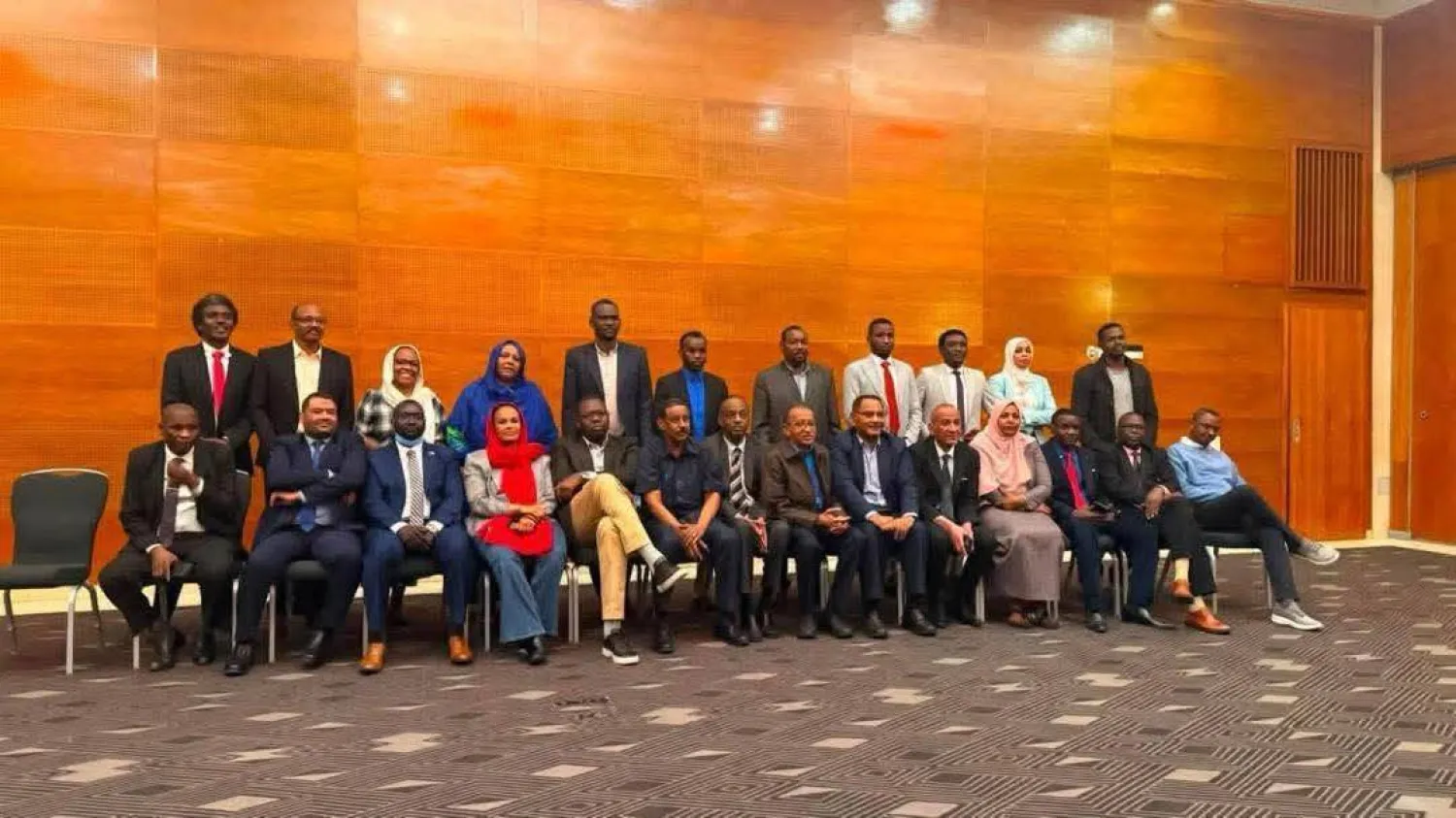

Sudanese Groups Agree on Basis for Transition to Democratic Rule

A photo shows political and civil groups who participated in the Addis Ababa meeting and agreed on a new path to end the war
TT

Sudanese Groups Agree on Basis for Transition to Democratic Rule

A photo shows political and civil groups who participated in the Addis Ababa meeting and agreed on a new path to end the war

Sudanese political and civil forces from rival camps have reached a significant breakthrough, agreeing on a common vision to launch a process aimed at ending the war and laying the groundwork for a peaceful transition to democratic civilian rule, following days of talks.

The forces, once grouped under one umbrella before the war split them apart and hardened their positions, issued a joint statement that included the Civil Democratic Alliance for the Forces of the Revolution, known as Somoud, led by former prime minister Abdalla Hamdok, the Democratic Bloc, an ally of the Sudanese army, and the Arab Socialist Baath Party, along with other parties, political forces, public figures, and civil, women’s and youth organizations.

The statement said the parties had agreed on a new political path to achieve comprehensive peace, end the war, and establish the basis for a peaceful solution that preserves Sudan’s unity and sovereignty.

It marks the first such consensus since Sudan’s war erupted in April 2023, bringing together anti-war forces represented by Somoud and the Democratic Bloc, the largest political alliance supporting the Sudanese army.

Early on Friday, the Sudanese forces handed the draft consensus vision to the international quintet mechanism, which includes the African Union, the Arab League, the European Union, the United Nations, and the Intergovernmental Authority on Development, IGAD.

The agreement followed the failure to hold a formal meeting called by the Quintet mechanism, pushing the political and civil forces into intensive side consultations to agree on the foundations of a new political process. The signatories said the consensus reflected a shared political and civil will to end the fighting and pave the way for a comprehensive, peaceful settlement.

The meetings brought together the Democratic Bloc, Somoud, and the Tasis alliance, which is aligned with the Rapid Support Forces (RSF). But the talks themselves were held between the Democratic Bloc and Somoud after members of the Democratic Bloc refused to sit with the Tasis delegation.

The joint statement said any political process must be comprehensive, with priority given to addressing the humanitarian disaster caused by the war, expanding civic space, and creating the conditions needed for a successful national dialogue.

It also stressed accountability for war crimes, criminal justice, and transitional justice to address the social and psychological scars left by the conflict.

Committee to draft the agenda

The parties agreed to form a preparatory committee of no more than 40 members, men and women, representing the different sides of the political process.

The committee would reflect political diversity, geographic balance and social, professional, women’s and youth representation, as well as those affected by the war, including displaced people and refugees.

The committee will identify the participants in the political process according to agreed criteria, draft the dialogue agenda and the principles and foundations of a political solution, oversee measures to prepare the atmosphere, set the dialogue methodology, determine the time and venue, and coordinate with regional and international mediators and guarantors.

The vision sets out three simultaneous tracks for the political process.

On the humanitarian track, the forces called for lifting sieges on cities and camps in Darfur, Kordofan and other affected areas, opening safe corridors for aid delivery and civilian protection, and requiring the warring parties to allow humanitarian organizations to operate without restrictions.

On the security track, the vision called for a humanitarian ceasefire based on the terms of the Jeddah Declaration and monitored by regional, international and UN bodies, in parallel with the launch of the political process, paving the way for a permanent and comprehensive ceasefire.

On the political track, it called for a comprehensive Sudanese dialogue among political and civil forces to address the roots of the national crisis and reach a new social contract that would underpin a democratic civilian transition.

The document also called for confidence-building measures before the process begins, including the release of detainees, prisoners and abductees, mechanisms to search for the missing, the cancellation of arbitrary measures against civil and political forces, guarantees for freedom of political and civil activity, and an end to politically driven war-related trials.

Participants in the Addis Ababa meetings on Wednesday and Thursday stressed that the ousted National Congress Party and its organizational fronts must be excluded from any role in the next political process, a position described as one of the principles that won broad consensus among the participating parties.

They also stressed the exclusion from the political process of the National Congress Party, which was ousted by the 2018 revolution, and its organizational fronts.

It is widely believed that the Democratic Bloc’s participation in the Addis Ababa meeting and the consensus that followed may have been directed by Sudanese army leaders.

The vision’s principles include affirming Sudan’s unity and sovereignty, linking the humanitarian, security, and political tracks as part of an integrated package to end the war, and restoring the path toward a democratic civilian transition.

The quintet mechanism had invited Sudanese forces, including the RSF-linked Tasis, to an exploratory meeting aimed at narrowing differences and opening a new political track to end the country’s continuing conflict.

The meeting also examined the possibility of forming a unified mechanism to support efforts to stop the war and negotiate transitional arrangements, ahead of a comprehensive political dialogue among the Sudanese.

Mubarak Ardol, head of the Democratic Alliance for Social Justice and a prominent Democratic Bloc leader, said the Addis Ababa consultations marked a major step since the war began.

He said participants had reached a common position on the preparatory committee for the political process and on the final statement, while maintaining their rejection of Tasis’ participation in the political process.

The Democratic Bloc includes several armed movements and political forces, most notably the Justice and Equality Movement led by Jibril Ibrahim, the Sudan Liberation Movement led by Minni Arko Minnawi, the Beja Congress, and the Democratic Unionist Party, among others.

Al-Wathiq al-Bireir, Secretary-General of the National Umma Party, said the Addis Ababa meeting aimed to agree on the foundations and mechanisms for preparing a comprehensive Sudanese political process.

He said his party remained committed to rejecting the return of the National Congress Party and the Islamic Movement to the political scene after the war.



Tunisian Rights Activist Sentenced to 25 Years in Prison

Tunisian rights activist Sihem Bensedrine. (Getty Images)
TT

Tunisian Rights Activist Sentenced to 25 Years in Prison

Tunisian rights activist Sihem Bensedrine. (Getty Images)

Prominent Tunisian rights activist Sihem Bensedrine told AFP on Friday that she had been sentenced to 25 years in prison on charges including falsifying part of a transitional justice commission's final report.

"Of course, this is a decision that has nothing to do with justice. It has to do with a totalitarian regime that wants to erase the legacy of the IVD," Bensedrine said, referring to the Truth and Dignity Commission of which she was president.

Bensedrine, 75, said she would lodge an appeal. She had been placed in pre-trial detention for over six months following her arrest in August 2024.

Prosecutors accused Bensedrine of falsifying the commission's final report, among other charges.

Bensedrine said she had been targeted by "officials who are holding the state hostage" in order to "settle scores" and "discredit our work".

Human Rights Watch said in a statement "Bensedrine has for decades been harassed, jailed, and pushed into exile for her human rights work. Her sentence would keep her in prison until she's 100 years old."

The Paris-headquartered International Federation for Human Rights (FIDH) has said the charges against Bensedrine were "groundless".

The commission's final report, published in 2020, called for "dismantling a system of corruption, repression and dictatorship" within state institutions.


Key Points from the US-Lebanon-Israel Agreement

US Secretary of State Marco Rubio and others watch, seated from left, Israel's Ambassador to the US Yechiel Leiter, counselor Dan Holler, and Lebanon's Ambassador to the US Nada Hamadeh, sign a framework agreement, described as a first step toward peace following months of conflict between Israel and the Lebanese group Hezbollah, at the State Department, Friday, June 26, 2026, in Washington. (AP)
TT

Key Points from the US-Lebanon-Israel Agreement

US Secretary of State Marco Rubio and others watch, seated from left, Israel's Ambassador to the US Yechiel Leiter, counselor Dan Holler, and Lebanon's Ambassador to the US Nada Hamadeh, sign a framework agreement, described as a first step toward peace following months of conflict between Israel and the Lebanese group Hezbollah, at the State Department, Friday, June 26, 2026, in Washington. (AP)

Washington on Friday released text of a trilateral framework between Lebanon, Israel and the United States aimed at ending hostilities that have been a violent second front of the Middle East war.

The following are highlights of the 14-point agreement signed in the US capital:

- 'Lasting peace' -

Israel and Lebanon, with US support, "affirm their shared goal of achieving lasting peace and security," the agreement begins.

The neighboring states "declare their intent to conclusively end the conflict, address its underlying causes, and to therewith formally conclude any state of war between them."

- 'Verified disarmament' -

The framework determines to make "irreversible progress" towards resolving all issues between Israel and Lebanon, while doing so is to be achieved through "direct bilateral talks, with the mediation and support of the United States."

The Lebanese Armed Forces (LAF) "will restore effective sovereignty over all Lebanese territory, pending the verified disarmament of non-state armed groups and dismantlement of associated infrastructure."

This will enable the Israel army to "progressively redeploy out of the Lebanese territory."

The framework will set out the steps and verification mechanisms to advance this process.

- Pilot zones -

The LAF will "gradually assume full and effective security responsibility in pilot zones, which will serve as the mechanism for phased and verified redeployments of the Israeli army and the deployments of the LAF."

Two initial zones have been agreed to by both sides, and future pilot zones will be agreed by mutual consent.

Upon confirmation of the disarmament of non-state armed groups, notably the Iran-backed Hezbollah, the LAF will assume full security responsibility in these zones.

"Internationally supported reconstruction efforts will begin, and Lebanese civilians will be able to safely return to these areas under the exclusive control of Lebanese state authorities," the agreement states. "The United States intends to work closely with both countries to verify and support this process."

- Working groups -

Lebanon's government under the deal reaffirms its commitment to restoring full sovereignty over its territory.

It will "rebuild the State's monopoly on the use of force, achieve the complete and verified disarmament of all non-state armed groups, and ensure that such groups will have no military or security role and no armed capabilities anywhere in Lebanon."

Lebanon asks for the support of international and particularly Arab partners, under the leadership of the United States, to do this.

Israel and Lebanon also are to establish "working groups to draft the full comprehensive peace and security agreement" between them, the framework says, and "immediately establish complementary tracks of ongoing direct engagement, facilitated by the United States."

- 'No territorial ambitions' -

Israel for its part states that its military actions in Lebanon "are solely a consequence of the attacks, threat posed by, and hostile intent of non-state armed groups, particularly Hezbollah."

"Termination of this threat," notably through disarmament of such non-state groups and "additional security arrangements to be agreed upon between the two countries," will eliminate any future necessity for Israeli military action or presence in Lebanon, it said.

It also stressed that "the Government of Israel declares that it has no territorial ambitions in Lebanon."


Hezbollah Supporters take to streets of Beirut to protest Israel deal

Hezbollah supporters block the old airport road in the southern suburbs of Beirut, with burning tires to protest against the trilateral agreement that was signed between the US, Israel and Lebanon on June 27, 2026. (Photo by Ibrahim AMRO / AFP)
TT

Hezbollah Supporters take to streets of Beirut to protest Israel deal

Hezbollah supporters block the old airport road in the southern suburbs of Beirut, with burning tires to protest against the trilateral agreement that was signed between the US, Israel and Lebanon on June 27, 2026. (Photo by Ibrahim AMRO / AFP)

Hezbollah supporters took to the streets of Beirut late Friday to protest an agreement between Israel and Lebanon, as a lawmaker from the Iran-backed group warned enforcing the deal risked sparking civil war, AFP reported.

The state-run National News Agency (NNA) reported that "Hezbollah supporters rode motorbikes through the streets of Beirut" including central areas and along a road leading to the airport "in protest at the framework agreement announced between Lebanon and Israel".

An AFP correspondent saw people riding motorbikes and chanting slogans along one road, as well as Lebanese army temporary checkpoints set up along several streets of the capital.

Lebanese "authorities will be unable to impose the implementation of the agreement signed in Washington unless they go, with American support, to civil war," said Hezbollah lawmaker Hassan Fadlallah, whose party has long rejected the direct Israel-Lebanon talks.

He added that "what happened in Washington is an attempt to disrupt the Islamabad path, and without the resistance (Hezbollah) nothing will pass," referring to the initial agreement between the US and Iran on halting the Middle East war, which includes Lebanon.

Footage circulating on local outlets and social media showed hundreds of Hezbollah supporters on motorbikes and mopeds roaming Beirut's southern suburbs, the group's stronghold, before they headed to the heart of the capital.

Some had gathered near the seat of the government and blocked a main road nearby, while other footage showed soldiers chasing away Hezbollah supporters who blocked the main road leading to the airport with burning tyres, before the army reopened it.

The NNA had said protesters blocked at least one major road with burning tyres.