Israel Approves Settler Building Plans in Palestinian West Bank Cityhttps://english.aawsat.com/arab-world/5285325-israel-approves-settler-building-plans-palestinian-west-bank-city
Israel Approves Settler Building Plans in Palestinian West Bank City
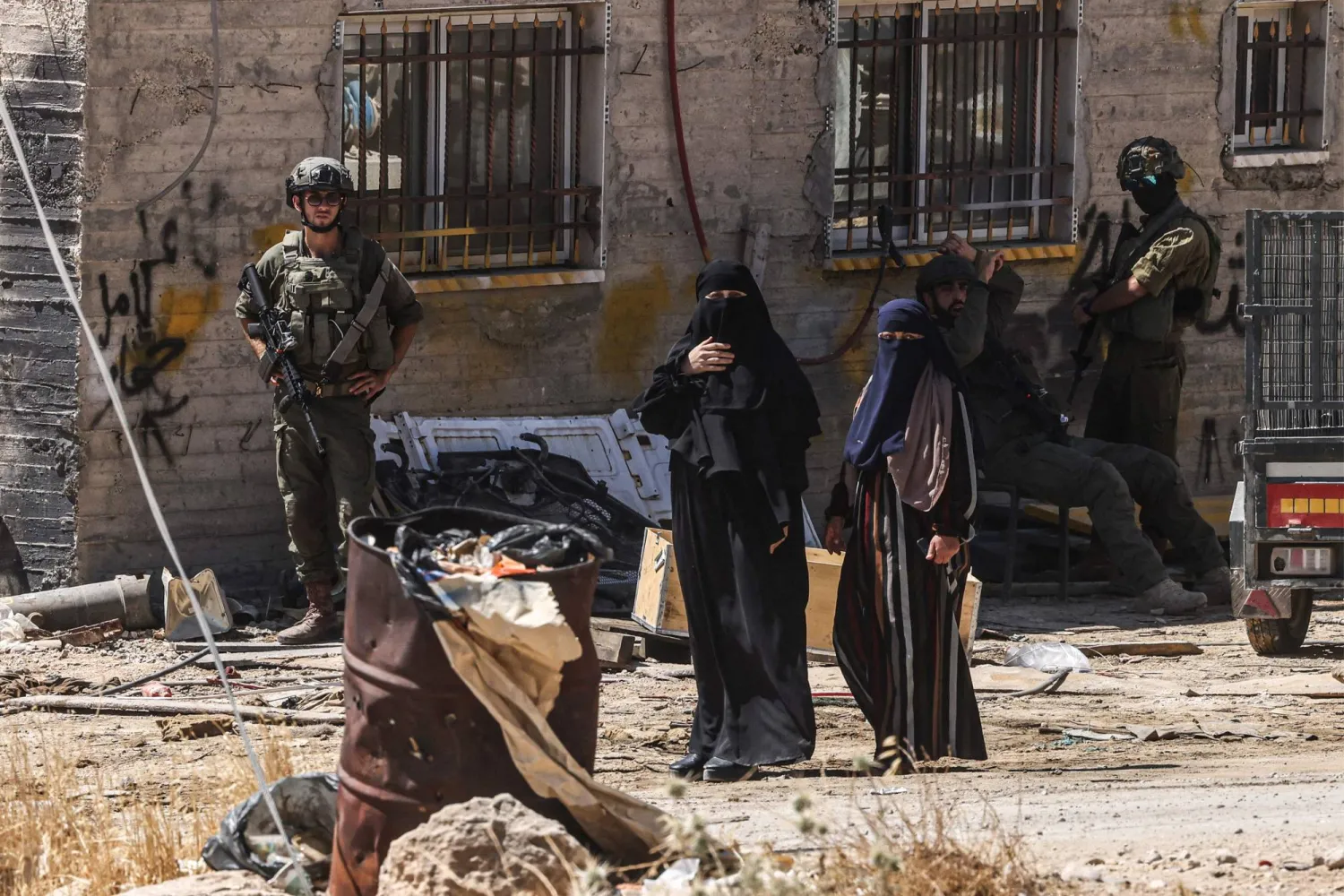
Israeli soldiers stand by as Palestinian women look on as Israeli bulldozers demolish a Palestinian home, which the Israeli authorities say was built without permission, in Ar-Rifaiyya village, south of the Israeli-occupied Palestinian West Bank city of Hebron on June 17, 2026. (AFP)
TT
TT
Israel Approves Settler Building Plans in Palestinian West Bank City
Israeli soldiers stand by as Palestinian women look on as Israeli bulldozers demolish a Palestinian home, which the Israeli authorities say was built without permission, in Ar-Rifaiyya village, south of the Israeli-occupied Palestinian West Bank city of Hebron on June 17, 2026. (AFP)
Israel on Wednesday approved the expansion of a Jewish school for settlers living in the center of the Palestinian city of Hebron in the occupied West Bank, in a construction push that Palestinians say violates a decades-old agreement.
Israel's finance minister announced the plans a day after saying he had scrapped a deal that gave the Palestinian municipality control over certain planning and construction around Hebron's historic core, home to a flashpoint holy shrine.
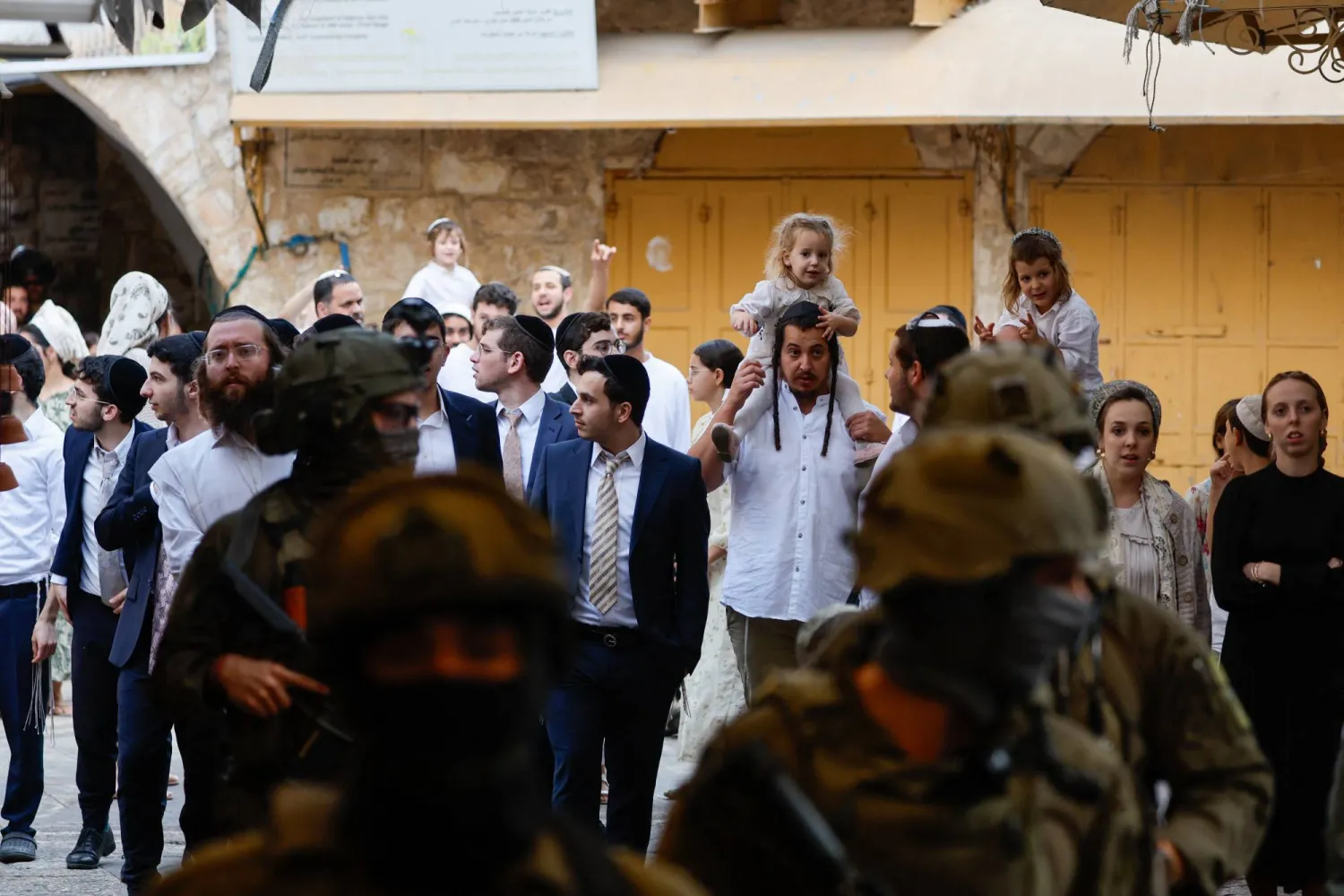
The enclave around the Cave of the Patriarchs - revered by Muslims, Jews and Christians - is home to more than 1,000 Jewish settlers who live among tens of thousands of Palestinians under complete Israeli security control.
Under the 1997 Hebron Agreement, Israeli troops remain deployed in the area, but construction has generally required approval from the Palestinian municipality, including around the shrine.
The religious heritage of the city has made it a focal point for Israeli settlers, who are determined to expand the Jewish presence.
Bezalal Smotrich, Israel's far-right finance minister, said construction of a 1,000 square meter building for a Jewish school in Hebron's historic core had been approved.
"We are continuing to build the Land of Israel in practice and to implement practical sovereignty in the settlements," Smotrich, who has said he wants to bury the idea of Palestinian statehood, said in a statement.
Issa Amro, a Palestinian activist who lives in Hebron, said he feared Israel's dismantling of parts of the Hebron Agreement would leave Palestinian residents of the city without basic services.
He said that move was aimed at making life miserable for Palestinians and forcing them to leave.
"It means ethnic cleansing of Palestinian families from their homes, and more displacement," he said, describing Israel's actions as stealing Palestinian dreams to have a state "and to live without violence, without fear, with peace".
Strikes Hit Inactive Abu Duhur Military Airport in Northwest Syriahttps://english.aawsat.com/arab-world/5308271-strikes-hit-inactive-abu-duhur-military-airport-northwest-syria
A picture taken on January 21, 2018 shows damaged Syrian air force fighter planes at the Abu Duhur military airport area in Syria's Idlib province. (File/AFP)
Strikes Hit Inactive Abu Duhur Military Airport in Northwest Syria
A picture taken on January 21, 2018 shows damaged Syrian air force fighter planes at the Abu Duhur military airport area in Syria's Idlib province. (File/AFP)
Unidentified aircraft on Tuesday struck an out-of-service military airfield in northwest Syria where forces from the country's defense ministry are present, a security source told AFP.
"Early on Tuesday morning, unknown aircraft bombed the Abu Duhur military airport in Idlib province," the source said on condition of anonymity.
The facility has been out of service since 2012 and is currently protected by Syrian defense ministry forces, the source said, without immediately reporting casualties.
According to the Syrian Observatory for Human Rights monitor, the strikes came after "a visit by a Turkish military delegation to the airfield in recent days as part of efforts to reactivate it".
Türkiye is a key ally of the new authorities.
No side has claimed the strikes on the airfield, which suffered heavy damage during Syria's civil war.
The Israeli military said "no comment" in response to an AFP inquiry about the strikes.
Israel has launched hundreds of strikes on Syria since the December 2024 toppling of longtime ruler Bashar al-Assad by opposition forces.
A US-led international coalition against the ISIS group has previously carried out strikes on senior extremist figures in the northwest.
Syria is now part of the coalition.
After taking power, the new authorities in Damascus took control over the Abu Duhur airfield which had been held since late 2018 by Assad's forces.
Committee Led by Assistant Interior Minister Investigates Death of Young Man in Syrian Police Custodyhttps://english.aawsat.com/arab-world/5308261-committee-led-assistant-interior-minister-investigates-death-young-man-syrian
Mohammad Ghamira, a Syrian Civil Defense worker who died after mistreatment at a police station in al-Haffah, in the Latakia countryside. (Minister of Emergency and Disaster Management)
Committee Led by Assistant Interior Minister Investigates Death of Young Man in Syrian Police Custody
Mohammad Ghamira, a Syrian Civil Defense worker who died after mistreatment at a police station in al-Haffah, in the Latakia countryside. (Minister of Emergency and Disaster Management)
Syrian authorities have detained seven people in connection with the death of a 29-year-old man who was beaten while in police custody, as two government ministers pledged to hold those responsible accountable once investigations are completed.
Mohammad Hossam al-Din Ghamira died Sunday at Latakia University Hospital from complications of bleeding in the brain and digestive tract after being beaten following his detention at al-Haffah police station in Latakia province.
Interior Ministry spokesman Nour al-Din al-Baba announced that a committee had been tasked with investigating the circumstances of his death. Its work would extend beyond the case to evaluate the performance of police departments across Syria, particularly in the Latakia province.
In comments to the Syrian state news agency SANA on Monday, al-Baba said that the committee would issue recommendations and that citizens would see improvements in police performance in the coming weeks.
The ministry “does not deny its responsibility for this unfortunate incident,” al-Baba acknowledged, while urging that the case be kept within its proper context without exaggeration.
He explained that the committee had arrived in al-Haffah to hear testimony from Ghamira’s family and local residents and had three days to complete its work.
A separate independent and professional medical committee was also formed to conduct a forensic examination of the body.
The Emergency and Disaster Management Ministry reported that Ghamira, one of its employees and a father of two, suffered from hemophilia, a disorder that prevents blood from clotting properly.
According to the ministry, he died from complications of cerebral and gastrointestinal bleeding caused by the beating.
A family source who requested anonymity told AFP that Ghamira had been accused in a financial case and detained for three days before being released for lack of evidence. The source alleged that he was “severely tortured,” causing his health to deteriorate before his death.
Emergency and Disaster Management Minister Raed al-Saleh mourned Ghamira as a “brother, friend and colleague” and confirmed that personnel at the police station accused of beating him had been detained and would face legal action.
“Syrians sacrificed for 14 years to reach a Syria that safeguards their dignity and humanity,” al-Saleh wrote, pledging there would be “no impunity.”
Interior Minister Anas Khattab ordered an investigative committee headed by Maj. Gen. Ahmad Mohammad Latouf, assistant interior minister for police affairs.
Khattab stressed that any violations or abuses by Interior Ministry personnel would be dealt with firmly under established laws and procedures, adding that anyone found responsible would receive “just punishment.”
Ghamira’s uncle, Issam Ghamira, told Al-Ikhbariya television that his nephew died after being struck inside the police station. He recounted that the family had informed the station chief that Ghamira suffered from hemophilia and asked that he not be harmed.
Activists and youths in al-Haffah announced a peaceful protest outside the police station following Ghamira’s burial, demanding disclosure of the circumstances surrounding his death, a transparent and independent investigation, and accountability for anyone found responsible.
Calls have also made for peaceful demonstrations in several other parts of Syria.
According to the Syrian Network for Human Rights, several people have died while in custody since the new authorities took power. In January 2025, state media reported that a detainee died in Homs following “violations” by security personnel, who were subsequently arrested and referred to the judiciary.
Risk of Escalation in Lebanon as Israeli Military Prepares for ‘Intensified’ Fightinghttps://english.aawsat.com/arab-world/5308259-risk-escalation-lebanon-israeli-military-prepares-%E2%80%98intensified%E2%80%99-fighting
The rubble and debris of flattened buildings litter the hillside following an Israeli airstrike that targeted a neighborhood in the southern Lebanese village of Nabatieh al-Fawqa on August 15, 2026. (AFP)
Risk of Escalation in Lebanon as Israeli Military Prepares for ‘Intensified’ Fighting
The rubble and debris of flattened buildings litter the hillside following an Israeli airstrike that targeted a neighborhood in the southern Lebanese village of Nabatieh al-Fawqa on August 15, 2026. (AFP)
The confrontation in southern Lebanon is entering a sensitive phase as Israeli military operations continue alongside US-mediated negotiations, while Israel’s Channel 12 has reported that the Israeli military is preparing for the possibility of several days of intensified fighting in Lebanon.
The report has raised questions over whether any escalation would remain contained or spread, although there has been no public indication of a decision to launch a wider war or set a deadline for negotiations.
Channel 12 reported that Israel remains determined to complete its operations in the Ali al-Taher Heights and linked the intensity of military activity to the negotiations. Washington, meanwhile, has reiterated its commitment to the “pilot zones” plan, maintaining that Hezbollah’s disarmament is part of the process.
Retired Lebanese Brig. Gen. Khalil Gemayel told Asharq Al-Awsat that Israeli preparations for several days of fighting did not, in his assessment, mean Israel intends to launch a broader war.
Rather, it wants to settle the battle for the Ali al-Taher Heights, securing a battlefield achievement, he added.
Any expansion of the confrontation would largely depend on the scale of Hezbollah’s response, particularly if it broadened its operations and struck Israeli communities, potentially prompting Israel to widen the fighting, he explained.
Gemayel described Ali al-Taher as a key defensive hub for Hezbollah in southern Lebanon, noting that Israeli forces were attempting to advance gradually along the hills toward sensitive positions, tunnel entrances and underground facilities with the assistance of specialized engineering units.
Hezbollah intervenes locally when Israeli troops approach critical points in its defensive network, he remarked.
Capturing the area could give Israeli Prime Minister Benjamin Netanyahu a military and political achievement while dealing Hezbollah a significant military loss, he noted.
15 August 2026, Lebanon, Nabatieh District: First responders are searching the rubble following an Israeli airstrike on a house in a tourist area of Ansar, southern Lebanon, before dawn, completely destroying the building and causing extensive damage to surrounding properties. (dpa)
Retired Brig. Gen. Naji Malaeb, meanwhile, said Israel’s escalation could be part of an attempt to draw Hezbollah into a response that would provide grounds for widening its operations.
He told Asharq Al-Awsat Israel may have used an incident that caused casualties in the Ali al-Taher Heights as a pretext to expand its operational reach beyond areas it occupies. He questioned whether Israel was attempting to provoke Hezbollah into a response that would allow it to broaden its military campaign.
Malaeb said increasingly forceful rhetoric from Hezbollah and its secretary-general, Naim Qassem, including warnings that Israel would “pay the price,” made that scenario worth considering.
A wider escalation would not necessarily begin with a ground advance. Israel could instead rely heavily on air power and expand its strikes to other areas, he went on to say.
Malaeb warned that expanding the conflict from the south deeper into Lebanon could also bring Iran into the confrontation, particularly if Beirut’s southern suburbs were targeted.
An Iranian response could provide Israel with a pretext to resume attacks on Iran even without US participation, he argued.
On the ground, the United Nations Interim Force in Lebanon (UNIFIL) reported a “significant increase in Israeli military activity in southern Lebanon” over the previous two weeks, recording an average of 137 projectiles a day between August 5 and 16.
Israeli operations continued across several areas. Drones dropped explosives around the Ali al-Taher Heights and Dabsha Hill, while Mansouri came under artillery fire. Strikes and shelling were also reported around Wadi al-Hujeir, Qantara, Aitaroun, Khiam, Hadatha and Mais al-Jabal, while Israeli forces carried out explosions in Bani Hayyan and Majdal Zoun.
لم تشترك بعد
انشئ حساباً خاصاً بك لتحصل على أخبار مخصصة لك ولتتمتع بخاصية حفظ المقالات وتتلقى نشراتنا البريدية المتنوعة