


Baghdad Urges OPEC to Raise Iraq's Production Quota

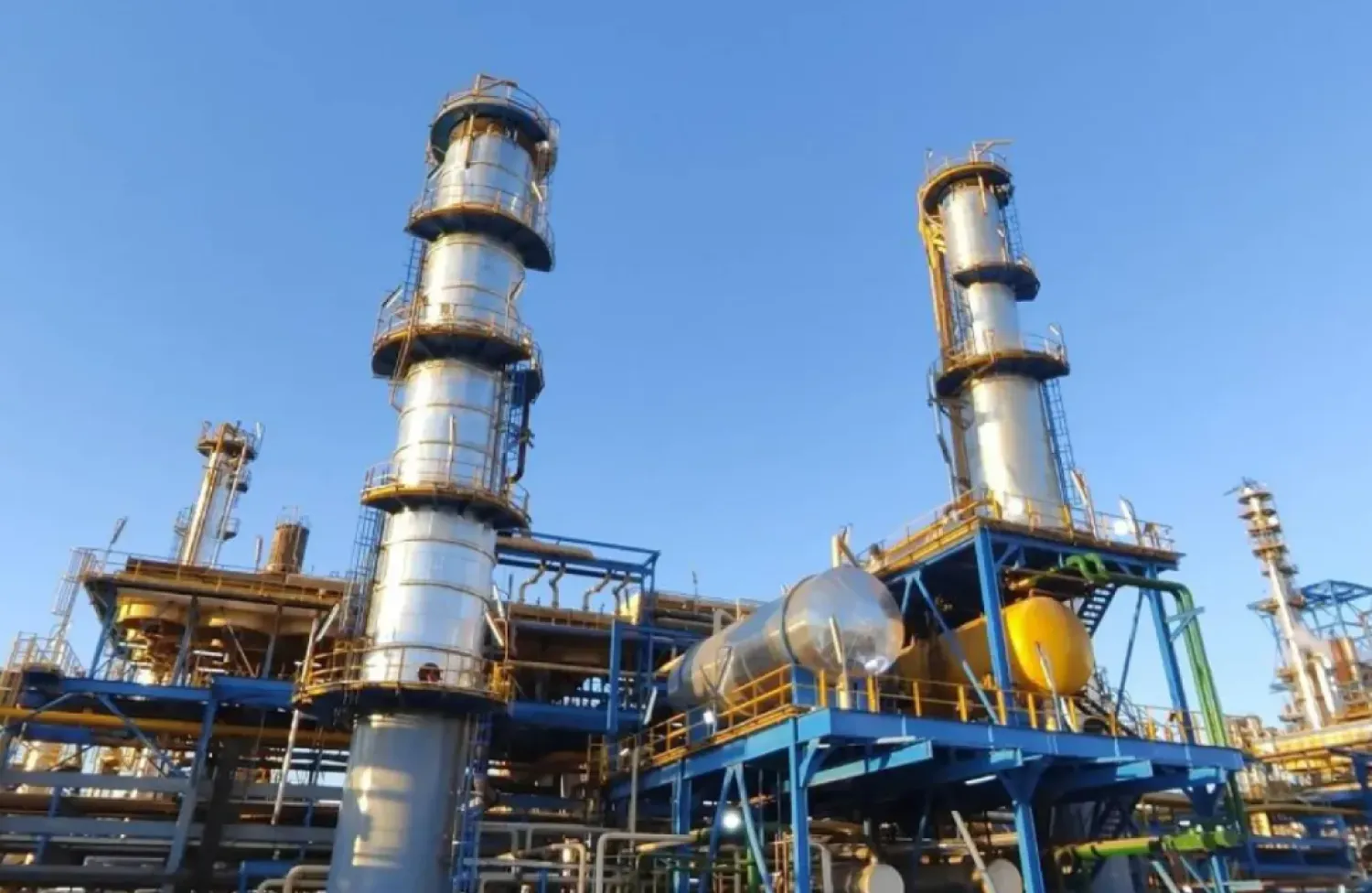
A handout picture released by Iraq's Prime Minister's Press Office on January 2, 2025, shows a partial view of the oil refinery of Baiji north of Baghdad, during the inauguration ceremony of the fourth and fifth units. (Iraq's Prime Minister's Press Office / AFP)
TT

Baghdad Urges OPEC to Raise Iraq's Production Quota

A handout picture released by Iraq's Prime Minister's Press Office on January 2, 2025, shows a partial view of the oil refinery of Baiji north of Baghdad, during the inauguration ceremony of the fourth and fifth units. (Iraq's Prime Minister's Press Office / AFP)

Baghdad has urged OPEC to increase Iraq's oil production quota, taking into account the damage done to its industry by its history of conflicts and the recent regional war, its oil ministry said Thursday.

Like other oil producers, Iraq, a founding member of OPEC, was greatly affected by the Middle East war, as it is hugely dependent on oil exports, which make up about 90 percent of its budget revenues.

Iraq's oil ministry said that reassessing production baselines was important "to ensure they are aligned with the sustainable production capacities of member countries", and with respect to "Iraq's unique security and economic circumstances".

OPEC has "responded by launching a process to reassess" its member states' capacities, the ministry said.

Following reports of a possible Iraqi exit from OPEC, oil ministry spokesperson Salim al-Rikabi told AFP that Iraq "has no intention of withdrawing from the organization and remains committed to its mechanisms".

But he added that the cartel "has to raise Iraq's production quota. Otherwise, a decision will have to be made about whether to stay or leave the organization".

Iraq has started increasing its production "in line with its capacities and needs", he said.

The ministry said that "reports suggesting that Iraq is considering ending its membership in OPEC do not reflect" the government's position.

Iraq's ministry said that any change would be decided within OPEC's existing framework, but noted there was a "high level of understanding" among members regarding Iraq's situation after decades of wars, sanctions, and recent attacks on the sector during the Middle East War.

All of these challenges will be considered to "ensure that Iraqi oil production reaches a fair level".

The Middle East war and Iran's blockade of the Strait of Hormuz choked off shipments and prompted production cuts in key oil-producing countries including Iraq, shaking world energy markets.

During the conflict, several Iraqi oil fields were struck by drones mostly launched by pro-Iran armed groups.

Before the war, Iraq produced around four million barrels per day (bpd), and exported an average of 3.5 million bpd, mostly via Hormuz.

After the recent deal between Washington and Tehran to end the fighting, Iraq now hopes to return within two months to its previous production levels.

A former oil ministry official, who requested anonymity, warned against Iraq's exit from OPEC.

A "withdrawal would not serve the interests of Iraq", which is exclusively dependent on the oil sector, he said.

"I don't think that Iraq has really the incentives to leave OPEC," said Jorge Leon, an analyst at Rystad Energy.

Instead, he added, Iraq might be trying to apply pressure to "the capacity review exercise that the group is currently doing", which will serve as the basis for the 2027 quota.


As 5% Treasury Yields Lose Shock Value, Investors Start Worrying about 6%

US Department of the Treasury (Reuters)
TT

As 5% Treasury Yields Lose Shock Value, Investors Start Worrying about 6%

US Department of the Treasury (Reuters)

For years, 5% on the benchmark US 10-year Treasury yield was viewed as the point at which global financial markets would start hitting turbulence. That threshold is beginning to look less like a ceiling and more like a waypoint.

This month's breach of 5% - something that has happened only briefly in recent decades - has forced investors to contemplate an unsettling question: What if 6% is the new number that should be keeping them awake at night? Reuters reported.

The latest move above 5% has not lasted long enough yet to properly test that theory. But it has always been a psychological marker rather than an automatic tripwire, according to BlueBay Asset Management's head of market strategy, Mike Bell.

"People think of it as if there's a magic number for Treasury yields at which it becomes a problem, (but) it's a relative number, not an absolute number," Bell explained.

What matters is how Treasury yields compare with other key investment metrics, particularly the earnings yield on stocks. Bell says that relationship ‌is now approaching ‌an inflection point, potentially setting the stage for an equity selloff.

History offers some guidance. MSCI's main world ‌stocks ⁠index halved in value ⁠the last time the 10-year Treasury yield broke 5%, which was just before the global financial crash. It suffered a similar slump less than a decade earlier when a near 6.8% spike helped pop the dotcom bubble.

JP Morgan's analysts say one of the reasons why the pain-point might now be above 5% again is a "key structural shift" in the global economy, with AI, healthcare and services playing a bigger role. Many of those firms are spending and expanding, regardless of the level of borrowing costs.

That means "the traditional interest-rate channel looks materially less binding" and the "breaking threshold" of stock markets may be "meaningfully higher, potentially in the 5.5%-6.0% range", JP Morgan said, referencing the views of some of the major investors at one of its most recent conferences.

PROFOUND REPRICING

In ⁠the $29-trillion Treasury market, which anchors pricing for virtually all financial assets, a shift from 5% to 6% ‌would represent a profound adjustment in the global cost of capital.

A 6% Treasury yield ‌would imply either significantly higher inflation expectations, growing concerns about US fiscal sustainability, a conviction that interest rates will remain elevated for years - or a mix of ‌all three.

Federal Reserve policymaker Austan Goolsbee said this week that he didn't know whether markets would react differently to a lengthier period of ‌5% yields than they had in the past.

Paul Jackson, Invesco global head of asset allocation research, said investors focus on Treasury yields for a simple reason: Treasuries represent the world's risk-free benchmark and at above 5%, investors can lock in the highest returns on US bonds since 2007.

Jackson's own calculations show world stocks start to drop when the 10-year yield has traded at an average of 4.72% for 12 months and then rises.

That tipping point remains some way off ‌for now - the 12-month average is currently around 4.34% - but Jackson said he was already dialling back on stocks and switching some money into government bonds to cash in on the juicy yields.

"If Treasury ⁠yields keep rising then there ⁠is a risk that the stock market is lower in 12 months' time," he said.

EMERGING QUESTIONS

Emerging markets, which have enjoyed something of a hot streak in recent years, are often among the first casualties when US yields surge.

Higher Treasury returns tend to strengthen the dollar and make dollar-denominated assets more attractive. That sucks capital away from EM economies and can tip hard-up countries into crisis if the cost of servicing their dollar-denominated debt spirals.

Data on investment flows shows last week saw the biggest exodus from EM bond funds in months, with billions also withdrawn from equity funds. Issuance of emerging-market sovereign debt has also been notably lighter than usual this month.

"It's not an optimal picture for EM," said Alison Shimada, Head of Total Emerging Markets Equity, Allspring Global Investments, although she stressed that for now nothing was going "horribly wrong" and therefore remained "constructive".

Perhaps the biggest risk is psychological.

Once investors start asking whether 6% is attainable, the debate shifts beyond a temporary spike in yields. It becomes a broader reckoning with the possibility that the era of abundant liquidity and ultra-cheap money has ended, forcing global asset prices to adapt to a permanently higher cost of capital.

Premier Miton CIO Neil Birrell said while stock markets were showing no sign of collapsing right now, that might be because investors weren't yet plugging in 5%-plus yields into their longer-term profit forecasting models.

"The markets look fine until everyone re-runs their valuation models," Birrell said. "Ultimately, the numbers are the numbers and they've got to come through."


East Pipes Signs $12.27 Million Contract with Aramco

One of the manufacturing facilities of Eastern Pipes Company in Saudi Arabia. (Company photo)
TT

East Pipes Signs $12.27 Million Contract with Aramco

One of the manufacturing facilities of Eastern Pipes Company in Saudi Arabia. (Company photo)

Saudi Arabia's East Pipes Integrated Company for Industry has signed a new five-month contract with Saudi Aramco to manufacture and supply steel pipes, with the total value exceeding 46 million riyals ($12.27 million), including value-added tax, the company said on Thursday.

The contract was formally signed on Tuesday, Sept. 22, 2026, after the contract award procedures were completed on the same day.

The company said the contract is expected to have a positive financial impact, which will be reflected in its financial results for the fourth quarter of fiscal year 2026-2027.

The company said there were no related parties involved in the transaction and that the contract was concluded under customary commercial terms and conditions, in line with transparency and corporate governance requirements.


Saudi Sukuk, Bonds Gain New Route to Liquidity

An investor walks past the Tadawul logo at the Saudi stock exchange. (Reuters)
TT

Saudi Sukuk, Bonds Gain New Route to Liquidity

An investor walks past the Tadawul logo at the Saudi stock exchange. (Reuters)

Saudi Arabia is bringing trade execution, clearing and settlement into a connected electronic workflow for its riyal-denominated sukuk and bond market, a step aimed at making secondary trading more efficient.

The change could make existing liquidity easier to find, improve price discovery and cut manual processing. It follows an approach seen in international markets, where electronic trading has developed alongside integrated local post-trade systems.

Tradeweb’s alternative trading system, previously available to international investors in Saudi Arabia, now also offers an electronic route for domestic investors and dealers.

The US-based company said GIB Capital and Saudi Awwal Bank executed the first domestic trade on the system.

Trade details were sent to the Securities Clearing Center Company, known as Muqassa, for post-trade processing and then to the Securities Depository Center Company, known as Edaa, for settlement.

Tradeweb is licensed by Saudi Arabia’s Capital Market Authority to operate the system for sukuk and debt instruments.

Under the new process, a domestic investor can request and compare quotes electronically from eligible dealers. Once a trade is executed, its details go to Muqassa, which sends settlement instructions to Edaa. Participation is limited to professional investors and domestic dealers who meet the relevant registration and account requirements.

Previously, domestic execution and settlement followed separate processes, which could require trade details to be transferred or entered into different systems.

The connected electronic record should reduce repeated data entry and manual intervention, while making trades easier to trace and audit. The trades remain bilateral, and existing local settlement arrangements still apply.

Electronic trading does not create liquidity in itself, Enrico Bruni, Tradeweb’s Managing Director and Co-head of Global Markets, told Asharq Al-Awsat. It does, he said, make existing liquidity easier to find and access.

A standardized, traceable request-for-quote process lets investors compare prices from eligible dealers. Bruni said wider use among clients and dealers could, over time, improve price discovery and deepen the secondary market.

Enrico Bruni, Tradeweb’s Managing Director and Co-head of Global Markets. (Tradeweb)

From international to domestic trading

Tradeweb launched the alternative trading system in Saudi Arabia in October 2025, initially allowing international investors to trade riyal-denominated sukuk and debt instruments electronically. Early trades involved international institutions, including BlackRock, BNP Paribas and Goldman Sachs.

The domestic route gives institutions and dealers in Saudi Arabia an electronic trading channel while keeping post-trade processing and settlement within local infrastructure. A transaction can now start with an electronic request for quotes and proceed through local clearing and settlement.

The platform is still at an early stage. Bruni did not provide specific trading-volume figures since its launch, saying activity first focused on access for international investors before trading between domestic participants was added.

A growing need for price discovery

The process arrives as Saudi Arabia’s riyal debt market expands and international participation increases.

Saudi government debt instruments are expected to enter J.P. Morgan’s emerging-market government bond index in stages from January 2027, widening the pool of investors who track the index or invest in its securities.

That broader international investor base, alongside growing domestic participation, could increase demand for efficient access to dealer liquidity and clearer price discovery as the secondary market develops.

Scope for expansion

Bruni said electronic trading could eventually extend beyond government sukuk and riyal-denominated debt instruments to corporate bonds, repurchase agreements and derivatives. Any addition would depend on client demand, available liquidity and regulatory approval.

Tradeweb said the current infrastructure could support other products and trading methods while preserving Saudi market account structures, settlement arrangements and trading practices.

Over the next two to three years, Bruni said, success would be measured less by a particular trading volume than by regular use among more domestic and international investors, a larger network of liquidity providers and a wider range of traded instruments.

For now, the change is chiefly operational: it connects execution with local clearing and settlement and makes dealer liquidity easier to access.

As participation grows, that could help develop secondary trading in riyal-denominated sukuk and bonds.
