

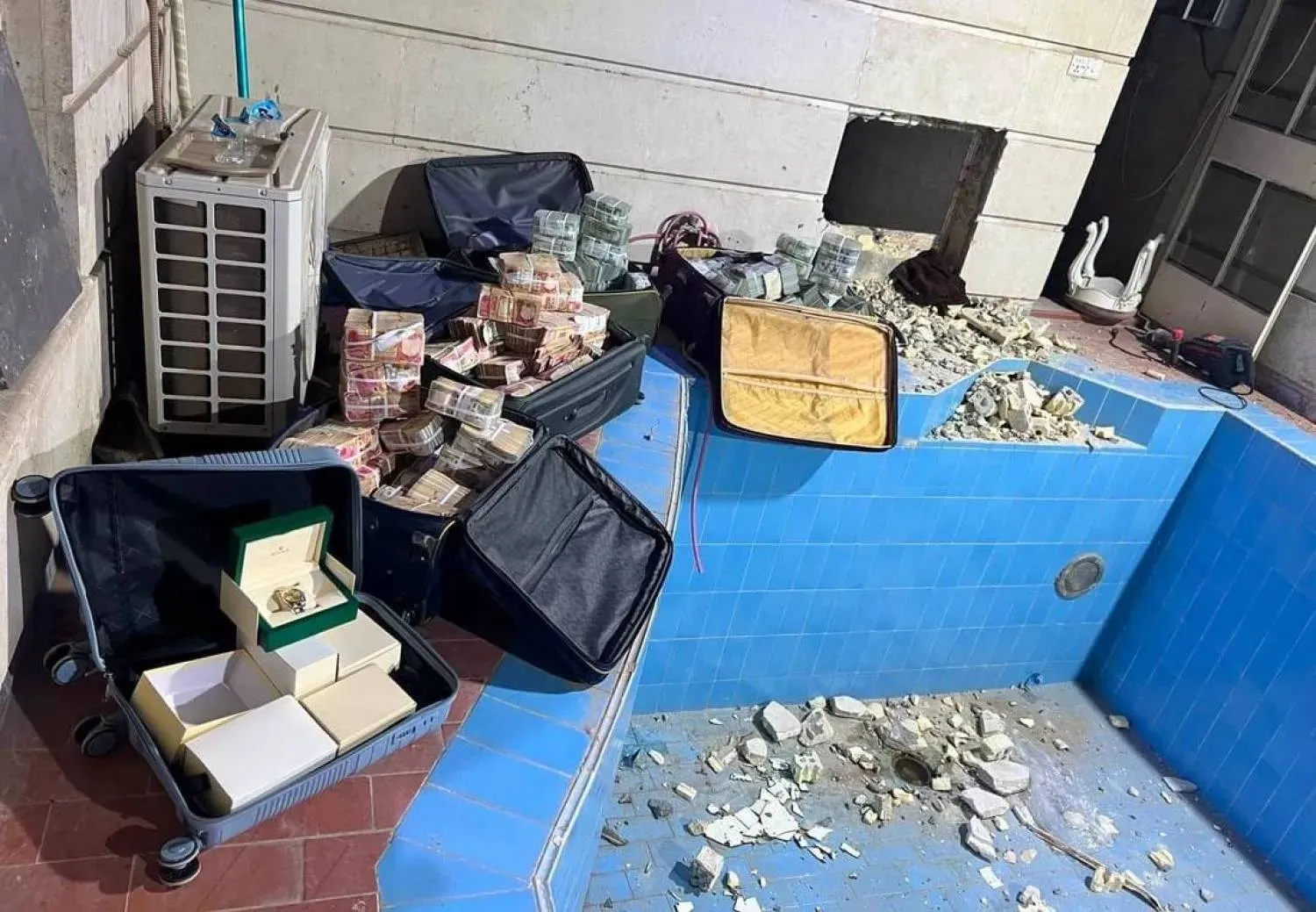

Iraq Seizes Millions of Dollars at Deputy Oil Minister’s Home

A photo released by Iraq’s judiciary shows cash and valuables that were hidden in the home of Deputy Oil Minister Ali Maarij al-Bahadly.
TT

Iraq Seizes Millions of Dollars at Deputy Oil Minister’s Home

A photo released by Iraq’s judiciary shows cash and valuables that were hidden in the home of Deputy Oil Minister Ali Maarij al-Bahadly.

Iraqi authorities arrested Deputy Oil Minister Ali Maarij al-Bahadly, a US-sanctioned official accused of using his post to help Iran-linked networks smuggle oil.

Iraq’s Supreme Judicial Council said initial questioning of al-Bahadly led to the seizure of $11 million and 4 billion Iraqi dinars, about $3 million, as well as several properties. It said investigations were continuing.

Al-Bahadly was arrested before dawn on Sunday at his home in Baghdad’s upscale Zayouna district. Later, state media published images showing security forces pulling bags of cash from inside the walls of the house.

From politics to oil

Al-Bahadly entered Iraq’s oil sector in the early years after 2003, working as head of drilling operations at the Maysan oil fields authority. He later became director general and chairman of Maysan Oil Company.

His career also reflected shifting political loyalties. He won a parliamentary seat in 2014 with the State of Law Coalition and chaired parliament’s oil and energy committee.

He later moved toward the Reconstruction and Development coalition led by former Prime Minister Mohammed Shia al-Sudani, which backed him for the oil ministry before he hit a US veto and, later, arrest.

The US Treasury Department sanctioned al-Bahadly in May under Executive Order 13902.

Washington accused him of using his position to facilitate oil smuggling for Iran-linked networks by falsifying certificates of origin, mixing Iranian oil with Iraqi oil and exporting it.

It also accused him of providing financial support to sanctioned figures and groups, including smuggler Salim Ahmed Said and the Asaib Ahl al-Haq faction.

Accountability

A former Oil Ministry official told Asharq Al-Awsat that al-Bahadly “works within an integrated system in which most of the powerful, dominant political forces take part while remaining beyond accountability.”

The former official, who asked not to be named, did not clear al-Bahadly of corruption allegations.

But he said any serious fight against corruption would have to strike at “the powerful parties under whose protection and umbrella some officials in the Oil Ministry and other ministries operate.”

Observers see “US fingerprints” behind the pursuit of senior Oil Ministry officials, including deputy ministers Adnan al-Jumaili who was arrested recently.

Analysts say Washington views Baghdad’s latest “anti-corruption” campaign as a way to contain Iranian influence and a necessary step toward dismantling it.

Public support for the campaign is broad. But some Iraqis fear its momentum could fade, and that authorities may avoid the “big heads” that are widely blamed for corruption across Iraq over the past two decades.

On the street, Iraqis remain stunned by the methods corruption suspects allegedly used to hide cash, from underground pits to sealed rooms that security forces had to break open to reach the money.

Observers are also struck by the scale of the sums allegedly stolen and by the failure of oversight bodies to uncover them in recent years. Many believe what has emerged so far is only a tiny fraction of the public money looted.

Prison sentences

In the latest corruption cases, the Supreme Judicial Council said on Tuesday that the Diyala Criminal Court sentenced three people to 10 years in prison for embezzling funds allocated to compensate martyrs and people wounded in terrorist attacks.

It said the convicts exploited their jobs at the Diyala governorate office to issue 301 fake checks and transfer money from the compensation account to the governorate office’s operating advances account.

In other developments, authorities released former lawmaker Mohammed al-Sayhood on bail on Tuesday.

Sayhood, a cousin of former PM al-Sudani, was arrested on Sunday as part of a wider campaign targeting lawmakers and officials over suspected corruption.

A security source said he was released for health reasons.


Source to Asharq Al-Awsat: 4 Issues at Cairo Talks Aim to Accelerate Gaza Ceasefire Implementation

 Palestinian man uses a sledgehammer on the rubble of destroyed buildings near a displacement camp in Nuseirat, in the central Gaza Strip, on June 28, 2026. (AFP)
Palestinian man uses a sledgehammer on the rubble of destroyed buildings near a displacement camp in Nuseirat, in the central Gaza Strip, on June 28, 2026. (AFP)
TT

Source to Asharq Al-Awsat: 4 Issues at Cairo Talks Aim to Accelerate Gaza Ceasefire Implementation

 Palestinian man uses a sledgehammer on the rubble of destroyed buildings near a displacement camp in Nuseirat, in the central Gaza Strip, on June 28, 2026. (AFP)
Palestinian man uses a sledgehammer on the rubble of destroyed buildings near a displacement camp in Nuseirat, in the central Gaza Strip, on June 28, 2026. (AFP)

Four “critical and decisive” issues are at the center of the latest round of Cairo-hosted negotiations aimed at accelerating the implementation of the Gaza ceasefire, according to a well-informed Egyptian source involved in the talks.

Israel has repeatedly violated the ceasefire announced last October, killing more than 1,000 Palestinians and assassinating senior Hamas leaders. Mediators led by Egypt, Qatar, and Türkiye are seeking to preserve the agreement and move it into its next phases in an effort to restore calm to the enclave after nearly three years of war.

A Hamas delegation and representatives of other Palestinian factions arrived in Cairo on Tuesday.

The Egyptian source told Asharq Al-Awsat that the talks, expected to continue through Wednesday, build on negotiations launched last week and are intended to settle four key issues.

The first is the immediate launch of the National Committee for the Administration of Gaza, with priority at this stage given to its work rather than the issue of weapons of factions.

The second involves establishing the framework for weapons storage and reconciling proposals for both disarmament and storage. The third focuses on redefining the mandate of the Board of Peace, particularly with regard to the guarantees it can provide.

The fourth concerns coordination over the planned International Stabilization Force, with several countries having already dispatched delegations to discuss the initiative. The identities of participating states are expected to become clear soon.

The source acknowledged that differences remain over several issues, but said Nickolay Mladenov, the High Representative for the Board of Peace, could travel to Cairo if the talks continue to progress positively and recent amendments gain momentum.

He added that the most encouraging development is Hamas’ constructive approach, noting that its delegation has full authority to make decisions and is participating alongside other Palestinian factions.

The source also pointed to intensive diplomatic efforts to ensure the success of the Cairo talks, highlighting the presence of Turkish intelligence chief Ibrahim Kalin in the Egyptian capital.

Egypt, Türkiye, and Qatar, he stressed, are coordinating to shield Hamas from pressure by other regional actors, including Iran, which has recently become more involved in the crisis, in an effort to speed up implementation of the Gaza agreement.

He continued that the immediate priority is completing the first phase of the ceasefire before moving to the second, which envisions the national committee assuming responsibilities in Gaza and the deployment of international forces.

By contrast, Israel remains focused on procedural matters, including compiling and classifying weapons inventories, while Arab mediators are pressing for agreement on the core political issues needed to enable international forces to assume their role.

Overall, the source described Hamas’ position as positive so far but remained skeptical that Israel would fully implement the agreement without further pressure from the US.

Hamas political adviser Taher al-Nunu said in a statement Tuesday that a delegation led by Zaher Jabarin had arrived in Cairo for meetings with Egyptian officials and mediators to continue implementing the ceasefire agreement.


Syria Drafts Law to Protect Victims’ Rights from Assad Era

Monday’s demonstration outside the Palace of Justice in Damascus called for criminalizing symbols of the Assad era (Facebook). 
TT

Syria Drafts Law to Protect Victims’ Rights from Assad Era

Monday’s demonstration outside the Palace of Justice in Damascus called for criminalizing symbols of the Assad era (Facebook). 

Syria’s Ministry of Justice has completed a draft law aimed at protecting the rights of victims of the Assad era, preserving the historical record, safeguarding the collective memory of future generations, and preventing the recurrence of abuses.

Justice Minister Mazhar al-Wais said Tuesday that the bill will be submitted to parliament as soon as it convenes to complete the constitutional process and secure final approval.

His remarks came a day after demonstrators gathered outside the Palace of Justice in central Damascus, calling for enforcement of Article 49 of Syria’s constitutional declaration. The provision criminalizes glorifying the former Assad regime and its symbols, as well as denying, praising, justifying, or minimizing its crimes.

Recent weeks have also seen protests in several parts of the country accompanied by violence and vandalism targeting supporters of the former regime and remnants of its security and military apparatus, raising concerns about social stability.

Al-Wais stressed that denying or justifying crimes committed by the former regime, or glorifying those responsible, violates the constitutional declaration because it undermines victims’ rights and Syria’s national memory. He said these principles form part of the country’s transitional justice framework.

He added that the Public Prosecution is pursuing such violations under existing law and urged the public to report acts or statements that breach the constitutional declaration so legal action can be taken.

According to legal sources, launching transitional justice proceedings before enacting a dedicated transitional justice law has created a gap between Syrians’ expectations for comprehensive accountability and current prosecutions conducted under the penal code.

Mohammed Suleiman Dahla, head of the Damascus Bar Association, told Asharq Al-Awsat that ongoing cases classify abuses as war crimes and crimes against humanity under international criminal and humanitarian law while simultaneously prosecuting them under the Syrian Penal Code.

He said the forthcoming transitional justice law — expected before the current trials conclude — would become the governing legislation, particularly regarding sentencing. Specialized judicial chambers handling such crimes have already begun operating in Damascus within the regular court system, from the Public Prosecution through investigative bodies to the criminal court, with plans to expand them to other provinces.

Dahla stressed that transitional justice legislation is essential for social recovery, institutional reform, closing the chapter on the past, preventing future abuses, and preserving historical memory. He also called for reviewing laws that helped the former regime consolidate control over the state, society, and the economy.


Israeli Troops Face Resistance from Residents as they Push into a Town in Syria

A man rides a motorcycle in the village of Abdin, Daraa province, Syria, Monday, June 29, 2026. (AP Photo/Omar Sanadiki)
TT

Israeli Troops Face Resistance from Residents as they Push into a Town in Syria

A man rides a motorcycle in the village of Abdin, Daraa province, Syria, Monday, June 29, 2026. (AP Photo/Omar Sanadiki)

As Israeli troops and vehicles entered the town of Abdin in southern Syria, residents blocked the roads with rocks, and some young men and boys threw stones to push back the military patrol.

Tensions in this part of the country created by a buffer zone occupied by Israeli forces have flared into violence in recent days, leaving residents anxious that more escalation is coming. Residents of Abdin, located near a UN-patrolled buffer zone now controlled by Israeli troops, tried to resist against a military incursion Sunday, The Associated Press reported.

Residents said Israeli troops fired warnings shots at walls and between the angry protesters, before firing artillery rounds at the village. No one was harmed in the exchange, but most residents fled, and most were still too afraid to return on Monday. Many fear that there will now be more intense incursions and raids following the skirmish.

“They come into the village regularly, every few days,” said resident Mohammad al-Hassan, standing not far from a group of children looking at an exploded shell. “They come in armored 4x4 vehicles, they roam around the village and search some houses, they knock on doors and if people don’t answer the door they break it down and enter the houses. Women and children start screaming, it’s a terrifying thing, them coming here.”

Israel says it needs buffer zones to prevent attacks

Israel seized control of a UN-patrolled buffer zone in southern Syria in December 2024, following the ouster of former Syrian President Bashar Assad in an insurgent offensive. Israeli officials initially described the move as temporary to protect their borders from militant groups, but more recently top Israeli officials have said they plan to occupy the buffer zone in Syria indefinitely.

The Israeli military presence in southern Syria is part of a shift to a more aggressive strategy by Israel after the deadly October 2023 Hamas-led attacks in southern Israel. The Israeli military took over large portions of Gaza as part of a broad invasion, and later seized control of chunks of Lebanon — where the Hezbollah militant group has fired missiles and drones across the border — and Syria. Israel calls these areas “buffer zones” and says they are needed to prevent future attacks by militant groups.

There have been no cross-border attacks from Syria into Israel since Assad’s ouster, except for two rockets from a little-known militant group. But Israel's military incursions into southwestern Syrian towns have sometimes sparked resistance by residents that has spiraled into deadly clashes.

Syrian officials condemn Israeli incursions

Syria’s interim president, Ahmad al-Sharaa, has called on Israel to withdraw from the area that the UN says is 235 square kilometers (91 square miles). The Syrian government also condemned the Israeli incursion and shelling in Abdin.

The clashes in Abdin were the second outbreak of violence in less than 24 hours. Earlier on Sunday, the Israeli military announced that it had killed armed men in southern Syria without giving details.

An Israeli military official said Monday that Israeli soldiers had killed two militants who were planning on attacking Israeli troops. The official who spoke on condition of anonymity under military briefing rules did not specify where in Syria the incident took place.

The mayor of the Syrian village of Hadar said two unknown people driving a pickup truck just south of the village were killed in an attack, and that their bodies were taken by the Israeli military.

“There was the sound of an explosion when it happened,” Imad Hassoun told The Associated Press. “They weren't from Hadar. If they were, we would immediately know.”

Regarding the incident in Abdin, the Israeli official said armed militants opened fired against one of the Israeli military’s strongholds but nobody was harmed in the attack, without giving further details.

Residents fear increasing instability

People in Abdin were initially hopeful that US-mediated talks between Israel and Syria in France aimed at reaching a security agreement would diffuse tensions, but the talks appear to have stalled.

Fearing the unstable security situation and struggling to cope with a lack of jobs and services, many residents who have lived in these towns are leaving elsewhere. The closest government security checkpoint to Abdin is some 10 kilometers (6 miles) away, and those who choose to stay are struggling with water and electricity shortages.

Sobhi al-Tawlbi, 66, says farmers have struggled to access their yield and sources of water.

“We need the government to support us a little so we can remain steadfast in our villages,” he said, asking for the international community to put pressure on Israel to stop its military incursions.

Syrians living in that broader border area have maintained that they are not a threat to anyone and want a stable life, following over 13 years of civil war that decimated Syria.

“Why are they bothering us? We are living here peacefully in this border area,” said al-Hassan.
