
Macron Says Syria Must Not Be Destabilized After Bombs Wound 18

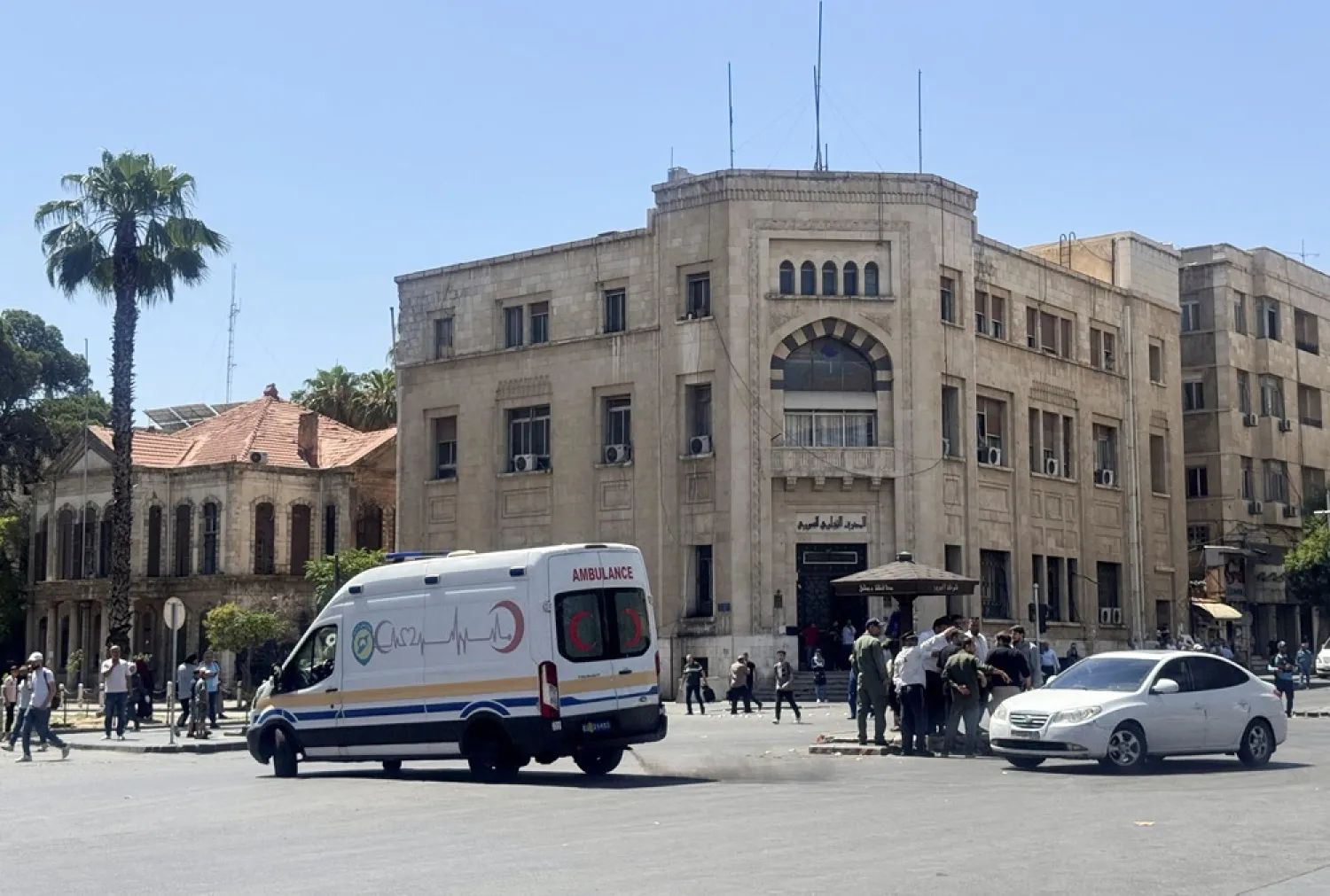
An ambulance drives past the site where explosive devices blew up near a hotel where French President Emmanuel Macron was meant to be staying, in Damascus, Syria, July 7, 2026. (Reuters)
TT

Macron Says Syria Must Not Be Destabilized After Bombs Wound 18

An ambulance drives past the site where explosive devices blew up near a hotel where French President Emmanuel Macron was meant to be staying, in Damascus, Syria, July 7, 2026. (Reuters)

French President Emmanuel Macron warned on Tuesday that Syria must not be destabilized after twin bomb attacks near the Damascus hotel where he spent the night, during a landmark state visit to a country emerging from years of civil war. 

The attacks cast a shadow over the first trip of a European Union head of state since Bashar al-Assad was toppled in late 2024, as President Ahmed al-Sharaa tries to rebuild the country's image after more than a decade of conflict. 

The two leaders vowed to step up economic and diplomatic ties with new ambassadors to be installed in each country. 

In a joint press conference with his Syrian counterpart, Macron said we must "not let ourselves be destabilized" by such attacks, before which he had already left for the presidential palace in the heart of the Syrian capital, and reiterated Paris' support for the country. 

Sharaa saluted Macron's "courage" for carrying on with his visit despite the bombings. 

An AFP team saw Macron arrive for a meeting with Sharaa, while other journalists heard at least one blast echo through Damascus before seeing a plume of smoke rising near the hotel, where security forces closed a road and ambulances rushed to the scene. 

Syria's interior ministry said one bomb had been placed inside a car parked on the side of a road, while the second was planted in a garbage container. 

It said they exploded "while preparations were underway" to dismantle them. 

Syria state media said the blasts wounded 18 people, including four police officers. 

An AFP photographer near Syria's tourism ministry, opposite the hotel, saw windows damaged by one of the explosions, amid a heavy security presence. 

- Economic forum - 

France's Elysee Palace said Macron would continue his trip until his expected departure on Tuesday evening, when he travels to Ankara for a NATO summit and holds talks there the following day with Türkiye's president. 

The explosions are the second in the Syrian capital since Thursday, when 10 people were killed in a bombing in a Damascus cafe. 

The French president had postponed announcing the date of his visit until his plane landed on Monday, for security reasons. 

Syrian Foreign Minister Asaad al-Shaibani said that Macron's visit marked a "pivotal point" in the two countries' relations, vowing to continue to "confront terrorism in all its forms". 

Sharaa also announced "our agreement to begin the process of exchanging resident ambassadors between Damascus and Paris as soon as possible, signaling the return of diplomatic relations to their normal state". 

The blasts came moments before Syrian state television announced Macron's arrival at the palace. 

The visit included an economic forum during which the two sides signed 15 bilateral agreements in several sectors, including civil aviation, health, banking, water infrastructure and roads, although French investors remain cautious about the situation. 

"After the Strait of Hormuz crisis, the world realizes the value of a safe and stable corridor," Sharaa said at the forum. 

"Here the importance is highlighted of the geography of Syria, which today has regained its vital role as an indispensable link in the global corridors market." 

Macron was accompanied by several economic players including Rodolphe Saade, chief executive of maritime transport giant CMA CGM, and TotalEnergies head Patrick Pouyanne. 

Before the Damascus blasts, Pouyanne said that "the security situation still doesn't allow us to operate, but I think it is a positive initiative to come here, to Damascus". 

- Civil society - 

Before arriving at the presidential palace, Macron held a meeting Tuesday morning with civil society representatives at the Four Seasons Hotel. 

The French leader had said on X that "nothing can smother the aspiration of Syrian women and men to live in a fully sovereign, safe, pluralistic and united Syria". 

The last French president to visit Syria was Nicolas Sarkozy in 2009, before Assad brutally crushed pro-democracy protests in 2011, sparking a conflict that killed more than half a million people and devastated the country's infrastructure and industry. 

In May 2025, Macron hosted Sharaa in France on his first official visit to a European country, a move that preceded the Syrian leader's trip to Washington last year to meet US President Donald Trump. 


Palestinian Election Nominations Open, Unsettling Gaza Factions

A Palestinian woman waves a Fatah flag at the movement’s eighth conference at Al-Azhar University in Gaza City on May 14, 2026 (Reuters)
TT

Palestinian Election Nominations Open, Unsettling Gaza Factions

A Palestinian woman waves a Fatah flag at the movement’s eighth conference at Al-Azhar University in Gaza City on May 14, 2026 (Reuters)

Palestinian factions face difficult choices over how to take part in legislative elections set for November 28, the first in 20 years.

A Hamas delegation has held a series of meetings in recent days with leaders of other factions in Cairo.

The group said the talks were part of continuing political consultations on developments affecting the Palestinian cause, including the elections, efforts to end the political split and plans to rebuild and reactivate the Palestine Liberation Organization on democratic, inclusive and national foundations.

A Hamas source and a source from another faction involved in the meetings told Asharq Al-Awsat that they had again discussed the possibility of running on a single national list led by technocrats and academics acceptable internationally, with the aim of representing the broadest possible coalition.

Another factional source said the Hamas delegation had offered nothing new on which to build.

Sources said the Fatah Democratic Reform Current, led by Mohammed Dahlan, had put a proposal concerning the national list to Hamas at a bilateral meeting and was awaiting a response. None disclosed its details, citing the sensitivity surrounding the elections.

Hamas also hopes the elections will be postponed, despite publicly insisting they should take place on schedule. At the same time, it continues to seek the broadest possible national list to compete with Fatah.

The uncertainty is adding to confusion among the factions, which will have 12 days from Saturday to settle their plans.

Islamic Jihad has decided to support such a list without fielding candidates of its own. But the Palestinian left, particularly the Popular Front and the Democratic Front, remains undecided about joining Hamas and other factions on a common list.

Both fronts have called for the elections to be postponed while the factions seek common ground to end the split and rebuild the PLO, a position supported by some other factions.

The Democratic Front has sought to form a list of leftist parties that would include the Popular Front, keeping a broad national list with Hamas as its last option. A Democratic Front source told Asharq Al-Awsat that, as the opening of nominations approaches, it may ultimately decide to join the wider national list.

Fatah insists the elections should go ahead. Palestinian President Mahmoud Abbas reaffirmed that position in his address to the United Nations General Assembly, saying the vote was part of a process to renew the institutions of the Palestinian National Council before holding a presidential election.

He said it formed part of a comprehensive national reform program for the Palestinian Authority that would strengthen governance, transparency and accountability.

The stance has left several factions still weighing how to participate. The Popular Front had been awaiting a positive response from Fatah to its call to postpone the elections and begin national steps, including a broad meeting to discuss the Palestinian situation.

Fatah has given neither a positive nor a negative response, leaving the Popular Front undecided. The front considers the timing unsuitable for any election.

Fatah appears to see an opportunity to win as many votes as possible while Hamas’s popularity has declined following the war in Gaza and the destruction it has caused there. But internal disagreements also pose challenges for Fatah, amid calls within the movement to hold all elections, including the presidential vote, at once.

The Palestinian Central Elections Commission said it would begin accepting candidate-list applications for the 2026 legislative elections at 8 a.m. on Saturday at its headquarters in Al-Bireh and its regional office in Deir al-Balah in the Gaza Strip.

Nominations will remain open for 12 days, including public holidays, and close at 4 p.m. on Wednesday, October 7. Applications submitted outside that period will not be accepted.

Candidates for the Palestinian Legislative Council must run on lists under a full proportional representation system; individual candidacies are not permitted. A list’s coordinator and authorized representative must submit its application.

The commission urged prospective lists to complete their applications and supporting documents and check that they meet the legal requirements before filing.

Each list must have between 16 and 132 candidates. At least one woman must appear among its first three names, with at least one woman in every subsequent group of three. A list must also submit signatures from 3,000 eligible voters supporting its candidacy, its electoral program and its symbol or logo.

Other requirements include proof of a $20,000 bank payment, a sealed list of candidates in order, and an application and supporting documents for each candidate.

Candidates must be Palestinian, at least 23 years old on election day, permanent residents of the Palestinian territories and listed on the final voter register. They must also meet the remaining legal requirements.

The nomination period is the third stage of the electoral process, following voter registration and the publication and objections stage.

The commission said 2.97 million Palestinians were eligible to vote: 1.24 million in Gaza, 1.59 million in the West Bank and 140,000 Jerusalem ID holders in the city.

Its data showed that people who have not voted in a general election before make up a majority of eligible voters. It said 1.50 million voters are under 38, representing 53% of those eligible.

That age group is especially significant after nearly two decades without a legislative election.

Women account for 49.9% of eligible voters and men for 50.1%, the data showed.


Flash Floods Hit Western Libyan Cities, Destroy Bridges in North

Floodwaters submerge the Libyan city of Mizda (Verified social media pages)
TT

Flash Floods Hit Western Libyan Cities, Destroy Bridges in North

Floodwaters submerge the Libyan city of Mizda (Verified social media pages)

Flash floods swept across southern, western and northern Libya, destroying roads and bridges, sweeping away cars and leaving people dead by drowning. Rescue teams raced to evacuate stranded families as the interim Government of National Unity (GNA) declared a state of emergency.

Mizda and Nesma, in southwestern Libya, have faced dire conditions since Thursday. Floodwaters from overflowing valleys surged into homes, tore through roads and brought down high-voltage transmission towers, causing extensive damage to public and private property.

GNA’s Ministry of Local Government sent bulldozers and heavy trucks to both cities to help with rescue operations. A bridge between Mizda and the Tininai area collapsed, severing the road and isolating the area beyond it.

The ministry urged Mizda residents to stay home. The municipal council mobilized humanitarian aid and other support, including an air ambulance, to meet urgent needs in the city and its outskirts.

Heavy rains flood a street in the Libyan city of Mizda on September 24 (Municipal Media Center)

Nesma’s municipal media center declared the city a disaster area on Friday. Emergency teams were evacuating families trapped in flooded homes and searching for missing people, it said, warning that severe weather could continue in the coming hours.

Mizda General Hospital appealed for essential medical supplies on Friday morning, saying most had run out. It warned that it could not keep providing emergency care without an immediate delivery.

The Ambulance and Emergency Service said families in Nesma had fled to mountains and other high ground as water rushed through their homes.

Two people had been recovered dead and others were still missing, it said. All roads into the city were closed.

The General Water and Sanitation Company sent emergency crews from Khoms, in western Libya, on Friday to pump out floodwater and reopen roads.

In Ghadames, an emergency team rescued a Filipino engineer working for the Man-Made River Company after his vehicle broke down in a valley as floodwater began flowing through it, the Emergency Medicine and Support Center said on Thursday evening. He had been inspecting wells.

In northwestern Libya, the Bani Walid security directorate closed the road to Tarhuna because of flooding in Wadi Washtata. It warned drivers not to cross or approach the wadi.

Bani Walid - Tarhuna road closed due to floods (Bani Walid Security Directorate)

Bani Walid General Hospital said it had urgently treated several people who had nearly drowned in the flood-hit Tininai area. It put its departments on heightened alert to handle emergencies around the clock.

The General Electricity Company in Tripoli activated its emergency operations room and put maintenance crews on alert to address faults that could affect the power grid.

Minister of State for Prime Minister and Cabinet Affairs Mohamed Ben Ghalboun said on Friday that he had ordered maximum readiness after heavy rain sent water into neighborhoods and homes and caused some valleys to overflow.

His instructions called for urgent coordination with affected municipalities, emergency medical care, drainage and road reopening, and steps to keep electricity, communications and water services running while protecting lives and property.

The Libyan Red Crescent said its central emergency operations room was monitoring the floods around the clock. Field teams were updating reports from its branches to assess humanitarian needs and coordinate the response.

It urged residents to heed weather warnings, avoid unnecessary travel during heavy rain and stay clear of valleys and flood channels.


Washington Pushes for Lebanese Army to Secure Southern Border Alone

A UNIFIL soldier aboard a military vehicle during a patrol in southern Lebanon (UNIFIL)
TT

Washington Pushes for Lebanese Army to Secure Southern Border Alone

A UNIFIL soldier aboard a military vehicle during a patrol in southern Lebanon (UNIFIL)

Lebanon fears a vacuum in its south when the mandate of the UN peacekeeping force expires late this year. The United States and Europe agree that the Lebanese army should ultimately secure the border, but differ over whether it can do so alone now.

Washington last week blocked a Lebanese proposal to extend the mandate of the United Nations Interim Force in Lebanon (UNIFIL) by six months.

UN Under-Secretary-General for Peace Operations Jean-Pierre Lacroix is due in Beirut next week to discuss ways to avoid a vacuum with President Joseph Aoun and other Lebanese officials.

Lebanese ministerial sources told Asharq Al-Awsat that Beirut was waiting to hear Lacroix’s proposals. Options raised so far include a European force to replace UNIFIL and more personnel for the United Nations Truce Supervision Organization (UNTSO).

The sources also cited a French-Italian initiative to form a replacement force after European and Asian countries contributing to UNIFIL said they were willing to stay in Lebanon to continue the mission.

Most UN Security Council members support extending UNIFIL’s mandate or forming a replacement force, but Washington opposes both options. Western diplomatic sources told Asharq Al-Awsat that the US position is that the Lebanese army alone should secure the border. On that basis, they said, “there should be no need for any other force in the area.”

Europe agrees that the army should eventually protect the border and maintain security on its own. It says the army cannot yet do the job without international support.

“The Lebanese army should ultimately take on the mission by itself, but at present it cannot do so alone and needs international support during this transitional phase,” the diplomatic sources said.

The European position rests on two factors. The first is Israel’s occupation of Lebanese territory and the failure of security talks to reach understandings that would allow direct coordination between the Lebanese and Israeli armies.

The second is the Lebanese army’s need for more personnel and weapons. That issue was not settled at meetings in Paris last week, despite international willingness to support the army and official security forces.

Lebanon backs the European approach. Its army “needs weapons, ammunition and vehicles,” Lebanese sources said. “Without the support it needs, the army cannot carry out the mission alone.”

“Washington must begin equipping and strengthening the army before talking about leaving it solely responsible for border security,” the sources told Asharq Al-Awsat.

Beirut’s insistence on an international force also reflects a concern about direct coordination with Israel. Lebanese officials believe Washington’s opposition to a force in the south is meant to push the Lebanese army toward such coordination. Beirut, meanwhile, wants an international witness to Israeli violations.

“Beirut wants a witness to any violations Israel commits in the south, because Tel Aviv will dispute the Lebanese army’s reports and campaign against it,” Lebanese sources following the issue said.

“What is needed is an international force that can testify to Israeli violations before the world and help the Lebanese army deploy.”

Lebanon also wants the force to help clear mines and remnants of war, reopen roads, and provide electricity, ambulance services and health care at clinics, the sources said. The army’s duties in the south include securing the return of residents under current conditions.

Several countries, particularly in Europe, have expressed interest in a replacement force if efforts to extend UNIFIL’s mandate fail.

Representatives of European countries discussed an alternative mission at meetings early this month, Western diplomatic sources told Asharq Al-Awsat. They focused on bringing together countries that could work well together and securing the approval of Lebanon and Israel. Funding was also discussed.

France, Italy, Spain and Britain are among the countries willing to join any replacement force, Lebanese sources following the issue said.

UNIFIL currently has 8,100 personnel in the south. Its French contingent continues to patrol the border area occupied by Israel and escort convoys of Lebanese residents from three predominantly Christian border villages on journeys to and from other parts of Lebanon.

Lebanon has raised the need for an international presence in the south with visiting officials.

Aoun most recently discussed it in Beirut with Vice Admiral Edward Ahlgren, Britain’s senior defense adviser for the Middle East.

Aoun said that allowing UNIFIL’s mandate to lapse without forming a replacement international force would create a vacuum that would not serve security or stability, particularly while Israel continues to occupy a number of southern villages and towns.

Lebanon’s efforts have met US opposition. Prime Minister Nawaf Salam plans to seek a way through the impasse with US Secretary of State Marco Rubio when they meet in Washington next Monday.

Salam also raised the issue with several officials he met in New York on the sidelines of the 81st session of the UN General Assembly.

They included UN Under-Secretary-General for Humanitarian Affairs and Emergency Relief Coordinator Tom Fletcher, whom he met on Thursday.

“We discussed the importance of maintaining an international presence under the UN umbrella in the south after UNIFIL’s mission ends, to prevent any vacuum and support stability and the process of extending state authority,” Salam said.