Oil Rises as US Strikes on Iran Raise Fears Over Shaky Truce

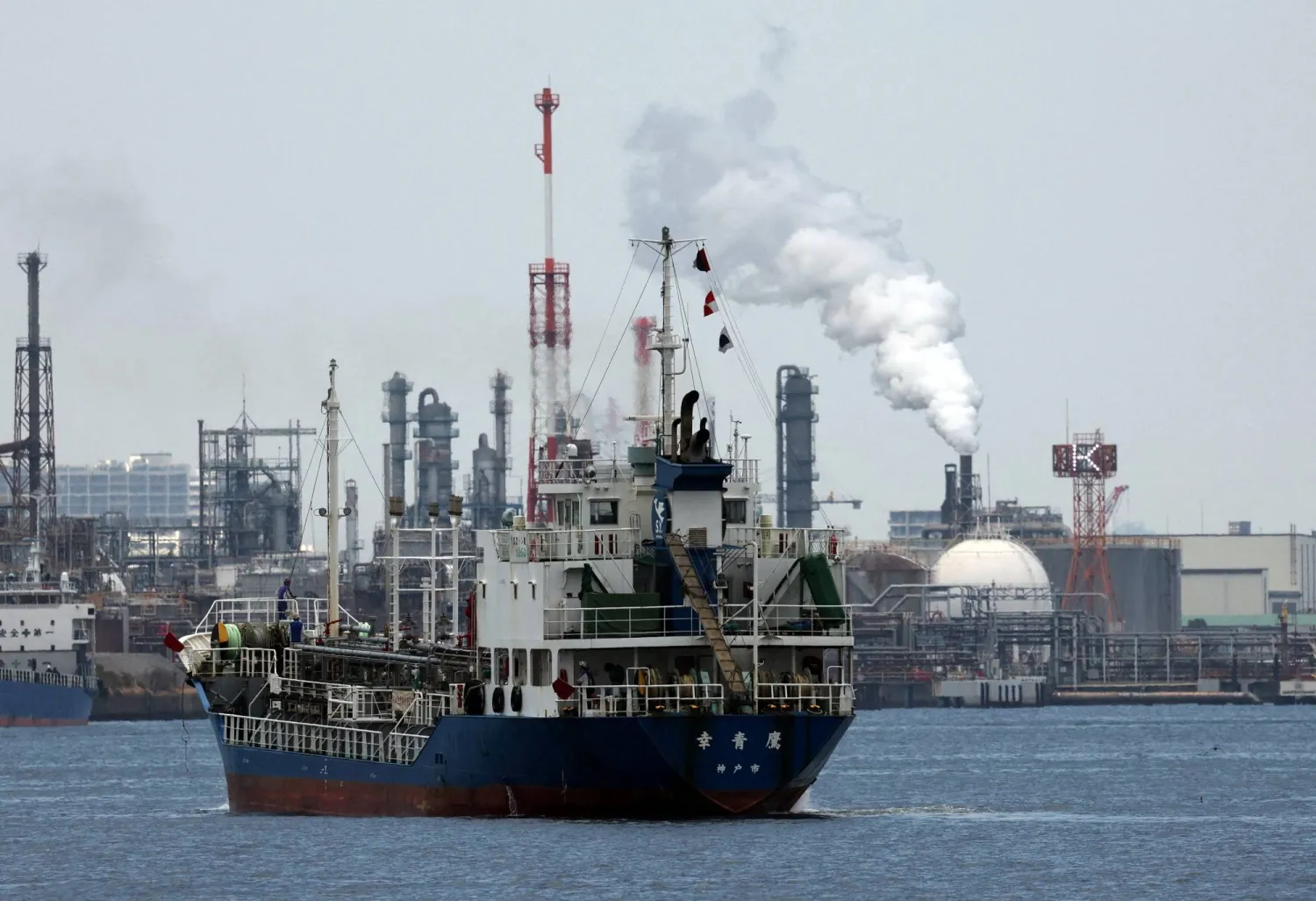
FILE PHOTO: A small tanker sails near an oil refinery, in the Keihin Industrial Zone in Kawasaki, south of Tokyo, Japan March 17, 2026.  REUTERS/Issei Kato/File Photo
FILE PHOTO: A small tanker sails near an oil refinery, in the Keihin Industrial Zone in Kawasaki, south of Tokyo, Japan March 17, 2026. REUTERS/Issei Kato/File Photo
TT

Oil Rises as US Strikes on Iran Raise Fears Over Shaky Truce

FILE PHOTO: A small tanker sails near an oil refinery, in the Keihin Industrial Zone in Kawasaki, south of Tokyo, Japan March 17, 2026.  REUTERS/Issei Kato/File Photo
FILE PHOTO: A small tanker sails near an oil refinery, in the Keihin Industrial Zone in Kawasaki, south of Tokyo, Japan March 17, 2026. REUTERS/Issei Kato/File Photo

Oil prices gained more than 2% on Wednesday after the US military launched airstrikes against Iran and reimposed crude sales sanctions, raising fears their fragile truce was unravelling and Middle East supplies could be disrupted again.

Brent crude futures gained $1.92, or 2.6%, at $76.08 a barrel at 0400 GMT. US West Texas Intermediate crude climbed $1.82, or 2.6%, to $72.26 a barrel, Reuters reported.

Both benchmarks rose about 3% on Tuesday after the US revoked the general license authorizing the sale of Iranian crude following the Iranian attacks.

"While the revocation doesn't fundamentally change oil market dynamics, it's important from a sentiment perspective. It heightens the risk of a breakdown in the temporary deal between the US and Iran," ING commodity ⁠strategists said on ⁠Wednesday.

The US airstrikes were in response to Iranian attacks on three commercial vessels that were transiting the Strait of Hormuz, US Central Command said on Tuesday.

"The current conflagration is a reminder to the market of how fragile passage through the Strait still is," said Saul Kavonic, head of research at MST Marquee.

"This presents a contrary indicator to the prevailing sentiment that the market could be flooded into oversupply, which may scare some of the record short positioning to cover," he ⁠said, adding that if tensions persist and traffic through the waterway remains below 50% of pre-war levels, the resulting supply constraints could support higher oil prices.

After the US and Iran signed their truce agreement last month, oil prices tumbled back to pre-war levels and traders amassed large short positions in oil futures, or bets that prices would fall further.

Expectations of a wave of pent-up Middle East supply coming onto the market caused the price declines.

The latest attacks renewed concerns about tanker traffic through the Strait of Hormuz, which carried cargoes equal to about one-fifth of global energy supply before the war began in February.

Since the war started, nations have drawn down their inventories to make up for the supply shortfall.


UN: AI Boom Drives Intangible Investment to Record Level

FILE PHOTO: An AI sign is seen at the World Artificial Intelligence Conference in Shanghai, China July 6, 2023. REUTERS/Aly Song/File Photo
TT

UN: AI Boom Drives Intangible Investment to Record Level

FILE PHOTO: An AI sign is seen at the World Artificial Intelligence Conference in Shanghai, China July 6, 2023. REUTERS/Aly Song/File Photo

The AI boom has helped drive investments in intangible assets such as software, data and research to a record high in 2025, the United Nations' patent and innovation agency said Wednesday.

These investments, which encompass research and development, software and data, brands, design and organizational know-how, represent a large and growing share of the global economy, the World Intellectual Property Organization said.

Across the 29 economies studied, which account for 57 percent of global GDP, intangible investment "reached an all-time high" of over $10 trillion in 2025, according to WIPO.

The study included the United States, EU nations, Britain, Japan, India as well as other countries. However, China, the world's second-largest economy, was not among the nations covered.

The record figure was detailed in the World Intangible Investment Highlights 2026, which WIPO co-published with the Rome-headquartered Luiss Business School.

Since 2008, intangible investment has grown by 3.5 percent annually in real terms; way ahead of tangible investments, which saw annual growth of just 0.98 percent over the same period, the study said.

"These figures point to a durable structural shift in the composition of investment, with intangible assets playing a growing role in value creation," WIPO said.

The United States accounts for the largest share of intangible investment by far, reaching nearly $5 trillion in 2025.

This was around six times the level in second-placed Japan, with Germany third.

Sweden retains its position as the most intangible-intensive economy, reaching 17.4 percent of GDP in 2025, followed by the United States at 15.6 percent and France at 15.2 percent.
Meanwhile India, Japan and the Philippines recorded the fastest growth, said WIPO.

The report said intangible investments proved more resilient than tangible ones in the face of high interest rates, trade tensions and the economic slowdown seen in recent years.

Between 2020 and 2025, they grew by 5.5 percent annually in real terms, compared to 3.2 percent for tangible investments.

The report said artificial intelligence was playing a major role in the transformation.

While it initially drives physical investments in data centers, semiconductors and energy infrastructure, WIPO estimates that its lasting impact stems primarily from investments in software, data, research and development, and corporate reorganization.

Investment in software and databases recorded the highest aggregate real growth rate across all intangible asset categories between 2013 and 2023, at 7.3 percent annually, ahead of organizational capital (4.9 percent) and brands (4.4 percent).

According to AFP, the report also highlights the economic importance of brands, with investments across the 29 economies reaching $1.4 trillion in 2025.

The US leads global brand investment by a wide margin, exceeding $566 billion in 2025 -- more than four times the figure for Britain, in second place on $137 billion, followed by Japan on $112 billion.

Established in 1967, Geneva-based WIPO helps creators and entrepreneurs protect their intellectual property across borders.


S&P: Resilient GCC Economies to Support Recovery Despite Prolonged Geopolitical Uncertainty

A view of Riyadh, Saudi Arabia. (Reuters file)
TT

S&P: Resilient GCC Economies to Support Recovery Despite Prolonged Geopolitical Uncertainty

A view of Riyadh, Saudi Arabia. (Reuters file)

The economies of Gulf Cooperation Council (GCC) are based on strong foundations that enhance their ability to overcome the fallout of the Middle East war, supported by robust net asset positions and liquidity buffers despite prolonged geopolitical uncertainty, Standard & Poor’s Global Ratings said in a recent report.

The rating agency projected a temporary slowdown in GCC growth in 2026 before the region's economies regain strong recovery in 2027, with countries and economic sectors' ability to absorb shocks according to their financial and geographical conditions.

In its report “Middle East War: GCC Sensitivity and Sector Vulnerabilities Aren't Homogenous”, S&P said outlooks on GCC sovereign ratings are stable supported by expectation that large, liquid government assets will absorb fiscal shocks and that hydrocarbon exports will resume amid supportive prices

“We anticipate a pronounced dip in GDP growth in 2026 followed by a strong recovery, with average real GDP growth of about 5.3% in 2027,” the agency wrote.

Gradual recovery of energy supplies

S&P Global Ratings' base case assumes that supply disruptions in the Strait of Hormuz will ease in the second half of 2026.

“We expect oil shipments during that period will average about 75% of the pre-war volumes and that Brent crude will average $110 per barrel (/bbl) for the remainder of 2026 and $80/bbl for 2027,” the report said.

It expected the GCC region's real GDP to fall 3% on average in 2026, with Saudi Arabia (2.6%) and Oman (1.6%) and UAE (1.5%) projected to grow.

Ability to recover differs

S&P said four of the six GCC sovereigns' net assets exceed annual GDP.

It said sovereigns, such as the UAE, Saudi Arabia, Kuwait, and Qatar, display greater capacity for resilience than Bahrain and Oman, though Oman stands to benefit further from its geography outside the Strait of Hormuz.

The agency added that Saudi Arabia's and Oman's geographic advantages will likely continue to offer benefits extending beyond hydrocarbons, with maritime and logistical disruption weighing more on other GCC countries' trade, manufacturing, real estate, and hospitality.

Oil production exceeds pre-war levels

S&P forecasted that between 2027 and 2029, GCC oil production will exceed pre-war levels.

During this period, Saudi Arabia's oil production will increase to an average of 10.6 million barrels per day (bpd) while the UAE’s production will increase to 4.5 million bpd.

“We expect regional pre-war production levels will be exceeded as Qatar’s North Field East expansion starts producing with the first train expected to come on stream in early 2027,” the report added.

Resilience of GCC banks

In the banking sector, S&P said despite uneven external risks across the region, “we consider GCC banks' credit quality to be stable, supported by deposit growth that offers funding stability and solid capital buffers that mitigate risks from potentially weaker asset quality.”

In the first quarter of 2026, it said total domestic deposits rose by about 4.2% in the GCC region, slightly accelerating to 6.2% year-to date to April-end.

Domestic private sector deposit growth remained on par with 2025, at about 11.6% annualized at the end of April 2026, supported by a strong pick-up in Saudi Arabia.

In a scenario involving external funding outflows--assuming 50% external bank funding and 30% non-bank funding outflows, the rating agency said some banks would likely require support of about $1.2 billion and $5.8 billion, respectively, based on the first quarter 2026 financial data.

Energy and real estate more vulnerable

S&P said the conflict will weigh heaviest on sectors reliant on tourism, consumer spending, transportation and logistics and energy.

It said regional uncertainty could negatively affect high-net-worth investors' decisions, leading to weak transaction volumes, particularly in the apartments segment given the potential for oversupply.

Conversely, utilities, telecommunications, and healthcare continue to demonstrate resilience, supported by defensive business models and relatively stable demand.

Redirecting investment

S&P said the prolonged geopolitical fragmentation, intermittent regional clashes, and the failure to normalize trade flows through key routes like the Strait of Hormuz would be a sustained erosion of business confidence, investment appetite, and cross-border capital flows.

The next phase of GCC corporate credit differentiation will be shaped less by balance sheet strength alone, and more by companies' ability to sustain confidence, investment, and economic diversification amid prolonged uncertainty.


Saudi Investment Ministry to Participate in LEAP East 2026 to Showcase Opportunities

Saudi Investment Ministry to Participate in LEAP East 2026 to Showcase Opportunities
TT

Saudi Investment Ministry to Participate in LEAP East 2026 to Showcase Opportunities

Saudi Investment Ministry to Participate in LEAP East 2026 to Showcase Opportunities

The Saudi Ministry of Investment, represented by Invest Saudi, will participate in LEAP East 2026, which will take place in Hong Kong from July 8 to 10, as part of its efforts to strengthen the Kingdom's presence on the global investment stage.

The participation aims to showcase Saudi Arabia's investment environment in the information and communications technology (ICT) and entrepreneurship sectors, while enhancing engagement with global investors and technology companies.

The Invest Saudi pavilion will feature representatives from Saudi Arabia's investment ecosystem to provide information and services to investors and showcase the Kingdom's investment enablers, including its regulatory framework, advanced digital infrastructure, and incentives and services that facilitate the investor journey.

It will also highlight investment opportunities in artificial intelligence, data centers, cloud computing, and emerging technologies.

The participation highlights Saudi Arabia's competitiveness in the technology sector. The Kingdom ranks among the world's leaders in 5G speeds, has one of the highest fiber-optic penetration rates globally, and hosts the world's leading cloud service providers, reinforcing its position as a regional hub for the digital economy and advanced technologies.

The participation also showcases Saudi Arabia's entrepreneurship ecosystem and the programs and enablers it offers to support the establishment and growth of startups.

It will promote the Startup Saudi Program and strengthen engagement with investors, venture capital funds and international partners, helping attract high-quality investments and forge strategic partnerships.

The participation builds on the investment ecosystem's efforts to attract foreign direct investment, strengthen partnerships with global technology companies, and support knowledge transfer and technology localization.

It reinforces Saudi Arabia's position as a global destination for high-value investments and a regional hub for business and investment.