
Hezbollah Cuts Ties with Lebanon's Presidency While Sparing the Army

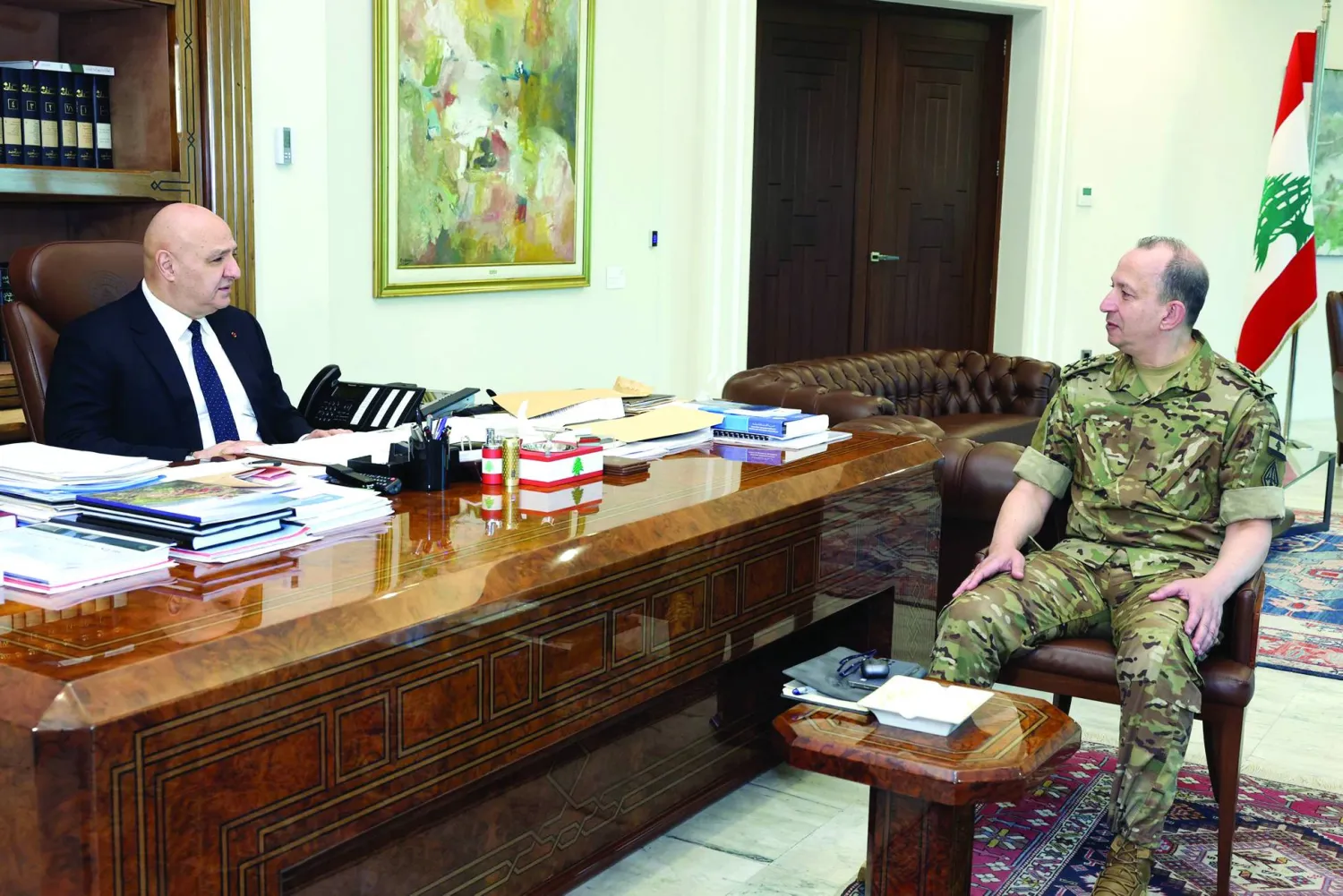
Lebanese President Joseph Aoun meets with Army Commander Rodolphe Haykal during an earlier meeting. (Lebanese Presidency)
TT

Hezbollah Cuts Ties with Lebanon's Presidency While Sparing the Army

Lebanese President Joseph Aoun meets with Army Commander Rodolphe Haykal during an earlier meeting. (Lebanese Presidency)

In recent days, Hezbollah has sharply escalated its confrontation with the Lebanese authorities, particularly the presidency, ahead of President Joseph Aoun's visit to Washington. One of the group's lawmakers openly declared that "the bridges with the authorities have been severed and the consequences will not be favorable."

At the same time, however, Hezbollah has continued to avoid direct confrontation with the Lebanese Army's leadership, despite previously warning that it would treat any party attempting to disarm it by force in the same way it treats the Israeli military.

As Lebanese, American, and Israeli discussions continue over implementing the proposed "pilot zones" in southern Lebanon, a plan that would place those areas under the control of the Lebanese Army while removing both Israeli forces and Hezbollah's military presence, the group's recent escalation appears to signal that it is unwilling to cooperate with the proposal. Hezbollah had previously strongly criticized the framework agreement and its provisions.

No Decision to Use Force

According to military sources, there is "no political or military-security decision to implement the pilot zones by force." The sources told Asharq Al-Awsat that "the issue must be resolved through dialogue and politics, not by placing the Lebanese Army in direct confrontation with Hezbollah, as the consequences would be catastrophic on every level."

After Hezbollah MP Hassan Fadlallah used the parliamentary podium earlier this week to launch a sharp attack on President Joseph Aoun, accusing him of "becoming a political actor who deepens divisions among the Lebanese instead of serving as president and a symbol of national unity," fellow Hezbollah lawmaker Ali Fayyad said on Friday that "the problem with this government has become serious, very serious. The bridges with it have been severed, the possibility of reaching an understanding no longer exists, and the consequences will not be favorable."

Escalation in the Streets?

Hilal Khashan, professor of political science at the American University of Beirut, attributed Hezbollah's escalating rhetoric toward the authorities to what he described as the existential challenges the group currently faces "after finding itself on the chopping block and after the decision was made to eliminate its military wing." He added that "it is not unlikely that Hezbollah will escalate in the streets in the coming days and weeks, despite President Aoun's warning that taking to the streets is a red line."

Speaking to Asharq Al-Awsat, Khashan said the available indications suggest that "Hezbollah is preparing for confrontation and that the next phase will be extremely difficult and dangerous." He added that concerns over divisions within the Lebanese Army if it were forced into a confrontation with Hezbollah are well founded and that the consequences of such a decision should not be underestimated.

According to Khashan, the army commander is fully aware of those risks and is acting accordingly. President Aoun, himself a product of the military establishment, also understands this reality well and is familiar with the army's internal composition.

Khashan believes Hezbollah is currently in a weakened position. However, he argues that strong communal solidarity has led most Lebanese Shiites to rally behind the group, believing that if Hezbollah were ultimately defeated, the gains achieved by the Shiite community over recent decades would come to an end. In their view, they want their community to remain the dominant force in the country.

A Return to Assassinations?

Ali Al-Amin, political writer and editor-in-chief of the Janoubia news website, argues that Hezbollah "is not operating as a Lebanese political party concerned with the national considerations that shape the president's positions on negotiations, Lebanon's foreign relations, or the country's security. Hezbollah today is, in effect, part of Iran's Revolutionary Guard, and its position toward President Joseph Aoun reflects Iran's position toward him."

Asked whether this rhetoric could foreshadow action by Hezbollah against domestic opponents, whether the government or rival political forces, Al-Amin said such a scenario "cannot be ruled out." He suggested it could take various forms, "including assassinations or efforts to stir unrest in the streets." However, he argued that none of these options would ultimately benefit Hezbollah.

"The more Hezbollah attacks President Aoun, the more Lebanese rally around him and the more isolated the party becomes. Any attempt by Hezbollah to provoke internal confrontation would harm everyone, but there is no doubt that Hezbollah itself would be the first to pay the price."

Hezbollah Wants the Army to Remain Neutral

Responding to another question, Al-Amin argued that Hezbollah's efforts to keep the Lebanese Army out of the confrontation are "far from innocent." He said the party has sought to amplify praise for the army as a military institution loved by all, on the condition that it satisfies all political factions by remaining neutral.

Speaking to Asharq Al-Awsat, Al-Amin said Hezbollah wants the army to remain, as it has always preferred, "a force that is effectively sidelined except when its role serves the party's own interests." He pointed to Hezbollah's refusal to hand over its positions to the army when requested, citing the case of Ali al-Taher Hill north of the Litani River. He also recalled the explosion that killed six Lebanese soldiers as they attempted to take control of one of Hezbollah's tunnels in the Tyre district following the November ceasefire agreement.

Al-Amin added that Hezbollah also seeks to exploit any disagreement between the government and the army, "even if merely superficial," in order to deepen and magnify those divisions.

Iraq Closes Three Iran Crossings, Pursues Those Behind Attacks on Saudi Arabia

Travelers at the Shalamsheh border crossing between Iraq and Iran after Iraqi authorities ordered its closure as a precautionary measure following the latest drone attacks on Saudi Arabia on September 12, 2026 (Reuters)
TT

Iraq Closes Three Iran Crossings, Pursues Those Behind Attacks on Saudi Arabia

Travelers at the Shalamsheh border crossing between Iraq and Iran after Iraqi authorities ordered its closure as a precautionary measure following the latest drone attacks on Saudi Arabia on September 12, 2026 (Reuters)

Iraq closed three border crossings with Iran on Saturday, officials told AFP, after a drone attack on a Saudi Arabian pipeline that both Riyadh and Baghdad said was launched from Iraq.

An Iraqi security source and a government official told AFP that authorities ordered the closing of three border crossings with Iran.

The security source said the decision was "part of an intelligence effort to track down the perpetrators and prevent their escape... and to hinder the smuggling of drones through these crossings".

Both sources, who spoke on condition of anonymity because they were not allowed to speak to the media, could not specify when the crossings would reopen.

The closed crossings are Shalamsheh in Basra province, al-Shib in Missan and al-Mandali in the central province of Diyala.

Other border crossings with Iran are still open.

A security official said that "security forces found drone launchers near the Iraq-Iran border in the al-Tib" region, a remote part of Missan, close to the al-Shib crossing. A second security source gave the same account.

Military spokesperson Sabah al-Numan said the prime minister had approved "Iran's request to conduct a joint investigation into finding drone launch platforms near the Iraq-Iran border".

The government's security media cell said earlier that authorities "have started administrative and security reorganization operations at several border crossings".

It added that they had stepped up "intelligence activities" to determine "the breaches and violations that took place at these crossings".

It later announced that passengers stranded for hours at two crossings were permitted to pass.


Al-Halbousi Condemns Attacks on Saudi Arabia

Iraqi Speaker of parliament Mohammed al-Halbousi speaks with the news media as he departs the Department of State after meeting with Secretary of State Mike Pompeo, in Washington, on March 28, 2019. (AP)
TT

Al-Halbousi Condemns Attacks on Saudi Arabia

Iraqi Speaker of parliament Mohammed al-Halbousi speaks with the news media as he departs the Department of State after meeting with Secretary of State Mike Pompeo, in Washington, on March 28, 2019. (AP)

Speaker of the Iraqi Council of Representatives Haibat Al-Halbousi strongly condemned the attacks targeting the Kingdom of Saudi Arabia that originated from within Iraqi territory.

In a statement issued on Saturday, Al-Halbousi rejected the use of Iraq's territory or airspace to threaten Saudi Arabia's security or that of any neighboring state, describing such actions as unacceptable violations that contradict Iraq's national interests, stated foreign policy, and regional relations.

Al-Halbousi emphasized the critical need to restrict weapons exclusively to the state and its constitutional institutions under the authority of the commander-in-chief of the Armed Forces.

He stressed that enforcing state control over arms is vital to reinforcing national sovereignty, preserving domestic stability, and preventing Iraq from being drawn into wider regional conflicts.


Lebanese Army Detains Bashar Assad’s Relative on Weapons and Drugs Charges

Ousted Syrian President Bashar Assad - File Photo
TT

Lebanese Army Detains Bashar Assad’s Relative on Weapons and Drugs Charges

Ousted Syrian President Bashar Assad - File Photo

Lebanese authorities have detained a relative of ousted Syrian President Bashar Assad along with the son of a notorious drug dealer in northeast Lebanon on charges of carrying weapons and drugs, officials and the Lebanese army said Saturday.

Suleiman Assad and Ali Zeiter, son of Noah Zeiter, the suspected drug trafficker arrested last year, were detained Friday near the northeastern city of Baalbek, said the two judicial officials, who spoke on condition of anonymity because they were not authorized to speak to the media. Suleiman Assad is the son of Hilal Assad, a cousin of the ousted president, The AP news reported.

A number of Syrian officials and relatives of Assad have fled from Syria to other countries including Lebanon, after the five-decade Assad family rule came to an end in December 2024, when the opposition seized power. Bashar Assad and his younger brother, Maher, have been living in Russia.

The Lebanese army said in a statement that it detained three people, including a Syrian citizen who did not have documents proving that he is staying legally in Lebanon.

The army said they had weapons with them along with hashish, a drug that is processed from cannabis that are widely planted in northeast Lebanon. The army did not release the names but the initials of their first and family names matched those of Assad and Zeiter. The army said they were questioned under the supervision of judicial officials.

The arrest of Suleiman Assad comes weeks after Lebanon handed over to Syrian authorities a retired major general who commanded a division in Bashar Assad’s army.