


Rights Group Warns Israel's Policies are Pushing the West Bank Healthcare System to Collapse

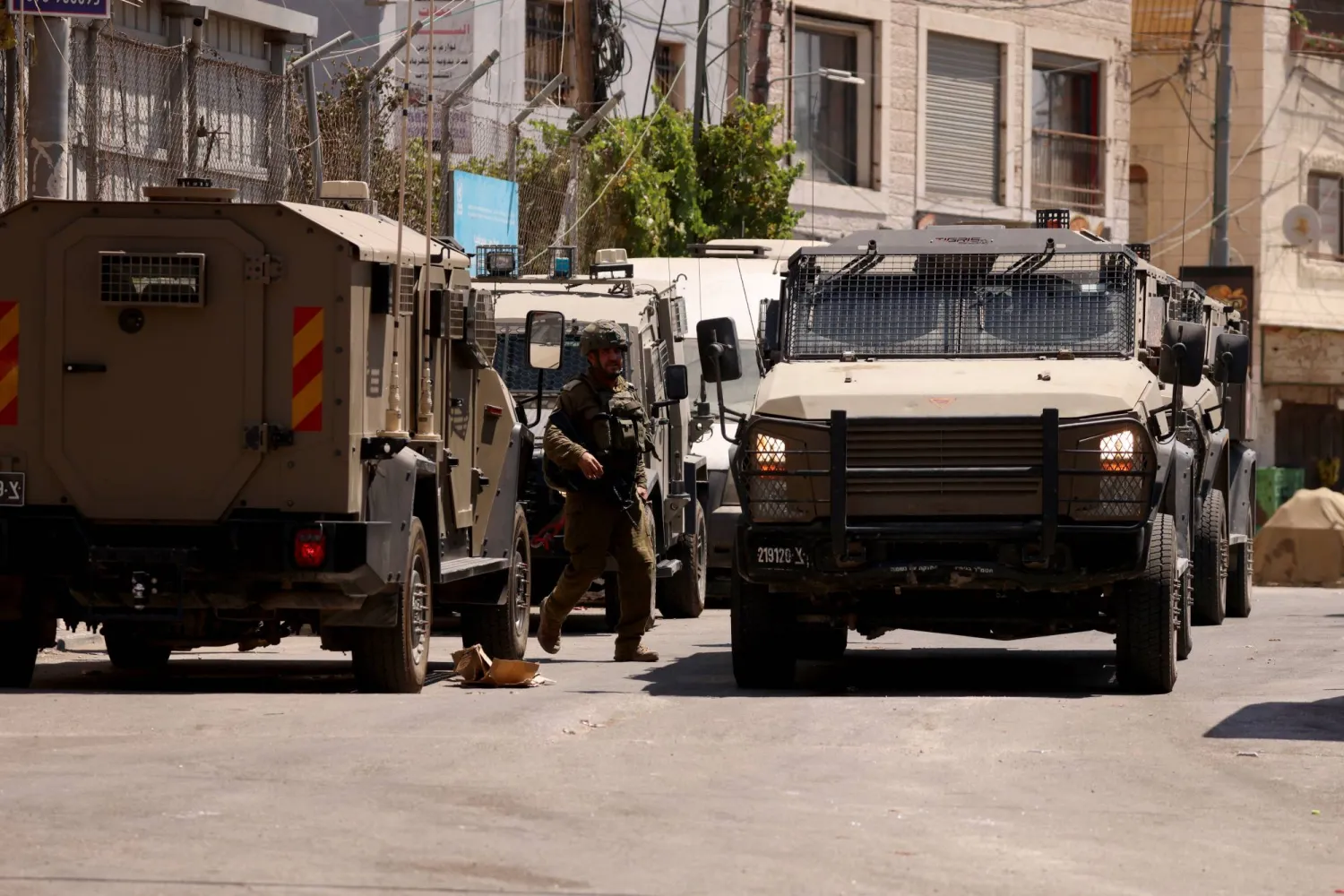
Israeli security forces patrol a street during a military operation in the Qalandia refugee camp, south of the West Bank city of Ramallah, 06 August 2026. EPA/ALAA BADARNEH
TT

Rights Group Warns Israel's Policies are Pushing the West Bank Healthcare System to Collapse

Israeli security forces patrol a street during a military operation in the Qalandia refugee camp, south of the West Bank city of Ramallah, 06 August 2026. EPA/ALAA BADARNEH

For six months, 70-year-old Bassam Musleh searched desperately for a pharmacy or clinic that could fill his prescription for blood pressure and other heart medications. Public dispensaries were out of stock, he said, and he couldn't afford the private ones.

But when he arrived Tuesday at a mobile clinic in the West Bank village of Iktaba, pulling the tattered prescription from his pocket, a local aid group finally gave him the medication he needs, The Associated Press said.

Musleh, who has a pacemaker, is one of hundreds of thousands of Palestinians struggling to get healthcare in the West Bank, where a report released Thursday by Physicians for Human Rights Israel warns that Israeli policies have pushed the territory's health system to the brink of collapse.

Since the war between Israel and Hamas in Gaza began nearly three years ago, Israel has withheld billions of dollars of tax and customs revenues collected on behalf of the Palestinian Authority, the government body that administers parts of the Israeli-occupied West Bank. Without those funds, the PA has struggled to pay health workers, buy medications and support public hospitals, pharmacies and clinics, 75% of which have reduced operations and are functioning just once or twice a week.

At the same time, Israeli military raids and a surge in new checkpoints are also impeding the ability of Palestinians to get adequate medical care, with life-threatening consequences.

“If this continues, it is patients — not institutions — who will pay the price,” said Milena Ansari, PHRI's director of the Occupied Palestinian Territory Department, who wrote the report.

Israel has withheld at least $2.5 billion in revenues from the West Bank

Because Palestinians don't control their own borders, the PA relies on Israel to collect taxes on goods that enter the West Bank through Israeli ports. But rights groups for decades have accused Israel of weaponizing the funds as a means of political pressure.

Israeli Finance Minister Bezalel Smotrich stopped sending monthly clearance revenues to the PA last year and, as of June, Israel had cumulatively withheld at least $2.5 billion from the PA since 2023, according to the International Crisis Group.

Smotrich's office and the office of Israeli Prime Minister Benjamin Netanyahu did not respond to repeated requests for comment from The Associated Press.

In an interview with the AP, Palestinian Health Minister Majed Abu Ramadan said that unpaid staff aren't showing up to work, creating a backlog of cases and delaying routine surgeries. Earlier this year, Palestinian doctors went on strike and some primary healthcare centers closed.

Some of the most impacted are those with cancer, kidney and heart problems, older people and those who have been displaced, health officials said.

At PHRI's mobile clinic in Iktaba, hundreds of people streamed in seeking treatment.

Mohammed Sarris said it's been weeks since he's been able to get the eye drops he needs for irritation caused by his diabetes.

The 64-year-old has been relying on the mobile clinic since he was forced from his home last year in the Nur Shams refugee camp, where he had easier access to healthcare provided by UNRWA, the UN Relief and Works Agency for Palestinian refugees.

A retired government worker, he earns a meager pension, often rationing medicine so he can afford food.

"It's degrading. ... All of this has affected us a lot,” he said.

The UN and other aid agencies say more patients are coming to their clinics

Physicians for Human Rights Israel said the number of patients at its mobile clinics has doubled in the last two years, from about 250 a day to around 500.

Roland Friedrich, UNRWA's West Bank director, said there's been a marked increase in patients at its health centers across the territory. The agency is trying to bridge the gap, but lacks funds to scale up health services and faces Israeli restrictions on imports of medications, he said.

Earlier this year, Israel revoked the licenses of more than three dozen humanitarian organizations, among them Doctors Without Borders, known by its French acronym MSF.

Last year, MSF had 12 mobile clinics operating in the South Hebron Hills. But because they could no longer coordinate their movements with the Israeli military, the group reduced the number of clinics it runs by half, impacting more than 40,000 people, said Joan Tubau, head of mission for Doctors Without Borders in Gaza and the occupied West Bank.

More Israeli checkpoints and roadblocks prevent Palestinians from accessing care

The lack of medicine, staff shortages and reduced services are being compounded by harsher Israeli restrictions on freedom of movement in the West Bank.

In recent years, the military has erected new barriers, checkpoints and roadblocks, closing off towns and cities, sometimes with little warning.

In July, at least two women gave birth in ambulances because checkpoints were closed, said Aseel Baidoun, deputy director of advocacy and campaigns for Medical Aid for Palestinians, or MAP, an international organization. One of the babies was stillborn.

She said three others also died trying to get to hospitals this year, including two more infants and a 30-year-old woman who died of a heart attack after an ambulance was stopped at a checkpoint near Sinjil, outside Ramallah.

The Israeli military has denied that it prevents medical treatment for civilians and said there is no intention to delay treatment or medical evacuations.

In response to questions about the stillborn infant, who was delivered in an ambulance near Nablus, the army said the emergency vehicle hadn’t completed “required coordination” prior to arriving at the checkpoint. It said the military conducted a security check, which only lasted a few minutes.

Dr. Leen Ibrahim, who works with MAP, said one of the consequences of this crisis is the impact on mental health.

“People here feel suffocated by everything they’re going through," she said.

At the clinic Tuesday, some Palestinians broke down waiting for hours to be seen.

“The line is so long,” said Asala Wawi, 65, wiping tears from her face as she got her eyes checked. “I'm tired."



Algerian Parliament Approves Death Penalty for Arson, Child Abduction

Lawmakers vote on a bill to amend the penal code. (Algerian Parliament)
TT

Algerian Parliament Approves Death Penalty for Arson, Child Abduction

Lawmakers vote on a bill to amend the penal code. (Algerian Parliament)

Algeria’s National People’s Assembly approved a bill on Thursday expanding the death penalty for arson and crimes against children, drawing opposition warnings about the irreversible consequences of judicial error.

The amendments to the penal code, passed by a large majority, provide for capital punishment for deliberately setting fire to forests and property, and for child abductions followed by murder or brutal abuse.

The measures aim to strengthen legal deterrence and protect society.

The government secured passage with support from lawmakers in the “presidential majority” — parties that back President Abdelmadjid Tebboune’s policies: the National Liberation Front, the Democratic National Rally, the Future Front and the National Construction Movement.

Islamist lawmakers from the Movement of Society for Peace, the Ennahda Movement and the Justice and Development Front also backed the bill on religious grounds, despite being in opposition.

Lawmakers from the Workers’ Party, the Socialist Forces Front and the Rally for Culture and Democracy voted against it. Their small numbers gave them little sway over the outcome.

Justice Minister Lotfi Boudjemaa attended the vote after presenting the bill to the assembly last Monday.

Tougher penalties, renewed debate

The bill, which has stirred considerable controversy in Algeria, contains eight articles, including new provisions on arson, attacks on property and child abduction.

Among the toughest is Article 395 bis, which prescribes the death penalty for “anyone who deliberately sets fire to forests, scrubland, fields, whether cultivated or uncultivated, trees or sections of forest.”

It also covers timber stored in piles or bundles within forest areas.

Article 396 bis 1 extends capital punishment to “the deliberate burning of any property, public or private” when committed “for the benefit of a foreign state or foreign entity, in connection with treason, collusion with the enemy or membership in an organized criminal group.”

Article 396 bis 2 targets anyone who “incites, encourages, finances, organizes or facilitates these acts,” including acts committed or incited through social media.

For crimes against children, Article 291 prescribes the death penalty for “anyone who abducts a child, tortures a child, sexually assaults a child or amputates one of a child’s limbs,” notwithstanding any conflicting penalty under existing legislation.

Those convicted of any of these crimes cannot benefit from mitigating circumstances, further tightening the penalties.

The government proposed the amendments in direct response to devastating fires that swept through parts of eastern Algeria this summer, killing dozens of people. The killing of children after their abduction has also become alarmingly more prevalent in recent years.

“Justice should not respond to death with death”

The opposition warned that the law could turn the judiciary into “an instrument of revenge,” instead of protecting victims’ rights and helping them secure redress while safeguarding defendants’ rights and guaranteeing a fair trial.

“We believe that true justice should not respond to death with death,” said Mohammed Abdoussi, a lawmaker from the Rally for Culture and Democracy.

“No one has the right to take another person’s life, and the state and the judiciary are no exception to this principle,” he told parliament in remarks reported by the media.

“Our position on the death penalty is therefore clear and rooted in principle, and we have expressed it on many occasions.”

He said his parliamentary group had proposed abolishing the death penalty and replacing it with life imprisonment in 2008.

During debate on the bill, the group raised the tragedy of the 2021 fires in Kabylie and the killing of Djamel Ben Ismail, who was brutally attacked after local residents wrongly accused him of starting the fires.

“Following this crime, 48 people were sentenced to death, before the number of death sentences was reduced to 38 on appeal,” Abdoussi said.

“This raises a crucial question: Had the initial sentences been carried out, 10 additional people could have lost their lives on the basis of rulings that were subsequently changed.”

“This example demonstrates the danger of a punishment that cannot be reversed once carried out,” he added. “Human justice, however accurate, remains susceptible to error, while a death sentence cannot be corrected after it has been carried out.”


Syria, Hezbollah Exchange Messages to Ease Security Tensions through Turkish Mediation

Hezbollah supporters carry Lebanese and Hezbollah flags during a commemoration marking the second anniversary of the assassination of the group’s former secretary-general, Hassan Nasrallah (EPA)
TT

Syria, Hezbollah Exchange Messages to Ease Security Tensions through Turkish Mediation

Hezbollah supporters carry Lebanese and Hezbollah flags during a commemoration marking the second anniversary of the assassination of the group’s former secretary-general, Hassan Nasrallah (EPA)

Security issues dominated secret Turkish-mediated talks between Hezbollah and Syria, during which the two sides exchanged messages aimed at easing tensions.

Hezbollah offered assurances that it would stay out of Syria’s security and military affairs and refrain from supporting groups affiliated with the former government, in return for a Syrian pledge not to intervene militarily in Lebanon as part of any plan to disarm the group there.

Reuters cited six sources familiar with the matter as saying representatives of the Syrian government and Lebanon’s Hezbollah held direct talks in Türkiye in an effort to ease tensions.

It described the meeting as the first known encounter of its kind between the two longtime adversaries.

While Hezbollah has kept silent on the matter, Lebanese sources familiar with the group’s activities told Asharq Al-Awsat that this was the second meeting.

An initial encounter to “break the ice” took place in Istanbul on the sidelines of the “Pledge for Jerusalem Conference,” hosted by Türkiye last December.

Hezbollah’s delegation was led by Ammar al-Moussawi, the group’s official responsible for Arab and international relations.

“Türkiye is continuing to mediate between the two sides, and contacts through Türkiye intensified after US President Donald Trump’s threats that Damascus could carry out the task of disarming Hezbollah,” the sources said, referring to remarks in which he said Syrian President Ahmed al-Sharaa could accomplish the task.

The sources said the second meeting, reported by Reuters, took place in Türkiye during the first 10 days of September. No Hezbollah security or military officials attended, they added.

The two meetings “do not amount to negotiations or understandings, but fall within the framework of messages exchanged between the two sides through Turkish mediation,” the sources said.

Security priorities

Security issues top both sides’ priorities amid concerns, including Syrian fears that Hezbollah could support remnants of the former government or seek to reactivate the southern Syrian front against Israel.

Hezbollah has repeatedly denied in statements that it intervenes in Syrian affairs or supports any groups in southern Syria.

The sources said Türkiye “worked to address the fears previously raised by President Trump’s remarks about Syrian intervention inside Lebanon against Hezbollah, and provided assurances of no interference whatsoever in Lebanese affairs, in return for assurances from Hezbollah that it would stay entirely out of the Syrian arena, refrain from obstructing security measures along the border with Lebanon, and pledge not to provide support of any kind to groups affiliated with the former government.”

They said Hezbollah “publicly affirms that it is staying entirely out of the Syrian arena and is not intervening there in any way, maintaining its focus on Lebanon.”

Effort to ease tensions

Those accounts align with what Reuters reported from its sources, who included two Syrian officials, a US official and a senior Lebanese security source close to Hezbollah.

The six sources said the meeting took place last month at the invitation of Türkiye’s security and intelligence services in an effort to reduce tensions.

It brought together Hezbollah representatives and officials from Syria’s intelligence services and Foreign Ministry.

The Syrian Foreign Ministry, Türkiye’s foreign and defense ministries, and the US State Department did not respond to Reuters’ questions about the meeting. Hezbollah’s media office declined to comment.

Both Hezbollah and the Syrian government had signaled openness to talks.

Syrian Foreign Minister Asaad al-Shibani said in July that Damascus was open to meeting the group. A month later, Hezbollah Secretary-General Naim Qassem said in a televised address that the group had no objection to meeting Syria’s leadership.

Resolving points of tension

The US official, the two Syrian officials and the Lebanese source said the meeting focused on resolving points of tension between the two sides and went well.

One Syrian official said the two sides agreed there was no hostility between them, and Syria assured Hezbollah it would not intervene militarily in Lebanon to disarm the group.

The official said Syrian representatives, in turn, asked Hezbollah to help halt cross-border smuggling attempts and dismantle its remaining sleeper cells, particularly in southern Syria.

According to Reuters, the Syrian official said Hezbollah’s representatives did not directly respond to the request to halt arms smuggling and dismantle its cells in Syria, but pledged not to interfere in Syrian affairs.

The Lebanese source, who had direct knowledge of the meeting and its outcome, said the two sides “made significant progress on security issues.”

“Hezbollah wants to protect its rear,” the source said, referring to fears of a Syrian attack on the group inside Lebanon.

Both the Syrian official and the Lebanese source said no final agreement was reached and there was no plan to issue an announcement. The Lebanese source said contacts between the two sides through Türkiye began about two months ago.

Iran absent from meeting

Three of the sources said Türkiye, a key ally of Syrian President Ahmed al-Sharaa, pushed for the meeting because it wanted to be directly involved in those efforts. Iran, Hezbollah’s main backer, was absent from the meetings.

The Lebanese security source said Hezbollah attended with Iran’s knowledge, but Tehran was disappointed that it was not directly involved and that Sharaa has so far rejected the idea of establishing any direct relations with it.

That disappointment was the main reason no final agreement was reached and no announcement was made about the meeting, the source said.


Egypt Warns of Israeli Attempts to Impose New Reality at Al-Aqsa Mosque

Egypt stressed the need to preserve the historical and legal status of Jerusalem’s holy sites and protect Al-Aqsa Mosque’s religious standing (Reuters)
TT

Egypt Warns of Israeli Attempts to Impose New Reality at Al-Aqsa Mosque

Egypt stressed the need to preserve the historical and legal status of Jerusalem’s holy sites and protect Al-Aqsa Mosque’s religious standing (Reuters)

Egypt warned that repeated Israeli incursions into Al-Aqsa Mosque “aim to change the status quo and impose a new reality within the holy site.”

In a Foreign Ministry statement on Thursday, Egypt condemned the entry of hundreds of Israeli settlers into the mosque and the accompanying provocative acts and religious rituals in its courtyards, saying they violated its historical and legal status quo.

Egypt stressed the need to preserve the historical and legal status of Jerusalem’s holy sites and protect Al-Aqsa Mosque’s religious standing.

It said maintaining existing arrangements governing the holy sites was crucial to preventing escalation, warning that repeated violations were fueling tensions.

Cairo said “these practices are part of a systematic policy that evades all forms of deterrence or accountability,” warning of consequences for security and stability in the occupied Palestinian territories and across the region.

The Arab League on Thursday condemned the entry of more than 1,300 Israeli settlers into Al-Aqsa Mosque on the fifth day of the Jewish holiday of Sukkot.

It also condemned the accompanying public religious rituals and prayers in the mosque’s courtyards under Israeli police protection, as well as restrictions on Palestinian worshippers and obstruction of their access.

It said: “The growing scale and frequency of these incursions, and the accompanying attempts to impose religious rituals inside the mosque, constitute a flagrant assault on its sanctity and a systematic effort to change its historical and legal status quo, imposing facts on the ground that pave the way for dividing it by time and space.”