
Hezbollah Chief’s Call for Dialogue Met with Skepticism in Lebanon

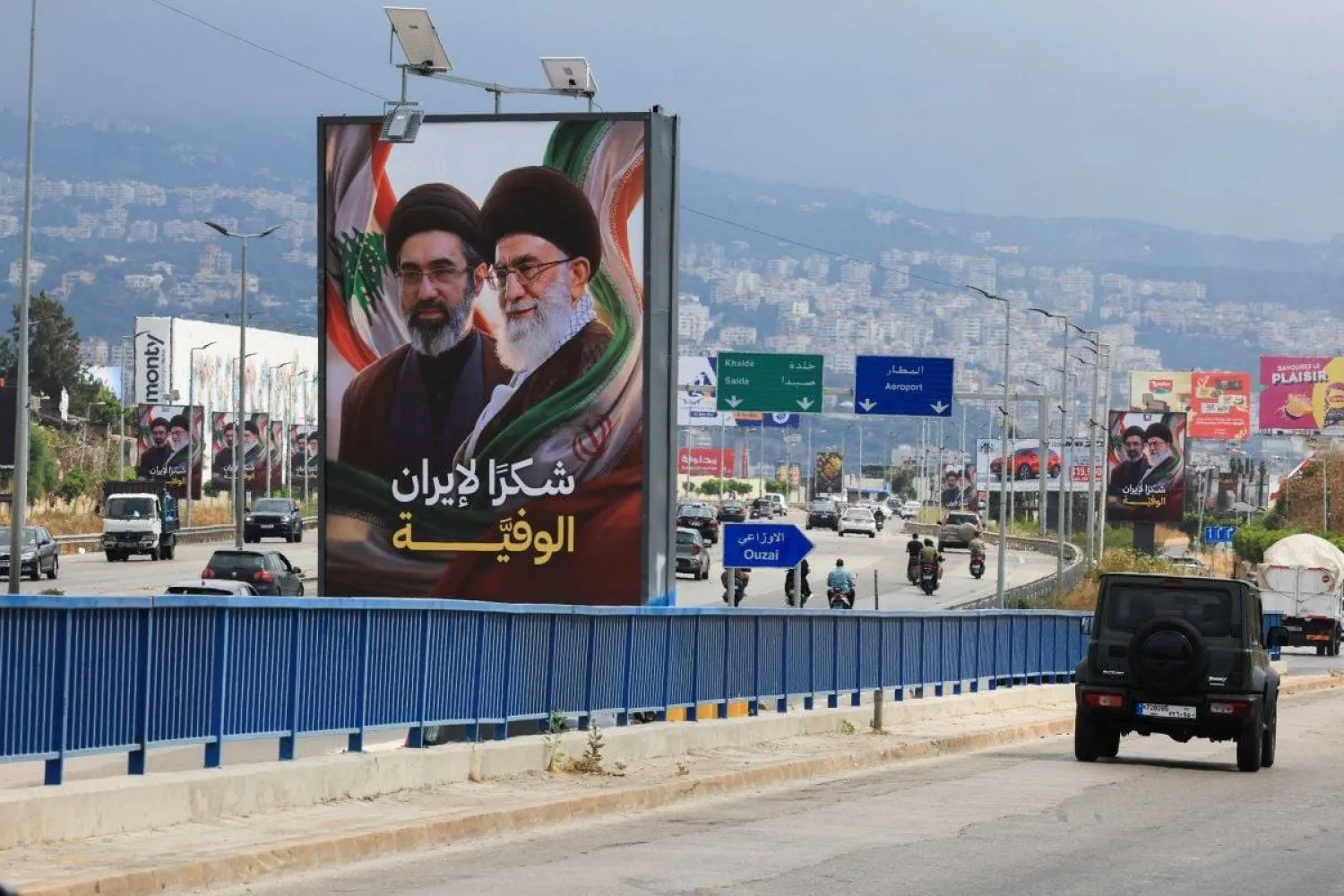
Cars and motorcycles pass billboards depicting Iran's new Supreme Leader, Mojtaba Khamenei, and his late father, Ali Khamenei, bearing the slogan "Thank you to loyal Iran," along the highway leading to Beirut's Rafik Hariri International Airport on June 22, 2026. (Reuters)
TT

Hezbollah Chief’s Call for Dialogue Met with Skepticism in Lebanon

Cars and motorcycles pass billboards depicting Iran's new Supreme Leader, Mojtaba Khamenei, and his late father, Ali Khamenei, bearing the slogan "Thank you to loyal Iran," along the highway leading to Beirut's Rafik Hariri International Airport on June 22, 2026. (Reuters)

Hezbollah Secretary-General Sheikh Naim Qassem’s call last week on Lebanese authorities to launch dialogue has left official circles questioning its motivations.

The Iran-backed party had previously thwarted all dialogue efforts by President Joseph Aoun since his election to resolve the issue of its weapons arsenal. Hezbollah had deemed dialogue over the issue as a red line given the Israeli occupation, attacks and violations.

Even as he called for dialogue, Qassem attacked the Lebanese authorities, accusing them of being "an aide to Israel instead of being an aide to Lebanon's sovereignty."

He also attacked Aoun, saying he has not acted as an "arbitrator and a unifier," but rather he has become "partisan and a divider, which is entirely inconsistent with his role."

Qassem's remarks prompted a direct response from Prime Minister Nawaf Salam, who stressed that "dialogue and unity can only be built with the courage to acknowledge facts despite their bitterness, and by taking responsibility for reckless choices for which the Lebanese continue to pay a heavy price."

Sources familiar with Aoun's positions said that both before and after Qassem's statements, he had long stressed that the doors of the presidential palace were open for dialogue with the party and with all other forces.

What is required of these forces, however, is a genuine desire and intention to achieve positive results, rather than for them to repeat their negative positions which they do daily through the media, they told Asharq Al-Awsat.

The sources said that Hezbollah had always negatively received the president’s calls for dialogue, leading to a rupture in communications between them. Contact is now taking place indirectly through parliament Speaker Nabih Berri, a key Hezbollah ally.

Meanwhile, sources close to Hezbollah said that launching dialogue between the party and president demands "mechanisms, prerequisites, and a positive atmosphere, both in positions and in the manner of engagement".

They noted that the decisions taken by the authorities, government, and president since March 3 have all been "negative", adding that no new dialogue had been launched since.

The government banned Hezbollah’s military activities after the party fired rockets at Israel on March 2 in solidarity with Tehran during the US-Israel war on Iran.

In remarks to Asharq Al-Awsat, the sources said that dialogue "is in the interest of both parties".

Recent experiences have proven that neither the military option nor direct negotiations are effective, making establishing communication channels necessary "to define what the authorities want and what Hezbollah wants."

"In light of this, a joint strategy would be developed to determine shared goals, which requires closed-door communication and the launching of positive initiatives aimed at building trust between the two sides," the sources said.

Skepticism

MP Waddah Sadek expressed surprise at Qassem's call for dialogue, saying: "It might be more effective for the Lebanese authorities to open a dialogue with Iran to resolve the issue of Hezbollah's status, because ultimately the party does not own its decision-making, and it will have to consult Tehran on any position and decision it takes."

"At any rate, the issue of weapons has become much larger than a dialogue conducted by the Lebanese state, whether with the party or even with Iran; it has become linked to the situation of the entire region," he told Asharq Al-Awsat.

"Furthermore, there are government decisions, the constitution, and the Taif Agreement that clearly address the weapons file, which no longer requires dialogue," he stressed.

Lebanon has held numerous dialogue rounds since 2006 to formulate a defense strategy, but all efforts reached a dead-end with Hezbollah’s refusal to discuss handing over its arsenal or with it sending its fighters to prop up the Syrian regime during the country’s civil war. In recent years, the party has turned southern Lebanon into a front against Israel, first in solidarity with Hamas in Gaza and later in solidarity with its backer, Iran.

Editor-in-Chief of the "Janoubia" website Ali Al-Amine dismissed Qassem’s call for dialogue as a "ploy," saying that the Hezbollah leader "says one thing and then does the opposite."

President Aoun "spent a year after the first support war [in solidarity with Gaza] in calling for dialogue with the party, which led to internal and external criticism against him. Hezbollah exploited the idea of dialogue to carry out agendas on the ground that go against the positions of the state and the 2024 ceasefire agreement," he added.

Qassem’s call becomes even more suspicious given the ongoing "unprecedented campaign accusing the president of treason that the party is promoting through its media and policies," he noted.

"The state, on the other hand, has never refused dialogue with Hezbollah, even to this day," he remarked. "Dialogue must be held under the authority of the state, its sovereignty and free decision-making."

There can be no dialogue so that it can be used in favor of Iran’s interests or undermine the bilateral negotiations between Lebanon and Israel, or undermine the authority of the Lebanese state, he stressed.

"As long as Hezbollah does not recognize the sovereignty of the state and authority of the constitution and laws, then such dialogue calls are attempts at stalling and seeking to suspend government so that the party can keep its power, role and weapons forever," he added.

Iraq Closes Three Iran Crossings, Pursues Those Behind Attacks on Saudi Arabia

Travelers at the Shalamsheh border crossing between Iraq and Iran after Iraqi authorities ordered its closure as a precautionary measure following the latest drone attacks on Saudi Arabia on September 12, 2026 (Reuters)
TT

Iraq Closes Three Iran Crossings, Pursues Those Behind Attacks on Saudi Arabia

Travelers at the Shalamsheh border crossing between Iraq and Iran after Iraqi authorities ordered its closure as a precautionary measure following the latest drone attacks on Saudi Arabia on September 12, 2026 (Reuters)

Iraq closed three border crossings with Iran on Saturday, officials told AFP, after a drone attack on a Saudi Arabian pipeline that both Riyadh and Baghdad said was launched from Iraq.

An Iraqi security source and a government official told AFP that authorities ordered the closing of three border crossings with Iran.

The security source said the decision was "part of an intelligence effort to track down the perpetrators and prevent their escape... and to hinder the smuggling of drones through these crossings".

Both sources, who spoke on condition of anonymity because they were not allowed to speak to the media, could not specify when the crossings would reopen.

The closed crossings are Shalamsheh in Basra province, al-Shib in Missan and al-Mandali in the central province of Diyala.

Other border crossings with Iran are still open.

A security official said that "security forces found drone launchers near the Iraq-Iran border in the al-Tib" region, a remote part of Missan, close to the al-Shib crossing. A second security source gave the same account.

Military spokesperson Sabah al-Numan said the prime minister had approved "Iran's request to conduct a joint investigation into finding drone launch platforms near the Iraq-Iran border".

The government's security media cell said earlier that authorities "have started administrative and security reorganization operations at several border crossings".

It added that they had stepped up "intelligence activities" to determine "the breaches and violations that took place at these crossings".

It later announced that passengers stranded for hours at two crossings were permitted to pass.


Al-Halbousi Condemns Attacks on Saudi Arabia

Iraqi Speaker of parliament Mohammed al-Halbousi speaks with the news media as he departs the Department of State after meeting with Secretary of State Mike Pompeo, in Washington, on March 28, 2019. (AP)
TT

Al-Halbousi Condemns Attacks on Saudi Arabia

Iraqi Speaker of parliament Mohammed al-Halbousi speaks with the news media as he departs the Department of State after meeting with Secretary of State Mike Pompeo, in Washington, on March 28, 2019. (AP)

Speaker of the Iraqi Council of Representatives Haibat Al-Halbousi strongly condemned the attacks targeting the Kingdom of Saudi Arabia that originated from within Iraqi territory.

In a statement issued on Saturday, Al-Halbousi rejected the use of Iraq's territory or airspace to threaten Saudi Arabia's security or that of any neighboring state, describing such actions as unacceptable violations that contradict Iraq's national interests, stated foreign policy, and regional relations.

Al-Halbousi emphasized the critical need to restrict weapons exclusively to the state and its constitutional institutions under the authority of the commander-in-chief of the Armed Forces.

He stressed that enforcing state control over arms is vital to reinforcing national sovereignty, preserving domestic stability, and preventing Iraq from being drawn into wider regional conflicts.


Lebanese Army Detains Bashar Assad’s Relative on Weapons and Drugs Charges

Ousted Syrian President Bashar Assad - File Photo
TT

Lebanese Army Detains Bashar Assad’s Relative on Weapons and Drugs Charges

Ousted Syrian President Bashar Assad - File Photo

Lebanese authorities have detained a relative of ousted Syrian President Bashar Assad along with the son of a notorious drug dealer in northeast Lebanon on charges of carrying weapons and drugs, officials and the Lebanese army said Saturday.

Suleiman Assad and Ali Zeiter, son of Noah Zeiter, the suspected drug trafficker arrested last year, were detained Friday near the northeastern city of Baalbek, said the two judicial officials, who spoke on condition of anonymity because they were not authorized to speak to the media. Suleiman Assad is the son of Hilal Assad, a cousin of the ousted president, The AP news reported.

A number of Syrian officials and relatives of Assad have fled from Syria to other countries including Lebanon, after the five-decade Assad family rule came to an end in December 2024, when the opposition seized power. Bashar Assad and his younger brother, Maher, have been living in Russia.

The Lebanese army said in a statement that it detained three people, including a Syrian citizen who did not have documents proving that he is staying legally in Lebanon.

The army said they had weapons with them along with hashish, a drug that is processed from cannabis that are widely planted in northeast Lebanon. The army did not release the names but the initials of their first and family names matched those of Assad and Zeiter. The army said they were questioned under the supervision of judicial officials.

The arrest of Suleiman Assad comes weeks after Lebanon handed over to Syrian authorities a retired major general who commanded a division in Bashar Assad’s army.