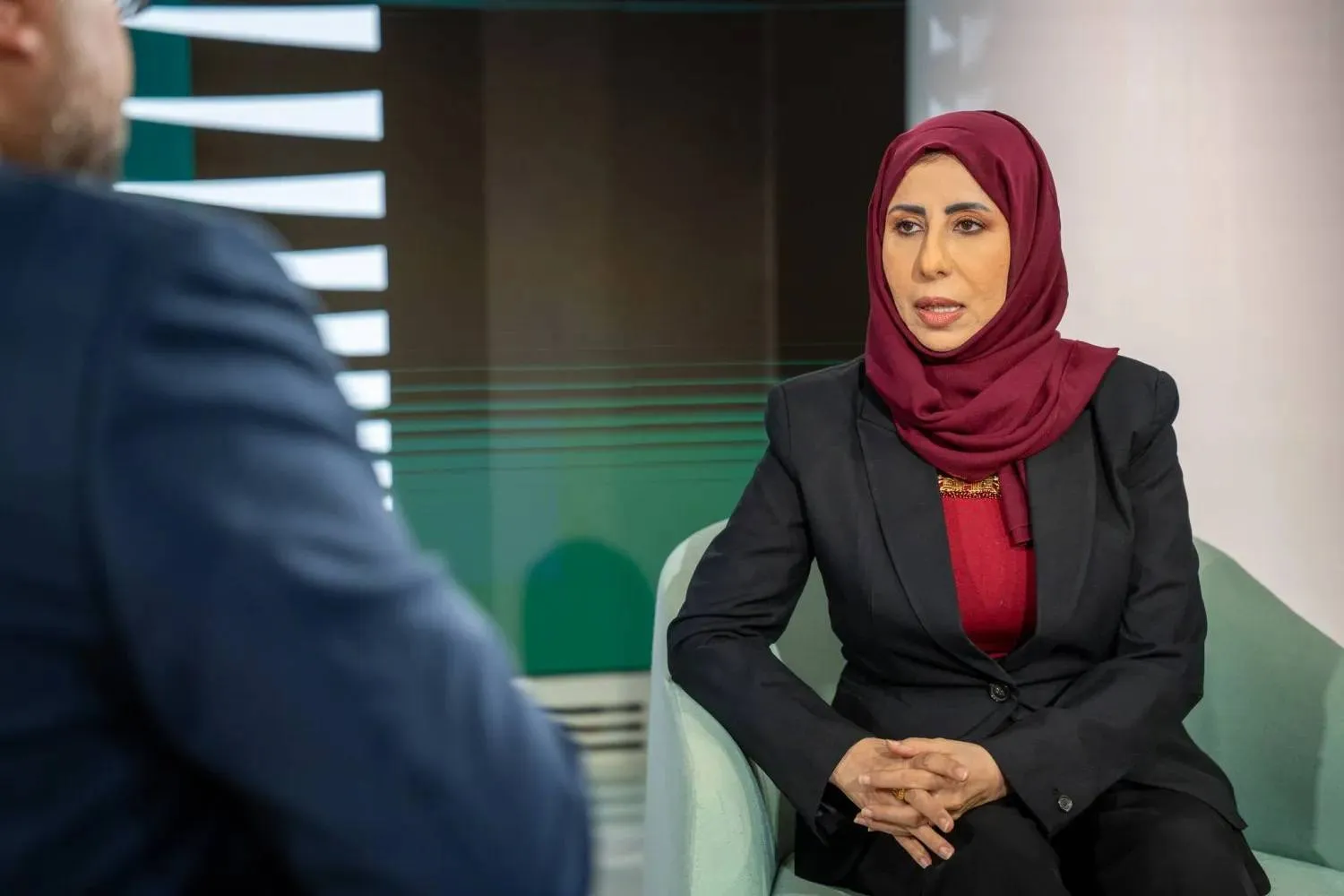

What kind of relationship binds the Houthis to Iran? Afrah al-Zouba, the first woman to head Yemen’s Foreign Ministry, has a term for it: “mutual instrumentalization.”
“I use the term because it describes the relationship more accurately,” al-Zouba told Asharq Al-Awsat in her first interview since taking on the challenging portfolio.
The Houthis, she said, “are not merely a tool with no domestic project of their own. At the same time, what they have become cannot be separated from their deep and accumulated relationship with Iran.”
She went further.
The group “is not simply an arm,” al-Zouba said. “It is a threat in its own right, whose interests intersect with the Iranian project wherever that helps expand its influence and impose a fait accompli.”
“We are dealing with a terrorist group that has an ideological and political project at home, built on sheer violence and the myth of discriminatory and racist dynastic entitlement toward Yemeni society,” she said.
The group, she added, “believes it has an absolute right to power and wealth, and to harness the forces and segments of the population to serve its project and establish an extremely closed and isolationist theocratic system hostile to citizenship, freedoms, and human dignity.”
Explaining ‘mutual instrumentalization’
Al-Zouba said the relationship works both ways.
“The Houthis benefit from Iran to strengthen their project at home, while Iran benefits from the Houthis and Yemen’s strategic location as a tool of influence and pressure in the region,” she said.
But that mutual reliance, she said, is no longer limited to Iran.
“The terrorist Houthi movement has expanded their cooperation and exchange of interests with terrorist elements and organizations, smuggling networks linked to the Yemeni arena, terrorist groups in the Horn of Africa, and armed groups in Iraq,” she said.
That, she added, reflects “an increasingly intertwined web of interests, tools and smuggling routes, compounding the cross-border threat.”
The danger, in al-Zouba’s view, lies in attempts to turn Yemen and its strategic location into a platform for threatening neighboring countries, ships, ports, and maritime routes.
She cited attacks reaching Mokha port and efforts to turn the Red Sea, Bab al-Mandab, and the Gulf of Aden into “arenas for pressure and coercion.”
Such conduct, she said, “drags Yemen into conflicts that do not serve the interests of its people and threatens the security and stability of the region and international navigation.”
One widening escalation
In recent days, Houthi attacks have widened from government forces in Marib and Hadramout to camps for displaced people and civilian sites in Marib and Mokha.
The attacks have also reached Najran in Saudi Arabia, while threats against ships and maritime routes in the Red Sea and Bab al-Mandab have resurfaced.
Asked whether she viewed the developments as separate incidents or as part of a single escalation, al-Zouba was unequivocal.
“I do not treat them as separate incidents,” she said.
“When missiles and drones are used against state forces, then the attacks extend to civilians and displaced people, vital civilian and economic facilities and Saudi Arabia, while coinciding with threats to ships and maritime routes, then we are looking at one pattern expanding geographically and applying pressure on several fronts at the same time.”
Al-Zouba noted that the escalation came while political efforts were still under way, led by Saudi efforts to return to a political track.
“There are no domestic reasons or developments that explain this escalation,” she said.
Instead, she said, the regional context pointed to “clear Iranian escalation.”
She cited Iran’s dispatch of two aircraft to Sanaa and Hodeidah airports without the Yemeni government’s approval, as well as what she described as repeated Iranian attempts to use the Red Sea “as an arena for pressure and for harming international trade and the global economy.”
The latest attacks, al-Zouba said, should therefore be read “in their broader context, not as isolated or passing events.”
‘The state’s sovereign right’
How will the government respond? And does the military response announced by the armed forces, along with the National Defense Council’s move to raise readiness, signal a shift from containment to a new military course?
Al-Zouba said the principle was straightforward.
“The political and legal principle is clear: the state has a sovereign and legitimate right to defend its citizens, forces and institutions, and to take the necessary and proportionate measures to deter attacks.”
On military decisions, she said the National Defense Council “remains in continuous session to deal with the situation.”
The council, she said, has put restoring state institutions and protecting sovereignty at the top of its priorities and instructed the armed forces to respond to sources of fire and confront Houthi attacks.
That, she said, “is part of the state’s responsibility to protect its borders, ports and citizens and prevent them from being subjected to repeated coercion.”
Still, al-Zouba said the government’s fundamental position had not changed.
Its goal, she said, remains “ending the coup, restoring state institutions and returning to the path pursued by the state, leading to a genuine and sustainable political solution.”
She rejected the idea that deterrence and negotiations were incompatible.
“I see no contradiction between the state protecting itself and a political solution,” she said.
“On the contrary, a sustainable solution cannot be reached from a position that allows attacks to continue at no cost. We want a political solution, but under a state capable of protecting its citizens, sovereignty and institutions.”
Peace backed by deterrence
After 12 years of truces, negotiations and repeated attempts at de-escalation, is a political solution still possible? And did containing the Houthis encourage further escalation?
Al-Zouba said hope remained for ending “this nightmare that Yemenis have been living through for 12 years in a way that spares their blood and protects their country’s resources.”
She pointed to a long political track stretching from the National Dialogue Conference to the Kuwait talks, the Stockholm Agreement and later de-escalation initiatives.
The government pursued those efforts, she said, “in search of a way out that would restore stability to the country.”
But its experience with the Houthis, she said, revealed a recurring pattern dating back to the six wars.
“At more than one stage, whenever the group found itself under pressure, it moved toward de-escalation, only to rebuild its strength, enhance its capabilities and return to the offensive,” she said.
That experience, she added, showed the limits of containment.
“A policy of containment, when not coupled with consequences and a clear cost for violating commitments, may be understood as permission to do more.”
Al-Zouba said the government and the Yemeni people “yearn to be rid of this suffering.”
She pointed to deprivation, extrajudicial killings, arbitrary arrests and forced recruitment in Houthi-controlled areas, as well as attacks on oil facilities and sources of revenue in government-held areas.
Her formula was simple.
“We want a genuine peace backed by tools of pressure and deterrence, enforcement mechanisms and accountability,” she said.
“A de-escalation that leads to a solution, not an opportunity to reposition and rearm.”
Red Sea: Protecting ships is not enough
On the Red Sea, al-Zouba said Yemen’s location gives it a major responsibility in the Red Sea, Bab al-Mandab and the Gulf of Aden.
Those waterways, she said, “are not merely a Yemeni or regional matter. They are arteries for trade, energy and supply chains around the world.”
The Yemeni government, she said, views the Saudi-launched “multinational defensive maritime coalition” as “an important step.”
It shifts maritime security, she said, “from fragmented responses to institutional cooperation” encompassing ship protection, information-sharing, maritime awareness, training and stronger capabilities to confront threats.
But she said ship protection alone cannot provide a lasting answer.
“Protecting a ship at sea alone cannot be enough indefinitely if the sources of the threat on land and along the coast remain outside state authority.”
For al-Zouba, “the sustainable part of the solution” is to enable the Yemeni government to extend its authority over its coasts, ports and territorial waters.
That also means strengthening the coast guard, naval forces, port security and anti-smuggling capabilities.
“Historically, Yemen was a point of transit, trade and connection with the world,” she said.
“It is unfair for its location today to be reduced to the image of a source of threat, instead of for Yemen to once again become a bridge for trade and stability.”
What Yemen wants from the world
Al-Zouba said the international community has developed a better understanding of Houthi conduct.
The government, she said, appreciates recent international positions, including those from the UN Security Council, states and regional and international organizations.
She highlighted statements affirming Yemen’s sovereignty, the government’s right to manage its airspace and ports of entry, and opposition to attacks on Saudi Arabia and commercial shipping.
But political statements, she said, are not enough.
“The value of a political position becomes clear when it is translated into implementation.”
Al-Zouba said the government wants “effective implementation of UN Security Council resolutions, the sanctions regime and the arms embargo.”
It also wants routes used to smuggle missiles, drones, dual-use components and technical expertise shut down, and networks that finance or facilitate those activities held accountable.
She also called for stronger Yemeni state capabilities, particularly the coast guard, specialized agencies and port security.
“We are not asking the world to fight on our behalf,” she said.
What Yemen wants, she said, is not to be asked to surrender its responsibility to protect its citizens, resources and sovereignty “while the cost of violations remains almost nonexistent.”
“Every violation that carries no cost encourages the next one.”
The government’s demands go beyond security.
Al-Zouba renewed a request she said Yemen has been making for five years: to “correct the way international support and aid for the Yemeni people are delivered.”
The goal, she said, is to move away from “periodic support that merely treats the symptoms of the humanitarian crisis” and instead address its root causes by supporting state institutions and strengthening their ability to function.
Yemenis are not bargaining chips
Beyond missiles and politics, al-Zouba turned to the humanitarian toll.
Millions of Yemenis, she said, are living in extremely harsh conditions and “must not be turned into instruments of pressure or hostages in the hands of the Houthi militia in political and military calculations.”
“When a displaced person who was already forced to leave his home is targeted in Marib, or a UN employee working to serve people is detained, or children’s vaccines and aid are disrupted, then we are dealing with a humanitarian cost that goes beyond the political approach.”
Al-Zouba accused the Houthis of controlling resources, obstructing humanitarian work, detaining staff, disrupting vaccine deliveries and turning those issues into tools of pressure against civilians.
“Humanitarian issues are rights, not bargaining chips or tools of blackmail,” she said.
But she also tied any lasting solution to the restoration of the state.
“Aid can ease the pain, but it cannot replace a state that provides education, health services and salaries and protects its citizens.”
Three priorities for the Foreign Ministry
Away from the war, Asharq Al-Awsat asked al-Zouba what she wanted Yemenis to see from the Foreign Ministry in the first stage of her tenure.
She set out three priorities.
The first is “providing Yemeni diplomacy with the resources it needs to perform its role and keep pace with the state’s political action.”
“The Foreign Ministry is the main channel of communication with the world,” she said.
“Its staff at home and abroad must therefore be able to convey state policy and defend its interests.”
The second priority is serving Yemenis abroad.
Al-Zouba pointed to the country’s large expatriate communities, saying they are far more than a consular matter.
“They are not merely a consular file. They are part of the national economy and everyday ambassadors for Yemen, and their remittances amount to billions of dollars annually, supporting millions of families.”
The third priority is “improving the ministry’s institutional structure and completing reforms begun during the previous period.”
Al-Zouba paid tribute to Dr. Shaya al-Zindani, who led the ministry in the previous period.
Diplomatic work, she said, “is by nature cumulative, with the efforts of successive officeholders complementing one another.”
Her goal is a more unified ministry.
“I want a ministry that operates as one system, with professional staff, a unified message and clear mechanisms for evaluation and accountability, so that it reflects the state’s foreign policy rather than disparate individual judgments.”
Diplomats’ salaries and appointments
On delayed salaries for diplomats, conditions at diplomatic missions and appointments, al-Zouba praised Yemen’s diplomatic corps.
It had worked, she said, “throughout these years under extremely difficult conditions and remained one of the state’s fronts abroad.”
“It is unfair to speak of effective diplomacy without paying attention to the professional and living conditions of those carrying this responsibility.”
Al-Zouba said she was working with the prime minister and the political leadership to “untangle accumulated problems and explore possible solutions to improve the financial situation of staff and diplomatic missions.”
But she offered no timetable.
“This issue is tied to the state’s available resources, so I will not give dates or promises that cannot be guaranteed,” she said.
“But I can confirm that it is at the top of our agenda.”
Appointments, she said, are “a normal process in any diplomatic service” but require “careful study and deliberation” under current conditions.
She laid out four criteria: “competence, need, performance and the national interest.”
Appointments, she added, must comply with laws and regulations, avoid unfairly excluding eligible personnel, and reflect the needs of the ministry and its missions.
‘Yemen is an opportunity, not a problem’
Al-Zouba wants to change how Yemen presents itself to the world.
The war and the humanitarian and economic crises are undeniable challenges, she said, “but Yemen remains an opportunity and a promising country for our brothers and friends.”
She pointed to what the country has to offer: “a strategic location, a young population, resources and potential, vital maritime routes, and a long history of trade and engagement.”
“Diplomacy should not go to the world only to explain what we need,” she said, “but also what Yemen can offer as a partner.”
Al-Zouba said she wants relations with Yemen’s brothers and friends to move “from managing the crisis to building partnerships in maritime security, trade, energy, investment, recovery and reconstruction, and capacity-building.”
At the forefront, she said, is Yemen’s partnership with Saudi Arabia and the Gulf Cooperation Council countries, “by virtue of geography, shared interests and common security,” alongside balanced relations with other friendly states.
Her message is that a stronger Yemeni state benefits the wider region.
“The stronger and more stable the Yemeni state is, the more Yemen becomes an added value to regional security rather than a burden on it,” she said.
“We are not talking about Yemen as a permanent problem, but as an opportunity and an anchor for stability and cooperation.”
‘Yemen is bigger than these difficult years’
Asked what message she would send to Yemenis at home and abroad, al-Zouba said: “Yemen is bigger than these difficult years.”
“We are an ancient Arab state, and a people historically known for trade, openness, engagement and respect for the societies in which Yemenis live.”
At home, she said, the priority is to “restore the idea of the state before anything else.”
That means a state that “protects the citizen, monopolizes arms and sovereign decision-making, rests on the rule of law and equal citizenship, and redirects resources toward serving the people.”
Yemenis’ political differences, she said, “should not lead them to disagree over these fundamental principles.”
Her message abroad was equally direct.
“We want to restore Yemen’s natural place as a sovereign state with an ancient civilization, and for our diplomacy to reflect the image of a people capable of building, engaging and contributing to the stability of its surroundings,” she said, “rather than for Yemen to remain captive to the image of crisis and its repercussions.”