

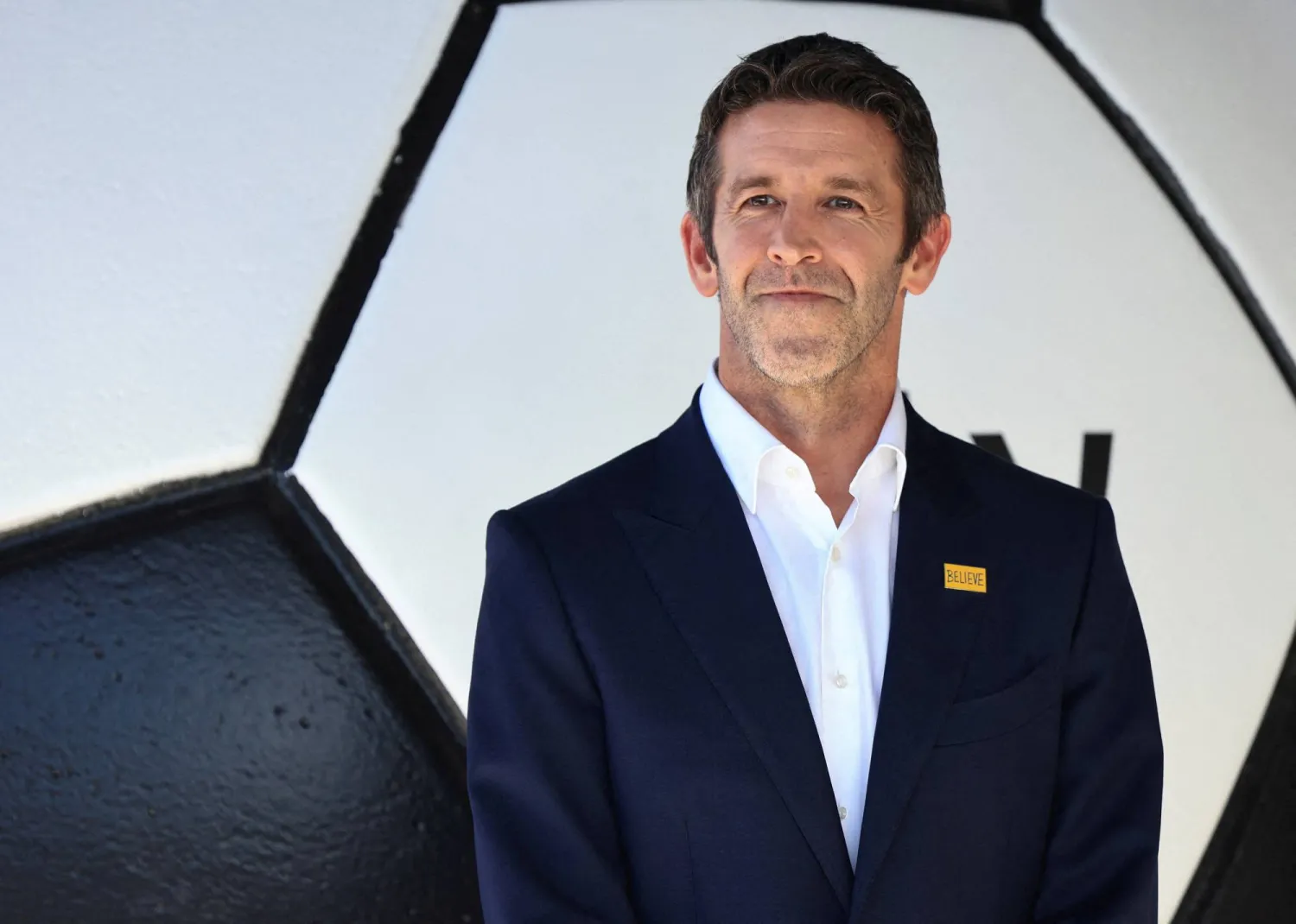

Apple’s Ternus Faces AI Test as Foldable iPhone Takes Center Stage

Apple's Senior Vice President Hardware Engineering John Ternus attends the premiere of season four of the Apple TV series "Ted Lasso" at the Academy Museum in Los Angeles, California, US, July 27, 2026. (Reuters)
TT

Apple’s Ternus Faces AI Test as Foldable iPhone Takes Center Stage

Apple's Senior Vice President Hardware Engineering John Ternus attends the premiere of season four of the Apple TV series "Ted Lasso" at the Academy Museum in Los Angeles, California, US, July 27, 2026. (Reuters)

When new CEO John Ternus unveils Apple's latest products on Wednesday, Wall Street expects him to show that the company can still deliver breakthrough hardware and a Siri virtual assistant capable of competing in the AI race.

Analysts expect Apple to announce at its Cupertino, California, headquarters a new iPhone that folds open like a passport. They said it could quickly emerge as the category leader in the nascent folding phone market, despite an expected price of more than $2,500 and having cameras and processors that may not lead the market.

The company has already announced a deep overhaul of Siri — in part by tapping Google's AI tech behind the scenes — and that may prove to be Ternus' first big success after years ‌of delays. A successful ‌revamp by the end of this year could give Apple a good chance ‌of ⁠pulling even with ⁠longtime rival Google's Gemini assistant, analysts said.

Investors have largely looked past Apple's slow start in generative AI because of the company's billion-plus device installed base and loyal customer base. Ternus now faces pressure to convince consumers that Apple's devices are the best way to use AI, which could determine whether he inherits former CEO Tim Cook's momentum or plays catch-up.

NEW PREMIUM IPHONES

Apple is expected to update its premium iPhone Pro and Pro Max devices but hold off on refreshing the iPhone Air and the base and budget lines until spring. The aim is to drive interest in the real ⁠star of this week's show, the folding phone.

"Even with a $2,500 price tag, the ‌Apple foldable is going to fly off the shelves, especially because ‌Apple is excellent at creating an aura of exclusivity, luxury, and scarcity," Nabila Popal, senior research director at IDC, told Reuters.

Popal expects the phone to generate more than $45 billion in revenue for Apple by the end of next ‌year, even as foldables overall remain a single-digit share of the phone market.

The main appeal of a folding phone is the sheer newness after nearly two decades of candybar-style phones.

While Samsung , Google and China's Huawei have sold folding phones since 2019, analysts expect Apple to benefit from entering late by solving key engineering challenges, such as a hinge that feels sturdy over ‌thousands of uses and minimizing any crease in the screen when the device is open.

"They've seen what has worked and what hasn't worked with their competitors," ⁠said Anshel Sag, an ⁠analyst at Moor Insights & Strategy who has tested many folding devices.

NEW SIRI'S BIG MOMENT

Ternus' key challenge will be persuading customers to adopt the new Siri and convincing them and third-party developers that Apple can keep pace with rivals such as OpenAI, which roll out big improvements every few weeks, while Apple has traditionally moved more slowly.

"If Siri still sucked, then he would have a much more difficult Wednesday," said Carolina Milanesi of Creative Strategies. "Now they can comfortably say Siri is delivering and has value, but they need to just continue to work and make it better and keep up."

Analysts say Ternus, who kept a low profile as hardware engineering chief for five years, is likely to focus on delivering powerful devices as a base to expand on-device AI.

But he faces a steep regulatory challenge, said Gene Munster of Deepwater Asset Management: Apple's Siri update might take until 2028 to win approval in China and won't initially be available in Europe due to a regulatory dispute.

"It matters a lot that they get the US out in time because it builds the confidence that they can do something in Europe," he said.



French AI Firm Mistral Valued at Over 21Bn Euros after Latest Funding

FILE PHOTO: An advertisement for Mistral AI, the French artificial intelligence company, is displayed inside the Grand Central subway station in New York City, US, May 21, 2026. REUTERS/Shannon Stapleton/File Photo
TT

French AI Firm Mistral Valued at Over 21Bn Euros after Latest Funding

FILE PHOTO: An advertisement for Mistral AI, the French artificial intelligence company, is displayed inside the Grand Central subway station in New York City, US, May 21, 2026. REUTERS/Shannon Stapleton/File Photo

Mistral said Tuesday it had raised three billion euros ($3.5 billion) in what it described as the largest-ever European tech equity fundraising, valuing the French AI firm at over 21 billion euros.

The startup, which is considered Europe's leading AI model developer and was valued at nearly 12 billion euros following the previous funding round, said new the funding would help expand its leading-edge research.

"This round means we can move faster on R&D, products, infrastructure and keep giving organizations the ability to run AI at scale, on their own terms," Mistral's chief executive and co-founder Arthur Mensch said in a statement.

The company emphasized it is focusing on so-called open-weight AI models that companies can run themselves with their own data.

"Organizations want to industrialize AI inside systems that are already complex: their own data, their own tools, their own compliance constraints," AFP quoted Mensch as saying.

"It's why we've built Mistral on open-weight frontier models and infrastructure that we control end to end, so our customers can too," he added.

With the Dutch maker of chip-making machines ASML leading the previous funding round and Samsung Electronics this round, Mistral said it had attracted the support of advanced manufacturers in the sector.

"This support reflects growing confidence that Mistral's approach can help organizations deploy state-of-the-art AI inside complex real-world environments while maintaining control over their data, infrastructure and knowledge," the company said.

Mistral has increased its spending on infrastructure this year, including a data center, its first, which will be built in France, in addition to a commercial agreement with Microsoft.


Huawei Launches New Foldable Smartphone as Competition with Xiaomi, Apple Heats Up

The Huawei logo is seen in this illustration taken on January 29, 2025. (Reuters)
TT

Huawei Launches New Foldable Smartphone as Competition with Xiaomi, Apple Heats Up

The Huawei logo is seen in this illustration taken on January 29, 2025. (Reuters)

Huawei launched a new version of its flagship foldable smartphone on Monday as it seeks to defend its lead in the Chinese market for premium handsets against Apple and Xiaomi, both of which are also unveiling new products.

The new Mate XT2 folds out twice to open into a tablet-sized screen and ‌features Huawei's ‌new Kirin 9050 Pro chip.

Huawei ‌says ⁠the chip's design ⁠allows it to deliver more computing power while using less electricity, helping the company overcome US restrictions on access to advanced technology.

Xiaomi launches a rival foldable phone later on Monday, while Apple unveils its latest ⁠iPhone series on Wednesday, with expectations ‌high that it ‌too will be unveiling a foldable phone.

The Mate XT2 ‌features a redesigned folding mechanism, improved water ‌resistance as well as an optional screen that prevents people nearby from seeing what is displayed. It also has upgraded cameras and delivers ‌42% better overall performance than its predecessor, based on company tests.

Huawei, which ⁠does ⁠not sell in the US due to sanctions, leads China's smartphone market with a 22.6% share in the second quarter, ahead of Apple's 18.1%, according to consultancy IDC. Xiaomi has 12.4% of the market.

Huawei is even more dominant in folding phones, accounting for 68% of shipments in China in the second quarter, according to Smart Analytics Global, a US-based research company.


AI Data Centers Are Less Thirsty Now, Tech Giants Say

 A drone view shows construction underway on Microsoft's ATL11 data center in Union City, Georgia, US, September 1, 2026. (Reuters)
A drone view shows construction underway on Microsoft's ATL11 data center in Union City, Georgia, US, September 1, 2026. (Reuters)
TT

AI Data Centers Are Less Thirsty Now, Tech Giants Say

 A drone view shows construction underway on Microsoft's ATL11 data center in Union City, Georgia, US, September 1, 2026. (Reuters)
A drone view shows construction underway on Microsoft's ATL11 data center in Union City, Georgia, US, September 1, 2026. (Reuters)

Data centers are running into a wall of public anger in the United States over their thirst for water and power.

The tech giants spending billions of dollars on them say the water part, at least, is solvable.

Data centers are the warehouses full of computer servers that run the internet and increasingly artificial intelligence.

The computers get hot, and keeping them cool takes water.

American chip giant Nvidia said in a June report that it can eliminate water consumption almost entirely at some facilities when deploying DSX, its newest system for designing and managing AI data centers.

It's a bold claim, and one the industry is under mounting pressure to make good on.

In 2025, data centers consumed 222 billion liters (59 billion gallons) of water worldwide for cooling, according to consultancy Rystad Energy.

Without adaptive measures, the figure could nearly triple to 644 billion liters by 2030, Rystad estimates. Steps to limit the growth could keep it under double.

Nvidia's new method uses a closed-loop cooling system in which liquid flows directly through the servers, as close as possible to the chips, whose temperature can rise above 80C (176F).

The problem is that "there's a pretty direct trade-off between how much water is used and how much energy is used" for temperature control, said Andy Masley, an independent researcher who covers AI and data centers.

Cutting back on water use usually means more power as the liquid in those sealed pipes still has to be cooled down somehow, usually by blowing air over it -- and that takes electricity.

Nvidia gets around some of this by letting the liquid enter the servers warmer than usual, at 45C.

Most other closed-loop systems ran at about 32C in 2024, according to the Uptime Institute, which certifies data centers.

By starting with warmer water, Nvidia does not need to pump in cooled air year-round.

"Simple fans circulating the air" are often enough, though sometimes a mix of methods is needed, said Josh Parker, Nvidia's head of sustainability.

At sites in extreme climates, or during a heatwave, chill airflow or water evaporation is still necessary.

- Public relations -

Microsoft, Amazon Web Services (AWS) and Meta told AFP that they also use closed-loop systems, which they said involve no net water loss.

The two cloud computing giants, which have been expanding their already huge data center footprints, used more water overall between 2022 and 2025, but their water use efficiency improved by 25 percent at Microsoft and 37 percent at AWS, according to their most recent sustainability reports.

There is no industry-wide consistency, however, in how companies report data on so-called environmental, social and governance (ESG) efforts.

Elon Musk's SpaceX, now a major player in data centers after it acquired his artificial intelligence company xAI, has never published an ESG report.

In June, ratings agency MSCI gave SpaceX its lowest ESG score.

"Because water is generally much cheaper than electricity," companies have less incentive to cut water use on cost grounds alone, said Shaolei Ren, an engineering professor at the University of California, Riverside.

"There are incentives," Ren said, but they have more to do with public relations amid the growing backlash to data centers across the United States.

Another obstacle is that upgrading an older data center to newer, less thirsty technology is expensive.

That may matter less than it sounds.

Older data centers are smaller and less powerful than the enormous new ones being built now, so they need less cooling in the first place, said Minh K. Le, who leads data center and hydrogen research at Rystad.

And the water a data center uses directly is only part of the story.

Water is used to generate the electricity that powers the data center, and to manufacture its chips and servers.

In the United States, that hidden water use can be twice the amount a data center consumes on its own.